


Do your new year’s resolutions feel a little hazy right now?
After the holidays, it’s easy to drift, especially with leftover cookies, late nights, and slow mornings.
That’s why I like to Set New Year Goals On Boxing Day (December 26). It’s close enough to the New Year to feel like a fresh start, and quiet enough to actually think.
I’m going to walk you through simple goal setting steps, how to write smart goals, and how to break big plans into small tasks you can finish.
Key Takeaways
- Boxing Day (Dec 26) is a low-pressure planning day: pick 3 to 5 goal categories so you don’t overcommit.
- Write SMART goals (specific, measurable, achievable, relevant, time-bound) and schedule a weekly review so progress stays visible.
- For health goals, Ipsos reported that for 2025, 73% planned to eat healthier and 73% planned to drink more water, while 69% planned to sleep more and 39% planned to drink less alcohol.
- If you want a motivation safety net, plan for the “Quitter’s Day” slump: Strava’s widely cited 2019 analysis points to the second Friday of January, which is January 9, 2026.
- For money goals, Fidelity’s December 2025 study for 2026 says 78% of people considering a financial resolution plan to build emergency savings, and Bankrate’s 2025 survey found 18% of U.S. adults still had no emergency savings.
Why Boxing Day Is Ideal for New Year’s Resolutions and Goal Setting

Boxing Day is December 26, and it has a special advantage: it sits right between “holiday mode” and “back to real life.”
You still have the New Year on your mind, but you haven’t hit the full rush of January yet. That’s the sweet spot for calm, practical planning.
Researchers from Wharton popularized the “fresh start effect,” the idea that a clear calendar landmark can make it easier to begin a goal because it feels like a new chapter. Boxing Day works like a mini landmark, especially if you treat it as your reset day.
Here’s how to use Boxing Day without turning it into a giant project:
- Set a timer for 30 minutes. Do a fast brain dump on sticky notes: health, money, learning, relationships, home, and digital life.
- Circle 3 to 5 categories. This keeps your focus realistic, and it protects your time and energy.
- Turn one sticky note into a measurable goal. Examples: “Walk 150 minutes per week,” “Declutter one room per month,” or “Save $50 per paycheck.”
- Write the first tiny task. The goal is to create momentum and raise your arousal level (that ready-to-act feeling) with a quick win.
If you’re tracking business or personal projects, you can even borrow a marketing mindset: in Google Analytics, measurable targets come from tracking events and results, not vague intentions. Your goals work the same way.
If you have support around you, use it. Many programs, including resident support organizations like St Martins, use person-centered goal setting so goals match the person, not a generic checklist.
Steps to Set Effective New Year Goals
Good goals feel clear. Great goals feel clear and doable on a random Tuesday.
This section gives you a simple plan you can finish on Boxing Day, then maintain all year.
Reflect on the past year
Start with a quick, honest look back. List wins, losses, habits, and surprises from the last 12 months.
Make it real by counting something. Workouts, brazilian jiu-jitsu classes, gratitude journal entries, nights of lack of sleep, and even the times you tightened privacy settings or improved browser security all count.
Also list small quality-of-life wins. Better good housekeeping, scheduling massages, or finally replacing old boxers can be signs you were already moving in the right direction.
Then write one sentence for each:
- Keep: what worked and felt worth it
- Stop: what drained you or pulled you off track
- Start: what would make next year easier
Finally, plan for the predictable wobble. If you treat early January like a test of character, you’ll get discouraged. If you treat it like a calendar pattern, you can build a simple backup plan.
A practical trick is to schedule a 10-minute review every week. St Martins-style progress check-ins work because consistency beats intensity.
Use the SMART framework (Specific, Measurable, Achievable, Relevant, Time-bound)
The SMART framework is popular for a reason, it forces clarity. It also traces back to management work from George T. Doran in 1981, which is a good reminder that goals should be written so you can actually run them in real life.
- Specific: Name the action. Example: “Walk after lunch” beats “get fit.”
- Measurable: Add a number you can track. Example: “150 minutes a week” or “12 books this year.”
- Achievable: Fit the goal to your current schedule and energy, then stretch it slightly.
- Relevant goals: Tie it to your life. If your stress is high, an anxiety-focused routine matters more than a flashy challenge.
- Time-bound goals: Give it a deadline and checkpoints. Monthly targets are usually easier than one giant December deadline.
If calendar blocking helps you, use it. Tools like Reclaim.ai can auto-schedule focus blocks and reschedule them when meetings collide, which makes follow-through easier on busy weeks.
Break big goals into small tasks (so you can start today)
A big goal is just a stack of small tasks. If the stack feels heavy, pull off the top card and do only that.
Try this simple breakdown:
- One-year goal: the outcome you want
- One-month target: what progress looks like in 30 days
- One-week plan: 2 to 3 actions you can repeat
- One-day task: the next tiny step
Goal Ideas to Kickstart the New Year
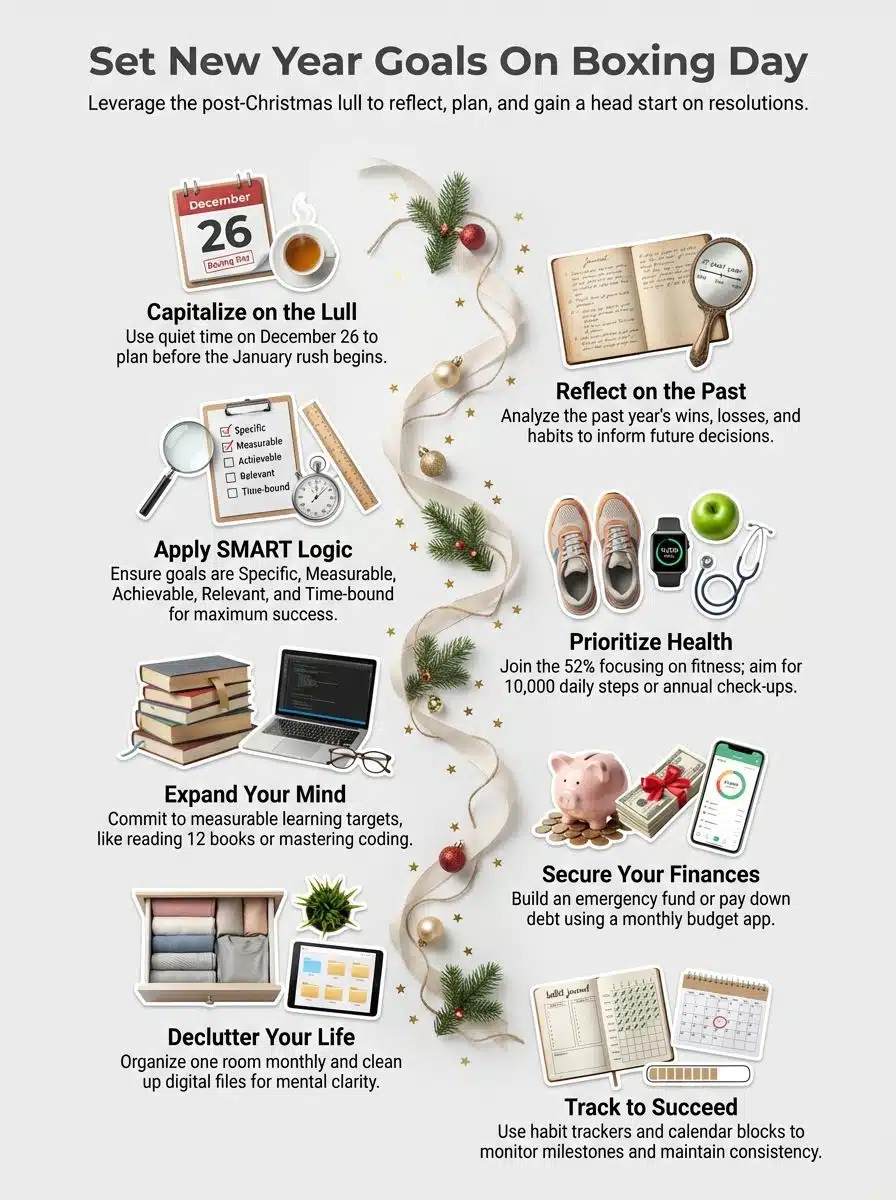
If you want concrete ideas for your new year’s resolutions, start here. Pick one goal, make it specific and measurable, and set a deadline.
Then track it weekly, even if you only write one line in a journal.
Health and fitness goals
If you want a goal that pays you back fast, start with health. Pew Research Center found that among people who made resolutions, 79% said their goals were about health, exercise, or diet.
For a simple, evidence-based target, CDC guidance for adults includes 150 minutes of moderate activity per week plus 2 days of muscle-strengthening activity. That turns “get fit” into a plan you can schedule.
Use these ready-to-write examples:
- Balanced diet: “Eat 2 cups of vegetables daily, 5 days a week, for the next 8 weeks.”
- Sleep: &ldquo>Get 7+ hours in bed Sunday through Thursday for 6 weeks,” which matches CDC’s adult sleep recommendation.
- Alcohol: “Do a 30-day break in January,” or “Drink only on Saturdays for 8 weeks.” Ipsos noted only about 1 in 5 planned to do Dry January for 2025, so a smaller, clearer target can be easier to keep.
- Exercise: “Walk 30 minutes, 5 days a week,” then add strength training twice a week.
If anxiety is part of your health goal, consider professional support. A sport psychologist can help with performance, routines, and sticking to a plan under stress. A licensed massage therapist can support recovery, and a 2024 systematic review found massage therapy often reduced anxiety intensity, though it should not replace medical care when you need it.
Personal growth and learning goals
Learning goals stick best when you keep them small and visible. Pick one skill and give it a finish line.
Try one of these:
- Reading: “Read 12 books this year, 10 pages a day.”
- Career skill: “Complete one Excel module weekly for 10 weeks.”
- Creative habit: “Write 150 words a day, 5 days a week, for 8 weeks.”
- Language: “Practice 15 minutes a day for 60 days.”
If you want a structured course, GoSkills lists a 7-day free trial, with individual plans shown at $39/month or $249/year. That makes it easy to set a time-bound goal like, “Finish the trial week and decide by day 7.”
For your digital life, add one small security habit. Clean up app permissions quarterly, tighten privacy settings, and upgrade browser security with stronger passwords and two-factor authentication where you can.
Financial planning goals
Money goals feel stressful when they’re vague. They feel calming when they’re measurable.
Fidelity’s December 2025 resolutions study for 2026 reported that 64% were considering a financial resolution, and 78% of those considering one planned to build emergency savings. Bankrate’s 2025 emergency savings data also found 18% of U.S. adults still had no emergency savings.
Here are three measurable options you can choose from:
| Goal | Measurable target | First step on Boxing Day |
|---|---|---|
| Emergency fund | Save $500, then $1,000 | Open a separate savings bucket and set an auto-transfer |
| Debt payoff | Extra $25 to $100 per paycheck | List balances and minimums, then pick one payoff method |
| Spending plan | Track spending weekly for 8 weeks | Choose a simple tool (spreadsheet or app) and log yesterday |
If you want a deadline, make it time-bound: “By March 31, I will have automated savings, reviewed subscriptions, and done one full month on my budget.”
Organizational and decluttering goals
Decluttering is easier when you decide what “done” means. A goal like “declutter one room per month” is clear, and you can track it on a calendar.
Also, protect the stuff you should not toss. IRS guidance updated in 2025 says many people should keep tax records for 3 years, sometimes 6 years, and in a few cases 7 years, depending on the situation.
| Category | Keep (common cases) | Practical declutter move |
|---|---|---|
| Tax return support docs (W-2, 1099, receipts) | 3 years (often) | Scan, label by year, and store in one folder |
| Bad debt or worthless securities claims | 7 years | Separate this into a clearly labeled “Hold 7 Years” file |
| Employment tax records (if you employ others) | At least 4 years | Create a dedicated payroll folder and set an annual reminder |
For a quick Boxing Day win, do this 20-minute sweep:
- Clear one surface (kitchen counter or desk)
- Shred obvious junk mail
- Create one “Action This Week” folder
- Unsubscribe from 5 emails and clean up one set of privacy settings
Takeaways
Set New Year Goals On Boxing Day, and you give your new year’s resolutions a head start.
Keep it simple: pick 3 to 5 categories, write SMART goals that are measurable and time-bound, then choose the very first small task.
Check in weekly, ask friends for support, and adjust fast when life changes.
FAQs on Setting New Year Goals on Boxing Day
1. Why set New Year goals on Boxing Day?
Boxing Day, the day after Christmas, gives you calm and space to think, it is a quiet time to plan. You can turn holiday rest into momentum for new year’s resolutions.
2. How does this help with goal setting?
You use fresh memory from the past year, to spot what worked and what failed. Then, you pick clear goals, and break them into bite-sized steps.
3. Will this make my new year’s resolutions stick?
It can, if you make simple plans, and follow small daily actions. A short plan, taken every day, beats a giant list you never touch.
4. Any quick tips for Boxing Day goal setting?
Write three goals only, no more, and name one first step for each. Ask, “What will I do tomorrow?” then set a date, and check in weekly. Think of it as packing your suitcase before a trip, one item at a time.






















