
Properly selecting edtech tools requires looking beyond polished sales demonstrations and focusing on pedagogical value, data security, and long-term adoption. Evaluating new educational software through a structured framework prevents costly procurement mistakes, protects student privacy, and ensures technology actively supports classroom instruction.
| Question to Ask | What It Evaluates | Primary Red Flag |
| 1. Does it align with learning goals? | Pedagogical value and curriculum fit | Features prioritize entertainment over core learning outcomes |
| 2. How is student data protected? | Privacy compliance (FERPA, COPPA, GDPR) | Vague data-sharing policies or ad-tracking scripts |
| 3. Does it integrate with our LMS/SIS? | Interoperability and roster automation | Lack of LTI compliance or manual CSV upload requirements |
| 4. What is the teacher adoption curve? | Usability and onboarding friction | Complex navigation requiring multi-day training sessions |
| 5. What is the Total Cost of Ownership? | Hidden fees (implementation, add-ons) | Low initial seat cost masked by mandatory onboarding fees |
| 6. What efficacy evidence exists? | Research-backed student outcomes | Vendor provides only self-funded testimonials without peer research |
| 7. What support and training are included? | Vendor reliability and ongoing service | Support restricted to email-only bots with 48-hour response windows |
7 Critical Questions to Consider When Selecting EdTech Tools
1. Does This Tool Directly Support Our Core Learning Objectives?
Technology should serve pedagogical goals rather than dictate them. Before purchasing software, evaluate whether the platform addresses a clear instructional gap or simply digitizes traditional worksheets. Reviewing established educational technology integration frameworks helps educators verify if a software platform genuinely deepens student engagement and critical thinking.
2. How Does the Platform Protect Student Data Privacy and Security?
Student data protection is non-negotiable. Schools must verify that vendors comply strictly with regulations like FERPA, COPPA, and state-level privacy mandates. Review vendor documentation to confirm that student information is encrypted at rest and in transit, and ensure that student data is never monetized or shared with third-party advertisers.
3. Can the Tool Integrate Seamlessly With Existing Systems?
Software that operates in an isolated silo creates massive administrative overhead. Ensure the platform supports open standards like LTI (Learning Tools Interoperability) and integrates directly with your existing Learning Management System (LMS) and Student Information System (SIS). Automated rostering through services like Clever or ClassLink saves hundreds of hours in manual account creation.
4. What Is the True Onboarding Curve for Teachers and Students?
Even the most advanced learning software yields zero return if teachers find it frustrating to navigate. Evaluate the user interface from both educator and student perspectives. A clean, intuitive design allows teachers to launch assignments in seconds and enables students to focus on mastering content rather than figuring out complex navigation menus.
5. What Is the Total Cost of Ownership Beyond the Base License Fee?
Initial quotes often hide substantial recurring expenses. When analyzing software pricing, calculate the Total Cost of Ownership (TCO) by factoring in mandatory implementation fees, premium feature tiers, professional development costs, and annual renewal increases. Understanding the full financial commitment prevents budget shortfalls in year two and beyond.
6. What Independent Research Demonstrates Real Educational Efficacy?
Do not rely solely on vendor-provided marketing claims or internal surveys. Look for independent evaluation studies, peer-reviewed research, or ESSA (Every Student Succeeds Act) tier alignment that proves the tool improves student outcomes. Reviewing official federal education research standards provides a clear benchmark for validating vendor efficacy claims.
7. What Level of Technical Support and Professional Development Is Provided?
Successful technology implementation relies on ongoing support. Inquire about response SLAs (Service Level Agreements), dedicated account managers, and asynchronous training resources for staff. A vendor should act as a long-term partner, offering structured professional learning modules to help educators continuously integrate the tool into evolving curricula.
The most uncomfortable truth in educational technology is that nearly half of all paid software licenses turn into “shelfware” within twelve months of purchase. School districts frequently rush into multi-year contracts driven by administrative hype or emergency grant funding, only to discover that classroom teachers quietly abandon the platforms due to operational friction or lack of time.
Looking ahead, the rapid influx of AI-driven tools threatens to exacerbate this problem. School leaders face a market flooded with automated platforms promising personalized learning, yet many lack foundational research in cognitive science. True procurement wisdom requires stepping back from novelty and demanding rigorous evidence. If a tool fails to simplify a teacher’s workflow or demonstrably improve student comprehension, it does not belong in the classroom budget regardless of how impressive its artificial intelligence capabilities appear on paper.
Frequently Asked Questions (FAQs) About Selecting EdTech Tools
What is the most important factor when selecting edtech tools?
Curriculum alignment and usability are the most critical factors. If a tool does not directly support learning goals or is too complex for teachers to use easily, it will quickly turn into unused shelfware regardless of its features.
How do I verify if an edtech tool complies with student privacy laws?
Review the vendor’s privacy policy to ensure explicit compliance with FERPA and COPPA guidelines. Confirm that the vendor signs standard student data privacy agreements and explicitly prohibits selling or profiling student information.
What is ESSA tier evidence in edtech evaluation?
ESSA tiers categorize educational tools based on the strength of their research evidence, ranging from Tier 1 (Strong Evidence from randomized controlled trials) to Tier 4 (Demonstrates a Rationale based on research-backed theory).
How can schools prevent buying edtech software that goes unused?
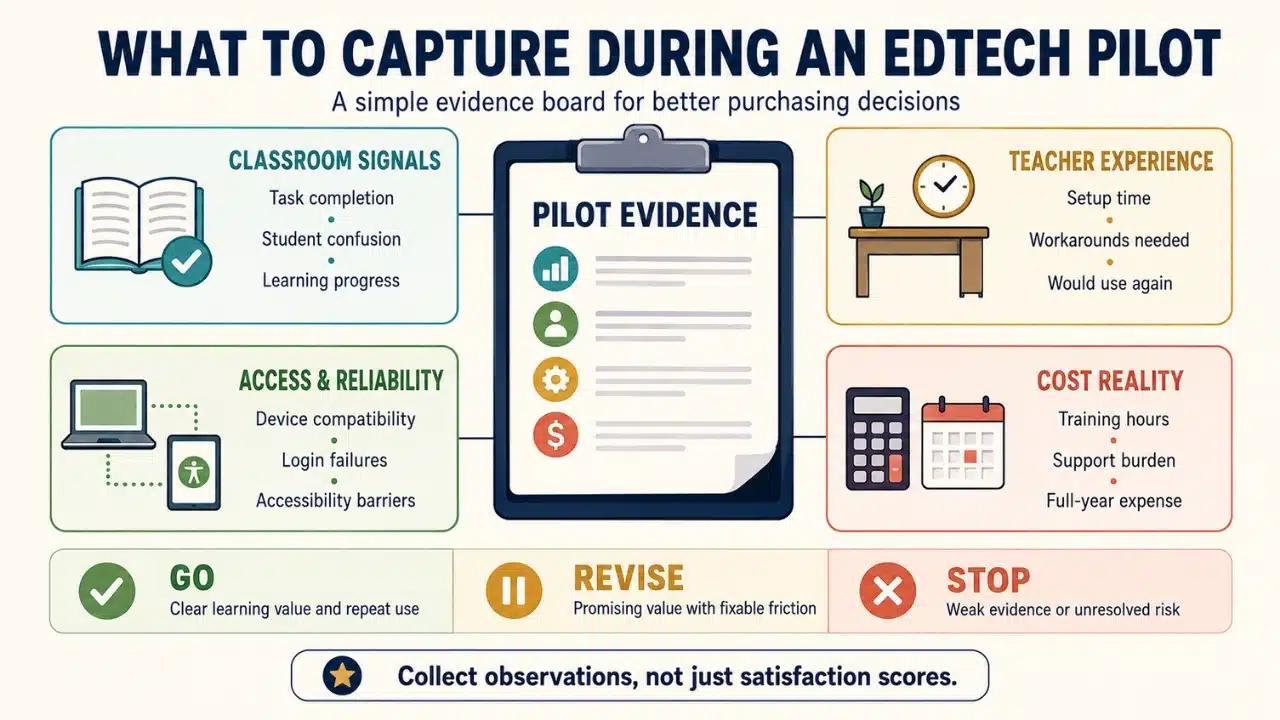
Involve classroom teachers directly in the pilot evaluation process before signing long-term contracts. Gathering real-world teacher feedback during a trial period ensures the platform solves genuine instructional challenges.
Why is LMS and SIS interoperability essential for school software?
Interoperability enables single sign-on and automated class rostering across systems. Without seamless integration, teachers and IT staff waste valuable instructional time manually managing user accounts and transferring grades.