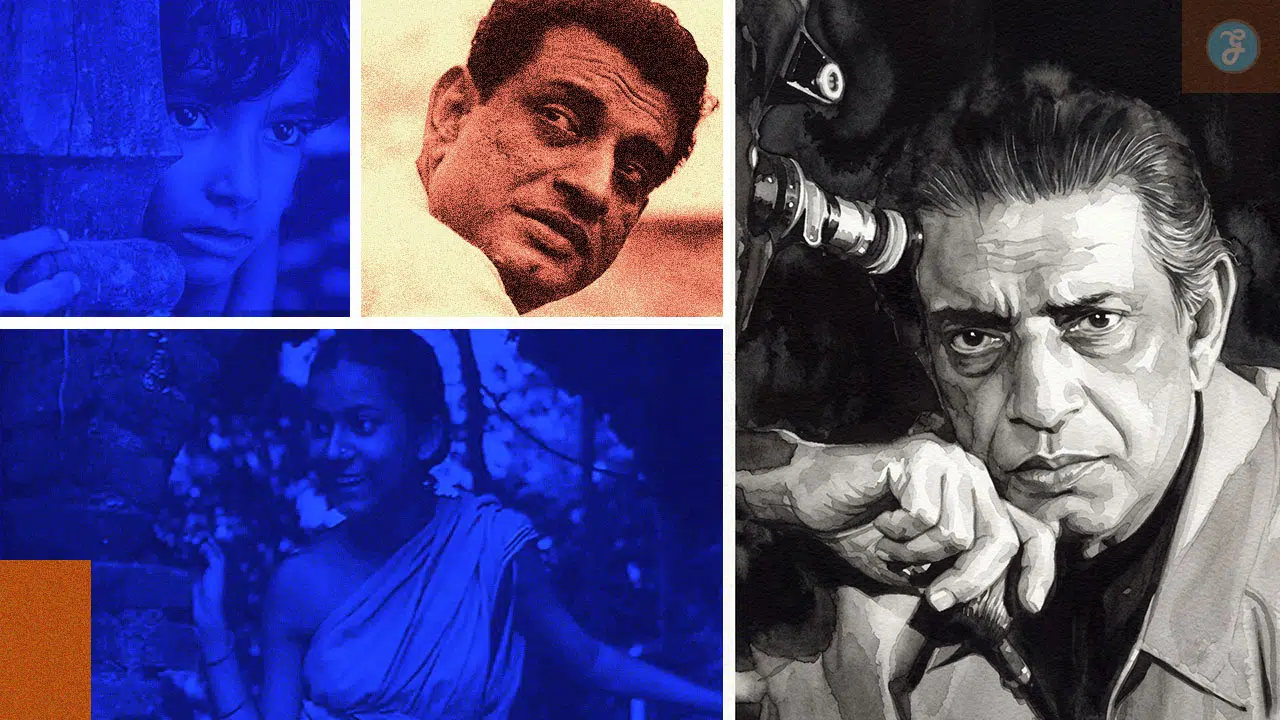
The humid air over South Kolkata on April 23, 1992, carried an unusual stillness. News of Manik-da’s passing traveled quietly along Bishop Lefroy Road, settling into the city like something deeply personal. While the world mourned a giant of cinema, Kolkata lost its closest observer. Yet to reduce the Satyajit Ray legacy to a body of films is to miss its true scale.
Ray is often framed within the stark brilliance of the Pather Panchali and the wider Apu Trilogy, celebrated as the architect of Indian cinematic realism. That legacy is undeniable, but it is also incomplete. He was not confined to cinema. He moved across disciplines with rare ease, shaping visual culture as a graphic designer, composing music with structural precision, and writing stories that continue to animate Bengali imagination.
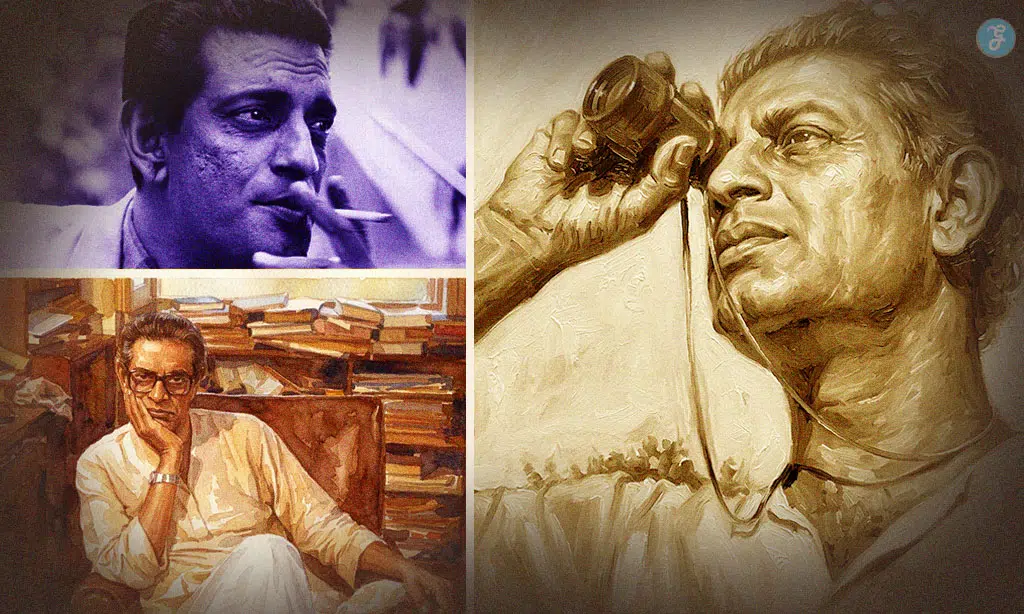
To understand Ray, one must step outside the frame. He did not merely direct films. He constructed entire cultural ecosystems. His life unfolded as an ongoing dialogue between image, sound, text, and design. Whether sketching book covers or composing film scores, his approach carried the same quiet exactness and intellectual rigor.
Where Vision Began: Design, Line, and Letter
Before the camera, there was the sketchpad. Ray’s artistic instincts were formed in lines, lettering, and layout. This foundation gave him a unique visual intelligence. He did not simply observe reality; he arranged it. Every frame in his cinema reflects a designer’s eye, where composition, space, and human gesture are calibrated with intention.
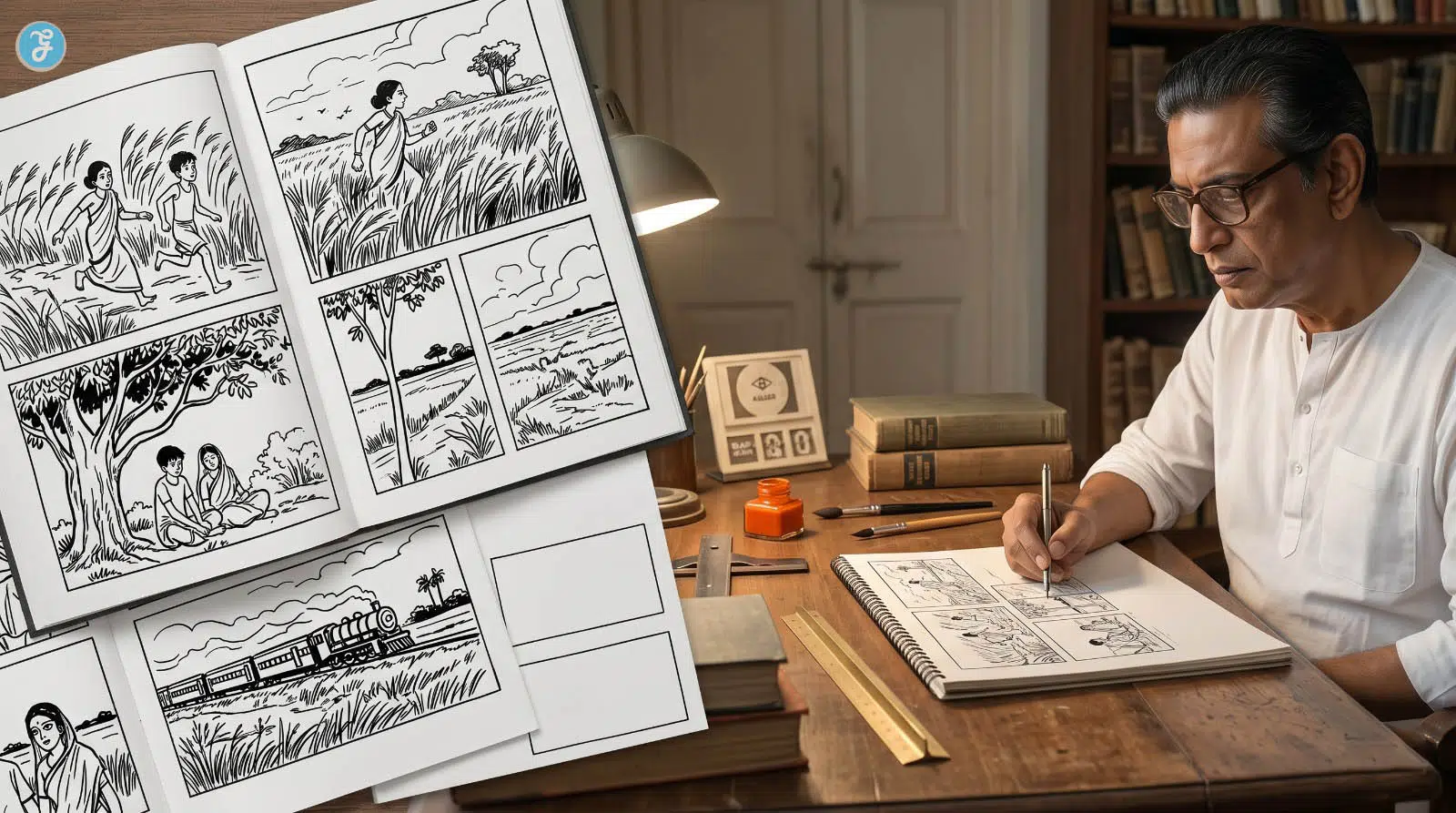
Ray’s time at Signet Press marked a definitive shift in Indian publishing. He did more than illustrate covers. He reshaped how Bengali books looked and felt. Before him, many jackets were crowded or ornamental. He introduced a cleaner visual language built on bold lines and symbolic imagery. His cover design for the abridged edition of Pather Panchali, titled Aam Antir Bhepu, reflects this approach. He used restraint to suggest mood rather than cluttering the composition with superfluous detail.
He also worked on the layout of the Pather Panchali novel years before he turned to film. This was more than graphic design. It was early visual thinking. It trained him to think in frames, where composition, spacing, and detail carried specific meaning. That discipline later allowed him to construct scenes on screen with the same quiet exactness he applied to the printed page. His work continues to serve as a blueprint for the modern multidisciplinary creator.
Artistic Integrity Against Power
For Satyajit Ray, a story had to arrive at its own truth. He resisted the idea that cinema should be shaped by political expectation or institutional messaging. This position wasn’t just rhetorical. It was tested early during the making of Pather Panchali and would go on to define his artistic identity.
The Pather Panchali Conflict
The production of Pather Panchali was marked by financial uncertainty and institutional scrutiny. Backed in part by the West Bengal government, the film was often viewed through a developmental lens. In a strange twist of bureaucracy, the funding was actually listed under “Road Improvement” because no specific fund existed for art films.
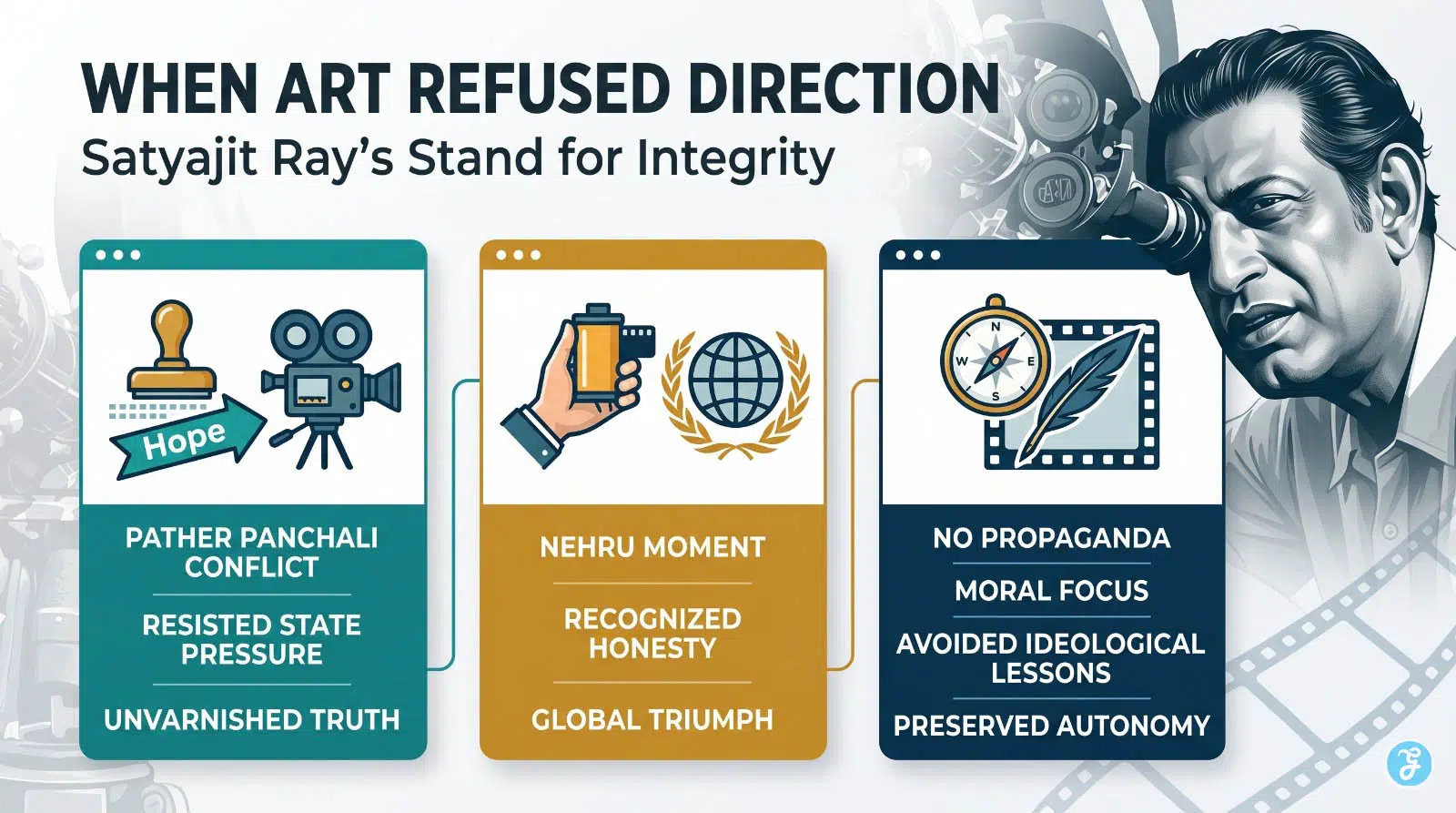
Naturally, officials suggested the narrative should gesture toward visible progress, perhaps a hopeful ending tied to state-led change. Ray resisted these impulses. He understood that any imposed resolution would dilute the emotional and narrative integrity of the film. Instead, he chose to retain the quiet devastation of departure, allowing the family’s journey to end without reassurance.
The Nehru Moment
The film’s international future wasn’t a sure thing. There were concerns in official circles that depicting poverty might hurt India’s image abroad. Some even questioned whether it should be sent to international festivals at all.
It was Jawaharlal Nehru who, after watching the film, recognized the value of its honesty. His support cleared the way for Pather Panchali to reach Cannes, where it eventually reshaped how the world saw Indian cinema. Nehru’s intervention remains a reminder that cultural confidence often lies in allowing unvarnished stories to be seen.
A Rejection of Propaganda
Ray’s cinema was guided by a disciplined moral imagination. He avoided turning the camera into an instrument of persuasion or ideological clarity. There are no imposed lessons in his work, no convenient resolutions to complex lives. By refusing to align his storytelling with state narratives, he preserved the autonomy of the frame itself.
This refusal did more than define his own practice; it established a quiet but enduring standard. For Ray, a filmmaker’s first responsibility wasn’t to power, or even to audience expectation, but to the internal truth of the story.
The Red Notebooks: Mapping the Mind
Ray’s preparation was legendary and lives on within his “Kheror Khata.” These were the red, cloth-bound journals where he meticulously planned every second of his films. He didn’t just write dialogue; he sketched every camera angle, the placement of furniture, and even the exact costumes.
These notebooks are a masterclass in pre-production. They show that by the time he arrived on set, the movie was already finished in his mind. For his film Shatranj Ke Khilari, his sketches for period costumes and chess pieces were based on months of historical research. This level of detail ensured that nothing was left to chance. It was this rigorous discipline that allowed him to maintain his specific directorial voice across decades of work.
The Symphonic Director: Soundscapes and Scores
For Satyajit Ray, cinema was inherently rhythmic. The movement of a scene, the pause between dialogues, and the emotional arc of a character were all tied to an internal sense of tempo. Over time, he came to feel that this rhythm could not always be translated through collaboration alone. That realization gradually drew him into composing his own scores, reshaping the soundscape of his films.
The 1961 Shift
In his early years, Ray worked with distinguished musicians such as Ravi Shankar and Vilayat Khan. Their contributions were significant, yet by 1961, during the making of Teen Kanya, Ray chose to take control of the music himself. This shift was less about rejecting collaboration and more about aligning sound precisely with narrative intent. By composing his own scores, he ensured that music remained inseparable from storytelling rather than functioning as an independent layer.
The Ray Sound
Ray’s musical language emerged from a dialogue between traditions. He was deeply influenced by Western classical composers like Wolfgang Amadeus Mozart and Ludwig van Beethoven, particularly their sense of structure and counterpoint. At the same time, he remained rooted in Indian melodic frameworks. The result was a distinctive hybrid, where Western orchestration often carried Indian tonalities. This approach gave his films a sound that felt both intimate and expansive, familiar yet contemporary.
Beyond His Own Films
Ray’s abilities as a composer occasionally extended beyond his directorial work. In 1965, he composed the score for Shakespeare Wallah, directed by James Ivory. The music captured the quiet melancholy of a fading theatrical world, demonstrating his sensitivity to mood even within another filmmaker’s vision.
Ray’s musical process was as visual as his directing. He developed a unique system of notation, often using Bengali script to map out Western orchestral movements. This allowed him to communicate complex rhythmic patterns to musicians who were trained in different traditions. It was a practical, hand-built solution that ensured his auditory vision remained as precise as his storyboards.
Precision in Every Note
Ray’s involvement with music was meticulous. He worked closely on arrangements, guided recordings, and paid careful attention to tonal balance. Just as importantly, he understood the expressive power of restraint. Silence, in his films, was never accidental. His scores rarely dominated a scene; instead, they shaped its emotional undercurrent with subtlety.
A Father’s Legacy, Feluda, and Shonku
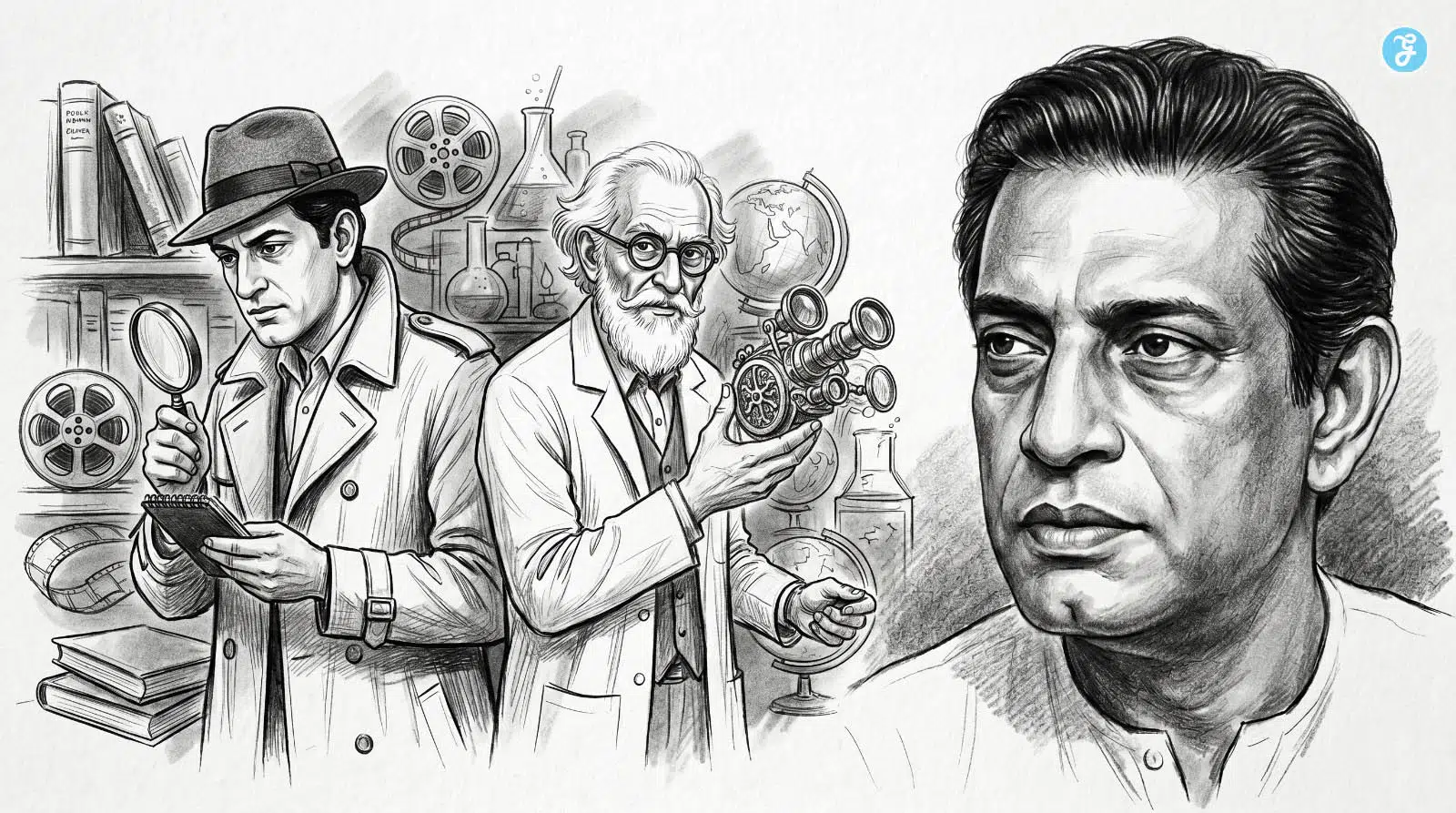
For Satyajit Ray, storytelling began long before cinema. It was shaped by inheritance, environment, and an early immersion in print culture. Literature was not secondary to his films. It was foundational to how he thought, observed, and created.
An Inherited World
Ray was the grandson of Upendrakishore Ray Chowdhury and the son of Sukumar Ray, both central figures in Bengali children’s literature and early printing innovation. In 1987, he directed a documentary on his father, a quiet tribute to a mind that had reshaped Bengali nonsense verse. This lineage was not a burden but a framework. Ray extended it, rather than stepping out of it, building a body of work that was distinctly his own.
Reviving Sandesh
The family magazine Sandesh, founded by his grandfather, had ceased publication after his father’s death. Ray revived it in 1961, not out of nostalgia but with clear intent. He wrote, illustrated, and edited the magazine himself, shaping it into a space where young readers were treated with seriousness and curiosity. The magazine reflected his belief that children’s literature could be imaginative without being simplistic, and educational without being didactic.
Genre and Imagination: Feluda and Shonku
Ray’s literary creations expanded the scope of Bengali popular fiction. His detective Feluda relied on observation and intellect rather than force, turning each story into an exercise in reasoning as much as suspense. Alongside him, Professor Shonku introduced readers to speculative science and global adventure, blending curiosity with imagination.
These characters did more than entertain. They created enduring entry points into logic, science, and cultural knowledge. Feluda stories draw on real locations, history, and art. Shonku’s journals engage with scientific ideas and ethical questions. Their continued popularity points to Ray’s ability to write across generations, crafting stories that remain accessible without losing their depth.
From Monochromatic Realism to Chromatic Complexity
For Satyajit Ray, change was not a departure but a continuation. As Indian cinema moved toward color and more urban narratives, he recalibrated his visual language without losing his core focus on human behavior. His evolution reveals a filmmaker attentive not just to form, but to context.
Kanchenjungha and the Darjeeling Mist
In 1962, Ray released Kanchenjungha, his first original screenplay and his first film in color. Set in Darjeeling, the film uses landscape with unusual intent. The shifting mist and mountain light do not function as passive scenery; they mirror the emotional states of the characters. As conversations unfold and tensions surface, the environment responds in subtle ways. The film also departs from conventional narrative structure, unfolding over a single afternoon and privileging interior conflict over external plot.
Urban Transitions and Technique
By the 1970s, Ray turned his attention to an increasingly restless Kolkata. Films like Pratidwandi, Seemabaddha, and Jana Aranya, often grouped as his urban trilogy, engage directly with political unease and shifting social values. Here, his technique becomes more visibly experimental. The use of negative imagery, freeze frames, and abrupt cuts reflects a fractured urban psyche, particularly that of the younger generation navigating uncertainty.
A Deliberate Use of Color
Ray’s transition to color was not merely technical. It became a narrative device. In his later work, color is used with restraint and intention, often to signal class distinctions, mood, and psychological distance. Rather than overwhelming the frame, it is carefully modulated, reinforcing his broader commitment to visual economy.
This adaptability ensured that the Satyajit Ray legacy did not remain fixed in the aesthetics of his early films. Instead, it expanded with the medium itself, demonstrating a sustained engagement with both technological change and evolving social realities.
The Global Root: A Vision Without Borders
For Satyajit Ray, the local and the universal were never opposites. He approached storytelling with a sensibility that was deeply rooted in Bengal yet informed by a wide cinematic exposure. This balance allowed his work to travel across cultures without losing its specificity.
A Defining Moment in London
In 1950, Ray traveled to London for his work in advertising. During this period, he watched an extraordinary range of films, an experience that broadened his understanding of the medium. Among them, Bicycle Thieves by Vittorio De Sica left a lasting impression. Its neorealist approach, grounded in everyday life and non-professional actors, offered a model of filmmaking that felt both accessible and powerful. Ray returned to India with a clearer sense of direction, which would soon take shape in Pather Panchali.
Universalism and the Honorary Oscar
The emotional world of Ray’s cinema extends beyond geography. Stories like that of Apu resonate because they engage with fundamental human experiences such as loss, aspiration, and resilience. In 1992, this global impact was formally recognized when Ray received an Honorary Academy Award. Accepting it from a hospital bed in Kolkata, he remained physically distant yet symbolically central to world cinema. The moment affirmed that regional storytelling, when handled with honesty, can achieve a truly international reach.
The Unmade Alien
Ray’s engagement with global cinema also included projects that never reached the screen. His script for The Alien, written in the late 1960s, imagined an extraterrestrial presence in a rural Bengali setting. The project did not materialize, largely due to production and contractual complications. In later years, some observers noted similarities between elements of his script and subsequent science fiction films. While these comparisons remain debated, the episode highlights the breadth of Ray’s imagination and his interest in genres beyond those he is commonly associated with.
Echoes in Modern Cinema
Even beyond his unmade projects, his global influence is not just a matter of history. It is visible in the symmetry and color palettes of Wes Anderson’s films. Anderson has openly admitted that the music and framing in “The Darjeeling Limited” were a direct homage to the master. Similarly, Martin Scorsese has often spoken about how Ray’s films provided him with a window into a world he never knew, yet felt deeply familiar with. This is the heart of the Satyajit Ray legacy. He proved that the specific details of a local culture could be the bridge to a global audience. His work remains a textbook for filmmakers who want to capture human truth without the need for high-speed chases or digital effects. He taught the world that the most dramatic thing in a room is often a silent look between two people.
The Unfinished Legacy: A Living Guide for Storytellers
The Satyajit Ray legacy is not fixed in the past. It still informs how stories are made and understood today. For Satyajit Ray, storytelling was never limited to one medium. Film, literature, music, and design were all part of the same practice.
His influence travels far beyond India. Filmmakers like Martin Scorsese and Wes Anderson have spoken about his work with clarity and respect. They respond to his control over detail and his attention to human behavior. What carries forward is not a visual style alone. It is a way of seeing.
Ray’s work also resists being placed in a closed timeline. Treating him as a figure of the past limits what he offers. His process moves across forms without friction. He wrote. He composed. He designed. Each discipline informed the other. That approach still feels current in a time when creative boundaries are less rigid.
He trusted observation over spectacle. His films rarely force emotion. They allow space. That restraint gives them longevity. It also explains why they continue to speak to new audiences, across languages and regions.
The conversation he began did not stop in 1992. It continues in small, quiet ways. In a filmmaker choosing a real location over a set. In a writer paying attention to detail. In a story that stays honest to its world.
That is where Ray remains present. Not as memory, but as practice.