Many passionate players still feel entirely excluded from global gaming culture. This systemic exclusion highlights the core of the Gender Gap In Gaming, where massive female audiences face hostile environments, thin representation, and minimal leadership opportunities within the industry.
Fortunately, this disparity is visible and measurable, providing a clear roadmap for meaningful structural reform. Analyzing recent player data reveals exactly where industry culture alienates female participants. Simultaneously, the rapid integration of generative AI is actively reshaping studio workflows, hiring dynamics, and character design frameworks while representation remains uneven.
Addressing these technological shifts is crucial for equitable development. Meanwhile, dedicated advocacy networks are already executing practical solutions, deploying actionable safety tools, targeted financial scholarships, and structural mentorship programs. These collaborative initiatives establish safer, more inclusive digital environments, proving that systemic changes can effectively dismantle long-standing barriers and foster lasting, widespread industry equity for all future creators.
Understanding the Gender Gap in Gaming
The gender gap in gaming is not really about whether women play video games. It is about who gets welcomed, who gets taken seriously, who gets promoted, and who gets to shape the games the rest of us play.
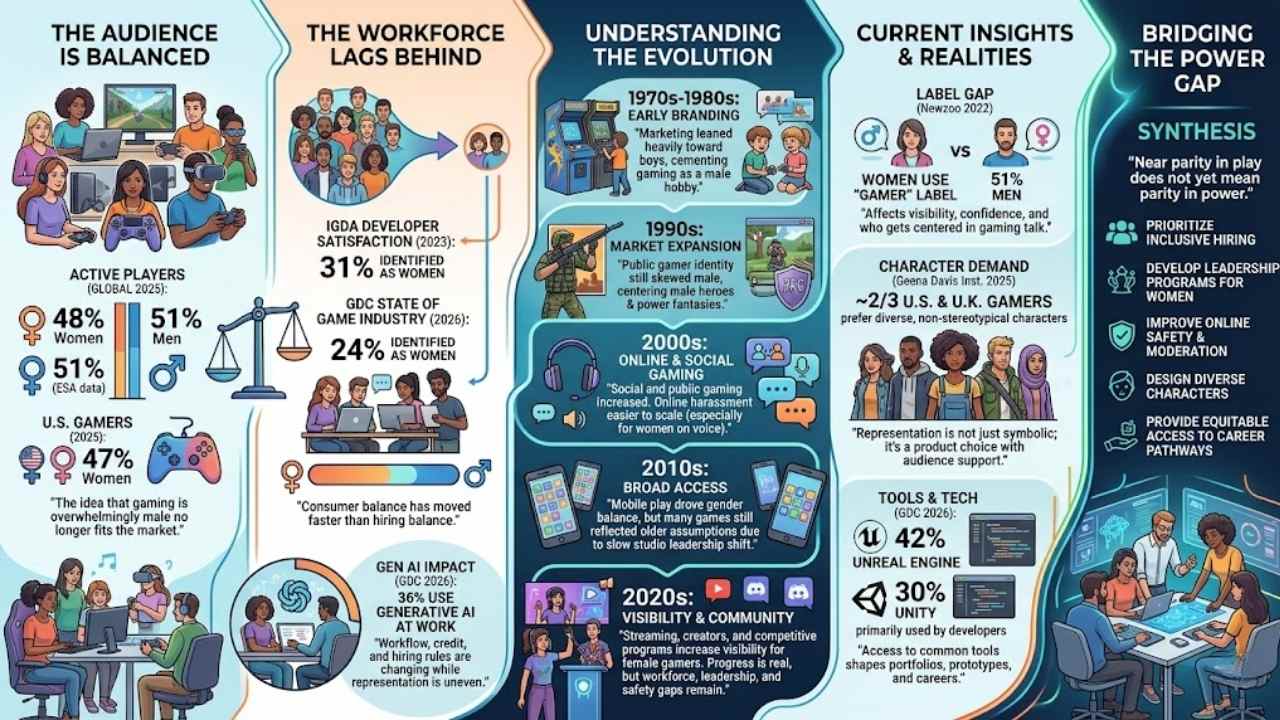
ESA’s 2025 global player report put active players at 48% women and 51% men, and U.S. data for 2025 showed women at 47% of gamers. That tells you the audience is close to balanced. The video game industry is not there yet.
On the workforce side, the 2023 IGDA Developer Satisfaction Survey found 31% of respondents identified as women, while GDC’s broader 2026 State of the Game Industry survey put that figure at 24%. Gen AI is now part of the same story, too: 36% of respondents in that 2026 survey said they use generative AI at work, which means hiring, crediting, and workflow rules are changing while representation is still uneven.
Near parity in play does not yet mean parity in power.
Historical overview of gender disparities in gaming
If you want to understand today’s gender gap, it helps to look at how the market was built. The audience widened faster than the culture did.
| Era | What changed | Why it still matters |
|---|---|---|
| 1970s to 1980s | Arcades and early home consoles grew fast, but much of the marketing leaned toward boys and young men. | That early branding helped cement the idea that gaming was a male hobby, even though women were always part of the audience. |
| 1990s | PC gaming, role-playing games, and first person shooter games expanded the market, but public gamer identity still skewed male. | Games often centered male heroes and male-coded power fantasies, which shaped who felt visible in gaming culture. |
| 2000s | Online multiplayer, voice chat, and early esports made gaming more social and more public. | They also made online harassment easier to scale, especially for women speaking on voice. |
| 2010s | Mobile play broadened access and pushed the audience much closer to gender balance. | The player base diversified faster than studio leadership did, so many games still reflected older assumptions. |
| 2020s | Streaming, Discord communities, creator economies, and official competitive programs increased visibility for female gamers. | Progress is real, but workforce data, leadership gaps, and safety issues show the gender gap has narrowed more in participation than in influence. |
Demographics of male and female gamers
The numbers look mixed only if you blend together players, identity, and employment. Once you separate those categories, the pattern is much easier to read.
| Topic | What the latest data suggests | What that means for readers |
|---|---|---|
| U.S. player base | Women made up 47% of U.S. gamers in 2025. | If women are still treated like outsiders, the issue is culture, not demand. |
| Global participation | ESA’s 2025 global report put active players at 48% women and 51% men. | The old idea that gaming is overwhelmingly male no longer fits the market. |
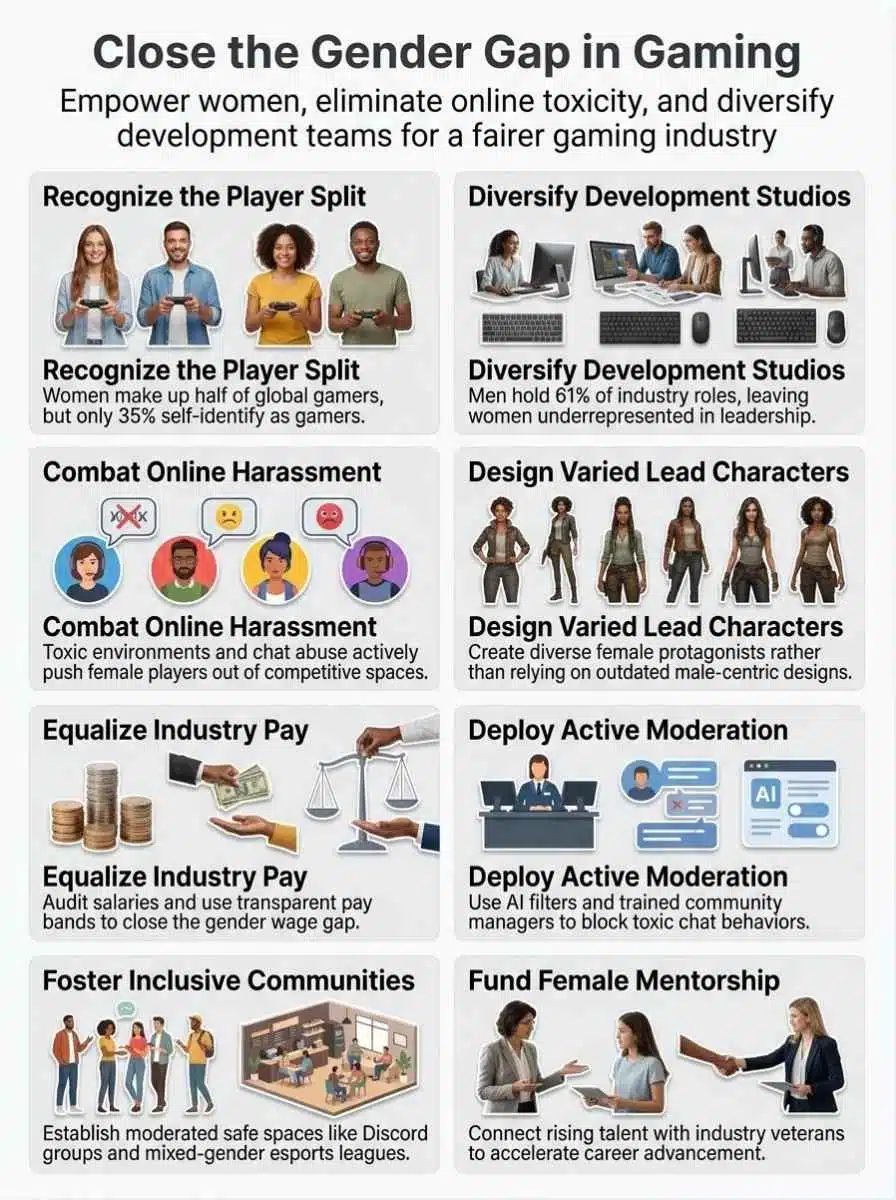
| Self-identification | A widely cited 2022 Newzoo snapshot found only 35% of women players used the label “gamer,” compared with 51% of men. | That label gap affects visibility, confidence, and who gets centered in gaming talk. |
| Game development workforce | IGDA reported 31% women in its 2023 developer survey, and GDC’s 2026 cross-industry survey reported 24% women. | Consumer balance has moved faster than hiring balance. |
| Character demand | A 2025 Geena Davis Institute study found around two-thirds of U.S. and U.K. gamers were more likely to play games with diverse, non-stereotypical characters. | Better representation is not just symbolic. It is a product choice with audience support behind it. |
| Tools and tech | In GDC’s 2026 survey, 42% of developers primarily used Unreal Engine and 30% used Unity. | Access to the most common tools matters because it shapes who can build portfolios, prototypes, and careers. |
Challenges Faced by Women in Gaming
Women still face friction at almost every stage of play and work. Some of it is obvious, like online harassment. Some of it is quieter, like who gets hired, who gets promoted, and whose ideas are treated as “core gamer” ideas.
Gender stereotyping and biases
Gender stereotypes still push female gamers into a narrow box. You can see it in genre assumptions, hiring language, character design, and in the lazy idea that women mainly want soft, casual experiences while men want the “real” games.
A 2024 study in Frontiers in Psychology by Júlia Gisbert-Pérez, Manuel Martí-Vilar, Cesar Merino-Soto, Guillermo M. Chans, and Laura Badenes-Ribera examined 180 university students who play video games. Using discriminant analysis, which is a method that spots the traits that best separate groups, the team found gender differences in age of gaming initiation, weekly gaming hours, motives like customization and social interaction, and perceived community toxicity.
- Do not design from stereotype. Design from motive. Players differ by what they want from a game, not by a cartoon version of gender roles.
- Test with mixed groups. If playtests come only from one kind of player, bias gets baked into tutorials, art direction, and team dynamics.
- Audit marketing copy. If a game sells itself as “for real gamers,” it often tells women they are guests in their own hobby.
Online harassment and toxic environments
This is still one of the biggest reasons the gender gap feels personal. A player can love a game and still leave because the chat is unbearable.
ADL’s 2023 youth research found that three-quarters of young people experienced harassment in online gaming, and women were among the groups most likely to face identity-based abuse. That helps explain why silence, muting, and hiding your gender still show up as survival tactics instead of simple preferences.
ADL’s 2026 Online Gaming Leaderboard is useful here because it focuses on concrete safety tools, not vague promises. It rewards games that let players block, mute, and report abuse across voice, text, usernames, and user-generated content.
| Safety feature | Why it matters |
|---|---|
| Block and mute tools | They give players immediate control, which matters most in fast-moving voice and text abuse. |
| Reporting for voice and text | Harassment often happens in speech, not just typed chat, so text-only systems miss the real problem. |
| Visible code of conduct | Clear rules make moderation easier to enforce and easier for players to trust. |
| Appeals and enforcement records | Transparent follow-through tells users the system is real, not decorative. |
Underrepresentation in game development roles
The player base is broad, but the pipeline into studios still narrows fast. That hurts product decisions, hiring fairness, and the sense that women in tech belong in game teams at every level.
IGDA’s 2023 survey reported 31% women among respondents, while GDC’s 2026 survey reported 24% women across a wider mix of game professionals. GDC also found that 17% of respondents had been laid off in the last 12 months, and in the United States one-third said they had been laid off in the past two years. In a shaky market like that, informal networks get stronger, and informal networks often favor the people who already look like the people in charge.
- Structured hiring beats “culture fit.” Clear rubrics reduce the bias that creeps in when teams hire people who feel familiar.
- Visible entry points matter. Women in Games International offers workshops, mentorship, and a job board, which helps turn vague interest into an actual next step.
- Remote access matters too. If your best opportunities sit behind relocation, conference travel, or expensive equipment, underrepresentation will stay sticky.
Lack of female protagonists in games
Players notice the difference between a woman who leads a story and a woman who decorates it. That sounds simple, but studios still get it wrong.
A 2025 Geena Davis Institute study found that around two-thirds of U.S. and U.K. gamers are more likely to play games with diverse, non-stereotypical characters, and nearly half hesitate to play games that rely on gender stereotypes. UNICEF’s gaming inclusion toolkit also cites a 2021 analysis of 27,564 video game characters that found female characters were ten times more likely to appear in revealing clothing and nearly five times more likely to show skin.
So the fix is not just “add more women.” It is to build female protagonists with agency, skill, and personality that do not depend on cliché.
- Check costume logic. If the armor works for men but turns decorative for women, players see the bias fast.
- Check narrative agency. Ask whether the character drives the plot or just reacts to it.
- Check play style. Female leads should get the same range of power, aggression, strategy, and leadership as everyone else.
Wage disparity and limited leadership opportunities
Money and influence tell you what an industry truly values. That is why pay and leadership matter so much in this conversation.
In GDC’s 2025 U.S. salary report, women earned 24% less on average than male counterparts, and only about one-third of respondents said their companies were working to close pay gaps. The same report found 60% of women and non-binary respondents felt undercompensated, compared with 50% of men.
| Issue | Recent signal | Best next move |
|---|---|---|
| Pay gap | Women earned 24% less on average in GDC’s 2025 U.S. survey. | Publish salary bands and promotion criteria before negotiations start. |
| Compensation trust | 60% of women and non-binary respondents felt undercompensated. | Run annual pay audits by role, level, and tenure. |
| Leadership visibility | Many women still do the work without getting the same public stage. | WIGI’s “No Woman, No Panel” rule is a simple model for events, summits, and public-facing leadership. |
| Promotion pipeline | Underrepresentation at entry and midlevel roles shrinks the future leadership pool. | Pair mentorship with sponsorship, stretch assignments, and visible decision-making roles. |
Progress in Bridging the Gender Gap
The story is not all setbacks. There has been real movement in player visibility, esports structure, creator economies, and support networks.
Rise of female gamers and content creators
Female gamers are not a side audience anymore. In the United States, women made up 47% of gamers in 2025, and ESA’s 2025 global data put women just a few points behind men worldwide.
That shift matters because visibility changes culture. When women stream, review, coach, speedrun, cast, and lead communities on Twitch, YouTube, and Discord, they make it harder for the old stereotype to survive.
- Creators widen the idea of who a gamer is.
- They also create safer micro-communities inside a messy gaming community.
- For readers who feel shut out, following a creator-led community is often the fastest way to find better norms.
Inclusion of women in esports and competitive gaming
Professional gaming still skews male, but the infrastructure is better than it was a few years ago. Riot Games’ VCT Game Changers is one of the clearest examples because it is an official circuit built to create visibility and competitive opportunity for women and other marginalized genders in VALORANT.
That matters for more than trophies. Official pathways attract coaches, sponsors, broadcasters, analysts, and new players who finally see a route into esports that does not begin with proving they deserve to be in the room.
| Named program | What it does | Why readers should care |
|---|---|---|
| VCT Game Changers | Creates official competitive opportunities and visibility in VALORANT esports. | It gives aspiring pros a defined route instead of a vague promise of inclusion. |
| League of Legends Game Changers Rising | Expanded in 2026 with a longer season in EMEA for players who identify as women. | It shows publishers are willing to build repeat structures, not one-off showcases. |
Increasing representation of female characters in games
Representation is getting smarter, even if it is still uneven. More studios understand that players want women who feel real, capable, messy, funny, strategic, and central to the action.
The market case is stronger now, too. The Geena Davis Institute’s 2025 findings show that inclusive character design lines up with what many players already want, which means better representation is not charity work. It is better product thinking.
Support groups and initiatives for women in gaming
If you want help right now, this is where progress becomes practical. These groups do different jobs, and that is useful because readers often need one clear next step, not a perfect master plan.
- Women in Games International offers mentorship, workshops, a job board, and a public “No Woman, No Panel” policy that pushes for better visibility at events.
- Women in Games runs advocacy, research, community action, and monthly social network gatherings in 2026 that help women and girls build real relationships in games and esports.
- IGDA Women in Games SIG focuses on gender balance in both the workplace and the marketplace.
- The ESA Foundation awarded scholarships to 28 students in 2025 who are pursuing careers in game development and esports, which matters because cost is still a real barrier to entry.
- The Global Video Game Coalition pushes responsible gameplay tools and family guidance, which helps communities think about safety as part of game design, not an afterthought.
- Women in Tech Global Conference 2026 and the Chief in Tech Summit show that game careers also benefit from the wider women in tech ecosystem, especially around leadership, AI policy, and hiring.
Strategies for Overcoming Challenges
You do not have to wait for the whole industry to fix itself before making better choices. Safer systems, better leadership, and more inclusive design usually start with a few specific moves done consistently.
Moderation of toxic gaming environments
Toxic spaces do not become healthy by accident. They improve when rules are visible, tools are fast, and moderation happens before abuse becomes the community norm.
- Choose games and servers with real safety tools. ADL’s 2026 safety framework highlights block, mute, and reporting across voice, text, usernames, and user-generated content for a reason.
- Put the code of conduct where players can see it. Hidden rules do not change behavior.
- Respond quickly to repeat abuse. Fast action matters more than long policy documents.
- Use voice moderation seriously. A lot of gender-based harassment happens in voice chat, so text-only enforcement misses the real problem.
- Track appeals and outcomes. Transparent process helps good moderators keep community trust.
- Give players control. Easy mute, block, privacy, and friend-only settings help people stay in a game instead of leaving it.
Promoting awareness and diversity initiatives
Awareness works best when it changes a process. If it stays at the slogan stage, it fades fast.
- Publish simple yearly diversity snapshots. Headcount, promotion rates, and pay bands tell a clearer story than broad mission statements.
- Use “No Woman, No Panel” style rules for events. This is a low-cost fix that improves leadership visibility right away.
- Audit marketing and character design together. A game can add better representation in the script and still erase it in trailers and key art.
- Train moderators and community leads. Harassment policy is only useful if the people applying it know what gender-based discrimination looks like in real time.
- Fund access, not just messaging. Scholarships, gear lending, workshop seats, and travel support do more than a campaign banner ever will.
Encouraging mentorship and leadership opportunities
Mentorship helps most when it is tied to a real career move. That could mean a portfolio review, a mock interview, a leadership assignment, or an introduction that actually leads somewhere.
The ESA Foundation’s 28 scholarships in 2025 show why financial support matters early, and Women in Games International shows why mentorship matters after that. One gets people in the door. The other helps them stay long enough to grow.
- Match juniors with mentors in the exact role they want. General advice is nice, but role-specific feedback is what changes portfolios and confidence.
- Add sponsorship, too. Mentors give advice. Sponsors create openings.
- Make leadership visible. Invite women to lead talks, ship reviews, community streams, and postmortems.
- Use cross-industry rooms. Events like the Women in Tech Global Conference and Chief in Tech Summit help game professionals build wider women in tech networks.
- Measure outcomes. If a mentorship program never leads to interviews, promotions, or shipped work, fix the program, not the people in it.
Building inclusive gaming communities
Inclusive communities feel different right away. You can tell from the welcome, the rules, the moderation, and who gets spotlighted.
- Start with clear norms. Say what respectful play looks like, and say what gets removed.
- Use built-in device and platform controls. The Global Video Game Coalition notes that virtually all major gaming devices offer settings that help players and families shape chat, contact, and other boundaries.
- Highlight women as experts, not exceptions. Put women on panels, streams, tournament desks, dev diaries, and mod teams.
- Create small, moderated on-ramps. New players often stay longer when their first community is well run and easy to read.
- Celebrate more than one play style. Competitive, social, cozy, creative, strategic, tabletop, and hidden object puzzle adventure players all belong here.
- Keep reporting simple. If it takes too many clicks to ask for help, people will leave before they report.
Final Thoughts
The gender gap in gaming is smaller than it used to be, but it is still real in harassment, hiring, pay, and leadership. Better moderation, stronger mentorship, fairer pay systems, and richer character design can move the needle fast. If you care about games, you can help by joining better communities, reporting abuse, supporting women-led spaces, and making room for more voices in every part of gaming culture.
That is how the gender gap in gaming gets smaller.
Frequently Asked Questions (FAQs) About the Gender Gap in Gaming
1. What causes the gender gap in gaming?
The gap comes from bias, past exclusion, and frequent harassment, which push some players out. It shows up in representation, in game industry jobs, and in competitive play like esports.
2. Has there been progress in closing the gender gap?
Yes, there is progress, with more diverse characters and stronger calls for inclusion. Still, change moves slowly and many challenges remain.
3. What are the main challenges now?
Harassment and toxic chat chase players away, hurting diversity. Hiring gaps at studios, narrow marketing, and weak community rules keep some groups from joining. Esports and leadership roles still skew one way, so representation lags.
4. What helps reduce the gender gap?
Clear policies, safer communities, fair hiring, and games that show varied characters help a lot. Developers and players must work together, or progress will stall.