

Do you ever feel like true clarity is missing from today’s noise? Maybe you listen to the radio or scroll through playlists and wish for a voice that speaks with both logic and heart. Many of us long for that rare combination of perfect melody and thoughtful depth.
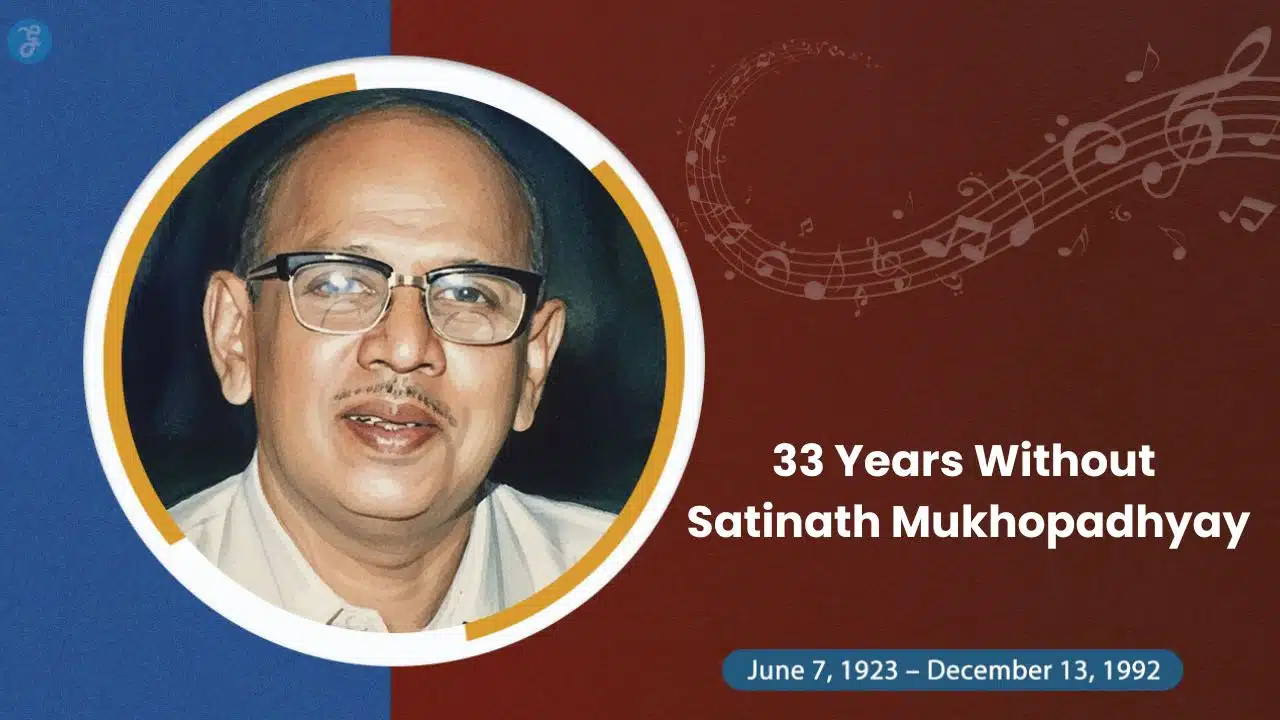
This is why Satinath Mukhopadhyay matters so much, even 33 years after his passing on December 13, 1992. He wasn’t just a singer; in the world of Bengali music, he was an intellectual force who brought a disciplined, almost scientific precision to emotion.
I’m going to walk you through his journey, from his classical roots in Lucknow to his legendary partnership with Utpala Sen. You’ll see why his songs still resonate in 2025 and how his “voice of reason” continues to influence artists today.
So, grab a cup of tea and let’s explore the life of a man who turned music into a conversation.
Key Takeaways
- December 13, 1992 marks the passing of Satinath Mukhopadhyay, yet his influence remains strong 33 years later.
- He was a classically trained artist born in Lucknow, which gave his Nazrul Geeti and Ghazals a unique, authentic Urdu nuance.
- His partnership with wife and singer Utpala Sen created one of the most iconic duets in Bengali music history.
- Songs like “Jey Din Rabona Aami” and “Jibone Jodi Deep Jwale” are timeless classics that define the golden era of Bengali modern song.
- He was known for his intellectual approach to music, treating lyrics with the precision of a poet and the logic of a composer.
What was Satinath Mukhopadhyay’s early life like?
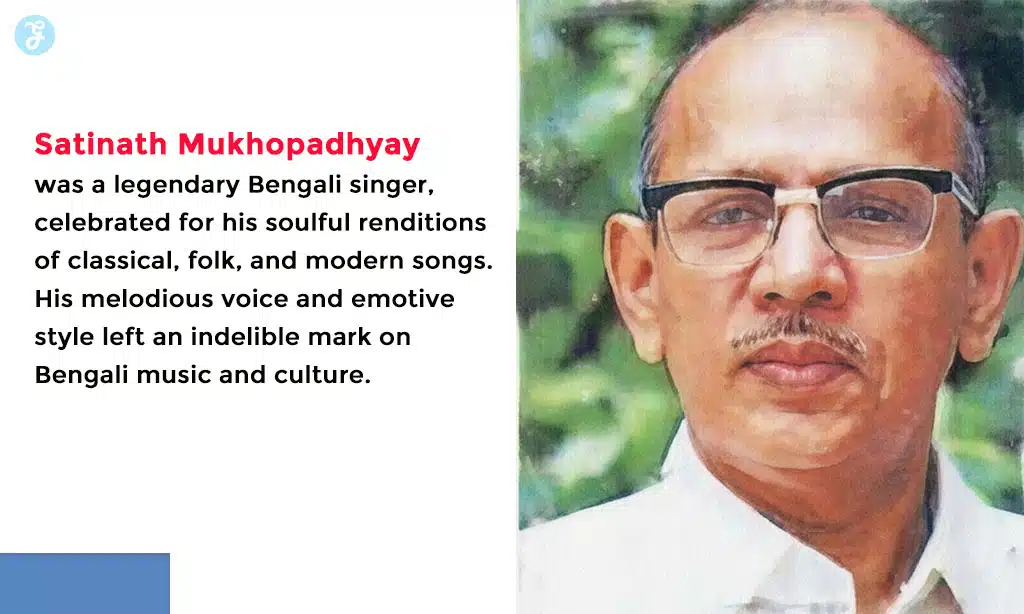
Satinath Mukhopadhyay was born on June 7, 1923, in Lucknow, a city famous for its rich culture and etiquette. This location is key to understanding his music. Unlike many of his Kolkata-born peers, growing up in Lucknow surrounded him with pure Hindustani classical music and flawless Urdu diction from day one.
His home wasn’t just about music; it was a place of discipline. His father, Taradas Mukhopadhyay, was a government officer, and Satinath initially followed a similar steady path, working at the Accountant General’s office (AG Bengal).
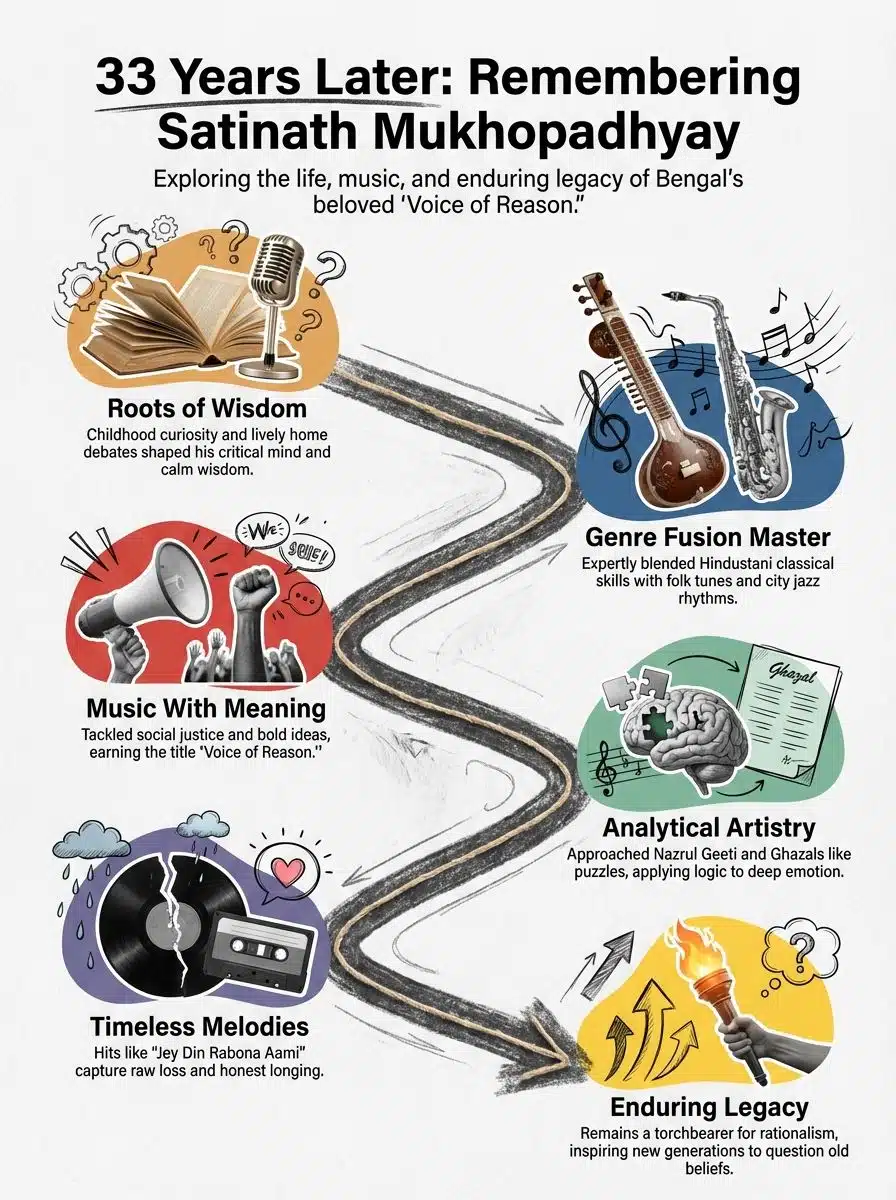
But his curiosity for the arts was undeniable. He didn’t just listen to music; he studied it. He trained under masters like Chinmoy Lahiri, which gave him a rock-solid classical foundation. This mix of Lucknow’s courtly grace and strict classical training shaped his unique “voice of reason”—a style where every note was calculated, and every word was crystal clear.
He learned to treat a song not just as a melody, but as a debate between structure and emotion. This intellectual start is why his later work stood out for its perfect grammar and logical progression.
Musical Journey and Contributions
Satinath Mukhopadhyay’s songs eventually reached every Bengali home, traveling from the radio waves of All India Radio (Akashvani) directly to the listener’s heart. His mastery over the harmonium was legendary; he could express as much with his fingers as he could with his throat.
How did Satinath Mukhopadhyay influence Bengali modern songs?
He bridged the gap between complex classical structures and the easy listening of modern songs (Adhunik Gaan). While contemporaries like Hemanta Mukhopadhyay were known for their romantic baritone, Satinath was known for his versatility and technical perfection.
He didn’t just sing about love; he sang about life’s realities. In the 1970s and 1980s, he helped push the Bengali music scene towards more structured, semi-classical compositions. He showed that a modern song could have the weight and dignity of a classical rag, a contribution that earned him massive respect among fellow musicians.
His influence was so profound that even today, reality show contestants on channels like Zee Bangla or Star Jalsha often choose his difficult compositions to prove their technical skill. He set a standard: you can’t just sing the notes; you must understand the grammar behind them.
What made Satinath Mukhopadhyay an expert in Nazrul Geeti and Ghazals?
This is where his Lucknow upbringing truly shined. Satinath Mukhopadhyay is arguably one of the finest exponents of Nazrul Geeti because he understood the ghazal ang (style) that Kazi Nazrul Islam intended. Many singers struggled with the correct Urdu pronunciation required for these songs, but for Satinath, it was his mother tongue.
He approached Nazrul’s work with a logical mind. He would break down the lyrics to find the hidden meaning, ensuring that the emotional delivery matched the poet’s intent perfectly. Whether it was a thumri-style track or a pure ghazal, his renditions were technically flawless.
His recording of songs like “Pashaner Buke Likhona” shows this expertise. He treated the song as a puzzle of emotions, solving it with his voice. This analytical yet soulful approach gave his music a depth that casual listeners might miss but true connoisseurs cherish.
What are some popular songs by Satinath Mukhopadhyay?
Fans still request his songs on Sunday morning radio shows across West Bengal and Bangladesh. His discography is vast, covering everything from film hits to private albums released by HMV and Megaphone. Here are a few that defined his career.
What is the significance of “Jey Din Rabona Aami”?
“Jey Din Rabona Aami” hits the heart with its simple words and honest tune. Satinath Mukhopadhyay’s clear voice makes every note stand out, keeping the feeling raw and real. People hold this song close because it speaks of mortality and memory in a way anyone can feel.
The melody sticks in your mind like an old friend you don’t want to leave. Many listeners say the song brings tears because it feels like Satinath himself is talking to us from beyond. It captures the essence of his legacy—the idea that an artist lives on through their art.
Why is “Jemon Kore Grahan Lage Chande” well-known?
People love this song for its deep feeling and haunting tune. Satinath Mukhopadhyay’s strong singing brings every word to life, using the metaphor of a lunar eclipse (“Grahan”) to describe pain and overshadowing in love. Listeners feel the sadness and beauty in each note.
The music sits heavy on your heart, much like a shadow that won’t leave. It’s a perfect example of his semi-classical style, where the tune is catchy but the vocal control required is immense. Musicians still talk about how he navigated the complex notes of this track with such apparent ease.
What makes “Jibone Jodi Deep Jwale” a memorable song?
“Jibone Jodi Deep Jwale” is perhaps his most iconic romantic number. It tugs at the heart with its gentle tune and honest words. Satinath Mukhopadhyay’s deep voice brings out every feeling in the song, making each note hit home.
Listeners feel a wave of longing and hope. The lyrics speak about lighting a lamp in one’s life that never goes out, a beautiful promise of eternal love. The musical arrangement, often featuring the sitar and tabla, blends softly in the background, setting a mood that stays long after the music stops.
This track is a staple at cultural functions and is often the first song a student learns when studying Satinath’s style. It stands out because it feels real, personal, and timeless.
What was Satinath Mukhopadhyay’s personal life and legacy?
Satinath Mukhopadhyay’s personal life was deeply intertwined with his music, most notably through his marriage to the legendary singer Utpala Sen. Their union was a powerful partnership of two musical giants. They weren’t just husband and wife; they were creative soulmates who supported each other through the ups and downs of the industry.
Together, they were a power couple in the Kolkata music scene, known for their hospitality and the vibrant musical gatherings (addas) at their home. Satinath was often seen as the steady, grounding force—the “voice of reason”—complementing Utpala’s emotive and sometimes fiery artistic temperament.
His passing left a gap that still feels wide after 33 years. Admirers miss his disciplined approach to art in an era of auto-tune and quick fixes. He inspired young minds to value Riyaz (practice) and study over instant fame. Even now, people look back on his philosophy as a steady guidepost—proof that honest thought and hard work never go out of style.
How is Satinath Mukhopadhyay remembered 33 years later?
Fans and thinkers still honor Satinath Mukhopadhyay’s voice. His ideas about musical integrity and precision spark talks today, just as they did before his death on December 13, 1992.
Music schools and cultural groups hold sessions in his name, especially as we move through his centenary celebrations (he was born in 1923, making the 2020s a decade of remembrance). Each year, students gather to analyze his unique vocal throw and diction.
Writers and critics use his work as a benchmark for quality. Some teachers in music academies use his recordings as “textbooks” for perfect pronunciation in Bengali and Urdu. Many see him as a north star for hard times; others say he brings hope with simple lines from an old song.
In a world of fleeting viral hits, people turn back to listen to what he sang—a voice of reason shining across generations.
Takeaways
Even after 33 years, Satinath Mukhopadhyay’s melodies still echo in our lives. His songs inspire many to think deeper about the craft of music and the power of a clear voice. People discuss his work as if he might walk through the door of a recording studio any day now, ready with another perfect take.
He showed us that music isn’t just about sound; it’s about intelligence and discipline. His voice may be silent, but his message keeps hearts and minds awake, urging new voices to follow his path of excellence.
FAQs about Satinath Mukhopadhyay
1. Who was Satinath Mukhopadhyay, and why do people remember him after 33 years?
Satinath Mukhopadhyay was a legendary Bengali singer and composer whose distinct voice and classical mastery defined an era of modern Bengali music until his passing on December 13, 1992. Fans and critics alike continue to honor him three decades later for timeless hits like “Pashaner Buke Likho Na” and his generous role in mentoring the next generation of artists.
2. What made Satinath’s approach to debate different from others?
He avoided the aggressive competition typical of the music industry, choosing instead to let his compositions speak through the voices of others, including rivals like Shyamal Mitra. Rather than shouting to be heard, he focused on the quiet power of melody, proving that collaboration often yields more lasting results than conflict.
3. How did Satinath influence conversations on tough topics?
He had a unique talent for translating the complex “tough” language of classical ragas into simple, accessible songs that anyone could enjoy. By weaving intimidating musical structures into popular hits like “Jibone Jodi Deep,” he invited everyday listeners to appreciate high art without feeling excluded.
4. Why does remembering Satinath matter today?
In a modern music landscape often driven by viral trends and quick fame, Satinath’s career stands as a testament to the enduring value of technical skill and humility. His legacy reminds us that steady dedication to one’s craft creates an impact that outlives the noise of the moment.





















