As the sun set over Palm Beach on December 28, the handshake between President Donald Trump and President Volodymyr Zelenskyy at Mar-a-Lago was intended to signal the beginning of the end. Images of the two leaders, flanked by aides holding the “20-Point Framework” (Russia-Ukraine Peace Deal), were beamed to a weary world, promising that the 1,405-day conflict was “95% solved.”
Yet, less than 24 hours later, the skyline of Russia’s Novgorod region was illuminated not by fireworks, but by the interceptor fire of air defenses battling a swarm of 91 drones targeting Vladimir Putin’s Valdai residence.
This is the paradox of December 2025: We are closer to peace than at any point since February 2022, yet the risk of a catastrophic escalation has never been higher. The diplomatic architecture is built, but the foundation is trembling. As negotiators race to finalize a treaty before the US State of the Union address in January, they face a stark reality: the “last mile” of this war is proving to be its most dangerous.
Key Takeaways: The Peace Crisis
-
The “95%” Illusion: The deal is near, but the final 5%, territorial sovereignty and Putin’s approval, remains the most dangerous hurdle.
-
“Article 5-Lite”: The US offers 15-year air/naval support (no troops) in exchange for Ukraine suspending its NATO bid.
-
Donbas Compromise: A proposed “Free Economic Zone” would make the east a demilitarized, neutral trade hub, though both sides remain skeptical.
-
“Black Swan” Crisis: The Dec 29 drone attack on Putin’s residence has stalled talks and heightened the risk of immediate retaliation on Kyiv.
-
The Referendum Trap: Ukraine needs a ceasefire to hold a required vote on the deal; Russia refuses to pause fighting without a signed treaty.
-
The Bottom Line: The world faces a fragile race between a diplomatic breakthrough in January 2026 and a military escalation that could end negotiations.
Anatomy of the Deal: The “20-Point Plan” Unpacked
While the full text remains classified, leaks from the Mar-a-Lago summit and diplomatic cables in Brussels have revealed the core mechanics of the proposed peace deal. It is a pragmatic, bitter pill for both sides, prioritizing stability over total victory.
The Security Architecture: “Article 5-Lite”
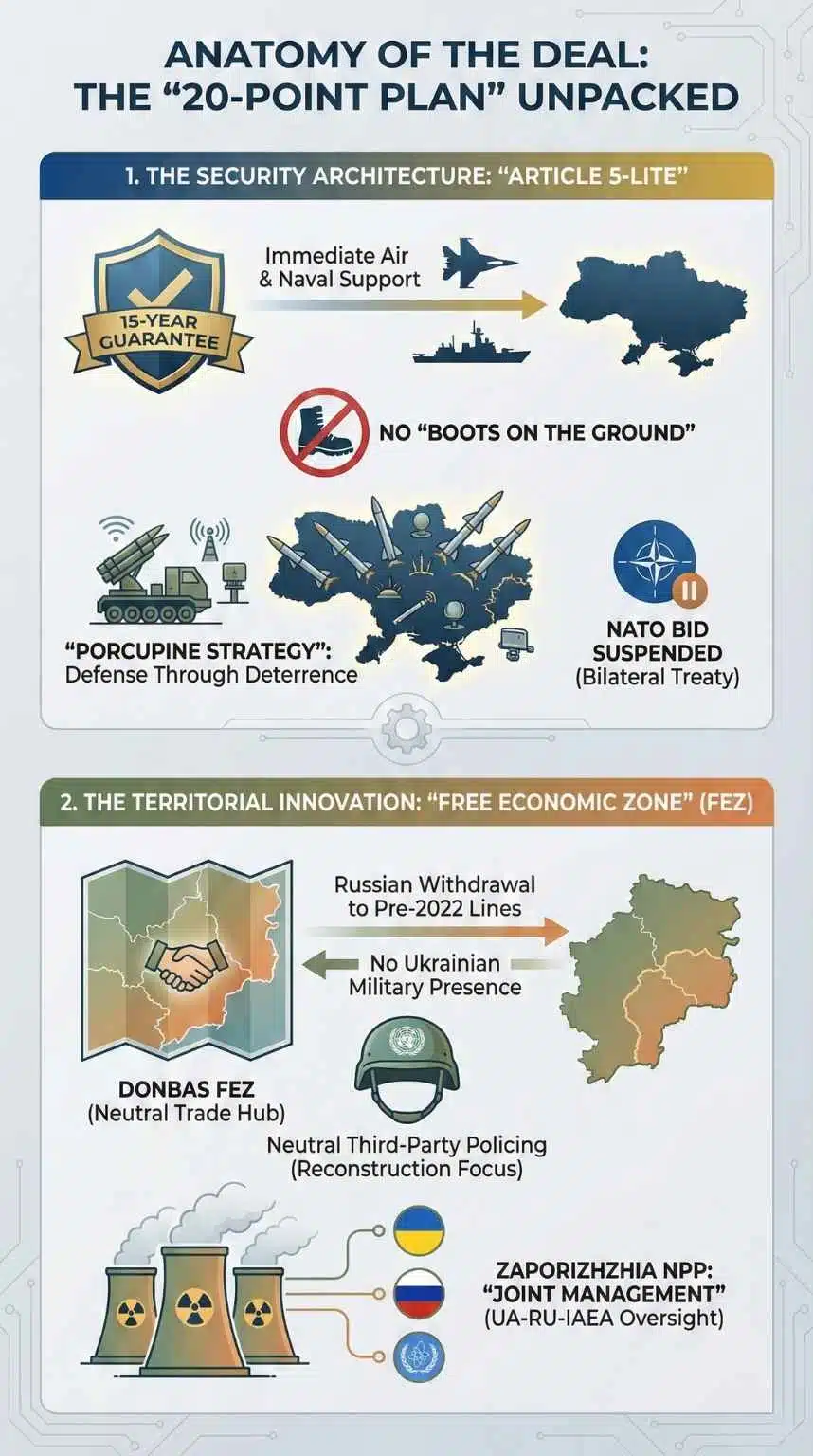
The cornerstone of the deal is a 15-year security guarantee provided by the United States. Unlike NATO membership, which Ukraine has agreed to suspend under the plan, this guarantee is a bilateral treaty.
-
The Offer: The US commits to immediate air, naval, and intelligence support if Ukraine is attacked again.
-
The Caveat: Explicitly excludes “boots on the ground,” relying instead on a “Porcupine Strategy”—arming Ukraine so heavily during the peace that invasion becomes impossible.
-
The Dispute: Zelenskyy argues 15 years is insufficient for generational healing, pushing for a 50-year binding treaty.
The Territorial Innovation: The “Free Economic Zone” (FEZ)
The most novel and controversial aspect of the plan attempts to solve the deadlock over the Donbas.
-
The Concept: The proposal creates a “Demilitarized Free Economic Zone” covering the contested areas of Donetsk and Luhansk.
-
The Mechanics: Russian troops would withdraw to pre-2022 lines, and Ukrainian troops would not enter. Instead, the zone would be policed by a neutral third-party force (potentially led by non-NATO nations like India or Brazil) and focused on reconstruction and trade.
-
Zaporizhzhia: The nuclear plant would see a unique “Joint Management” structure, with oversight from the IAEA, Russia, Ukraine, and US energy observers.
The “Gold Rush”: The Battle for Critical Minerals
While the headlines focus on borders, the fine print of the Mar-a-Lago talks focuses on business. Ukraine holds some of Europe’s largest reserves of titanium and lithium—metals essential for the EV revolution and defense manufacturing.
The “BlackRock” Fund
Sources confirm that the “Ukraine Development Fund,” advised by BlackRock and JPMorgan, is ready to deploy massive private capital, but only after a signed treaty. The US has reportedly secured “first right of refusal” on key extraction contracts in the proposed “Free Economic Zone,” effectively shutting China out of Ukraine’s resource market.
The Debt-for-Equity Swap
A quiet clause in the “20-Point Plan” suggests that a portion of Ukraine’s war debt to the US may be forgiven in exchange for equity in state-owned energy firms, specifically those controlling the gas transit network and the lithium fields in the Donbas.
The $300 Billion Question: Sanctions & Reparations
The peace deal creates a complex mechanism for the $300 billion in frozen Russian Central Bank assets sitting in Western banks.
-
The Compromise: The “20-Point Plan” reportedly does not confiscate the principal sum (to avoid destabilizing the global banking system). Instead, it proposes a “100-Year Bond”: the assets remain frozen, but the interest generated (approx. $15–20 billion annually) is legally siphoned off to fund a “Ukraine Reconstruction Bank.”
-
The Friction: Russia is demanding the eventual return of the principal assets as a condition for the deal. The US is proposing a “Snap-Back” mechanism: sanctions are suspended, not lifted, and can be reimposed instantly if Russia violates the ceasefire.
The Major Stumbling Blocks (The “5%” That Remains)
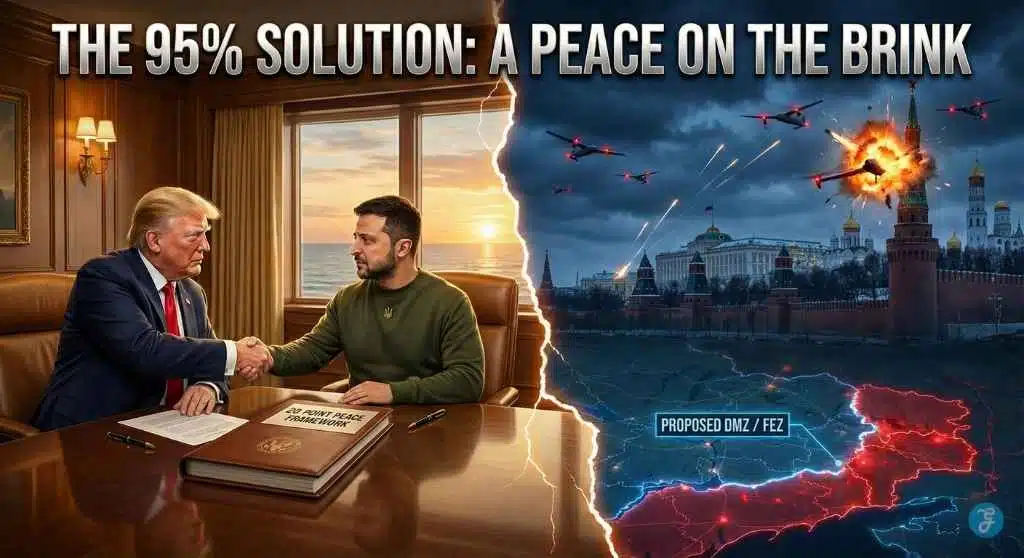
Despite the optimism, two structural hurdles threaten to collapse the talks.
The “Referendum Trap”
President Zelenskyy has drawn a red line: he cannot sign away territory or neutrality without the mandate of the Ukrainian people.
-
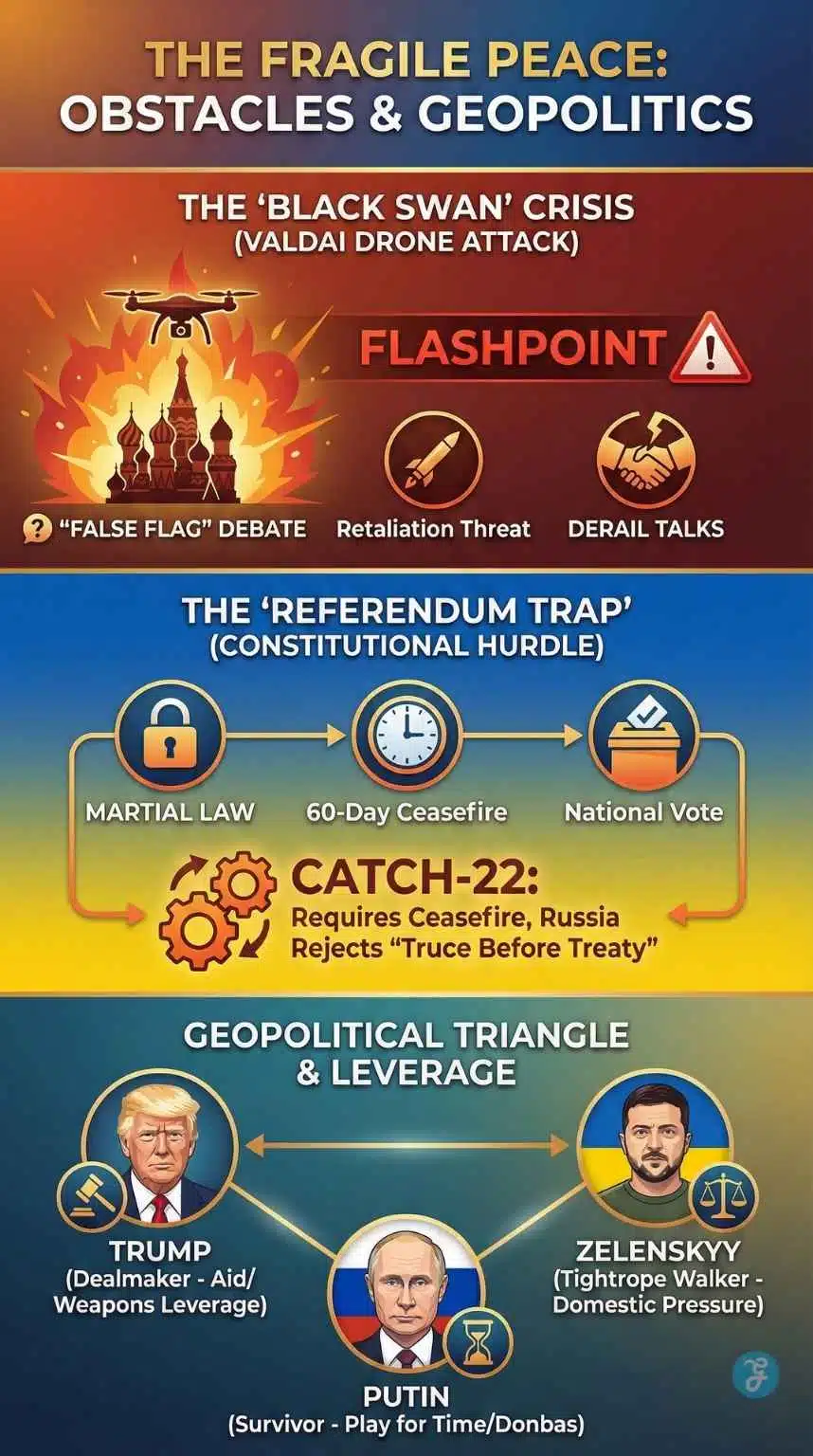
The Constitutional Crisis: Ukraine cannot hold a referendum under martial law.
-
The Timeline Clash: To lift martial law and organize a vote, Ukraine needs a 60-day ceasefire. Russia, fearing Ukraine will use this pause to re-arm and regroup, has historically rejected any “truce before treaty” arrangement.
The “Iron Curtain” of Annexation
While the FEZ solves the military status of the Donbas, it does not solve the legal status. Vladimir Putin amended the Russian constitution in 2022 to annex four Ukrainian regions. Walking this back is political suicide for the Kremlin; accepting it is political suicide for Bankova. The current draft uses “constructive ambiguity” language, but hardliners in Moscow are pushing for clarity that favors Russian sovereignty.
The Return of Domestic Politics: The “Post-War” Fight
If the guns stop, politics restarts.
The Rivals Emerging
Key figures like former General Valerii Zaluzhnyi (currently Ambassador to the UK) have remained quiet during the war. Analysts predict that the moment martial law is lifted for the referendum, a fierce political struggle will erupt.
The Narrative War
Opposition parties are expected to frame the “Free Economic Zone” as a “capitulation” and the 15-year security guarantee as a “paper shield,” potentially urging a “NO” vote in the referendum to topple the Zelenskyy government.
The “Black Swan”: The Valdai Drone Crisis
The trajectory of the war shifted violently yesterday, December 29. The alleged attack involving 91 long-range drones targeting the Valdai residence is a significant escalation.
-
The “False Flag” Debate: Zelenskyy’s administration has vehemently denied the strike, calling it a “manufactured crisis” designed by Moscow to sabotage the Mar-a-Lago progress.
-
The Threat: Russian Foreign Minister Sergei Lavrov’s statement that Russia is “revising its negotiating position” implies that Moscow may now demand more territory or harsher demilitarization terms as a “security buffer” for its leadership.
-
Imminent Danger: Intelligence agencies warn of a retaliatory “decapitation strike” against Kyiv’s government quarter within 48 hours. If such a strike occurs, the peace deal is likely dead.
The Geopolitical Triangle
-
Donald Trump: The US President is operating on a strict timeline. He views the peace deal as the crowning achievement of his first year in office. His leverage is blunt: he has reportedly told Putin that failure to sign will result in the release of “weapons systems currently withheld” to Ukraine, while telling Zelenskyy that refusal to compromise will end US aid.
-
Volodymyr Zelenskyy: The Ukrainian President is walking a tightrope between an exhausted population and a military that refuses to surrender land. He knows the US guarantee is his best hope for long-term survival, but the price—land and neutrality—is agonizingly high.
-
Vladimir Putin: The Russian President is playing for time. He likely views the “FEZ” as a temporary concession he can undermine later. However, the economic strain of a 4-year war and the recent drone scare have likely made the prospect of freezing the conflict appealing, provided he can sell it as a victory at home.
The “Justice Trade-Off”: Immunity vs. Accountability
This is the most emotionally charged part of the deal, often discussed only in hushed tones.
-
The ICC Problem: Vladimir Putin still has an active arrest warrant from the International Criminal Court (ICC). He cannot travel to signatory countries.
-
The Secret Clause: Leaks suggest the deal includes a “Head of State Immunity Protocol.” While it doesn’t cancel the ICC warrant (the US can’t force the ICC to do that), it effectively guarantees that the US and EU signatories will not enforce it during diplomatic summits.
-
The Backlash: Human rights groups are already preparing protests, calling this the “Impunity Clause,” arguing that trading justice for peace sets a dangerous precedent for future dictators.
The “China Factor”: Beijing’s Silent Veto
Beijing has remained officially silent on the “Free Economic Zone” proposal, but intelligence suggests Xi Jinping is watching the “Land-for-Peace” model closely as a blueprint for Taiwan.
-
The Precedent: If Russia is allowed to keep de facto control over annexed territory via a “demilitarized zone,” China may view this as a validation that territorial seizures can eventually be normalized by the West if the war of attrition is long enough.
-
The Supply Line: Crucially, US intelligence indicates that the sudden halt in Chinese “dual-use” component shipments to Russia in December 2025 was not a coincidence, but a quiet concession to Trump to allow the peace talks to proceed—a lever Beijing can pull back at any moment.
The Demographic “Black Hole”
A peace deal needs people to maintain it, and Ukraine is facing a crisis here.
-
The Return Rate: Of the ~8 million Ukrainians still abroad in Europe, polls in late 2025 show that only 40% intend to return immediately.
-
The Conflict of Interest: Surprisingly, allies like Poland and Germany are hesitant to push for mass repatriation. Their economies have absorbed the skilled Ukrainian workforce. The peace deal includes a “Human Capital Incentives” package—Western funding specifically to pay returning refugees a “resettlement bonus”—to prevent Ukraine from becoming a depopulated nation unable to rebuild itself.
The “Toxic Peace”: The Invisible Crisis
Even if the guns fall silent in January 2026, the land itself remains at war.
The Mining Threat
The 1,400-day conflict has turned Ukraine into the most mined country in human history. The “Free Economic Zone” is currently a death trap; demining estimates suggest it will take 30 to 50 years to make the agricultural land in the Donbas safe for farming again.
The “Red Forest” 2.0
Environmental assessments released this month show that heavy metal contamination (lead and mercury) from artillery duels in the east has poisoned the groundwater. The peace deal includes a “Green Recovery” fund, but experts warn that the ecological damage in the industrialized east may be irreversible, creating a “rust belt” that no treaty can heal.
Walking the Final Mile: The World Waits
As we look toward the Paris Summit in January 2026, three scenarios loom:
-
The Breakthrough: Cool heads prevail regarding the drone attack, and a “pre-ceasefire” is agreed upon to allow for Ukraine’s referendum process.
-
The Breakdown: A Russian retaliatory strike on Kyiv shatters the trust built at Mar-a-Lago, returning the war to high-intensity kinetic operations.
-
The Limbo: A “bad peace” is signed—the shooting stops, but the borders remain undefined and the underlying conflicts unresolved, turning Ukraine into a heavily armed, partitioned state.
For now, the world holds its breath. The deal is 95% done, but in war, the final 5% is always the hardest.
Frequently Asked Questions: The 2025 Peace Deal
1. Is the war actually over, or is this just a pause?
Technically, it is currently a “pause with intent.” If signed, the deal initiates a 60-day cooling-off period (Ceasefire Phase 1) to allow Ukraine to lift martial law and organize a national referendum. True “peace” only begins if the Ukrainian people vote “YES.” If they vote “NO,” the ceasefire dissolves, and the war likely resumes with even higher intensity.
2. Does Ukraine have to give up land to Russia under this plan?
On paper, no. In reality, it’s complicated. The “Free Economic Zone” (FEZ) proposal for the Donbas means Ukraine technically retains sovereignty (the map borders don’t change), but Kyiv withdraws its military and administrative control. It becomes a neutral, self-governing trade hub. Critics call this a “soft cession” of territory; supporters call it a necessary compromise to save the rest of the country.
3. If Russia attacks again in 5 years, will American soldiers fight?
No. The “15-Year Security Guarantee” is distinct from full NATO membership. It promises immediate US air support, naval intervention, and intelligence sharing, but explicitly excludes “boots on the ground.” The strategy is to make Ukraine a “porcupine”, so heavily armed during the peace that Russia can’t invade again, rather than relying on American infantry to defend it.
4. Why is the December 29 drone attack such a big deal?
Because of the target. Unlike previous strikes on oil depots, the alleged attack on Vladimir Putin’s Valdai residence is viewed by the Kremlin as an assassination attempt. This gives Russia a pretext to pause negotiations or launch a massive retaliatory strike on Kyiv’s government center (the Bankova). It has turned a diplomatic victory lap into a precarious standoff overnight.
5. What happens to the millions of Ukrainians currently living in Europe?
This is the silent crisis. The deal includes a “Human Capital Incentive” fund—essentially paying refugees a bonus to return home. However, with the Donbas turning into an economic zone and many cities still in ruins, early polling suggests less than 40% plan to return immediately. The fear is that Ukraine secures peace but faces a demographic collapse that makes rebuilding impossible.