

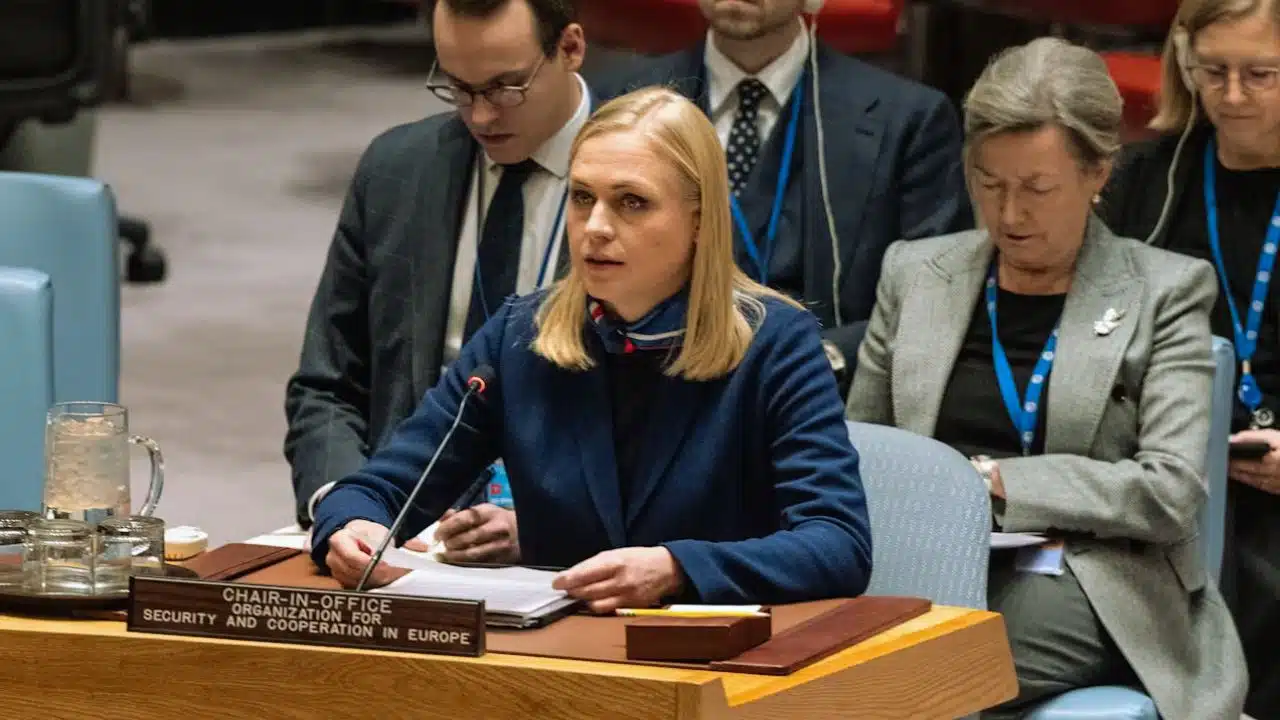
Finland has accused Russia of violating all ten core principles of the 1975 Helsinki Final Act through its full‑scale war against Ukraine and broader actions in Europe.
Speaking to the UN Security Council in early December 2025 as Chairperson‑in‑Office of the OSCE, Finnish Foreign Minister Elina Valtonen said Russia’s conduct breaches commitments on sovereignty, territorial integrity, non‑use of force, human rights, and cooperation that underpin the European security order.
Her remarks mark one of the strongest public condemnations yet by a NATO member bordering Russia and come as tensions remain high over the Ukraine war, closed border crossings, and competing narratives about who is undermining the “Helsinki spirit” of East‑West cooperation.
Finland’s Statement at the UN
Addressing the UN Security Council, Valtonen argued that Russia’s invasion of Ukraine, ongoing attacks, and attempts to redraw borders by force are incompatible with every single principle agreed in Helsinki fifty years ago. She linked those principles directly to the UN Charter, stressing that the Helsinki framework was designed to prevent exactly the kind of large‑scale aggression Europe is now witnessing in Ukraine.
Valtonen spoke in her dual role as Finland’s foreign minister and as Chairperson‑in‑Office of the Organization for Security and Co‑operation in Europe (OSCE), giving the comments additional institutional weight. The OSCE, whose roots lie in the Conference on Security and Co‑operation in Europe (CSCE) process launched by the Helsinki Accords, continues to monitor and document violations of international humanitarian and human rights law in the context of the Ukraine conflict.
What the Helsinki Principles Are
The Helsinki Final Act, signed in 1975 by 35 states including the Soviet Union, the United States and most European countries, set out ten principles to guide relations between participating states. These principles include sovereign equality of states, the non‑use of force, inviolability of frontiers, territorial integrity, peaceful settlement of disputes, non‑intervention in internal affairs, respect for human rights, self‑determination of peoples, cooperation among states, and good‑faith fulfillment of international obligations.
Together, these commitments became known as the “Helsinki Decalogue” and formed the political foundation for what later became the OSCE. While the accords were not a legally binding treaty, they created strong political norms that helped stabilize Cold War Europe and later supported democratic transitions and conflict‑prevention work across the continent.
How the Ukraine War Led to This Accusation
According to Finland and other Western governments, Russia’s 2014 annexation of Crimea and its full‑scale invasion launched in February 2022 violated core Helsinki principles on territorial integrity, inviolability of borders, and the prohibition of using force against another participating state. OSCE and UN reporting has documented extensive Russian attacks on civilian areas, arbitrary detentions, and other serious abuses, which Finland says further breach commitments on human rights and humanitarian law embedded in the Helsinki framework.
Valtonen told the Security Council that Russia’s attempt to impose its will on Ukraine by military means runs directly against the principle of sovereign equality and the right of each state to choose its own alliances. The accusation also reflects a broader concern in Helsinki and other European capitals that Russia is challenging the post‑Cold War security order not only through the war itself, but also through longer‑term pressure on neighboring states.
Finland’s Own Security Shift and Border Tensions
Finland has dramatically reshaped its own security posture since Russia’s full‑scale invasion of Ukraine, abandoning decades of military non‑alignment and joining NATO in 2023. The country, which shares a more than 1,300‑kilometer land border with Russia, argued that Alliance membership was necessary to deter potential aggression and respond to a more unpredictable regional environment.
At the same time, Helsinki has repeatedly closed its eastern land border to most passenger traffic, accusing Russia of orchestrating flows of asylum seekers toward Finnish crossing points in a hybrid operation designed to create instability. In April 2025, the Finnish government decided to keep the border closed until further notice, citing ongoing security concerns over what it described as instrumentalised migration from Russian territory.
Moscow’s Response: Counter‑Accusations Over Helsinki
Russia has strongly rejected Finland’s claim that it has violated all Helsinki principles, with Foreign Ministry spokeswoman Maria Zakharova calling such statements a blatant lie. In public comments and social media posts, Zakharova has instead accused Western states of breaching the Helsinki Act for decades through military interventions, recognition of breakaway territories, and what Moscow portrays as interference in other countries’ domestic politics.
Citing examples such as NATO’s 1999 bombing campaign in Yugoslavia, the 2008 recognition of Kosovo’s independence, and Western support for the 2014 Maidan uprising in Ukraine, Russia argues that it is the West, not Moscow, that has undermined the principle of non‑use of force and respect for sovereignty. These counter‑accusations show that the meaning of the Helsinki principles has become a central battleground in the information war over who is responsible for eroding European security norms.
Key Dates in the Helsinki–Finland–Russia Story
| Date | Event | Location | Significance |
| 1 August 1975 | Signing of the Helsinki Final Act by 35 states | Helsinki, Finland | Establishes ten guiding principles for relations between participating states, forming the basis of the CSCE and later the OSCE. |
| 2014 | Russia’s annexation of Crimea | Ukraine | Widely condemned as a breach of territorial integrity and inviolability of borders, contradicting Helsinki commitments. |
| February 2022 | Russia launches full‑scale invasion of Ukraine | Ukraine | Triggers the largest war in Europe in decades and sets the stage for Finland’s later accusation that all Helsinki principles have been violated. |
| May 2022–April 2023 | Finland applies to join and formally enters NATO | Helsinki / Brussels | Ends Finland’s long‑standing military non‑alignment and aligns its security directly with the Alliance in response to Russian aggression. |
| November–December 2023 | Finland closes all land border crossings with Russia | Eastern Finland–Russia frontier | Helsinki cites instrumentalised migration and hybrid pressure from Russia; closures are extended repeatedly into 2024. |
| 16 April 2025 | Finland decides to keep eastern border closed until further notice | Helsinki | Government says security risks linked to Russia‑origin migration flows remain too high to reopen crossings. |
| October 2025 | Finnish foreign minister publicly says Russia has breached all ten Helsinki principles | Various public statements | Marks a tougher Finnish line, framing Russia’s conduct as a systematic rejection of the Helsinki order. |
| 7–8 December 2025 | Valtonen tells UN Security Council Russia has violated every Helsinki principle | New York, UN HQ | As OSCE Chairperson‑in‑Office, she carries the accusation into the UN, linking the Helsinki Decalogue and UN Charter norms. |
Why the Dispute Matters for European Security
The clash over the Helsinki principles is not only symbolic; it goes to the heart of how European states understand their security, borders, and rights to choose alliances. For Finland and many of its partners, Russia’s actions in Ukraine show that a major power is willing to discard long‑standing political commitments against using force to change borders, raising fears for other countries along NATO’s eastern flank.
For Moscow, framing the West as the primary violator of Helsinki norms supports its narrative that current European security structures are biased and that NATO expansion itself undermines the principle of indivisible security. This narrative is likely to shape Russian diplomacy within the OSCE and the UN, complicating efforts to revive meaningful arms‑control talks or negotiate new confidence‑building measures.
What Comes Next
Looking ahead, the argument over who is upholding or breaking the Helsinki principles will continue to play out in three main arenas: the battlefield in Ukraine, diplomatic forums such as the OSCE and the UN, and the day‑to‑day security policies of states bordering Russia. Finland’s decision to join NATO, close its border crossings, and speak out forcefully at the UN suggests that it sees the Helsinki framework not as an abstract document but as a benchmark against which to judge concrete behavior.
Unless there is a substantial change in Russia’s conduct in Ukraine or a broader political settlement, the practical relevance of the Helsinki principles will depend less on formal declarations and more on how states act to defend sovereignty, human rights, and the non‑use of force in Europe. For now, Finland’s accusation that Russia has violated every one of those principles underscores just how far the continent has moved from the cooperative spirit that defined Helsinki in 1975.





















