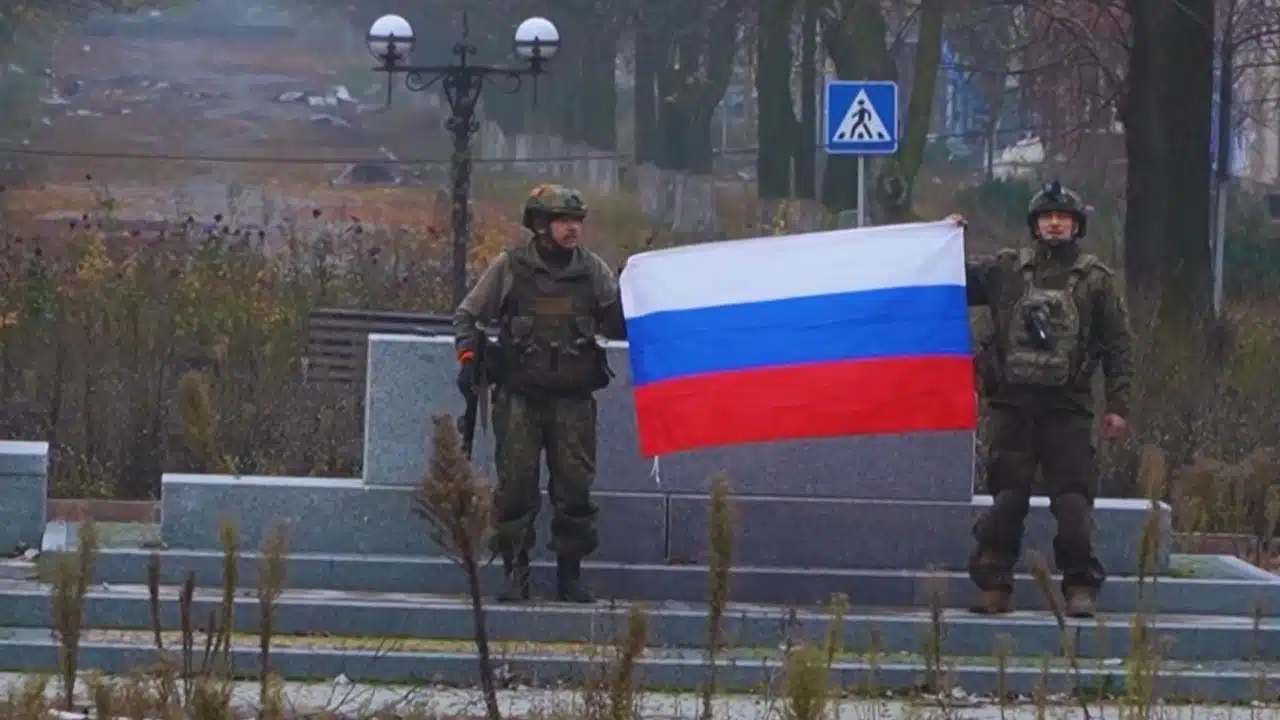
Russia escalated its battlefield messaging on Monday by declaring that its forces had captured two strategically important Ukrainian cities—Pokrovsk in the Donetsk region and Vovchansk in the Kharkiv region. The announcements were presented as major advances in Moscow’s months-long campaign to push deeper into Ukrainian defensive lines.
Kremlin spokesperson Dmitry Peskov said that Russia’s Chief of the General Staff, Valery Gerasimov, delivered the update directly to President Vladimir Putin during the president’s Sunday visit to a command post overseeing operations. Russian state media released carefully edited footage that appeared to show Russian soldiers raising a flag in Pokrovsk’s central square, portraying the moment as a symbolic victory.
However, Ukrainian officials quickly rejected the claims as premature and politically timed. Ukraine’s 7th Rapid Response Corps of the Air Assault Forces stated that Ukrainian defenders “continue to hold back” advancing Russian units in Pokrovsk and that active, intense fighting remains underway in and around the city. Ukrainian field commanders have stressed that although Russian units have edged closer to key districts, they have not secured full control, and Ukrainian forces are still positioned in several neighborhoods, logistical nodes, and defensive lines that remain contested.
Independent soldiers and analysts with knowledge of the battlefield also indicated that Russia’s announcement does not match the reality on the ground. They observed that Russian troops have made incremental gains in both cities but that the situation is far from settled. Throughout the conflict, Russia has repeatedly issued early declarations of victory in cities that remained highly contested for days or even weeks afterward. This pattern is consistent with its wartime communications strategy, which often blends military updates with political messaging aimed at creating pressure or influencing negotiation timelines.
Russia’s decision to release the claims shortly before major diplomatic engagements raised further questions. The announcement came just 24 hours before U.S. special envoy Steve Witkoff was scheduled to arrive in Moscow to meet Putin and discuss the Trump administration’s evolving peace proposal, adding an unmistakable layer of political timing to Moscow’s military narrative.
Ukraine Accuses Russia of Using Battlefield Claims to Influence Diplomacy
Ukrainian officials responded swiftly, stating that Russia’s declarations were part of a broader attempt to manipulate international perception ahead of renewed peace talks. Andriy Kovalenko, who heads Ukraine’s Center for Countering Disinformation, warned that Russia would likely engage in “many attempts to apply pressure on the front line over the next weeks and accompany this with loud statements.” According to him, these messages are deliberately crafted “for a Western audience” to heighten diplomatic pressure and present Russia as negotiating from a position of battlefield strength.
Ukraine’s military also highlighted the level of ongoing combat, reporting 43 Russian attacks in the Pokrovsk sector on Monday alone. These assaults ranged from infantry pushes to armored advances and precision strikes, underscoring that Russia’s claim of full control does not align with the active resistance and heavy fighting still taking place. Commanders have emphasized that Ukrainian forces continue to rotate additional units into the area to reinforce defensive positions and maintain supply routes into contested districts.
For Ukrainian leaders, Moscow’s announcements serve a dual purpose: shaping international perception and attempting to weaken Ukraine’s leverage in upcoming diplomatic negotiations. Kyiv views these tactics as a familiar pattern—Russia often pairs battlefield claims with broader diplomatic maneuvers, especially ahead of talks that could influence territorial discussions, ceasefire parameters, or recognition of occupied regions.
Independent military observers have also noted this trend. They have suggested that Russia’s messaging strategy frequently aims to create momentum or signal inevitability, even when actual battlefield conditions do not fully support that narrative. Ukrainian intelligence services continue to monitor Russian information operations closely, anticipating that Moscow will amplify similar claims in the coming weeks as negotiations draw nearer.
Strategic Importance of Pokrovsk and Vovchansk in the Wider War
The two cities at the center of Monday’s claims—Pokrovsk and Vovchansk—play significantly different but deeply interconnected roles in the broader conflict, making them key targets for Russian forces and vital defensive points for Ukraine.
Pokrovsk, located in the western part of the Donetsk region, has long been considered a crucial transportation and logistics hub. Before the war, the city had a population of roughly 60,000 and functioned as a prominent rail and road intersection linking Ukrainian positions across Donetsk and neighboring regions. For more than 20 months, Russian forces have attempted to encircle or breach Pokrovsk’s defenses. If Russia were to secure the city fully, it would gain a staging ground for further operations to the northwest and west, potentially threatening key Ukrainian positions and complicating Ukraine’s ability to maintain supply routes into several contested towns.
The city’s fall would also carry symbolic weight, as Pokrovsk has remained one of the most significant Ukrainian-controlled urban centers in Donetsk despite prolonged Russian offensives. Its defense has been central to Ukraine’s broader strategy of preventing Russia from consolidating territorial gains and achieving a clear breakthrough in the region.
Vovchansk, on the other hand, sits near Ukraine’s northeastern border with Russia and has been repeatedly targeted since early in the war. The city’s proximity to major transport corridors and its location along the route toward Kharkiv, Ukraine’s second-largest city, make it a critical buffer zone. For Russia, controlling Vovchansk would provide a direct line of approach toward northern Kharkiv and could allow Moscow to apply additional pressure on Ukrainian defenses while forcing Kyiv to divert troops to the region.
Despite Russia’s claims, Ukrainian forces maintain defensive positions in both cities, often shifting tactics between urban defense, counter-assault operations, and controlled withdrawals from high-risk areas. Soldiers on the ground have reported intense street-to-street engagements, heavy artillery exchanges, and the use of drones on both sides to track movements and strike targets. These conditions underscore the fluid and highly contested nature of the battlefields Russia now claims to have secured.
Diplomatic Activity Intensifies as Both Sides Position Ahead of Peace Talks
Monday’s announcements did not occur in isolation—they coincided with a series of significant diplomatic events involving Ukraine, its Western allies, and the United States.
Ukrainian President Volodymyr Zelenskyy met French President Emmanuel Macron in Paris on the same day, discussing security guarantees, military assistance, and Europe’s united approach to the upcoming negotiations. France continues to play an influential role in coordinating European support for Ukraine, and the meeting highlighted the urgency felt across European capitals as momentum builds toward new dialogue in Moscow.
Meanwhile, discussions held a day earlier in Florida between U.S. and Ukrainian officials led Zelenskyy to say that the revised U.S. peace plan “looks better” than earlier versions. He acknowledged, however, that the issue of territorial sovereignty remains the hardest and most sensitive point in negotiations. Ukraine’s constitution prohibits ceding territory, and Zelenskyy has repeatedly stated that any agreement must protect Ukraine’s internationally recognized borders.
Despite these challenges, the White House struck an optimistic tone. Press secretary Karoline Leavitt noted that the Trump administration is “very optimistic” about reaching an agreement to end the war, though officials stopped short of suggesting that a breakthrough is imminent. Diplomatic experts say both sides are maneuvering to strengthen their positions before talks resume, making Russia’s battlefield claims part of a broader political calculus.
Tuesday’s scheduled meeting between President Putin and U.S. envoy Steve Witkoff is expected to set the tone for the next phase of negotiations. Whether Russia’s latest declarations reflect tangible military progress or strategic messaging remains a central question—one that will weigh heavily on the atmosphere surrounding the discussions in Moscow.