

A new three-person crew is preparing to begin their journey to the International Space Station (ISS) on Thanksgiving morning, marking another important step in ongoing international space cooperation. The mission will send NASA astronaut Chris Williams and Roscosmos cosmonauts Sergey Kud-Sverchkov and Sergei Mikayev to join the station’s Expedition 73 team. Their launch is scheduled for 4:27 a.m. ET on Thursday, taking off from the historic Baikonur Cosmodrome in Kazakhstan, the world’s oldest and most active space launch site.
The crew will travel aboard the Roscosmos Soyuz MS-28 spacecraft, a proven vehicle known for transporting astronauts and cosmonauts safely to and from orbit. After liftoff, the spacecraft will follow a fast-track journey that lasts just over three hours, completing two orbits around Earth before automatically docking with the ISS at about 7:38 a.m. ET. Soon after docking, mission controllers will give the go-ahead for hatch opening, allowing the new arrivals to be welcomed aboard the station by the current crew.
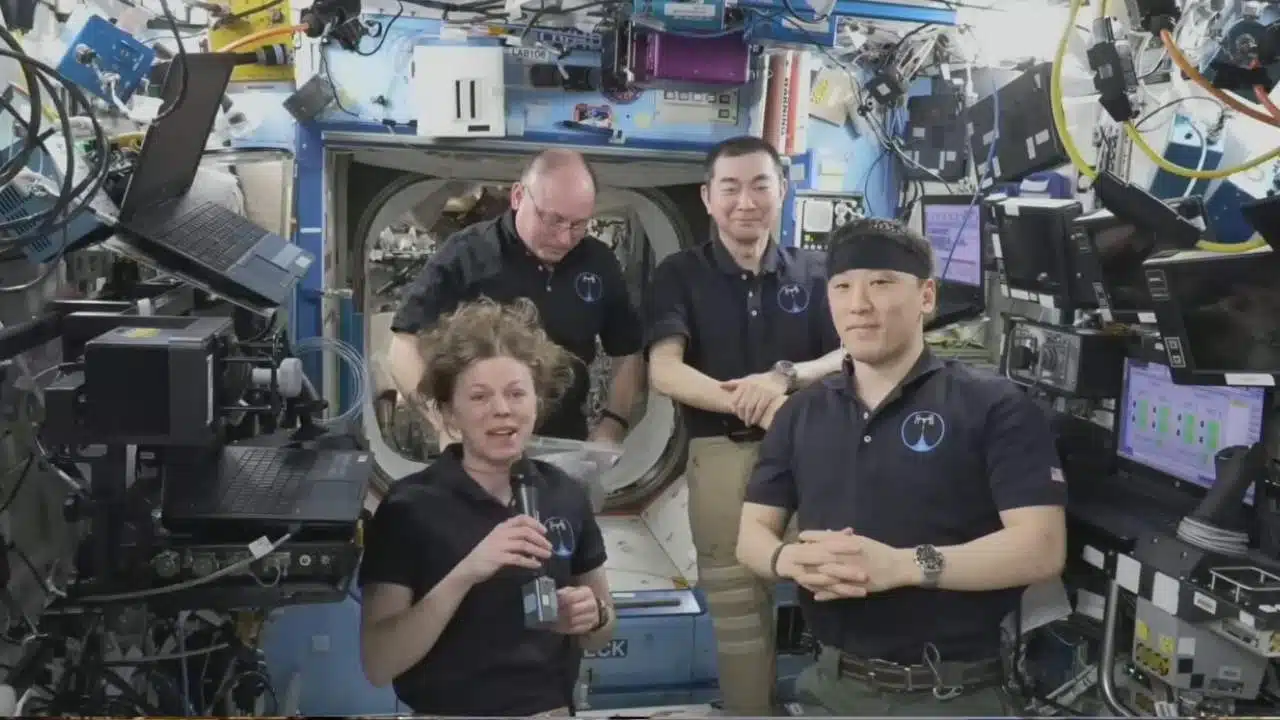
This Thanksgiving-day launch will add three new members to an already diverse team living and working in microgravity. The station is currently home to NASA astronauts Mike Fincke, Zena Cardman, and Jonny Kim, Japanese astronaut Kimiya Yui from JAXA, and Russian cosmonauts Sergei Ryzhikov, Alexey Zubritsky, and Oleg Platonov. Together they manage a wide range of scientific experiments, station maintenance, and technology demonstrations that support long-term human spaceflight.
For NASA astronaut Chris Williams, this journey marks his first ever trip to space. A physicist and medical imaging expert, Williams brings a strong research background to his role as a flight engineer. Cosmonaut Sergei Mikayev is also embarking on his first space mission, while Sergey Kud-Sverchkov returns to orbit for the second time, adding experience and continuity to the crew.
During their approximately eight-month stay aboard the ISS, the trio will support Expeditions 73 and 74, contributing to some of NASA and Roscosmos’ most important ongoing space studies. Williams, in particular, will be involved in high-value scientific research and the testing of new technologies aimed at improving the safety and sustainability of future space missions. One of his major assignments includes installing and evaluating a new modular exercise system, designed to maintain astronaut health on long-duration missions. Physical fitness is one of the most crucial challenges in space, where microgravity can weaken muscles and bones. Testing improved workout systems helps scientists better prepare crews for longer journeys, including future lunar and Mars missions.
Another focus of the mission is experimenting with cryogenic fuel efficiency, a key area of research for future deep-space missions. Cryogenic fuels power many rockets, and improving how they are stored and used could make long-distance missions safer, more efficient, and more cost-effective. Williams and his crewmates will also contribute to experiments that involve growing semiconductor crystals in microgravity. The station’s gravity-free environment allows crystals to form more uniformly, providing insights that could influence future materials science, electronics manufacturing, and high-precision technologies on Earth.
In addition to scientific work, Williams will help test new re-entry safety protocols—procedures that improve how spacecraft return safely through Earth’s atmosphere. These protocols will play an important role in the next generation of crew vehicles, especially as NASA prepares for more frequent lunar missions under the Artemis program.
This Thanksgiving launch is also a significant reminder of the international partnership that keeps the ISS running. Despite geopolitical tensions on the ground, the collaboration between NASA and Roscosmos continues in orbit, where cooperation is essential to maintain the station and advance scientific discovery. Sending an American astronaut to the ISS aboard a Russian spacecraft reflects how space age ncies can work together to achieve shared goals, even during complex global circumstances.
As the Soyuz MS-28 spacecraft lifts off before sunrise on Thanksgiving morning, it symbolizes not only human curiosity and scientific ambition but also the enduring spirit of global teamwork in space exploration. The mission strengthens the continuity of operations aboard the ISS and adds new scientific potential for the months ahead.






















