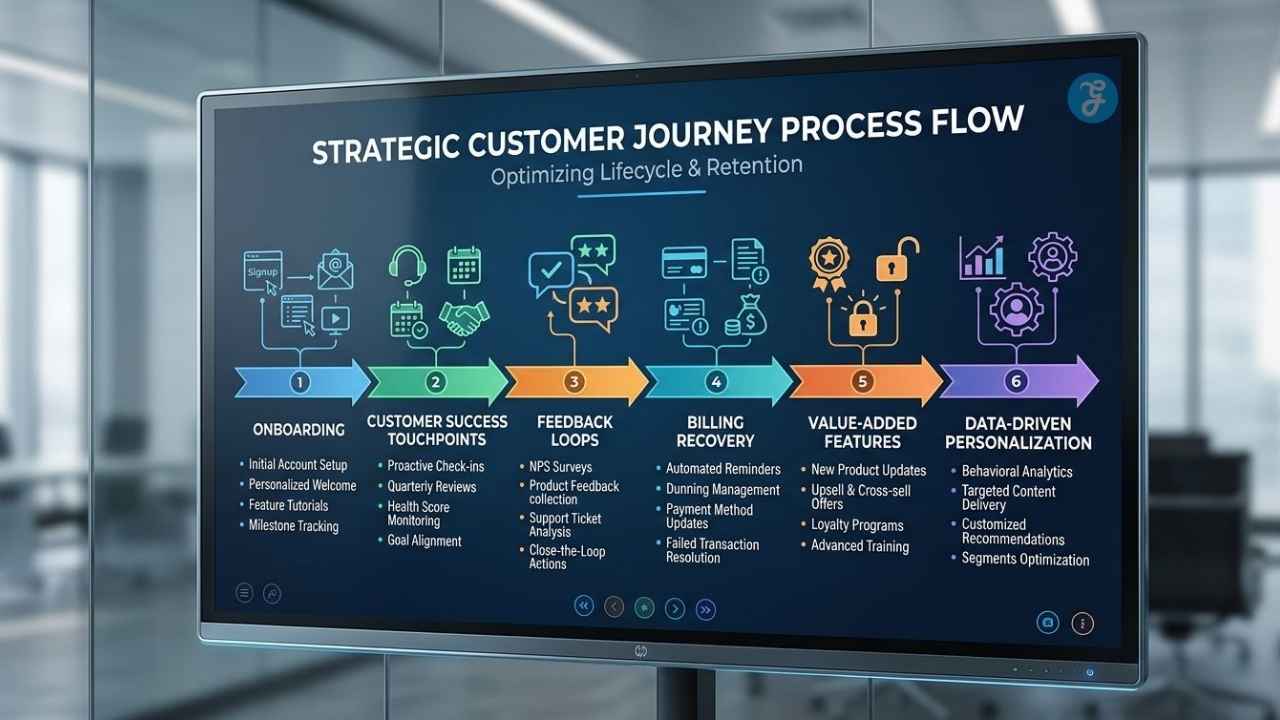
Is your mature SaaS product still growing, but customer retention feels softer than it should? I see that pattern all the time in B2B SaaS teams, new logos arrive, then churn quietly drags down recurring revenue.
I use cohort analysis, in-app experiments, billing data, and customer interviews to find the real leak. In mature products, the fastest gains usually come from fixing the moments that make a new customer stall, an existing customer go quiet, or a payment fail.
Read on.
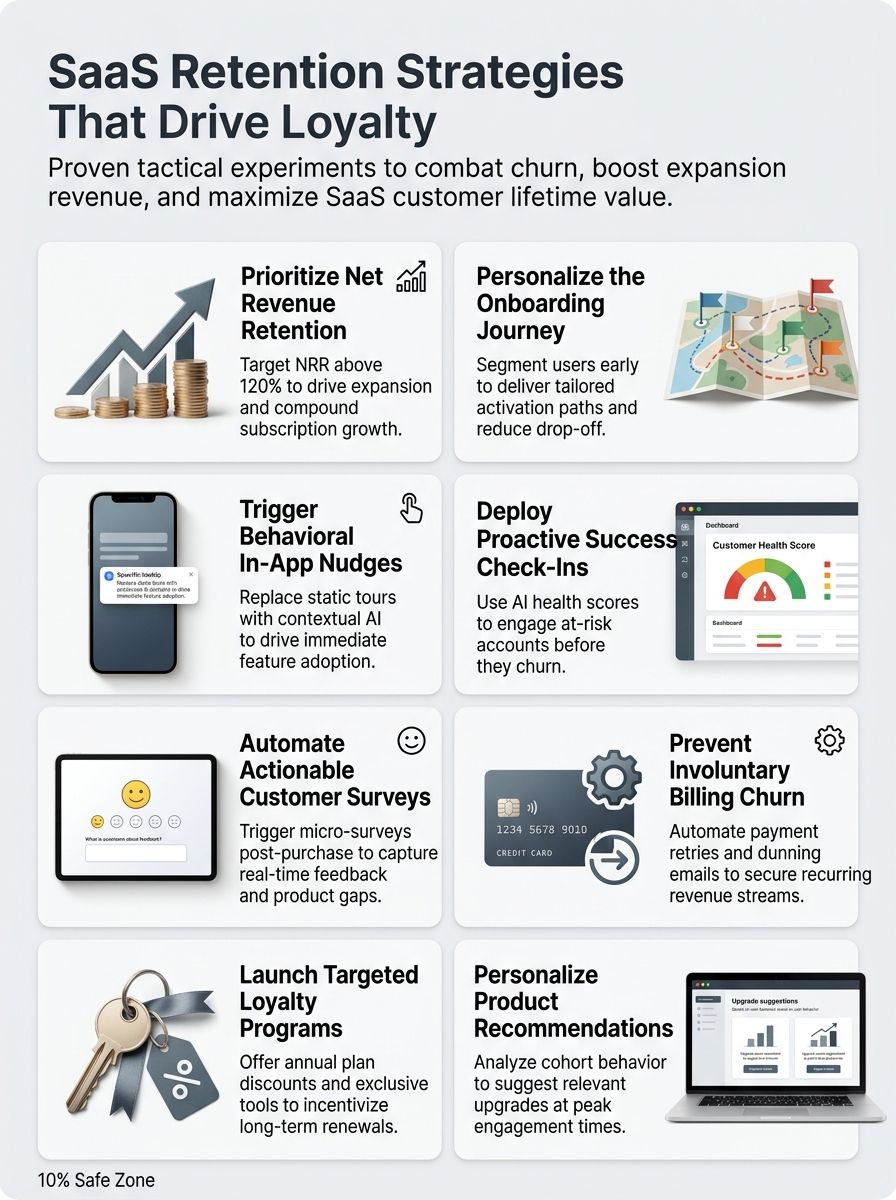
The Importance of Retention in Mature SaaS Products
Retention drives the whole subscription model. In SaaS Capital’s April 2026 survey of more than 1,000 private B2B SaaS companies, bootstrapped firms in the $3 million to $20 million ARR band posted median net revenue retention of 103% and gross revenue retention of 91%. I use that as a quick reality check: if net revenue retention is below 100%, new sales are doing cleanup work instead of creating real SaaS growth.
Benchmarkit’s 2026 B2B SaaS metrics report makes the next point clear too: expansion now contributes 40% of net new ARR at the median, and usage-based pricing models showed 108% NRR versus 98% for seat-only models. Mature SaaS customer retention is no longer just about stopping loss. It is about building a product and pricing structure that lets good accounts expand naturally.
- Retention compounds revenue. A saved account keeps paying this month, renews later, and can still upgrade.
- Retention improves acquisition efficiency. Better renewal and expansion rates shorten the time it takes to earn back sales and marketing spend.
- Retention protects product focus. Teams with stable cohorts can invest in better features instead of emergency churn fixes.
- Retention makes forecasting cleaner. MRR movements become easier to explain when contraction and involuntary churn are under control.
That is why I treat customer retention strategy as an operating system, not a side project. Every experiment below is meant to move a real business metric, not just make the dashboard look busy.
Identifying Core Retention Metrics
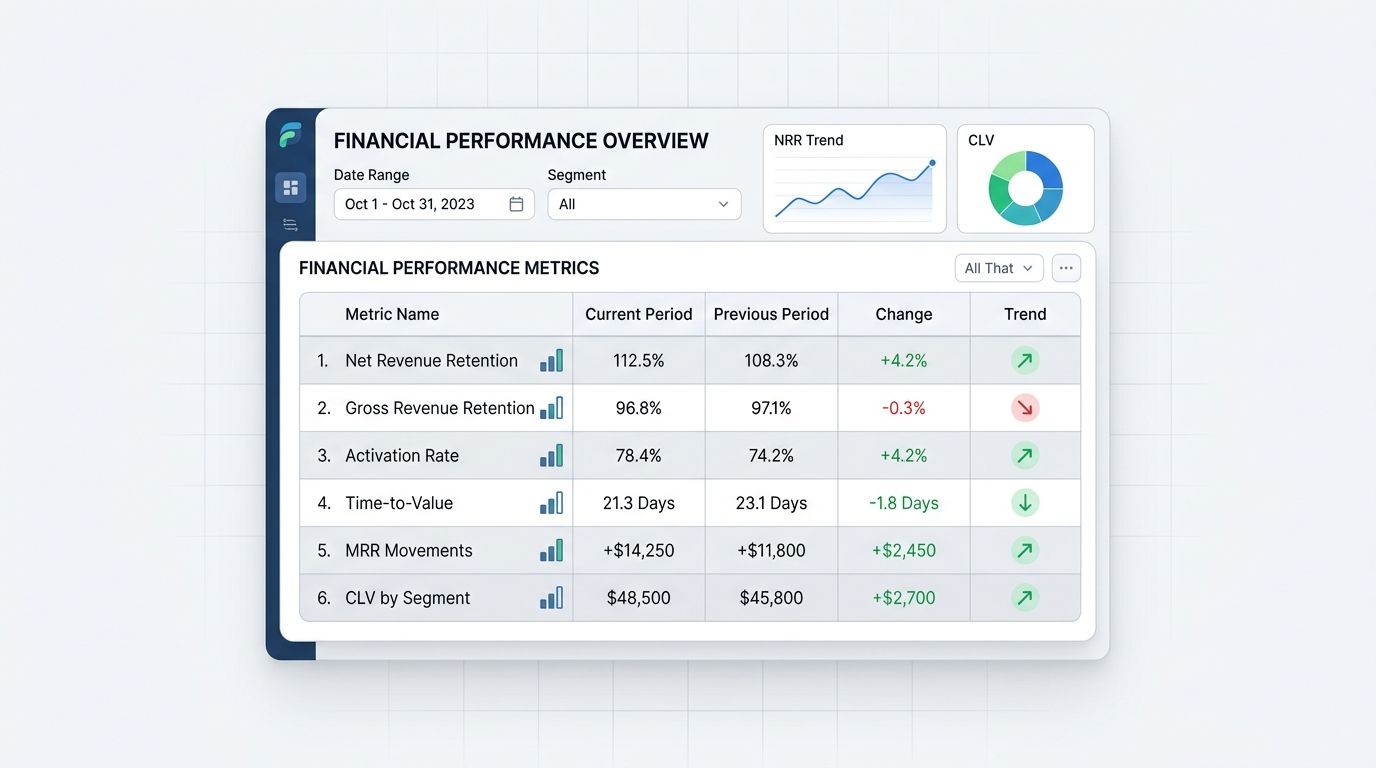
I keep a small metric set on one page. If a number does not point to a decision, it does not stay on my retention dashboard.
| Metric | What I watch | Why it matters | What I do next |
|---|---|---|---|
| Net Revenue Retention | Revenue kept from the same customer base after expansion, contraction, and churn | Shows whether the base is compounding or shrinking | Check pricing, expansion triggers, and at-risk segments |
| Gross Revenue Retention | Revenue kept before upsells | Stops expansion from hiding real customer loss | Audit churn reasons, onboarding gaps, and product fit |
| Activation Rate | Share of new accounts that hit the first real value event | Early activation is one of the strongest predictors of SaaS retention | Shorten setup and remove low-value steps |
| Time-to-Value | Days or minutes until a user completes the first useful workflow | Long setup creates silent churn before renewal ever shows up | Rebuild onboarding around one clear win |
| MRR Movements | New, expansion, contraction, churn, and reactivation | Shows exactly where recurring revenue is moving | Separate voluntary loss from billing failure and product friction |
| CLV by segment | Lifetime value for each persona, channel, and plan | Helps me decide which accounts deserve higher-touch retention work | Prioritize onboarding and success coverage by segment value |
Net Revenue Retention (NRR)
NRR is my anchor metric for a SaaS business. It tells me whether the same customer base is flat, shrinking, or expanding. Once NRR pushes past 100%, retention work starts to create leverage. Once it moves toward 110% and above, the account base is doing real expansion work for the business.
I never read NRR alone. A healthy number with weak gross retention can mean a few large expansions are masking deeper churn underneath.
Monthly Recurring Revenue (MRR) Movements
I split MRR changes into five buckets: new business, expansion, contraction, churn, and reactivation. That sounds simple, but it changes how fast a team can act. If contraction comes from underused seats, I change packaging or outreach. If lost MRR is tied to failed payments, I fix billing before I touch the product.
OpenView’s 2022 PLG benchmark work still gives a useful activation reference point: 20% to 40% activation is a normal range. If fewer than one in five trial accounts reaches your first value event, I assume the onboarding process is the first problem to solve.
Customer Lifetime Value (CLV)
CLV only becomes useful when I break it down by segment. A blended CLV number hides too much. Enterprise admins, team managers, and end users behave differently, adopt different features, and churn for different reasons.
That is why I pair CLV with customer data like persona, plan type, source, implementation path, and usage depth. It tells me where a personal customer success touchpoint is worth the cost and where self-serve retention strategies are enough.
Retention Experiment #1: Optimizing Customer Onboarding

For mature SaaS products, onboarding usually is not broken everywhere. It breaks at one hard step, data import, teammate invite, integration setup, admin approval, or first report creation. Fix that moment first.
Streamlining the onboarding process
Intercom’s current guidance is helpful here: product tours work best for short tasks completed inside the product. If setup runs longer or depends on an integration, I stop forcing a long tour and switch to a brief in-app prompt plus a help article or a human handoff.
- Define one activation event: Pick the action that proves value, such as importing data, inviting a teammate, or publishing the first workflow.
- Cut signup friction: Remove fields that do not help provisioning, routing, or compliance. Every extra decision slows Time-to-Value.
- Use behavior-based guidance: Show the next step after a real action, not as a generic tour everyone must click through.
- Break long setup into checkpoints: “Connect source,” “invite team,” and “run first output” are easier to finish than one giant onboarding task.
- Add billing and identity checks early: Verify payment status, email domain, and account role before the user reaches a dead end.
- Instrument every step. I want a funnel report that shows exactly where trial accounts drop off by segment.
Personalized onboarding for different user segments
Auth0’s current onboarding form template gives a clean example of what good routing looks like. It can branch the flow based on whether the person signs up as a business or an individual, which is useful for SaaS companies that need different provisioning paths. Its organization login flow can also route users by email domain, showing enterprise identity options to the right people and falling back to a standard login when the domain does not match.
That matters because a small self-serve team and a large security-conscious buyer should not see the same first-run experience. I usually split onboarding into at least three tracks:
- Self-serve users: fast activation, checklists, and clear in-app nudges.
- Team buyers: collaboration setup, role permissions, and invite workflows.
- Enterprise admins: SSO, security settings, domain routing, and implementation help.
Once those paths are separate, customer retention gets easier because each segment sees the shortest path to value instead of the noisiest one.
Retention Experiment #2: Proactive Customer Engagement
Proactive engagement beats reactive support almost every time. Salesforce’s 2024 State of Service research found that 73% of business buyers want companies to predict their needs before they arise, yet only a third think companies actually do it well. That gap is where a mature SaaS operator can win.
Using in-app messaging to guide users
I use in-app messaging to move users to the next milestone, not to broadcast announcements. The best message is short, timely, and tied to a real product signal.
- Trigger a message after the first successful setup step, so the user sees the next best action while momentum is high.
- Prompt inactive trial users with one clear task, not a list of features.
- Show admins different guidance than end users, especially for permissions, billing, and reporting.
- Surface upgrade prompts only when usage or limits make the offer obvious.
- Route high-value friction to customer success fast, instead of hiding behind a help article.
Intercom Outbound is a good example of the model I like. It lets teams target tours, checklists, and in-app messages using live behavioral data and product usage, which is exactly how proactive customer engagement should work in B2B SaaS.
Regular check-ins from customer success teams
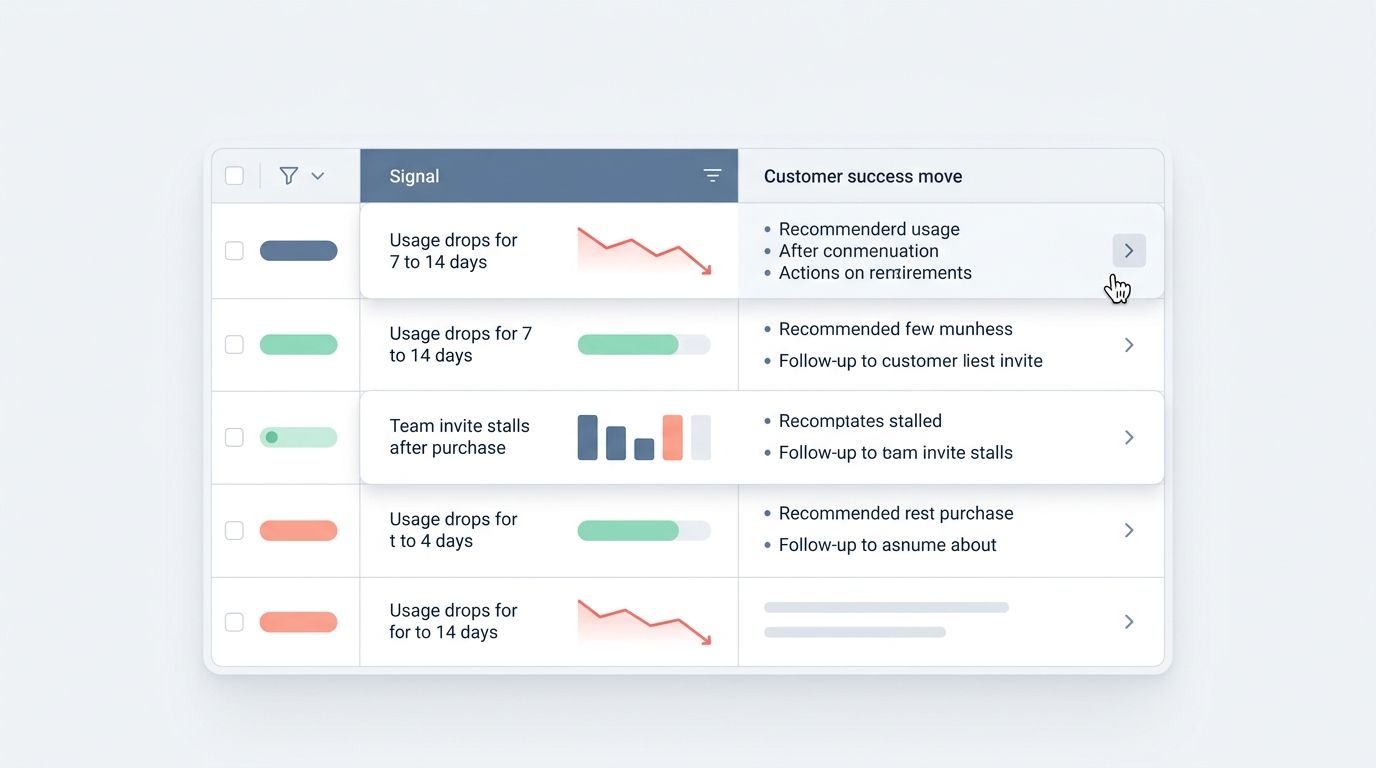
I still like human check-ins for mature accounts, but I do not schedule them blindly. The timing should follow risk signals or expansion signals.
| Signal | Customer success move | Why it helps retention |
|---|---|---|
| Usage drops for 7 to 14 days | Send a short check-in and offer a workflow review | Catches silent churn before renewal risk grows |
| Team invite stalls after purchase | Offer a setup session for admins | Multi-user adoption usually improves stickiness |
| Feature usage spikes | Share best practices and premium options | Turns adoption into expansion without forced selling |
| Support tickets cluster around one task | Book a guided fix and update the onboarding path | Reduces repeat friction across the whole cohort |
| Renewal window opens | Review outcomes, wins, and next use cases | Positions renewal as a value recap, not a billing event |
The key is simple: customer success should respond to signals, not calendars. That gives proactive retention strategies a measurable purpose.
Retention Experiment #3: Leveraging Customer Feedback

Customer feedback only helps if it changes behavior inside the company. I want feedback loops that move product, onboarding, or support within the same operating cycle.
Deploying surveys and feedback loops
- Survey after a real milestone: I prefer a short in-app question after first value, first report, or first renewal.
- Ask one diagnostic question first: “What almost stopped you?” is often more useful than a long satisfaction form.
- Separate onboarding feedback from renewal feedback: Early friction and late-stage value gaps are different problems.
- Tag every response: I map replies to setup friction, feature gap, pricing confusion, support quality, or billing pain.
- Close the loop: If a customer flags a fixable problem, someone should answer and tell them what changed.
The most common failure is not low survey volume. It is collecting feedback and never turning it into a product or success action.
Prioritizing user-requested features
I do not ship features by loudest voice or largest logo alone. Atlassian describes Jira Product Discovery as a place to gather opportunities, problems, and customer insights in one place, then score them with custom fields and formulas. That is close to the system I want.
For every new feature request, I score four things:
- How often the request appears across accounts.
- How much ARR is at risk if it stays unresolved.
- Whether the feature would improve activation, usage depth, or renewal odds.
- How much engineering effort it will actually take.
This keeps customer feedback tied to retention metrics instead of turning into a random backlog pile.
Retention Experiment #4: Reducing Involuntary Churn
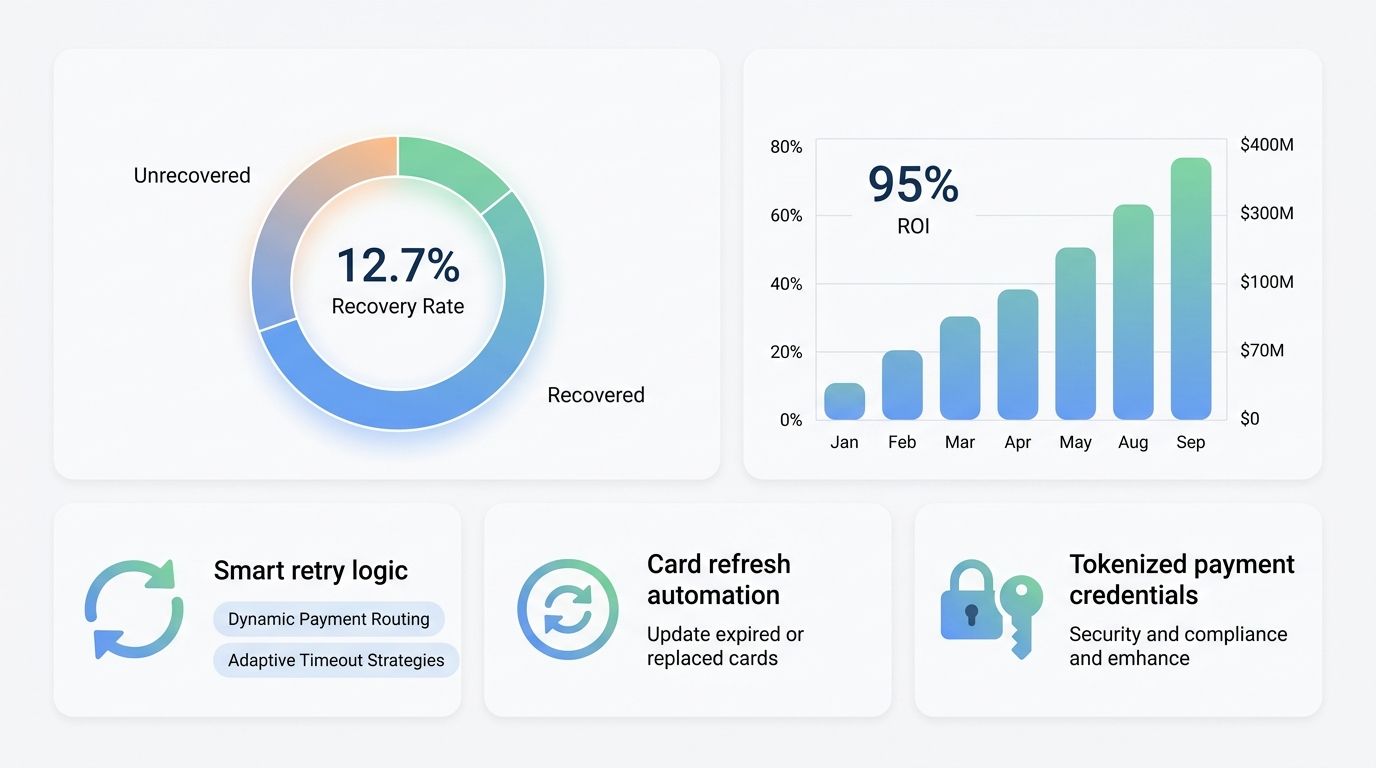
This is one of the cleanest retention wins in mature SaaS. Baremetrics reported in June 2026 that a sample of 119 typical US B2B SaaS companies recovered failed payments at a median attempted recovery rate of 12.7% in a single month, and 95% saw the tool pay for itself within month one. If your billing stack is messy, this experiment can move revenue fast.
| Tactic | Named example | Why it reduces churn |
|---|---|---|
| Smart retry logic | Stripe Smart Retries | Retries failed subscription charges at better times instead of on a fixed, blunt schedule |
| Card refresh automation | Stripe card account updater | Keeps recurring charges working after card replacement or expiration |
| Tokenized payment credentials | Stripe network tokens | Improves acceptance and reduces interruptions when saved card details change |
| Alternative recurring payment rail | ACH debit in the US | Can reduce failure rates for larger B2B payments and annual plans |
| Self-serve billing portal | Card updates, invoice history, plan pause, tax details | Lets customers fix payment problems before support tickets pile up |
Stripe’s current payments guidance highlights Smart Retries, card account updater, and network tokens as core tools for improving authorization rates. In plain English, that means fewer good customers are lost because of expired cards, poorly timed retries, or unnecessary payment friction.
Automated reminders for payment issues
I build reminders as a sequence, not a single warning email. Each message should tell the customer what failed, what happens next, and the fastest way to fix it.
- Send the first notice right after the failed charge with a clear update path.
- Follow with in-app messaging for active users who ignored email.
- Escalate faster for larger accounts or annual contracts.
- Offer ACH for US customers who repeatedly hit card failure issues.
- Track recovery by payment method, issuer, plan type, and customer segment.
GoCardless says roughly 30% of churn is involuntary and reports an average first-attempt failure rate of 2.5% for its ACH-based collections. For many US B2B SaaS companies, that is a strong reason to test bank-based recurring payments beside cards, especially for higher-value contracts.
Retention Experiment #5: Implementing Value-Added Features
Value-added features work best when they deepen the workflow and make the product harder to replace. I do not mean gimmicks. I mean features that save time, reduce risk, or make the account more useful to more people.
Introducing loyalty programs
In B2B SaaS, I rarely use consumer-style points systems. I get better results from commitment rewards: annual prepay discounts, admin training credits, migration help, priority support, and quarterly business reviews. Those benefits feel practical, which is what operators actually want.
The best version of a loyalty offer is one that increases adoption depth. If a reward gets the customer to invite more teammates, automate one more workflow, or lock in a longer contract, it supports retention instead of adding noise.
Offering exclusive content or tools
Benchmarkit’s 2026 report shows that 40% of net new ARR now comes from expansion at the median. Public company updates tell a similar story. Genesys said its cloud business kept NRR above 120% for a twelfth straight quarter in fiscal 2026, and Gong said half of its customers now run multiple products on its platform. That is the pattern I want to copy: expansion tied to deeper product use, not random upsell pressure.
| Value-added feature | Best fit | Retention effect |
|---|---|---|
| Private API access | Technical teams and partners | Embeds your SaaS product into the customer’s workflow |
| Premium analytics dashboards | Managers and executives | Makes reporting stickier and supports renewals |
| Sandbox or test environment | Admins and implementation teams | Encourages broader rollout with lower risk |
| Advanced security controls | Enterprise accounts | Reduces vendor replacement risk during procurement reviews |
| Office hours and expert training | New teams with low product maturity | Improves usage and speeds up adoption across roles |
My rule is simple: if a premium feature helps the customer complete a core job faster or across more teams, it can boost SaaS customer retention. If it is just decorative, it will not last.
Retention Experiment #6: Data-Driven Personalization

Personalization works when it responds to real user behavior, role, and account maturity. It fails when it becomes fancy segmentation with no action behind it.
Tailoring product recommendations
- Start with the job-to-be-done: Recommend the next workflow, not the next feature page.
- Use role-aware messaging: Admins need rollout help, managers need outcomes, and end users need speed.
- Trigger offers at high-intent moments: Plan-limit pressure, heavy usage, and cross-team adoption are better than calendar-based upsells.
- Connect CRM and product analytics: I want account stage, plan, persona, and in-app behavior in the same view.
- Test placement: A recommendation inside the right workflow usually beats a generic homepage banner.
- Measure retention impact, not clicks alone: A good recommendation should raise adoption, expansion, or renewal odds.
I usually run this through Mixpanel cohorts, warehouse data in BigQuery, and CRM attributes from the customer record. That gives me enough signal to personalize without overengineering the stack.
Analyzing user behavior for targeted campaigns
Mixpanel’s 2026 B2B benchmark work analyzed 577 billion events and reinforces a lesson I see in practice: repeated high-value workflows matter more than raw login counts. A customer who automates a process, invites teammates, and returns to the same core task is usually healthier than one who logs in often but never completes meaningful work.
| Behavior signal | Targeted campaign | Goal |
|---|---|---|
| First integration completed | Show advanced setup checklist | Move from activation to habit |
| Second teammate invited | Share admin best practices | Increase multi-user stickiness |
| Usage reaches 80% of plan limit | Present upgrade or add-on option | Turn demand into expansion revenue |
| No core action for 14 days | Send a recovery message with one suggested next step | Reduce silent churn risk |
| Failed renewal payment | Launch billing recovery sequence | Reduce involuntary churn |
That is the version of personalization I trust. It is specific, measurable, and tied to a customer retention strategy that an operator can actually run every week.
Common Pitfalls to Avoid in Retention Strategies
- Tracking NRR without GRR. Expansion can hide serious churn if you never look at gross retention.
- Confusing onboarding completion with value. A finished checklist does not matter if the customer still has not reached a meaningful outcome.
- Forcing one onboarding path on every user. Admins, champions, and day-to-day users need different guidance.
- Using product tours for long, messy setup. Short tours work. Integration-heavy setup needs messages, docs, or a human assist.
- Sending upsell prompts too early. Expansion works best after adoption is proven, not before it exists.
- Treating failed payments like support noise. Billing recovery should be a formal retention motion with reporting.
- Prioritizing features by volume alone. A request should earn priority because it affects activation, retention rate, CLV, or expansion.
- Looking only at logins. Product usage depth, repeat workflows, and cross-role adoption are better health signals.
Case Study: Successful Retention Tactics in Action
I like to think about retention as a stack, not a single tactic. A mature B2B SaaS team can use Auth0 to route signups, Intercom to guide the first workflow, Mixpanel to watch cohort activation, Jira Product Discovery to rank feature requests, and Stripe to protect recurring revenue after purchase.
Each layer solves a different leak. Auth0 keeps identity and onboarding relevant. Intercom nudges the user to the first win. Mixpanel shows which cohort is stalling. Jira Product Discovery stops roadmap decisions from being driven by the loudest account. Stripe reduces revenue loss from payment failure.
- Step 1: Segment the user correctly at signup.
- Step 2: Guide the first successful workflow with short, timed in-app prompts.
- Step 3: Watch cohort drop-off and flag risky accounts early.
- Step 4: Turn customer feedback into a scored roadmap decision.
- Step 5: Recover revenue automatically when billing friction appears.
This is why the strongest retention efforts feel coordinated. Product, customer success, finance, and revenue teams are all working the same customer lifecycle, just at different touchpoints.
Final Thoughts
Strong retention in a mature SaaS product rarely comes from one big redesign. I get the best lift by fixing the small moments that create churn: a confusing onboarding process, a silent at-risk account, an ignored feature gap, or a failed renewal payment.
Start with one experiment at a time.
Tighten onboarding, add proactive customer success outreach, close the feedback loop, protect billing, and personalize around real product usage. That is how I improve customer retention in B2B SaaS and build long-term customer loyalty without bloating the roadmap.
FAQs About Retention Experiments for Mature SaaS Products
1. What are top retention experiments for mature SaaS products?
Focus on onboarding tweaks, personalized engagement, feedback loops, pricing experiments, and A/B tests to lower churn and boost customer loyalty. Think of it like tuning a radio, small moves can clear the signal.
2. How do I run an A/B test for retention?
Pick a clear retention metric, such as churn rate, session frequency, or satisfaction score, then split users randomly and show two versions. Run long enough to see a real effect, analyze by segment, and pick the winner.
3. Which experiment gives the biggest lift in mature SaaS products?
Tight onboarding and timely, personal messages often cut churn most, and they raise customer loyalty fast.
4. How long should retention experiments run, and what do I do with the results?
Run tests until you reach a set sample size or a time window, often two to six weeks for mature SaaS products, depending on traffic. Check retention, churn, and satisfaction score, and review segments before you act. If one version wins, roll it out, monitor impact, then start the next experiment.