

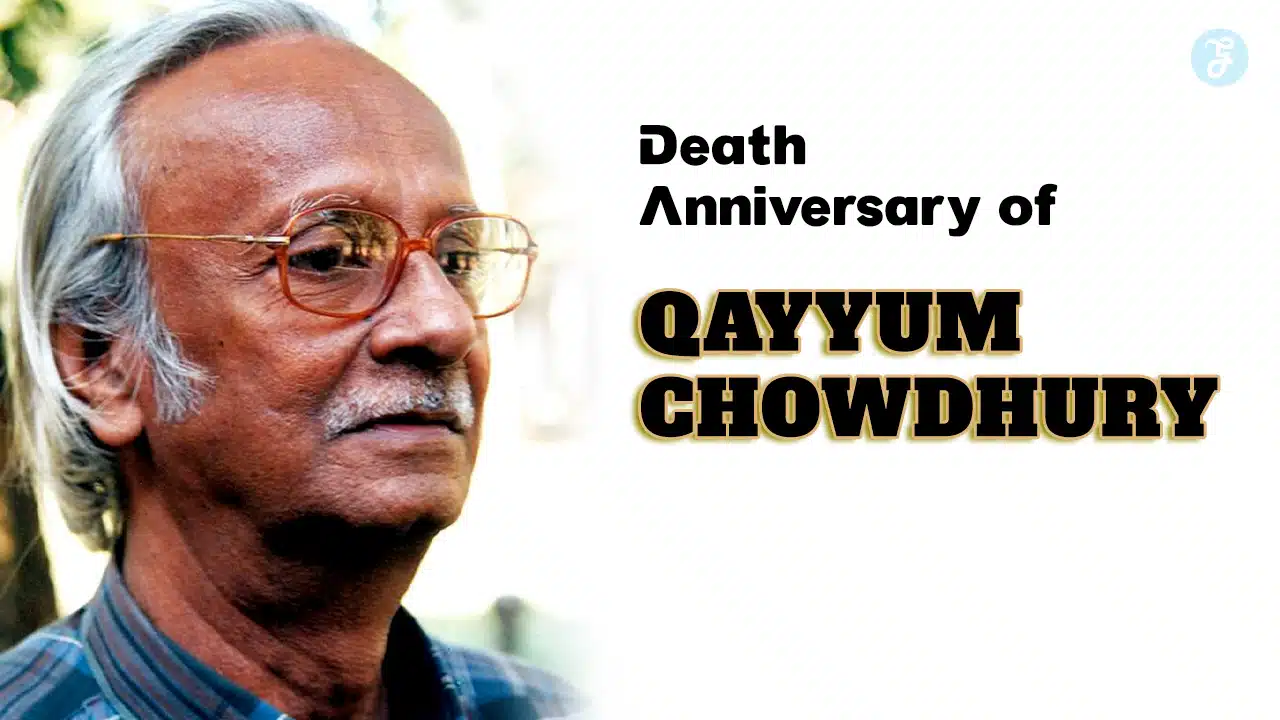
On 30 November 2014, Qayyum Chowdhury passed away in Dhaka, and today marks his death anniversary—a moment to remember the man who quite literally painted the soul of a nation.
A decade after his demise, Qayyum Chowdhury continues to have a significant impact on Bangladesh’s cultural history. He is still a reference point whenever the country debates artistic identity, the fusion of tradition and modernity, or the idea that design can be a force for national consciousness. As a titan of modern art and the pioneer of Bangladeshi graphic design, his story reads like a bridge between the rural roots of Bengal and the aspirations of a modern, sovereign state.
On his 11th death anniversary, it is also an invitation to ask a tough question: are we still living up to the aesthetic standards he set?
Qayyum Chowdhury at a Glance
Before we dive into the narrative, a quick snapshot helps frame the scale of his impact:
Full name: Qayyum Chowdhury
Born: 9 March 1932, Feni (Then, British India)
Died: 30 November 2014, Dhaka
Heritage: Bengali, deeply rooted in the soil of the Delta
Key roles:
- Professor at the Faculty of Fine Arts, University of Dhaka
- Chief Artist for The Daily Prothom Alo
- Revolutionary book cover designer for thousands of Bengali literary works
Signature titles:
- “The Artist of Bengal”
- “The Master of Book Design”
Major honors:
- Independence Award (Highest civilian award of Bangladesh)
- Ekushey Padak
- Sultan Padak
- Bangladesh Shilpakala Academy Award
These facts only hint at the scale of the Qayyum Chowdhury legacy. To really understand his influence, we need to go back to his formative beginnings.
Early Years: The Making of a Visual Poet
Qayyum Chowdhury’s biography does not start in a high-society studio. It begins in Feni and spans the breadth of rural Bengal. His father, a cooperative bank official, was frequently transferred, exposing young Qayyum to the diverse landscapes of the riverine delta. This constant motion shaped his outlook: fluid like the rivers, yet grounded in the soil.
As a young man, he was captivated not by the grand masters of Europe but by the everyday beauty of rural life—the farmers, the boatmen, and the lush paddy fields. His first love was visual storytelling, not just academic art.
Destiny pulled him toward the Government Institute of Arts (now the Faculty of Fine Arts) in 1949. There, he studied under Zainul Abedin and Quamrul Hassan. That tradition of combining artistic excellence with social responsibility became the invisible script that guided Qayyum’s life.
He spent his early years learning from the ground up, observing the changing political climate of East Pakistan, and absorbing the ethos of the Language Movement: art as a vehicle for identity, not just decoration.
At that point, nobody could have predicted that this quiet, observant student would become the visual voice of Bangladesh’s liberation and culture.
The Man Who Painted a Nation’s Soul: The Folk-Modern Synthesis
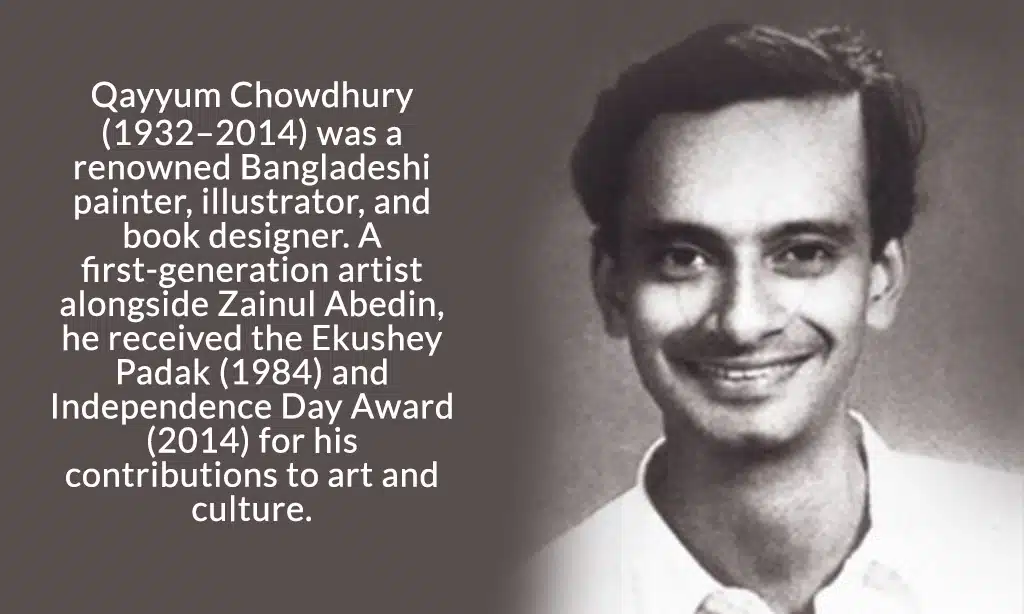
If there is one image that defines Qayyum Chowdhury, it is of a stylized figure—perhaps a woman or a freedom fighter—rendered in bold primary colors, bridging the gap between an ancient folk past and a modern future.
Defining the “Qayyum Style”
He possessed a unique ability to blend traditional folk motifs with modern geometric forms. For him, painting was not a hobby; it was a documentation of existence. At a time when modernism often meant abstraction, he saw the potential for elevating the “Gram-Bangla” (rural Bengal) to high art.
The Palette of Resistance
His canvases were dominated by the colors of the land and the flag: the deep red of the sun, the lush green of the harvest, and the ultramarine of the rivers. He did not just paint scenes; he painted the rhythm of Bengali life.
From Canvas to Constitution
After the Liberation War, his brush took on a national duty. He was part of the team that designed the Constitution of the People’s Republic of Bangladesh. Under his artistic touch, the document became more than a legal framework; it became a piece of cultural heritage.
In every sense, Qayyum Chowdhury, the man who painted the nation, did so both literally and metaphorically.
The Architect of Modern Bengali Design
While the art world remembers him as a painter, Qayyum Chowdhury’s influence on the publishing and media industry is even broader.
A Revolution on the Bookshelf
He revolutionized the concept of the book cover in Bangladesh. Before him, covers were often functional. He turned them into canvases. He experimented with typography, stretching and curving the Bengali alphabet to create visual poetry.
Creating a Visual Standard for Media
During his tenure with leading newspapers like The Daily Prothom Alo, he set a gold standard for visual journalism. He believed that a newspaper should educate the eye as well as the mind.
Democratizing Art
A crucial part of his legacy was making art accessible. He did not believe art belonged only in galleries. Through his illustrations, cartoons, and book covers, he brought high aesthetic standards into the living rooms of the middle class.
He believed in:
- Functionality: Design must communicate clearly.
- Identity: Even commercial work must reflect the local culture.
- Consistency: Maintaining high standards whether for a masterpiece or a daily sketch.
This philosophy laid the foundation for the flourishing graphic design industry in Bangladesh today.
Values at the Easel: Leadership and Mentorship
In an era when artists could be reclusive, Qayyum Chowdhury built his reputation around something less glamorous but far more durable: mentorship.
No Ivory Tower
Stories from students and colleagues repeatedly highlight one theme: he was profoundly accessible. As a teacher for 37 years at the Institute of Fine Arts, he refused to act like a distant master. He was a “Sir” to everyone, guiding hands with patience and grace.
Art with a Conscience
He was a freedom fighter with a brush. During the 1971 Liberation War, he used his art to design posters and banners that mobilized the public. He never separated his politics from his palette. He believed an artist had a responsibility to the soil they stood on.
A Listener, Not Just a Lecturer
Qayyum Chowdhury’s teaching style stood out for its humility. He was known to:
- Encourage students to look at their roots for inspiration.
- Attend exhibitions of young, unknown artists to offer encouragement.
- Remain active and curious until his very last breath.
The Man Behind the Legend: Passion, Music, and Simplicity
Public figures often become abstractions. Qayyum Chowdhury, the man, was more complex than the clean lines of his sketches.
A Lover of Classical Music
His life ended exactly where his passion lay—on a stage celebrating classical music. On 30 November 2014, he collapsed while addressing the audience at the Bengal Classical Music Festival. It was a tragic yet poetic exit for a man who saw rhythm in everything.
Perfectionism with Warmth
He could be exacting about design. He expected high standards from the printing press and the layout artists. Yet, many recall his gentle demeanor. He was soft-spoken, often seen with a simple smile, embodying the grace of the rural Bengal he loved to paint.
How Qayyum Chowdhury’s Legacy Shapes the Future
A decade after his passing, what does Qayyum Chowdhury really mean to contemporary Bangladesh?
The Bengali Aesthetic in a Digital Era
Today, Bangladeshi artists compete in a global digital marketplace. Yet, the “Qayyum style”—the bold lines, the vibrant colors, the typographic experiments—remains the bedrock of Bangladeshi visual identity. When we see a book cover that feels “authentically Bengali,” we are indirectly acknowledging the visual language he created.
A Blueprint for Cultural Identity
In a time of globalization, his life offers a yardstick for success:
- Innovate, but do not forget your roots.
- Make art accessible to the masses.
- Use your talent for the national interest.
For young designers and artists, his story is a reminder that you can be modern without ceasing to be Bengali.
Final Words: Why Every Death Anniversary Still Matters
On every death anniversary of Qayyum Chowdhury, it is easy to reduce him to a set of labels: the legendary painter, the book cover maestro, and the teacher. But if we look closer, we see a more demanding legacy.
He was:
- An artist who proved that local motifs could be modern art.
- A designer who professionalized the publishing industry.
- A patriot who believed culture was the backbone of a nation.
Remembering him is not just about paying tribute. It is about holding up a mirror to the present. Are we still committed to keeping our cultural identity vibrant? Are we still treating book design and media layout with the seriousness he demanded?
On his 11th death anniversary, one line captures his enduring relevance: he not only painted the country, but he also taught the country how to see itself. The real tribute to Qayyum Chowdhury will not be in statues or speeches, but in whether future generations of artists decide to color their canvas with the love of their own soil.
























