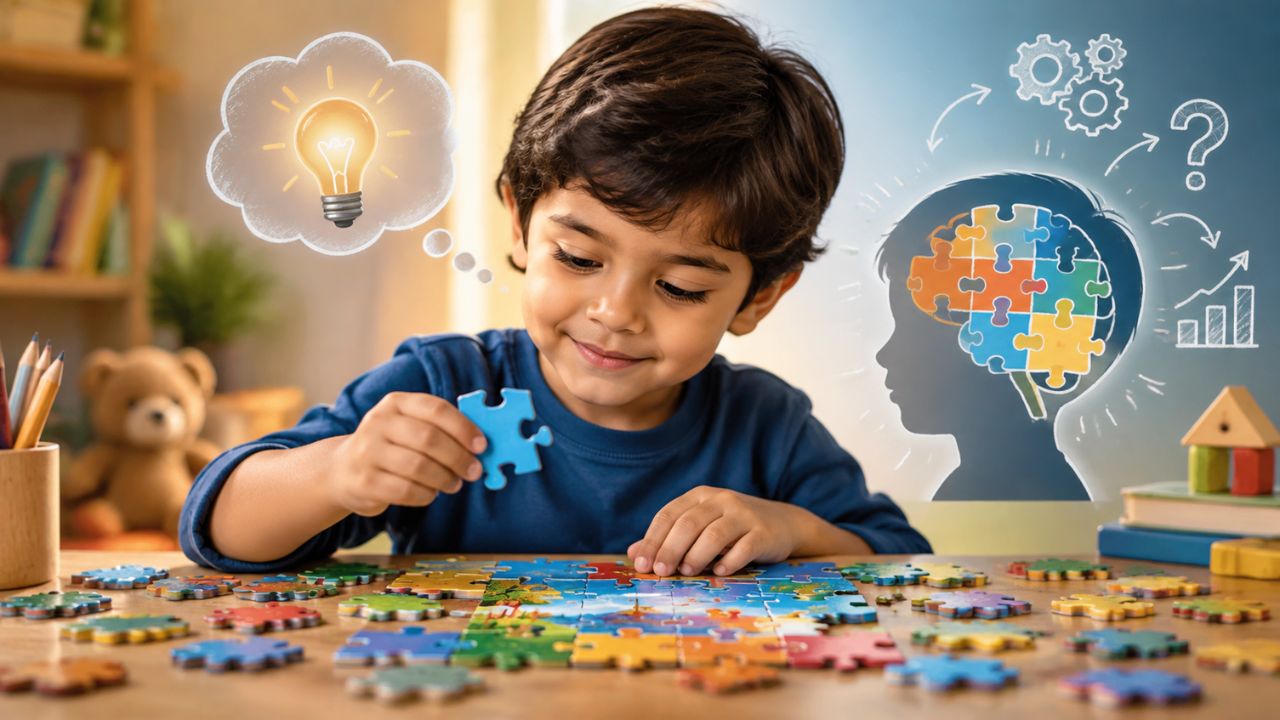
A child staring at a puzzle piece that does not fit is not wasting time. That moment is often where the learning happens.
The child has to decide what went wrong. Is the piece facing the wrong direction? Is the shape incorrect? Does another space look more suitable? Each attempt provides information.
This is why puzzles for problem-solving skills remain a valuable part of early childhood learning. They give toddlers and preschoolers a simple problem with a clear goal and immediate feedback. Children can test ideas, make mistakes, adjust their approach, and try again.
Puzzles will not magically improve every area of development, and they should not be treated as a replacement for conversation, creativity, movement, or social play. Their strongest value is more specific: they provide repeated practice with spatial reasoning, attention, planning, and persistence.
Why Puzzle Play Builds Early Problem-Solving Habits
Unlike many childhood activities, puzzles clearly show the relationship between an action and a result.
A child places a piece.
It fits.
Or it does not.
That simple feedback encourages experimentation.
When a preschooler rotates a puzzle piece, compares it with several empty spaces, and eventually finds the correct position, they are practising a basic problem-solving process:
- observing information;
- forming an idea;
- testing that idea;
- learning from the result;
- changing strategy when necessary.
These skills appear in many areas of life later, from mathematics and science activities to everyday decision-making.
The important part is not finishing the puzzle quickly. A child who spends time figuring out why something does not work may be doing more valuable thinking than a child who completes an easy puzzle from memory.
What Research Says About Puzzles and Cognitive Development
Research on puzzle play has shown a meaningful connection between puzzles and children’s spatial abilities.
One frequently cited longitudinal study followed young children between approximately ages 2 and 4 and later measured their ability to mentally transform shapes. Children who had more experience with puzzles performed better on the later spatial task.
However, the researchers did not prove that puzzles alone caused the improvement. Children who already enjoyed spatial activities may have been more likely to play with puzzles, and other experiences at home could also influence development.
More recent experimental research provides additional evidence that spatial assembly activities can improve specific spatial skills.
A randomized study involving 331 preschool children examined five weeks of spatial assembly training using physical and digital activities. Children improved most clearly on the types of spatial assembly tasks they practised. Improvements in broader mathematics skills were less consistent.
This distinction matters.
A puzzle is valuable because it helps children practise a particular kind of thinking. Parents do not need to buy into exaggerated claims that one toy can reshape a child’s entire learning ability.
The Hidden Skill Behind Every Puzzle: Spatial Thinking
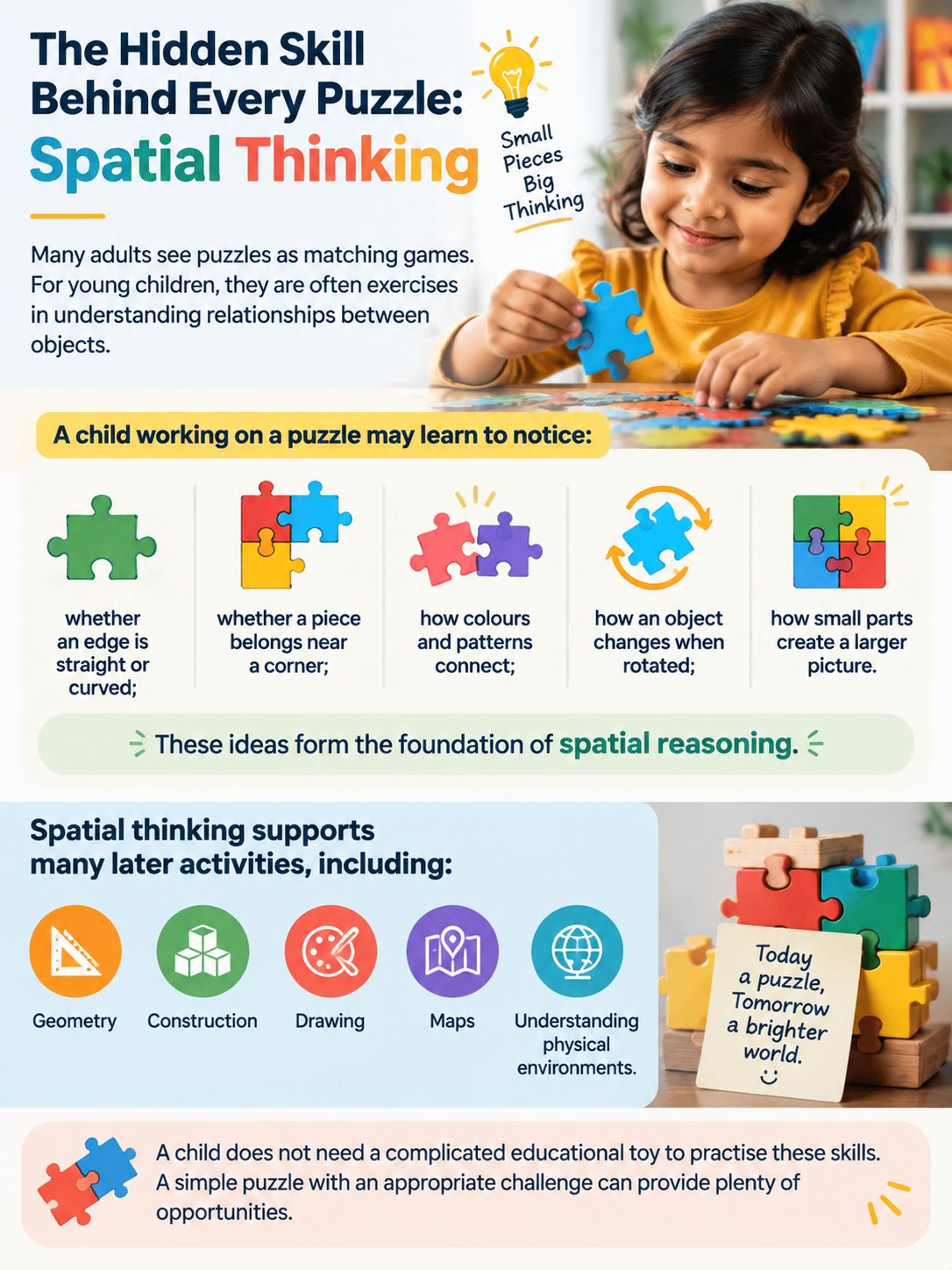
Many adults see puzzles as matching games. For young children, they are often exercises in understanding relationships between objects.
A child working on a puzzle may learn to notice:
- whether an edge is straight or curved;
- whether a piece belongs near a corner;
- how colours and patterns connect;
- how an object changes when rotated;
- how small parts create a larger picture.
These ideas form the foundation of spatial reasoning.
Spatial thinking supports many later activities, including geometry, construction, drawing, maps, and understanding physical environments.
A child does not need a complicated educational toy to practise these skills. A simple puzzle with an appropriate challenge can provide plenty of opportunities.
Let Children Struggle a Little Before Helping
Many adults accidentally remove the most valuable part of puzzle play: the thinking that happens before success.
When a child places a piece incorrectly, the natural reaction is often to point out the answer.
A better approach is to offer a small clue.
Instead of:
“Put it here.”
Try:
“Look at the shape of that piece.”
Or:
“Do you think turning it might help?”
This keeps the child involved in solving the problem.
Research on guided play suggests that children can benefit when adults provide support while still allowing children to make decisions. However, guided play is not the same as constant instruction. Too many questions can turn a playful activity into a test.
The best support is usually simple: stay nearby, encourage thinking, and step in only when frustration replaces exploration.
Language Makes Puzzle Time More Valuable
Puzzle play also creates natural opportunities to build vocabulary.
Parents and educators can use words such as:
- above;
- below;
- beside;
- corner;
- edge;
- inside;
- outside;
- turn;
- flip;
- between.
These words help children connect language with physical relationships.
For example:
“Does this piece have a straight edge like the outside of the puzzle?”
is more useful than simply saying:
“Try this one.”
Research has found that spatial language during play can support children’s mental-rotation skills. The conversation does not need to feel like a lesson. The best learning often happens through ordinary interaction.
The Right Puzzle Is Better Than the Most Advanced Puzzle
A common mistake is choosing puzzles based only on piece count.
A larger puzzle is not always a better learning tool.
A 30-piece puzzle with clear pictures may be easier than a 15-piece puzzle with similar colours and confusing shapes. A familiar picture may also make a difficult-looking puzzle much easier.
Look at the child’s behaviour instead.
| What You Notice | What It May Mean | What to Try |
|---|---|---|
| The child finishes without thinking | The puzzle may be too familiar | Introduce a different design or slightly greater challenge |
| The child tries, makes mistakes, and continues | The difficulty is probably useful | Let the child work independently |
| The child guesses randomly | The puzzle may be too difficult or the strategy is unclear | Reduce difficulty or demonstrate one approach |
| The child asks for help constantly | Adult support may be replacing problem solving | Give hints instead of solutions |
| The child becomes upset quickly | The challenge may be too high | Move to an easier puzzle and return later |
The best puzzle creates concentration, not constant frustration.
Age Labels Are Helpful, but They Are Not Rules
Toy packaging often includes age recommendations, but children develop at different speeds.
A toddler who has limited puzzle experience may struggle with a puzzle considered suitable for their age. Another child may solve the same puzzle easily because they have played with similar activities before.
For younger children, large-piece inset puzzles and simple shape puzzles are often a practical starting point because the connection between object and space is clear.
As children gain confidence, they can move toward:
- traditional jigsaw puzzles;
- tangram activities;
- pattern puzzles;
- construction challenges;
- simple logic games.
The goal is not to reach a certain number of pieces as quickly as possible. The goal is to give children problems they can meaningfully attempt.
Common Mistakes Parents Make During Puzzle Play
Solving too quickly
A child who receives the answer immediately loses the chance to discover a strategy.
Treating mistakes as failure
A wrong placement is information. It tells the child something about the shape, position, or size of the space.
Focusing only on completion
Finishing is satisfying, but the learning happens throughout the process.
Buying expensive “brain development” toys unnecessarily
Marketing often makes educational claims sound bigger than the evidence supports.
A simple puzzle that a child repeatedly chooses and enjoys may provide more value than a complicated toy that remains untouched.
Physical Puzzles and Digital Puzzles Serve Different Purposes
Physical puzzles have an obvious advantage for young children: they involve real objects.
Children can hold pieces, rotate them, compare shapes, and physically feel when something fits.
The American Academy of Pediatrics includes puzzles, blocks, and similar manipulative toys among activities that can support problem solving and fine-motor development. It also emphasizes that interaction between children and caregivers remains an essential part of early learning.
Digital puzzles can also involve spatial thinking, but they should not automatically replace hands-on play.
Research on structured digital and physical spatial activities has shown that both formats can improve specific spatial assembly skills. However, those findings come from carefully designed activities, not every puzzle app available online.
For most toddlers and preschoolers, physical puzzles are a strong foundation. Digital activities can be an additional option when they are age-appropriate and used thoughtfully.
Safety Comes Before Challenge
Puzzle difficulty should never come before safety.
For children under three, small parts require particular attention. In the United States, toys intended for children under age three must meet federal requirements related to small parts because of choking risks.
Parents should also consider the individual child. A younger child who still frequently puts objects in their mouth may need closer supervision, even if a product appears age appropriate.
Check puzzles for:
- loose pieces;
- broken wooden parts;
- damaged cardboard layers;
- removable knobs or attachments.
A safer, simpler puzzle is always a better choice than a more advanced one with unnecessary risk.
Repeating the Same Puzzle Is Not a Problem
Young children often want to solve the same puzzle again and again.
That repetition can serve a purpose.
The first attempts may involve searching and trial-and-error. Later attempts may involve memory, confidence, and faster recognition.
Eventually, a familiar puzzle may provide less challenge, but it can still offer enjoyment and independence.
Instead of constantly buying new puzzles, parents can rotate activities. Put some away for a while, bring them back later, and introduce different types of challenges through blocks, drawing, construction toys, and matching activities.
Variety matters more than having a large collection.
Final Thoughts
The real value of puzzles for problem-solving skills is not that they promise instant academic advantages. Their value comes from something more basic.
A good puzzle gives a child a problem they can understand, a chance to test ideas, and the freedom to learn from mistakes.
Parents do not need to turn puzzle time into a formal learning session. Choose a puzzle that matches the child’s ability, allow some struggle, use helpful language, and resist the urge to solve every difficult moment.
The most important skill a child develops may not be placing the final piece. It may be learning that when something does not work, another approach is worth trying.
FAQs about Puzzles for Problem-Solving Skills
1. How do puzzles help children develop problem-solving skills?
Puzzles encourage children to identify patterns, think logically, test different solutions, and learn from mistakes. These activities help build foundational problem-solving skills from an early age.
2. What problem-solving skills do puzzles develop?
Puzzles can strengthen skills such as logical reasoning, critical thinking, pattern recognition, decision-making, spatial awareness, and planning.
3. At what age should children start playing puzzles?
Children can begin with simple puzzles as early as 1–2 years old, depending on their development. As they grow, they can progress to more complex puzzles that require greater concentration and reasoning.
4. Can puzzles improve a child’s concentration?
Yes. Completing a puzzle requires children to focus on a specific task and pay attention to details, which can help develop concentration and persistence.
5. Do puzzles help children learn from mistakes?
Yes. Puzzles provide a safe way for children to try different approaches. When a piece does not fit or a solution does not work, children can adjust their strategy and try again.