Education is shifting from static textbooks and classrooms to dynamic, data-driven experiences. That shift is powered by potential edtech business models that turn learning products into sustainable companies, not just good ideas. If you are building an EdTech startup or expanding an existing product, choosing the right model can decide whether you grow, plateau, or burn out.
Global EdTech spending is expected to grow strongly over the next decade. Several reports estimate the market at over 200 to 250 billion dollars in 2024, with projections reaching 700 to 900 billion dollars by the early 2030s, at double-digit annual growth rates. That growth will not be evenly distributed. Models that align with real customer needs and clear value will capture most of the upside.
In this guide, I will break down 10 high-potential edtech business models, when they work best, and what to watch out for. You will see both classic revenue structures and newer, outcome-based approaches that investors and learners are increasingly looking for.
EdTech and the Opportunity
EdTech, or education technology, covers any digital tool that improves how people learn or how institutions deliver learning. This includes learning management systems, language platforms, coding bootcamps, online tutoring, creator-led courses, exam prep apps, and more.
The sector sits on top of the global education economy, which is worth several trillion dollars. Yet only a relatively small share of that spending has shifted into digital tools so far, even as adoption accelerated after the pandemic. Estimates suggest that total global EdTech expenditure may reach around 400 billion dollars by 2025, with strong compound growth.
For founders, operators, and investors, this means the timing is still attractive. The challenge is not whether there is demand, but how to package value in a way that schools, businesses, and individual learners can actually buy.
Quick Snapshot: Where EdTech Value Is Growing
| Area | Why It Is Growing |
| B2B learning platforms | Institutions need analytics, automation, and compliance |
| Direct-to-consumer skills | Workers reskill for AI, data, and digital careers |
| Corporate upskilling | Companies need faster talent pipelines |
| Assessment and credentials | Employers want proof of skills, not just degrees |
| Hybrid and cohort learning | Learners want structure, feedback, and community |
Pro Tip: Before you pick a business model, write down exactly who pays, what they get in return, and how you will prove the value within 3 to 6 months of them signing up.
Overview of EdTech Business Models
When people talk about edtech business models, they often mean either who pays (B2C, B2B, or B2G) or how they pay (subscription, one-time purchase, revenue share, or ads). The most resilient companies usually combine a clear customer segment with a recurring, predictable revenue structure.
Here are the core model patterns that keep showing up in successful EdTech startups.
| # | Model Name | Main Customer | Core Revenue Type |
| 1 | Direct-to-consumer subscription | Individual learners | Monthly or yearly fee |
| 2 | Freemium app with premium upgrades | Individuals | In-app purchases |
| 3 | One-time course or bundle sales | Individuals | One-time payments |
| 4 | B2B SaaS for institutions | Schools, universities | Per student or seat |
| 5 | Content licensing to institutions | Schools, platforms | Licensing fees |
| 6 | Tutoring or course marketplace | Tutors, learners | Commission on sales |
| 7 | Cohort-based courses and bootcamps | Professionals | High-ticket programs |
| 8 | Outcome or placement-based revenue | Learners, employers | Income or hiring fees |
| 9 | Corporate upskilling partnerships | Companies | Per employee packages |
| 10 | Certification and exam platforms | Individuals, schools | Exam and retake fees |
Table: 10 High-Potential EdTech Business Models
10 Potential EdTech Business Models with Huge Future Insights
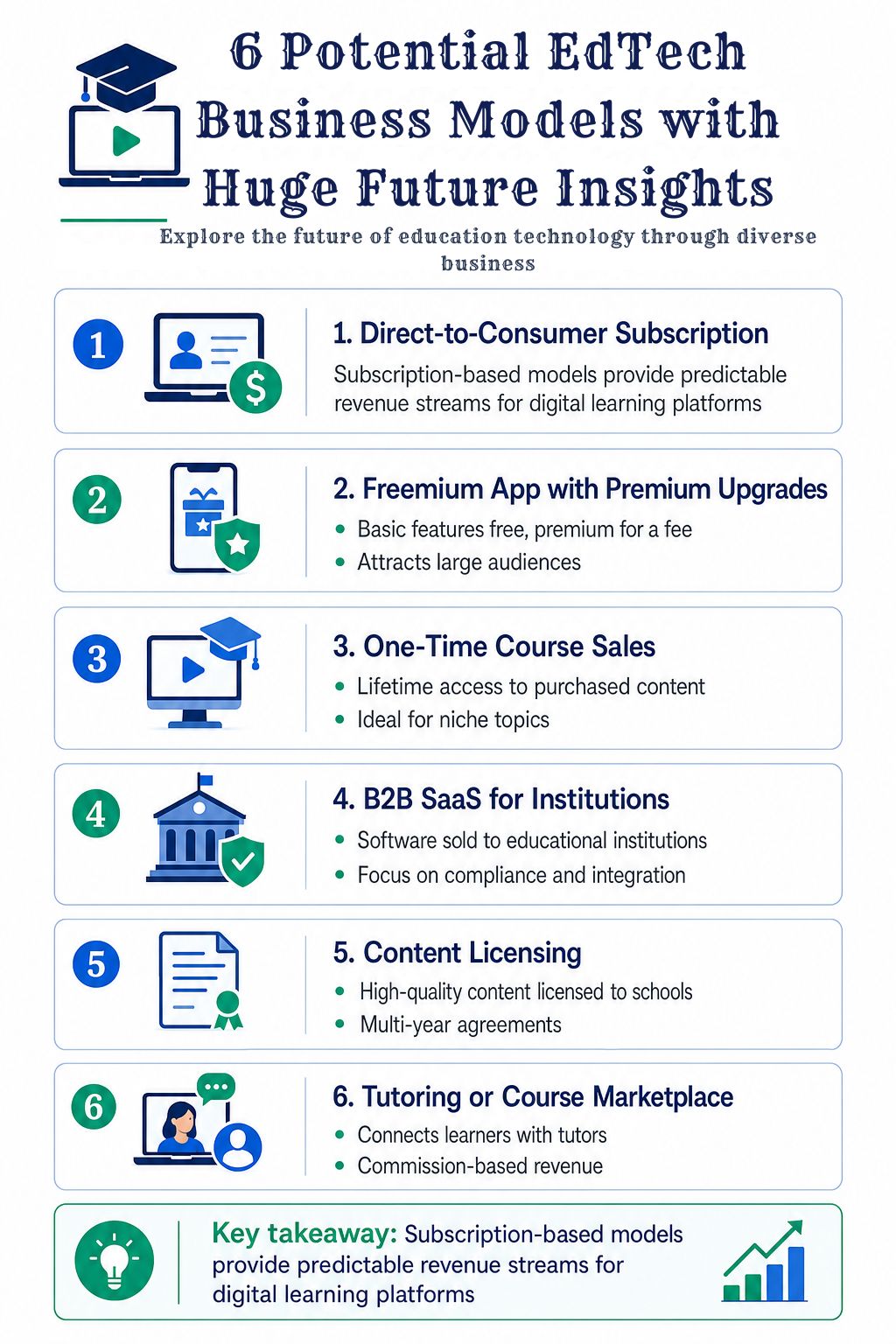
This section looks at each model one by one. You can mix and match some of them, but it helps to start with one primary way of making money and add others later.
1. Direct-to-consumer subscription
Direct-to-consumer subscription is the classic model used by many language learning and skills platforms. Users pay a recurring fee for ongoing access to content, features, and sometimes live sessions.
Typical use cases:
- Language learning platforms
- Coding and design skills platforms
- General self-improvement and professional upskilling
Key success factors:
- Fresh, regularly updated content
- Clear progress tracking that keeps users engaged
- Affordable pricing relative to perceived value
Pro Tip: Reduce churn by building small “wins” into the first week, such as visible progress, streaks, or a simple milestone certificate.
In a freemium model, most users never pay, but a smaller segment pays for extra features, content, or certification. This works well when you can reach very large audiences at relatively low cost.
Examples include:
- Language apps with limited daily lessons for free
- Test prep apps that charge for full question banks or analytics
- Study tools that unlock collaboration or export options
Strengths:
- Low barrier to entry for new users
- Viral growth if the free product is genuinely helpful
Risks:
- Conversion to paid can be low if the free tier is too generous.
- Dependence on a large user volume to reach sustainability
3. One-time course or bundle sales
Some learners prefer to pay once and keep access forever. Selling full courses or themed bundles can work especially well for niche topics or creator-led businesses.
This model often appears in:
- Specialist skills like advanced design, music production, or niche software
- One-off certification courses
- Lifetime access bundles during promotions
To keep revenue stable, creators may:
- Release new versions and upsell existing customers
- Add optional coaching or support layers.
- Combine one-time purchases with community memberships.
4. B2B SaaS for institutions
Business-to-business SaaS focuses on selling software to schools, universities, training providers, or governments. Customers pay per student, per seat, or via institutional licenses.
Common products:
- Learning management systems
- Student information and analytics platforms
- Classroom engagement and assessment tools
Institutions care about:
- Compliance and data privacy
- Integration with existing systems
- Reliability, support, and training
Pro Tip: In B2B edtech, sales cycles can be long. Design for pilots that demonstrate clear value in one semester or less so decision makers can justify expansion.
5. Content licensing to institutions and platforms
Instead of selling directly to learners, some companies create high-quality content libraries and license them to schools, publishers, or other platforms.
Licensing deals often involve:
- Multi-year agreements
- Per student, per campus, or per region pricing
- Co-branding or white labeling options
This model is attractive if:
- You can produce content that is hard to replicate
- You align with curriculum standards or high-stakes exams.
- You build strong distribution partnerships early.
6. Tutoring or course marketplace
Marketplaces connect supply and demand. In EdTech, that usually means matching tutors or course creators with learners, while the platform earns a commission or listing fee.
Variants include:
- One-to-one tutoring marketplaces
- Course marketplaces where creators upload video courses
- Hybrid models with both live and recorded options
Platform responsibilities:
- Building trust with reviews, ratings, and dispute handling
- Managing payments and sometimes tax obligations
- Ensuring quality standards and policy enforcement
Pro Tip: Start with a focused niche, such as exam prep in one country or language tutoring for professionals, rather than trying to be a general marketplace from day one.
7. Cohort-based courses and bootcamps
Cohort-based courses and intensive bootcamps use fixed start dates, live sessions, group projects, and strong community elements. They usually target professionals who want a meaningful skill upgrade in weeks or months.
Revenue characteristics:
- Higher ticket prices per learner
- Limited cohort sizes with waitlists
- Sometimes employer sponsorship
This model depends on:
- Strong instructors and mentors
- Clear outcomes like portfolio projects or certifications
- Structured support, including feedback and accountability
8. Outcome or placement-based revenue
Outcome-based models link revenue to results such as employment or salary. In some cases, learners pay through income share agreements, where they give a small percentage of future earnings for a limited period.
Typical features:
- Rigorous selection to boost success rates
- Strong focus on job readiness and interview skills
- Deep relationships with hiring partners
Risks include:
- Regulatory scrutiny in some regions
- Complex contract management and compliance
- Cash flow timing, since payment may arrive months after the program
When designed ethically, this model can align incentives across learners, providers, and employers.
9. Corporate upskilling partnerships
Companies face constant pressure to reskill employees for digital tools, data, and automation. EdTech providers can sell learning programs directly to employers as part of their talent strategy.
Common formats:
- Customized learning paths mapped to job roles
- Blended programs combining self-paced content and live workshops
- Ongoing subscription access for whole teams or departments
Revenue is often:
- Per employee per year
- Per program or cohort
- Part of a larger talent or consulting package
Pro Tip: In corporate EdTech, focus on metrics that matter to business leaders, such as reduced onboarding time, higher sales performance, or lower support tickets, not just course completion rates.
10. Certification and exam platforms
Learners and employers increasingly value proof of skills. Certification and exam platforms charge for assessments, proctoring, digital badges, and sometimes official credentials.
Use cases:
- Professional exams and microcredentials
- Skill assessments for hiring or promotion
- Placement tests for language and math levels
Revenue sources:
- Exam and retake fees
- Institutional packages for bulk access
- White label testing for other brands
How to Choose the Right Model for Your EdTech Startup
Not every model fits every product. Your choice should follow your learner, not the other way around.
Key questions to ask:
- Who is the true payer: learner, parent, school, employer, or government
- How often do they need the value: once, occasionally, or continuously?
- How easy is it for them to switch away from you
- How long is their decision-making cycle
Simple Comparison: B2C vs B2B Focus
| Aspect | B2C Focus | B2B Focus |
| Sales cycle | Shorter | Longer |
| Ticket size | Smaller per user | Larger per contract |
| Marketing | Brand, performance ads, social | Direct sales, relationships |
| Churn risk | Higher | Lower once embedded |
| Support demands | Broad and scaled | Deeper for fewer customers |
Pro Tip: If you are early and resource-constrained, it is usually safer to dominate one segment, such as individual professionals or small private schools, rather than trying to serve everyone at once.
Common Mistakes When Designing EdTech Revenue
Many EdTech products fail not because they lack impact, but because the business model does not match how customers actually behave.
Frequent mistakes include:
- Copying a popular subscription model even when usage is irregular
- Underpricing high-touch services like live tutoring or bootcamps
- Relying only on ads, which rarely sustain quality learning at scale
- Ignoring procurement realities in schools and governments
- Treating impact measurement as a “nice to have” rather than a sales tool
If you design revenue around how learners and institutions truly make decisions, you stand a much better chance of capturing long-term value.
Final Verdict
Edtech business models are not just about how you collect payments. They shape how you design your product, support your learners, and measure success. The most promising approaches combine recurring revenue, clear outcomes, and alignment between what learners want and what payers are willing to fund.
If you are building or refining an EdTech product, start by understanding exactly who you serve and what success looks like for them in measurable terms. Then pick one primary model, such as B2B SaaS, corporate upskilling, or creator-led membership, and test it thoroughly before adding more layers. With thoughtful design, you can turn a useful learning tool into a sustainable, scalable business that grows with the wider EdTech market.
Frequently Asked Questions (FAQs) on Potential Edtech Business Models
1. Which edtech business models attract the most investment right now?
Investors are especially interested in scalable B2B platforms, subscription models with strong retention, and outcome-based programs that can prove impact in skills and employment. Enterprise-focused tools with clear ROI often receive more stable funding than pure consumer content apps.
2. Are direct-to-consumer edtech business models still viable?
Yes, but they are more competitive. To succeed, B2C models need a clear niche, strong brand trust, and effective retention mechanics. Many successful platforms combine B2C subscriptions with B2B or corporate partnerships to diversify revenue.
3. How important are certifications in EdTech revenue models?
Certifications can be powerful when employers or institutions recognize them. In some markets, microcredentials and digital badges are becoming important signals of skills, especially in tech and business fields. Platforms that control respected credentials can charge for exams, preparation, and verification services.
4. Should an EdTech startup start with schools or with individual learners?
It depends on your product and strengths. Selling to schools can mean larger contracts but slower cycles. Selling to individuals can provide faster feedback and early revenue but requires strong marketing. Many founders start with B2C, validate value, and later adapt to institutional needs.
5. Can one EdTech company use multiple business models?
Yes. Mature companies often layer models, for example, combining subscriptions, corporate partnerships, and certification fees. However, in the early stage, it is usually better to focus on one main revenue engine until it is working reliably.