
Online education has moved far beyond recorded lectures. Today, learners expect structured, interactive, and scalable learning experiences that feel personal even at global scale. This is where MOOC Platforms have become essential, enabling educators, creators, and institutions to deliver learning to millions without traditional classroom limits. The United States leads this transformation due to its mature EdTech ecosystem, strong creator economy, and high adoption of digital learning infrastructure.
Our Selection Criteria
The companies included in this list were selected based on clear evaluation filters
- Country focus: Must be headquartered or primarily operating in the United States
- MOOC relevance: Platforms must support large-scale online learning or course distribution
- EdTech focus: Must serve education, training, or structured learning use cases
- Market validation: Verified through public product presence and real-world adoption
- SME classification: Focus on startups and mid-sized EdTech companies rather than legacy universities or large conglomerates
- Usability: Must support learners, educators, or creators with scalable learning tools
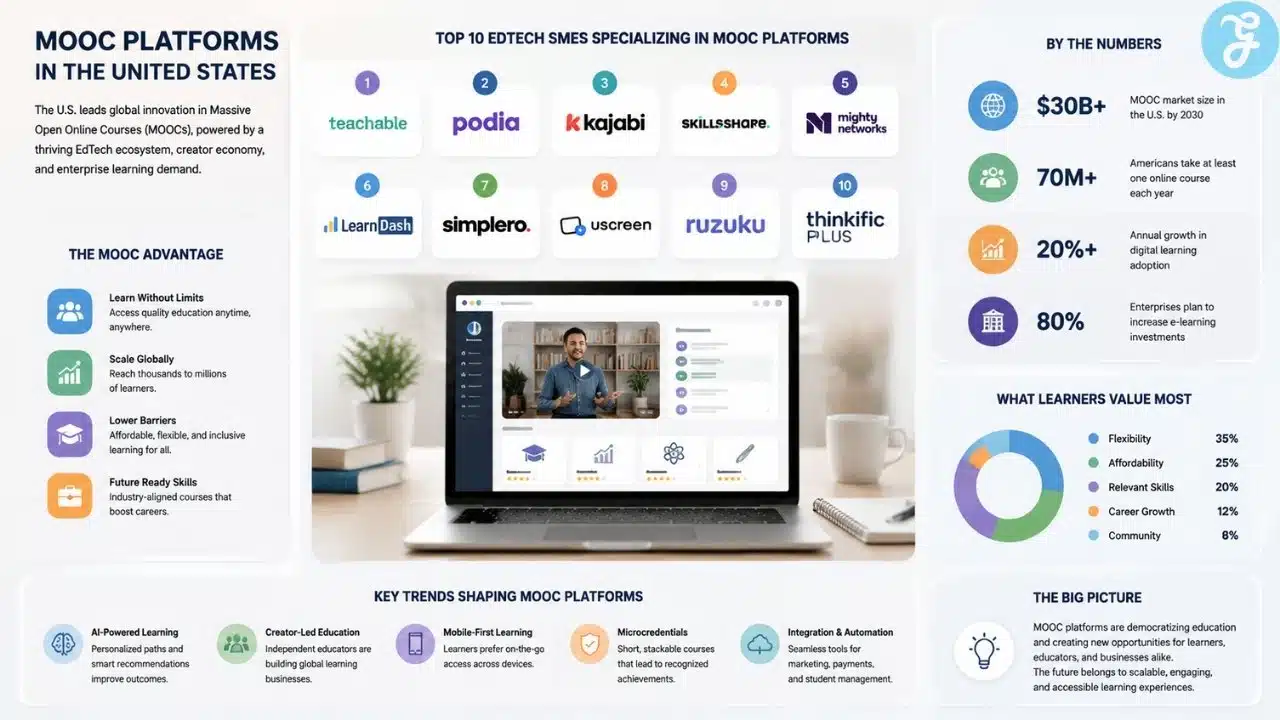
Top 10 US Edtech SMEs Specializing in MOOC Platforms
These companies represent the most practical and widely adopted platforms powering modern online education and creator-led learning ecosystems.
1. Teachable
Headquarters: United States
Website: www.teachable.com
Email: support@teachable.com
Teachable is one of the most widely used platforms for creating and selling online courses. It allows educators and creators to build structured learning programs, host video lectures, and manage student enrollment at scale. Its simplicity makes it ideal for independent educators entering the MOOC space.
Why We Chose It:
- Strong creator-first course building tools
- Supports scalable monetization of online education
Things to consider:
- Limited advanced academic LMS features
- Transaction fees may apply depending on plan
2. Podia
Headquarters: United States
Website: www.podia.com
Email: support@podia.com
Podia offers an all-in-one platform for hosting courses, digital downloads, and membership communities. It is designed for creators who want to build MOOC-style learning environments without technical complexity.
Why We Chose It:
- Combines courses, community, and digital products
- Beginner-friendly interface for educators
Things to consider:
- Less suitable for large institutional deployments
- Limited deep analytics compared to enterprise LMS tools
3. Kajabi
Headquarters: United States
Website: www.kajabi.com
Email: support@kajabi.com
Kajabi is a premium platform that enables creators to build full online learning ecosystems. It integrates course hosting, email marketing, automation, and payment systems, making it a strong MOOC infrastructure solution for independent educators and businesses.
Why We Chose It:
- Full business ecosystem for online learning
- Strong automation and marketing integration
Things to consider:
- Higher pricing compared to competitors
- Can be complex for beginners
Headquarters: United States
Website: www.skillshare.com
Email: support@skillshare.com
Skillshare is a large-scale learning community where instructors publish courses on creative, business, and technical skills. It operates on a subscription-based MOOC model that gives learners access to thousands of classes.
Why We Chose It:
- Massive learner community and course library
- Subscription-based MOOC learning model
Things to consider:
- Revenue model depends on engagement time
- Less control for individual instructors
5. Mighty Networks
Headquarters: United States
Website: www.mightynetworks.com
Email: support@mightynetworks.com
Mighty Networks enables creators to build learning communities combined with structured courses. It blends social interaction with MOOC-style education, making learning more collaborative and engaging.
Why We Chose It:
- Strong community-driven learning approach
- Combines courses with engagement tools
Things to consider:
- Not a traditional LMS structure
- Requires active community management
6. LearnDash
Headquarters: United States
Website: www.learndash.com
Email: support@learndash.com
LearnDash is a WordPress-based learning management system that enables universities, companies, and educators to create MOOC-style courses. It is widely used for structured academic and professional training programs.
Why We Chose It:
- Highly flexible LMS for scalable education
- Strong integration with WordPress ecosystem
Things to consider:
- Requires WordPress setup knowledge
- Maintenance depends on hosting environment
7. Simplero
Headquarters: United States
Website: www.simplero.com
Email: support@simplero.com
Simplero is an all-in-one platform combining online courses, email marketing, memberships, and automation tools. It supports creators who want to run MOOC-style businesses with minimal technical overhead.
Why We Chose It:
- Integrated learning and marketing system
- Supports recurring learning memberships
Things to consider:
- Interface may feel complex initially
- Less widely adopted than mainstream platforms
8. Uscreen
Headquarters: United States
Website: www.uscreen.tv
Email: support@uscreen.tv
Uscreen helps creators launch subscription-based video learning platforms. It is particularly strong for video-first MOOC delivery, allowing educators to monetize structured video libraries.
Why We Chose It:
- Strong video-based learning infrastructure
- Subscription monetization model for courses
Things to consider:
- Focused primarily on video content
- Limited text-based learning tools
9. Ruzuku
Headquarters: United States
Website: www.ruzuku.com
Email: support@ruzuku.com
Ruzuku provides a simple course creation platform designed for educators who want to launch structured online learning quickly. It supports step-by-step course design and learner engagement tools.
Why We Chose It:
- Extremely easy course creation workflow
- Designed specifically for educators and coaches
Things to consider:
- Limited advanced customization
- Smaller ecosystem compared to major platforms
10. Thinkific Plus
Headquarters: United States
Website: www.thinkific.com
Email: support@thinkific.com
Thinkific allows creators and organizations to build scalable online learning platforms. While it serves a global audience, its strong U.S. presence makes it a key player in MOOC-style education delivery.
Why We Chose It:
- Scalable infrastructure for online courses
- Strong support for branded learning environments
Things to consider:
- Advanced features require paid plans
- Some learning curve for customization
An Overview Of MOOC Platforms in the United States
MOOC Platforms in the United States are driven by a combination of creator economy growth, corporate training demand, and digital education adoption. These platforms allow individuals and organizations to scale learning beyond traditional classrooms, reaching global audiences with structured content, assessments, and interactive experiences.
Overview Comparison Table
MOOC platforms in this ecosystem generally fall into three categories
- Creator-focused platforms such as Teachable, Podia, Kajabi
- Community-driven platforms such as Mighty Networks and Skillshare
- LMS and structured systems such as LearnDash and Thinkific
Our Top 3 Picks and Why
- Kajabi for its complete business ecosystem for online education
- Teachable for its simplicity and creator-first design
- Skillshare for its massive learner network and subscription model
Why MOOC Platforms Are Booming in the United States
The United States leads MOOC innovation due to strong demand for upskilling, creator-led education, and enterprise training. Businesses and individuals increasingly prefer flexible learning models that do not rely on traditional institutions.
What’s Special About Them
- Strong creator economy integration
- Scalable global learning distribution
- Subscription-based learning models
- Integration of video, community, and assessments
- Low-barrier entry for educators and institutions
The Future of MOOC Platforms
MOOC Platforms are evolving from simple course hosting tools into full learning ecosystems. The next phase will focus on adaptive learning, AI-driven personalization, and deeper integration with professional certification systems. However, the challenge remains balancing accessibility with quality control, ensuring that mass education does not compromise learning depth.
Frequently Asked Questions (FAQs) About MOOC Platforms
What are MOOC Platforms?
They are digital platforms that deliver large-scale online courses to global learners.
Why is the United States leading this space?
Due to its strong creator economy, EdTech innovation, and high adoption of online learning systems.
Are MOOC Platforms only for universities?
No, they are widely used by independent educators, companies, and training organizations.
Can creators earn from MOOC Platforms?
Yes, most platforms support subscriptions, course sales, or revenue-sharing models.
Which MOOC Platforms are best for beginners?
Teachable and Podia are considered the easiest for new creators.