

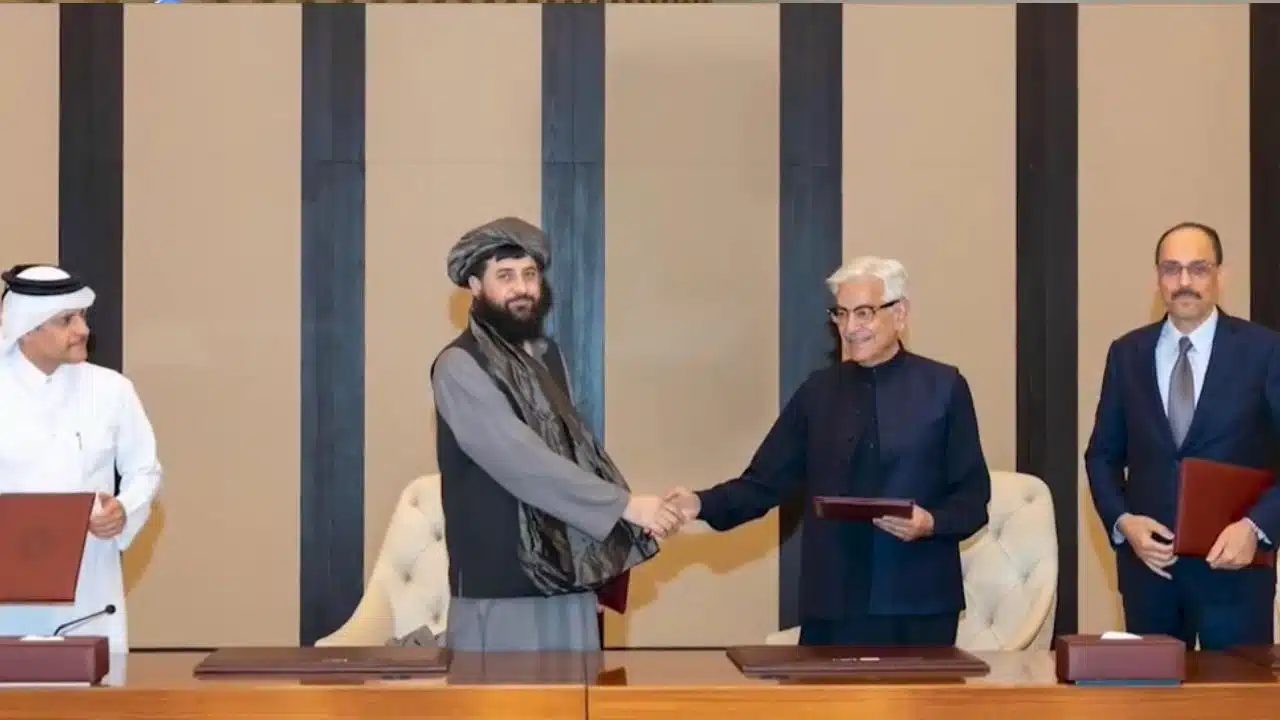
Pakistan and Afghanistan have agreed to an immediate ceasefire following high-stakes negotiations in Doha, Qatar’s Ministry of Foreign Affairs announced early Sunday, October 19, 2025. The breakthrough, mediated by Qatar and Turkey, aims to halt more than a week of deadly border clashes that have brought the two nations to the brink of a wider conflict.
The agreement was reached after a delegation led by Pakistan’s Defence Minister Khawaja Muhammad Asif met with their Afghan counterparts, headed by the Taliban’s acting Defence Minister Mullah Muhammad Yaqoob. The talks were convened to de-escalate the rapidly deteriorating security situation along the disputed 2,670-kilometer Durand Line, which has seen fierce exchanges of fire, artillery duels, and airstrikes, resulting in dozens of casualties on both sides. The successful negotiation of a Pakistan and Afghanistan agree to immediate ceasefire after peace talks in Doha marks a pivotal moment in the strained relationship between the two neighbors.
- Ceasefire Agreement: An immediate ceasefire was agreed upon in Doha on Saturday, October 18, 2025, and announced early the next day.
- Mediation: The talks were successfully mediated by the State of Qatar and the Republic of Turkey.
- High-Level Delegations: The negotiations involved high-level officials, including the defense ministers of both Pakistan and Afghanistan.
- Recent Clashes: The agreement follows over a week of intense border fighting, the worst since the Taliban’s return to power in August 2021, with dozens of military personnel and civilians killed or wounded.
- Core Issues: Pakistan’s primary concern is the alleged use of Afghan soil by militant groups, particularly the Tehreek-e-Taliban Pakistan (TTP), to launch attacks within its borders. The Afghan government has consistently denied these allegations.
- Next Steps: Both sides have committed to follow-up meetings to establish mechanisms for a sustainable and lasting peace.
The Brink of Conflict: A Week of Escalation
The Doha agreement comes after a week of spiraling violence that underscored the deep-seated mistrust between Islamabad and Kabul. Tensions flared on October 11, 2025, with both sides accusing the other of initiating unprovoked cross-border attacks. The situation deteriorated rapidly, with Pakistan’s military confirming it conducted “precision aerial strikes” against what it described as TTP militant hideouts within Afghanistan (Reuters, October 19, 2025).
Afghan officials, however, reported that these strikes hit civilian areas, resulting in tragic casualties, including the deaths of three local cricketers in Paktika province. This led to Afghanistan’s withdrawal from a planned T20 cricket tri-series in Pakistan, a move that highlighted how the conflict was spilling over into diplomatic and cultural arenas.
Statistics from the recent clashes paint a grim picture:
- Pakistani Casualties: At least seven Pakistani soldiers were killed in a suicide bombing near the border on Friday, October 17, 2025, an attack that Islamabad attributed to militants operating from Afghanistan.
- Afghan Casualties: Afghan authorities reported that Pakistani airstrikes on Friday killed at least 10 civilians in Paktika province, a claim Pakistan denies, stating its operations targeted over 100 militants.
- Overall Toll: While precise, verified numbers are difficult to ascertain amidst the conflict, reports from various news agencies suggest that the week-long clashes have resulted in dozens of deaths and hundreds of injuries, including both military personnel and civilians on both sides of the border.
The fighting represented the most significant military confrontation between Pakistan and the Taliban-led Afghan government since the fall of Kabul in 2021, threatening to destabilize an already volatile region.
Diplomatic Intervention and the Doha Accord
As the specter of a full-blown conflict loomed, Qatar and Turkey stepped in to mediate. The choice of Doha as a venue was significant, given its history of hosting peace talks related to Afghanistan, including the US-Taliban negotiations.
In a statement, Qatar’s Ministry of Foreign Affairs confirmed the outcome: “During the negotiations, the two sides agreed to an immediate ceasefire and the establishment of mechanisms to consolidate lasting peace and stability between the two countries”..
The statement further elaborated that both parties have agreed to “hold follow-up meetings in the coming days to ensure the sustainability of the ceasefire and verify its implementation in a reliable and sustainable manner.
Pakistani Defence Minister Khawaja Muhammad Asif stated on X (formerly Twitter) that the agreement would halt “the series of cross-border terrorist incidents originating from Afghanistan’s territory” and that both nations pledged to respect each other’s territorial sovereignty..
Official Responses
The announcement has been met with cautious optimism from regional observers. The primary point of contention remains the presence of anti-Pakistan militant groups in Afghanistan.
Pakistan’s Army Chief, General Asim Munir, speaking at a military academy graduation on Saturday, issued a stern message: “The Afghan regime must rein in the proxies who have sanctuaries in Afghanistan and are using Afghan soil to perpetrate heinous attacks inside Pakistan” (Al Jazeera, October 19, 2025). This sentiment reflects Pakistan’s long-standing demand for verifiable action against groups like the TTP.
Zabihullah Mujahid, the chief spokesman for the Afghan government, confirmed their participation in the talks, emphasizing their desire to resolve issues through dialogue. However, the Taliban administration has consistently denied that it allows Afghan territory to be used for attacks against other nations and has accused Pakistan of violating its sovereignty with its airstrikes.
Michael Kugelman, a South Asia analyst at the Wilson Center, noted that while the ceasefire provides “breathing room,” the core issues remain unaddressed. The Taliban are not addressing Pakistan’s concerns about cross-border terrorism,” he warned, suggesting that without progress on this front, any peace could be fragile,
The Human Impact
Caught in the crossfire have been the communities living along the rugged border. The clashes have forced hundreds of families to flee their homes in both Pakistan and Afghanistan. An anecdote from a resident near the Chaman border crossing, who wished to remain anonymous for security reasons, captured the fear: “Every time the shelling starts, we grab our children and run. We have seen our homes damaged and our neighbors injured. We pray this ceasefire holds.” The disruption of cross-border trade and movement has also led to a spike in the prices of essential goods, further compounding the misery for the local population.
The sustainability of the ceasefire will depend on the forthcoming follow-up meetings. Key indicators to watch will be:
- The establishment of a joint verification mechanism to monitor the ceasefire.
- Concrete steps taken by the Afghan government to address Pakistan’s concerns regarding militant sanctuaries.
- A reduction in inflammatory rhetoric from both sides and a commitment to resolving disputes through the newly established diplomatic channels.
The Doha agreement represents a crucial de-escalation in a dangerously escalating conflict. While the immediate threat of wider war has receded, the path to a lasting peace is fraught with challenges. The success of this ceasefire will hinge on the political will of both Islamabad and Kabul to address the root causes of their decades-old mistrust and to build a framework for cooperative security. The international community, particularly the mediators Qatar and Turkey, will be watching closely to see if this fragile truce can be transformed into a durable peace.
The Information is Collected from Times of India and ABC News.






















