The global public watched the Space Debris Conference 2026 in Riyadh with a sense of shared planetary responsibility. Diplomats and space agency leaders stood at the podium to warn us about the critical threshold of orbital clutter. They claimed that immediate regulatory action is necessary to protect Low Earth Orbit for future generations. This altruistic narrative is a carefully constructed geopolitical decoy.
The newly proposed debris mitigation frameworks are not designed to clean the vertical frontier. They are sophisticated legal barriers engineered to lock emerging economies out of space indefinitely. We are witnessing the rapid acceleration of Orbital coloniality disguised as environmental stewardship. The sky is being fenced off under the guise of safety. This shift requires us to look past the official press releases and examine the cold reality of orbital power.
The Surface Illusion vs. The Third-Eye Reality
The front-stage politics of the 2026 conference focused heavily on sustainability and collective security. Treaties were drafted to impose strict liability on any nation launching non-compliant satellite architectures. These regulations sound perfectly reasonable to the untrained observer watching the nightly news. The mainstream media portrays this as a victory for the “global commons” and orbital safety. However, beneath this polished exterior lies a strategy of exclusion and dominance.
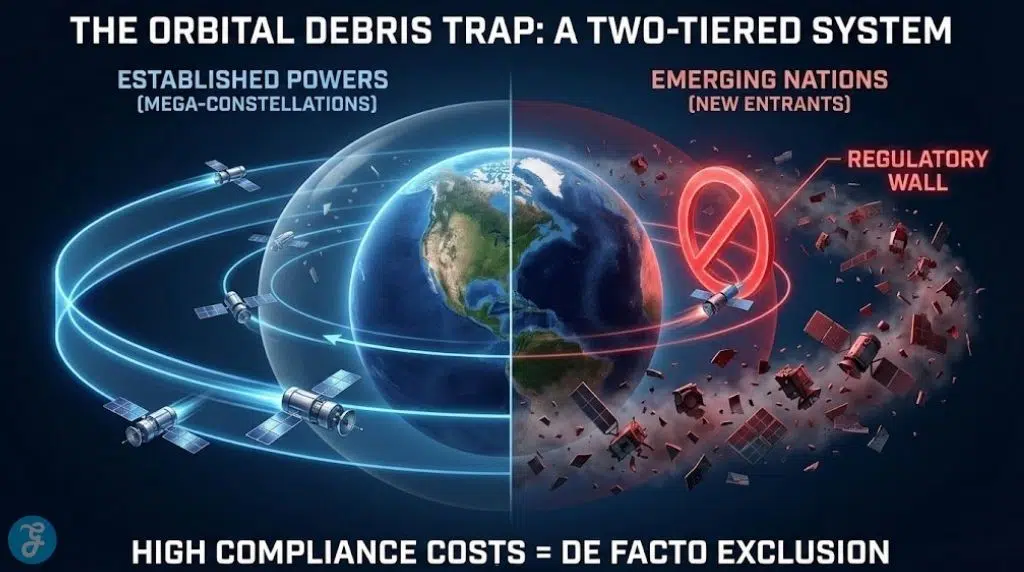
The back-stage reality reveals a completely different strategic objective. Superpowers with existing mega constellations are writing rules that only they can afford to follow. By setting the technical barrier to entry astronomically high, they effectively claim permanent ownership of prime orbital slots. They are pulling up the ladder after reaching the top of the atmosphere. To understand how this trap is set, we must analyze the specific fear-based narratives being deployed.
The Illusion of “Sustainable Space”
Major spacefaring nations argue that the exosphere has reached a tipping point. They cite the Kessler Syndrome as an imminent threat to all modern telecommunications. This fear-based messaging is designed to gain public consent for exclusionary laws. It frames the entry of new nations into space as a danger to the planet. By emphasizing catastrophe, they justify the immediate closure of the frontier.
The reality is that these “safety” protocols function as a regulatory wall. Emerging nations lack the heritage hardware and deep capital reserves to meet these sudden 2026 standards. This allows established powers to maintain their dominant position without competition. The environmental crisis is being utilized as a tool for market consolidation. This consolidation is most visible when examining the tactical alignment of intelligence and regulatory bodies.
| Public Diplomatic Stance | Hidden Strategic Objective |
| Enforcing strict post-mission disposal rules. | Bankrupting new space agencies with compliance costs. |
| Promoting international debris tracking. | Monopolizing global space situational awareness data. |
| Restricting launches to prevent collisions. | Securing prime orbital slots for private monopolies. |
| Mandating active debris removal technology. | Forcing technology dependency on Western providers. |
The Hidden Mechanics of Orbital Coloniality
Understanding the architecture of this new era requires a deep dive into the specific levers of control. Beyond the legal frameworks, there are mechanical and intelligence-based systems designed to maintain the status quo. These systems ensure that once a nation is locked out, it remains a subordinate player on the global stage. We must first examine how military and intelligence interests dictate these orbital boundaries.
The Security and Intelligence Angle
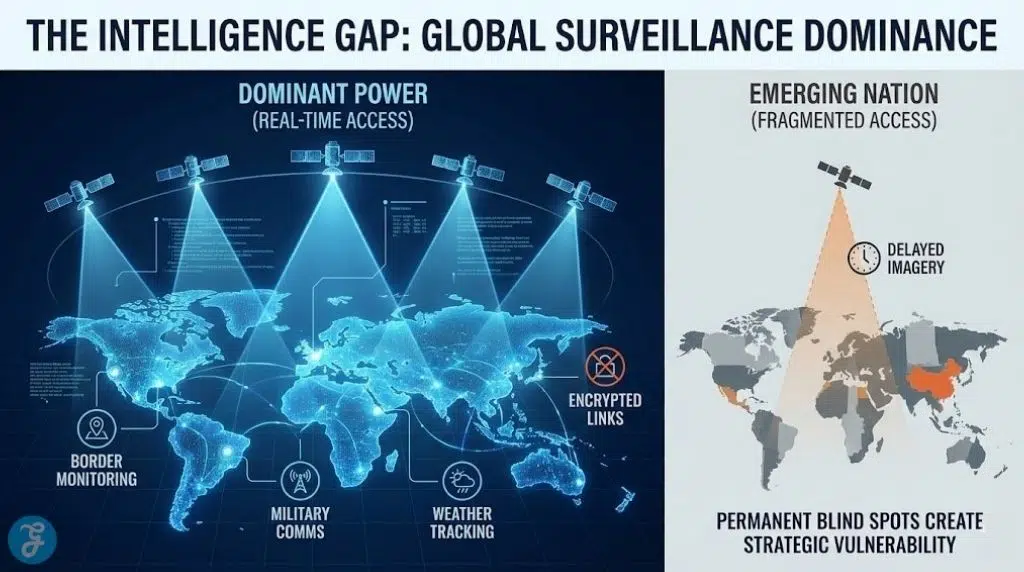
Current debris regulations serve as a flawless mechanism for military gatekeeping. National security apparatuses in dominant countries understand that Low Earth Orbit is the ultimate high ground for surveillance. Allowing developing nations to launch proprietary observation satellites threatens this monopoly on battlefield intelligence. This is the core pillar of the vertical frontier hegemony.
Intelligence agencies are heavily influencing international space law to maintain this chokepoint. If an emerging nation attempts to launch an independent satellite stack, dominant powers can veto the action citing debris hazards. This creates a closed loop of surveillance dominance where emerging states remain blind to troop movements. The intelligence gap between nations is being codified into law, ensuring that some nations always see more than others.
The Weaponization of Space Situational Awareness
Space Situational Awareness (SSA) is currently controlled by a handful of military networks. These entities decide which objects are considered “threats” to the orbital environment. By controlling the data, they control the narrative of who is allowed to launch. An emerging nation has no way to verify if their satellite is truly a debris risk. This lack of transparency turns safety data into a strategic weapon.
This creates a system of “Permit-to-Exist” in the exosphere. Dominant nations use their sensor networks to track and identify every new asset. They can effectively blind an adversary by claiming their satellite poses a collision risk. This allows for the quiet removal of competing intelligence assets under the banner of safety. These security maneuvers are mirrored by equally aggressive economic tactics designed to extract wealth from the digital sky.
| Surveillance Capability | Superpower Status | Emerging Nation Reality |
| Real-time Border Monitoring | Continuous autonomous coverage. | Reliant on purchased imagery. |
| Military Encrypted Comms | Secure sovereign networks. | Vulnerable to foreign jamming. |
| Space Weather Tracking | Proprietary early warning systems. | Dependent on public feeds. |

The Economic Undercurrent
The financial implications of this exclusion go far beyond the aerospace sector. Nations denied access to their own orbital slots are forced to become data vassals. They must purchase essential climate, agricultural, and connectivity data from the very entities monopolizing the sky. This is a fundamental transfer of national sovereignty to foreign corporate entities. It ensures that the economic growth of the developing world is perpetually taxed by those who own the stars.
This dynamic represents the core economic engine of Orbital coloniality in the modern era. Dominant aerospace corporations dictate the price of global connectivity and broadband access. Developing economies are drained of capital just to maintain basic digital infrastructure. These nations are paying a permanent “sky tax” to foreign powers for data generated above their own soil. To see the impact of this, we must look at how national autonomy is being eroded.
The Rise of the Data Vassal
A data vassal is a nation that has lost the ability to observe or connect itself independently. In 2026, the reliance on foreign mega-constellations for agricultural monitoring has become a critical vulnerability. If a provider raises prices or cuts access, an entire nation’s food security can be compromised. This power allows satellite-owning states to influence domestic policies without firing a shot.
The cost of this dependency is becoming visible in the 2026 global market reports. Emerging economies are spending a larger percentage of their GDP on satellite-enabled services than ever before. This capital outflow prevents them from investing in their own domestic space programs. The system is designed to keep the Global South in a perpetual state of technological catch-up. This economic lock-in is further supported by the strategic maneuvering of global power blocs.
| Digital Economy Sector | Cost Under Sovereign Space Access | Cost Under Data Vassalage |
| National Broadband | Capital expenditure for launch. | Perpetual subscription to foreign entities. |
| Precision Agriculture | Free localized telemetry. | High premiums for third-party soil data. |
| Disaster Response | Instant sovereign retasking. | Waiting in a commercial priority queue. |
The Geopolitical Chessboard
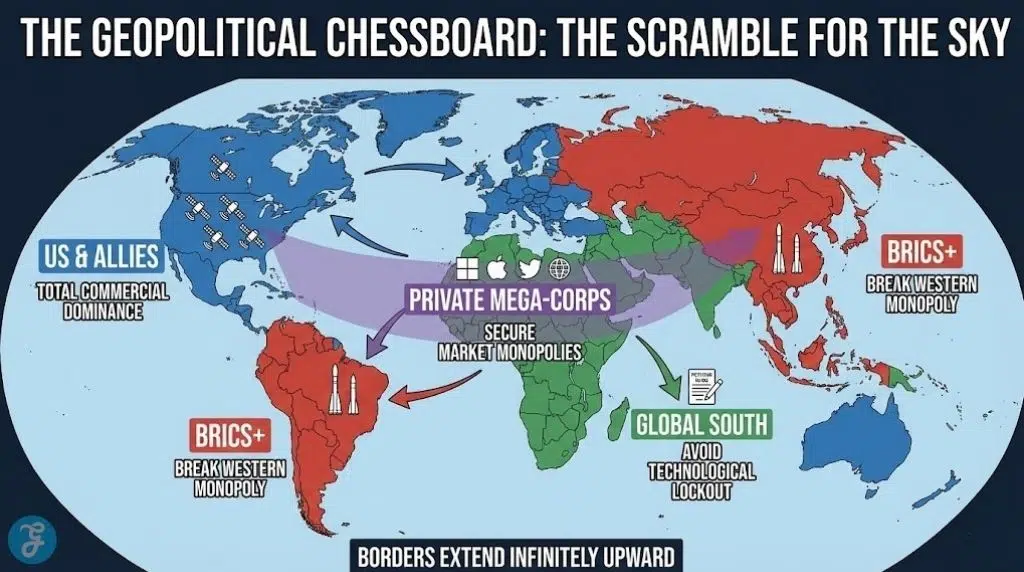
The race for the vertical frontier has triggered an unwritten alliance among established space powers. These nations are quietly forming a sovereign stack cartel to divide the remaining viable orbits before 2030. They are treating the sky exactly like the terrestrial continents during nineteenth-century colonial expansions. The “scramble for Africa” has simply moved to an altitude of five hundred kilometers. This creates a new map of the world where borders extend infinitely upward.
This cartel utilizes backdoor diplomacy to stall technology transfers to the Global South. International regulatory bodies are flooded with complex technical requirements that paralyze smaller space agencies. The geopolitical friction is shifting rapidly from terrestrial borders to orbital altitude. We are entering an era where control of the sky determines control of the ground. The following matrix illustrates how these players are positioning themselves for the next decade.
| Global Block | 2026 Orbital Strategy | Desired 2030 Outcome |
| US and Allies | Privatize and occupy prime LEO slots. | Total commercial data dominance. |
| Global South | Petition UN for equitable access. | Avoid permanent technological lockout. |
| BRICS+ | Launch independent alternative networks. | Break the Western connectivity monopoly. |
Strategic Power and Risk Matrices
The power dynamics of space are shifting faster than terrestrial lawmakers can comprehend. The true winners of the 2026 conference are not environmentalists but corporate mega-constellation operators. Understanding this matrix is essential for predicting the next decade of global conflict. These numbers and projections represent the new frontline of international relations.
| Declared Status | Actual Geopolitical Reality |
| Environmental Protectors | Sovereign Stack Cartel Members |
| Global Connectivity Providers | Digital Data Monopolists |
| Developing Space Agencies | Permanent Data Vassals |
| Debris Mitigation Treaties | Exclusionary Legal Frameworks |
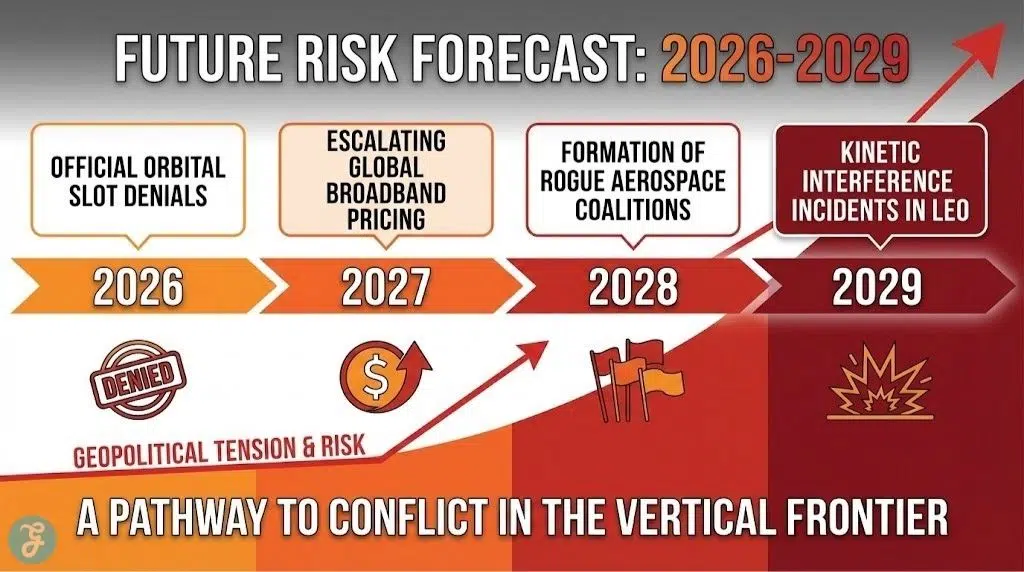
| Timeframe | Projected Security and Economic Risk |
| 2026 | First official denials of emerging nation orbital slots based on debris risk. |
| 2027 | Escalation of global broadband pricing dictated by dominant mega constellations. |
| 2028 | Formation of rogue aerospace coalitions attempting unregulated satellite launches. |
| 2029 | Kinetic interference incidents in Low Earth Orbit to enforce sovereign dominance. |
What’s “Over the Horizon”?
The next eighteen months will define the geopolitical structure of the sky for a century. As the regulations from the Riyadh conference are ratified, we will see the first official denials of orbital slot applications. This legal exclusion will spark unprecedented diplomatic crises at the United Nations. We are nearing a point of no return for space equity. The decisions made now will echo across the vertical frontier for generations.
Emerging economies will soon face a stark choice regarding their technological independence. They must either submit to data vassalage or attempt rogue launches outside the international regulatory framework. The latter option risks severe economic sanctions and potential kinetic interference in orbit. This manufactured debris crisis is the final nail in the coffin of the global common.
The ultimate success of Orbital coloniality depends entirely on our collective willingness to accept environmentalism as a weapon of exclusion. Who truly owns the sky when the tollbooth is built by the very powers who filled it with debris? We must decide if the vertical frontier belongs to all humanity or the highest bidder. The silence of the exosphere masks a battle that will determine the fate of nations on Earth.