

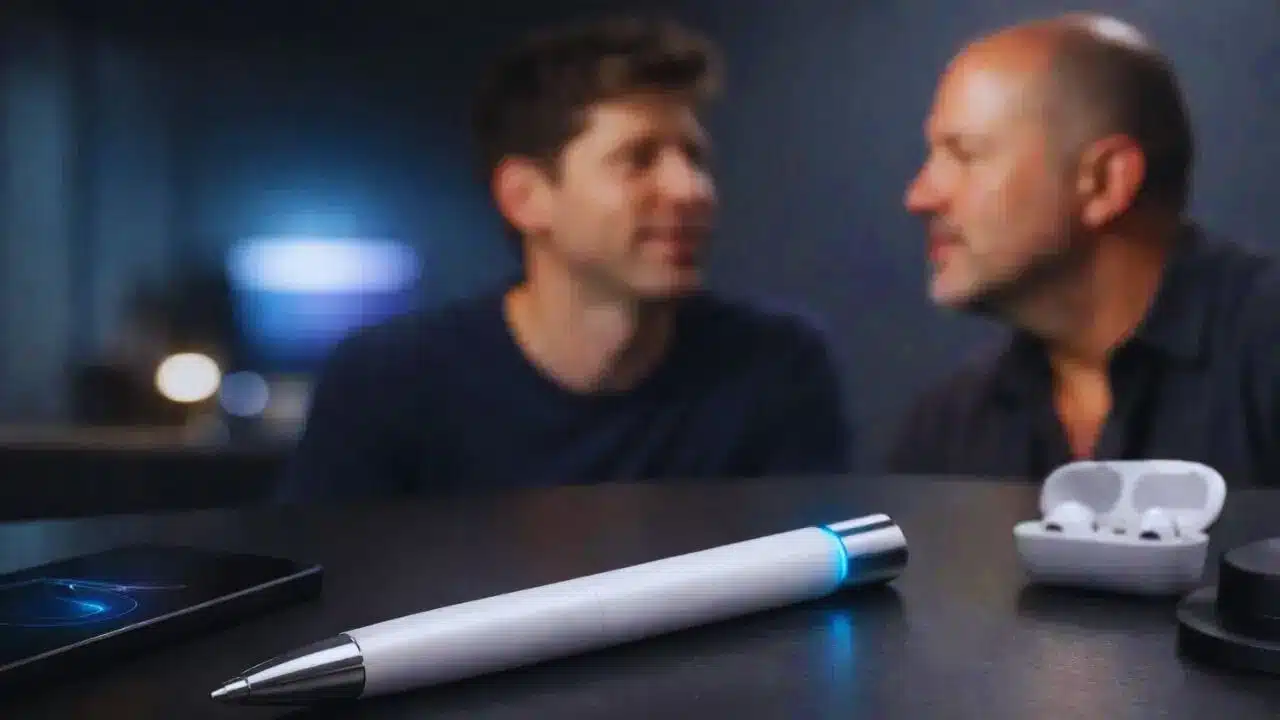
OpenAI AI-powered pen rumors intensified this week after a new leak claimed the company and designer Jony Ive are developing a pen-like AI device for a possible 2026 launch, alongside other prototype hardware ideas.
What the leak claims
Reports circulating this week describe a pen-shaped AI device—often framed as a “smart pen”—as one of the hardware concepts under development by OpenAI and Jony Ive.
One report also said the pen project is part of a broader effort that may include multiple devices, not just a single flagship product.
At least one leak described an internal codename tied to the pen concept and suggested vendor work is being explored ahead of any mass production timeline, though no official product name, specs, or launch schedule have been confirmed publicly.
What’s confirmed so far (and what isn’t)
OpenAI has publicly signaled interest in consumer hardware through its partnership with famed former Apple design leader Jony Ive, but the company has not confirmed a pen form factor.
Court-related reporting tied to the “io/iyO” trademark dispute indicated the first device is not expected to ship before 2026 and described work around a prototype and a planned 2026 release window in that legal context.
Because the “AI-powered pen” details originate from leak-style claims rather than product documentation or a formal OpenAI announcement, the form factor and feature set should be treated as unverified until OpenAI provides on-the-record specifics.
Why a pen could be strategically important
A pen-like device would fit a broader industry push toward “calmer” computing—tools that reduce screen dependence while staying close to everyday workflows like writing, sketching, and note-taking.
Smart pens already exist and typically focus on capturing handwriting, syncing it to a device, and sometimes linking writing to audio recordings.
If OpenAI enters this category, the competitive angle would likely be tighter integration with a conversational AI assistant (for transcription, summarization, search across notes, or turning handwriting into structured tasks), which aligns with how people already use general-purpose AI tools.
How smart pens work today
Many established smart pens rely on sensors/cameras that track writing and map pen strokes onto special patterned paper (often called microdot or “dot paper”).
Some models pair handwriting capture with onboard microphones so users can record audio and later tap notes to replay audio synchronized to the moment of writing.
These existing patterns matter because any OpenAI “AI-powered pen” would need to solve core basics—capture accuracy, battery life, storage, privacy controls, and cross-device syncing—before AI features become the main differentiator.
Existing smart-pen capabilities (reference point)
| Capability commonly offered today | How it typically works | Example evidence |
| Handwriting capture | Camera/sensor tracks pen strokes on microdot paper | Microdot/dot paper explained for smartpens |
| Audio recording | Embedded microphone records audio while writing | Audio recording features described for smartpens |
| Note–audio sync | Playback links recorded audio to specific notes/time | “Tap notes to replay synced recordings” described |
Legal and business context around “io” and a 2026 window
Separately from the pen leak, a legal dispute around the “IO” mark has surfaced unusually specific signals about timing and prototypes.
A U.S. appeals court summary described a temporary restraining order connected to an “AI-based audio computer” and said the product release was intended for 2026 in that context.
The same case narrative described public attention around a May 2025 announcement and indicated the parties viewed their products as a new way to interact with AI, positioned against traditional computing.
Key timeline points seen in public reporting and filings
| Date / period | What happened | Why it matters |
| Jan 2025 | OpenAI filed a trademark application broad enough to cover multiple hardware categories, alongside other product areas. | Trademarks can be defensive, but they show areas a company wants protected. |
| May 2025 | “IO” (linked to Sam Altman and Jony Ive) was publicly announced and drew major attention, later becoming central to a trademark dispute narrative. | The dispute provides rare external detail about prototypes and timing. |
| Jun 2025 | Court-document-based reporting said the first OpenAI/Ive device wouldn’t be wearable/in-ear and was unlikely before 2026. | Narrows likely form factors and reinforces a 2026+ window. |
| Dec 2025 | New leak reports described a pen-like AI device and suggested multiple hardware concepts may be underway. | Fuels the “AI-powered pen” narrative, but remains unconfirmed. |
Market reality: pens are small, but growing
Third-party market research estimates the global smart pen market was about USD 570 million in 2023 and could reach about USD 1.71 billion by 2032, citing a 13% CAGR for 2024–2032.
That growth is commonly linked to digital education tools and workplace digitization, which makes the category attractive even before adding generative AI features.
If OpenAI does ship an AI-powered pen, the device would enter a market where hardware margins can be thin, so subscription attach (premium AI features) or enterprise/education partnerships could matter as much as the pen itself.
What readers should watch next
The most important next step is an official statement: a product announcement, a developer preview, or regulatory/trademark updates that move beyond broad filings and leak claims.
If OpenAI and Ive do pursue a pen-like device, expect scrutiny on privacy and on-device controls—especially if the product records audio, captures handwriting, or continuously listens in the background.
Pricing, availability, and “must-have” features will likely determine whether this becomes a mainstream productivity tool or a niche accessory for students and creators.
Final thoughts
A pen-shaped AI device is plausible because it builds on proven smart-pen mechanics while offering a natural lane for AI: turning handwriting and spoken context into searchable, structured knowledge.
Still, the “OpenAI AI-powered pen” remains a leak-driven story today, with the firmest externally surfaced signal being a broader 2026 timeframe tied to public reporting and legal context around prototypes.
Until OpenAI confirms the design and feature set, the safest read is that the company is exploring multiple hardware directions—one of which may be an AI-powered pen—rather than locking in a single, finalized product.





















