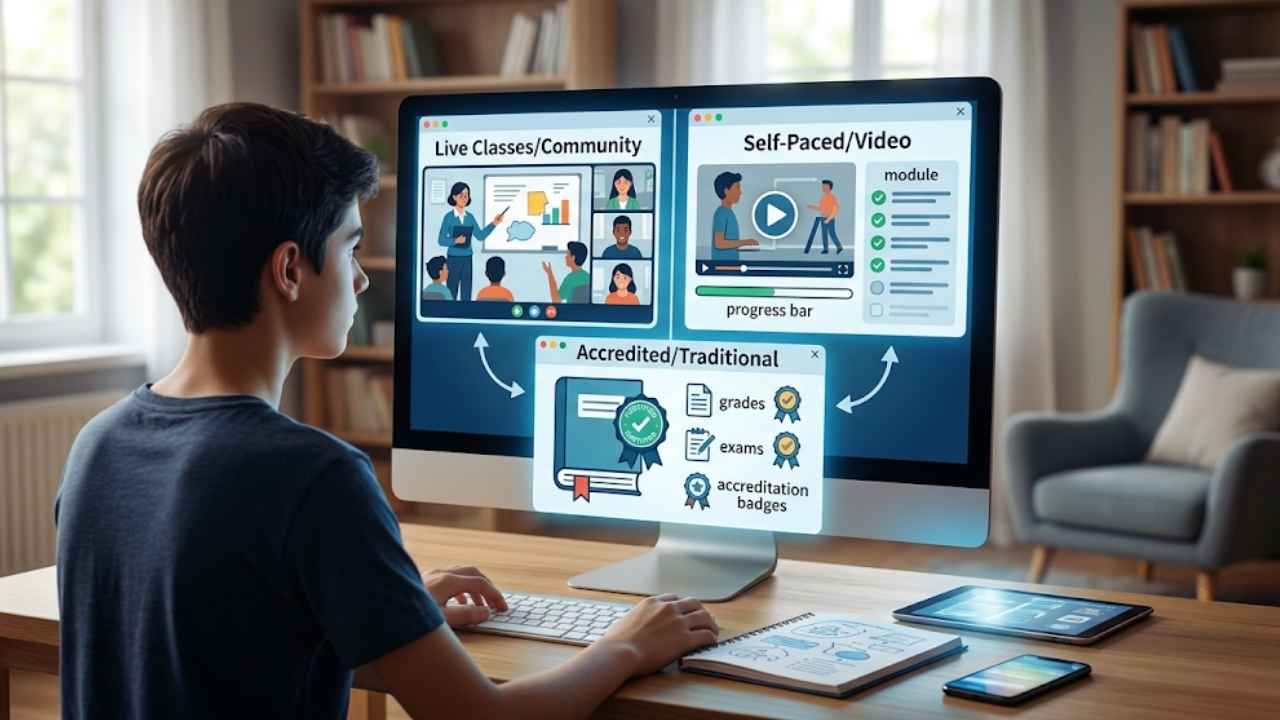
Online curriculum shopping becomes confusing quickly. One provider sells sequenced lessons but leaves the parent responsible for teaching and records. Another offers adaptive practice rather than full courses. A third is an online school with teachers, formal grades, and a diploma pathway.
Their websites may use the same words: complete, flexible, accredited, personalized, or all-in-one. Those labels do not tell families who grades an essay, whether a teacher is available, who issues a transcript, or how much daily supervision the learner will need. With online curriculum compared carefully, the first decision is not which brand has the largest course library. It is what the family wants to outsource.
A working parent may need lessons prepared in advance. A first-time homeschooler may need a clear sequence. A neurodivergent learner may need shorter videos, untimed work, or text-to-speech. A high school student may need formal credits and recognized records. The right choice should reduce a real pressure point. It should not add another dashboard, duplicate subscription, or unfinished lesson queue.
Curriculum, Practice Platform, and Online School Are Not the Same
A self-paced online curriculum generally provides ordered lessons, activities, quizzes, and parent reports. The learner works through the material at home, while the parent remains responsible for oversight and, in many cases, grades, legal records, and graduation decisions. A practice platform focuses more narrowly on skills. It may identify gaps and provide hundreds of questions without offering a complete teaching sequence in every subject.
A resource library supplies lessons and materials but expects the parent to decide what to use, in what order, and how to assess it. An online school goes further. It may enroll the learner, provide teachers, grade work, maintain official records, award credits, and issue a diploma. Paying for curriculum does not automatically mean enrolling in a school. This distinction becomes especially important during high school.
Online Curriculum Compared at a Glance
| Option | Main Role | Most Useful For | Responsibility That Remains |
| Time4Learning | Self-paced PreK–12 curriculum | Families wanting a prepared sequence and automatic activity reports | Parent remains teacher of record |
| Miacademy and MiaPrep | Flexible K–12 curriculum platforms | Learners needing adjustable pacing, short lessons, electives, and parent controls | Curriculum membership does not issue a school diploma |
| Khan Academy | Free lessons and practice | Subject support, mathematics, science, review, and test preparation | Parent must build the wider program |
| IXL | Skills practice and diagnostic guidance | Finding and practicing mathematics and language gaps | Extended teaching, projects, and writing feedback |
| Oak National Academy | Free England-aligned lesson resources | Parent-led lessons, revision, and planning | A parent chooses sequence, assesses work, and keeps records |
| Full online school | Teacher-supported school enrolment | Families needing grading, transcripts, and a possible diploma | Less freedom and a much higher financial commitment |
Time4Learning Offers Structure Without School Enrolment
Time4Learning provides self-paced online curriculum from preschool through Grade 12. At the time of writing, membership costs US$39.95 per learner each month and includes up to seven courses. Learners in Grades 6–12 can add courses for an additional monthly charge. Billing runs every 30 days, and discounts may be offered for annual plans or additional students.
The main benefit is reduced planning. Families receive a defined lesson sequence, printable activities, scheduling tools, automatic grading for supported activities, and parent reports. It does not remove the parent’s academic responsibility. Time4Learning identifies itself as a curriculum rather than a school. It does not independently award high-school credits or issue diplomas. Parents remain the teachers of record and decide how to evaluate courses, assign credit, and prepare official homeschool documents.
That makes it a reasonable starting point for a family that wants daily work prepared without enrolling in a private online school. It is less convincing for households expecting regular teacher feedback. Automated scores may help with quizzes and short-answer work, but they do not replace detailed comments on essays, projects, laboratory reports, or oral presentations.
Time4Learning currently recommends a device with a screen of at least 10 inches, a stable internet connection, and Chrome or Firefox. Its site states that Amazon Fire tablets are not supported. Families planning to rely on a tablet should confirm compatibility before subscribing.
Miacademy and MiaPrep Allow More Customisation
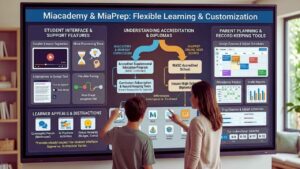
Miacademy covers K–8, while MiaPrep provides courses for older learners. Families can assign courses, adjust schedules, track attendance, review grades, and choose material from different grade levels or course groups. Current standard monthly pricing is US$48 per child for Miacademy and US$54 per child for MiaPrep. Annual and lifetime plans are also offered, and trial promotions may change.
These platforms put more visible emphasis on flexible learning. Their current feature descriptions include short instructional videos, text-to-speech, untimed tests, dark mode, flexible pacing, electives, and a moderated student community.
Those features may help a learner who needs the following:
- Smaller lesson segments
- More processing time
- Work above or below one assigned grade level
- A mixture of core subjects and electives
- Parent control over daily assignments
- Alternatives to dense blocks of text
The community, virtual rewards, and in-platform activities will appeal to some learners and distract others. Families should inspect the student interface rather than choosing solely from the parent-facing feature list.
The accreditation language needs careful reading. Miacademy describes itself as accredited as a supplemental education program. WASC confirms that it accredits supplementary education programs as well as schools, but these are distinct categories. A supplemental-program accreditation does not turn a curriculum subscription into school enrollment or make the provider responsible for issuing a diploma.
MiaPrep makes the same practical distinction for high school: its curriculum includes recordkeeping tools, but MiaPrep Online High School is the separate diploma-granting school.
Khan Academy Is the Broadest Free Option Here
Khan Academy provides free educational videos, articles, exercises, quizzes, and course challenges. Its strongest coverage is in mathematics, science, computing, economics, grammar, and test preparation, although the exact course catalogue changes over time.
Parents can create accounts for learners, assign material, and review activity. Accounts for children under 13 are created and managed through a parent account, and Khan Academy advises families not to place identifying information in a child’s username.
The platform is especially useful when a learner needs the following:
- Another explanation of a mathematics concept
- Practice before moving to harder work
- Review of an earlier topic
- Independent high-school study
- SAT or other supported test preparation
- A free supplement to a paid curriculum
Khan Academy is not an accredited school. It does not provide formal enrollment, transcripts, school grades, credits, or a diploma. Its own homeschool guidance presents it as a resource that families must place within a wider education plan.
That distinction prevents a common mistake. A large free course library can look like a complete curriculum, but the parent still has to decide what to teach, what to skip, how to cover writing and practical work, and how to maintain records. Khan Academy is the most broadly useful free option in this comparison. It is not the most hands-off.
IXL Is Strongest When the Problem Is a Skill Gap
IXL offers skills across mathematics, language arts, science, social studies, and Spanish, with coverage varying by country and membership package. Its diagnostic tools estimate current skill levels and produce suggested next steps in supported subjects. On its U.S. family subscription page, the current package covering mathematics, language arts, science, and social studies is listed at US$19.95 per month for one child, plus applicable tax. International prices, currencies, and subject packages differ, so families should use the version of the site for their location.
IXL is useful when a parent knows the learner is struggling but cannot identify the exact missing skill. It can also provide regular practice without requiring someone to create new problem sets each day. Its strength is repetition and measurement. That is also its limit.
A skills platform cannot replace sustained reading, essay feedback, open-ended investigations, laboratory work, creative projects, or thoughtful discussion. For many homeschool families, IXL works better as a focused practice tool than as the center of the whole curriculum.
Parents should also watch how the learner responds to constant scoring. Some students find visible progress motivating. Others focus so heavily on the score that corrections become stressful. A short trial should include ordinary difficult work, not only familiar questions the learner can complete easily.
Oak National Academy Is a Resource Library, Not a School
Oak National Academy provides free lessons and teaching resources covering Year 1 through Year 11. Its pupil materials include videos, quizzes, and lessons, while its teacher resources include worksheets, slide decks, curriculum plans, and downloadable units.
The material is designed around England’s education system. At Key Stage 4, some subjects are organized by GCSE examination board, including AQA, Edexcel, OCR, and Eduqas options where relevant.
That makes Oak particularly useful for the following:
- Families following England’s national curriculum
- Parents teaching an unfamiliar unit
- GCSE revision
- Replacing a missing lesson
- Building a free parent-led program
- Downloading worksheets and quizzes
Oak’s own parent guidance describes the service as a platform providing free lesson-planning and teaching resources. It does not enrol the child or take responsibility for the full homeschool program.
Families outside England can still use the lessons, but the terminology, sequence, subject emphasis, and examination preparation may not match local requirements. Oak is more organized than a random collection of free worksheets. It is still a set of resources that a parent must select, adapt, assess, and document.
A Full Online School Solves a Different Problem
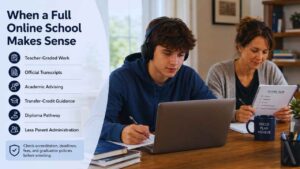
A family comparing curriculum subscriptions may eventually realize that curriculum is not what they need. They may need an institution to take responsibility for teaching, grading, academic records, and graduation planning.
MiaPrep Online High School shows how different that service is from buying MiaPrep curriculum. The school currently offers certified teachers, academic advising, marked work, office hours, live learning opportunities, official credits, transcripts, and a diploma route. Its Grade 9–12 school accreditation is separate from the supplemental accreditation of the self-paced curriculum.
The financial difference is substantial. At the time of writing, its core school tuition is US$440 per month or US$4,840 annually, with some materials and optional courses charged separately. Pricing, enrollment dates, assistance, and state funding options can change.
A full online school may be worth comparing when the family needs the following:
- Teacher-graded assignments
- Official transcripts
- Transfer-credit decisions
- Academic advising
- A recognised diploma route
- External accountability
- Less parental responsibility for high-school administration
It also means accepting the school’s course requirements, grading rules, deadlines, fees, and graduation policies.
Before enrolling, confirm the school’s accreditation directly, then ask the intended university, school, licensing authority, or employer whether its credits and diploma will meet their requirements. Recognition is never something to assume from a marketing phrase.
Which Option Reduces Work for a Working Parent?
Working parents often need a prepared sequence more than unlimited course choice. Time4Learning, Miacademy, or MiaPrep may reduce lesson planning because the core material is already arranged. Khan Academy and Oak can save money, but they generally require more parental work to build a balanced program.
None of these curriculum subscriptions is completely hands-off. A younger learner may still need help logging in, reading directions, finding offline materials, staying on task, and recovering from a technical problem. A self-paced course allows flexible timing; it does not promise independent study.
Before paying, ask how much work remains outside the platform:
- Does the parent need to grade essays?
- Are science materials supplied?
- Are books included?
- Does the learner need daily scheduling?
- Who reviews open-ended work?
- Does the parent create the transcript?
- How are missed lessons handled?
A practical homeschooling with technology routine should also give the learner one assignment hub, predictable login details, and a clear place for files. Curriculum software cannot compensate for a fragmented household system.
First-Time Homeschoolers Should Avoid Buying Several Core Programs
New homeschoolers often respond to uncertainty by subscribing to multiple platforms. That creates overlapping lessons, several reporting systems, conflicting terminology, and more work than the child can reasonably finish. Begin with one core structure. Add another service only when it fills a defined gap.
A workable combination could be:
- Time4Learning or Miacademy for the main sequence
- Khan Academy for extra mathematics explanation
- IXL for a specific skills gap
- Oak for an England-aligned topic
- A live tutor for writing feedback or advanced mathematics
Each tool needs a job. When two subscriptions perform the same role, one is probably unnecessary. Annual discounts are poor value when the family has not yet seen how the learner handles a normal week inside the platform.
Neurodivergent Learners Need the Actual Lesson Format
Words such as flexible, adaptive, and accessible are not detailed enough to support a buying decision.
A parent should inspect how the lesson behaves:
- Can spoken instructions also be read?
- Can videos be paused and replayed?
- Are quizzes timed?
- Does the learner have to type long answers?
- Can lessons be assigned outside one grade level?
- Are animations, avatars, and rewards optional?
- Does an incorrect answer produce an explanation?
- Can the learner work in shorter sessions?
- Are captions available and accurate?
- Can offline or oral work be recorded?
Miacademy currently lists text-to-speech, untimed tests, dark mode, short videos, and flexible scheduling. Those are useful starting points, not proof of individual suitability. A learner who prefers predictable computer-led instruction may thrive in a self-paced program. Another may need live explanation and conversation. A third may understand the subject but struggle with the program’s typing, visual density, rewards, or scoring system.
Use a trial with ordinary schoolwork. Testing only an entertaining elective or an easy lesson gives a misleading impression. A wider homeschooling with technology plan should connect curriculum choice with device access, attention needs, communication preferences, and accommodations already known to help.
Count the Costs Outside the Subscription
The advertised monthly fee rarely represents the full cost.
Families may also need:
- Printed workbooks
- Novels or textbooks
- Science and art supplies
- Printer ink
- Tutoring
- Examination or assessment fees
- Extra courses
- A compatible device
- Currency conversion and taxes
- Recordkeeping tools
- Time spent replacing weak lessons
Check the cancellation and refund terms before paying. Set a reminder before a trial converts into a normal subscription or before the next annual charge. Download reports, grades, certificates, and useful work samples before cancelling. Access to the parent portal may change when membership ends.
Questions to Ask Before Choosing
A provider should be able to answer these questions clearly:
- Is this a curriculum, practice service, resource library, or school?
- Who teaches and grades the learner’s work?
- Who creates the transcript?
- Does the program award credits or a diploma?
- Which subjects need additional books or supplies?
- Can the learner work at different levels by subject?
- Are written assignments reviewed by a person?
- Which accessibility tools are included?
- Can records be exported?
- What happens when the subscription ends?
- Does the program work in the learner’s country and on the available device?
- What is the full cost after additional children, courses, tax, and materials?
Vague answers are useful information. A family should not need to guess what it is buying.
Final Thoughts
With online curriculum compared by responsibility rather than marketing language, the choices become clearer. Time4Learning and Miacademy reduce planning but leave the parent in charge of the homeschool. MiaPrep serves older learners under a similar curriculum model, while its separate online school provides a diploma-granting route at a much higher cost. Khan Academy is the strongest free general supplement in this group. IXL is most useful for focused skills practice. Oak National Academy offers well-organized, free material for families using or borrowing from England’s curriculum.
Choose the service that removes the family’s biggest recurring pressure. Test the actual learner experience, confirm who owns the records, and calculate the work that still falls to the parent. The right curriculum should make an ordinary week easier to understand. If it creates more logins, more unfinished lessons, and more administration, its feature list is not solving the problem.
Frequently Asked Questions (FAQs) About Online Curriculum Compared
What Is the Best Online Curriculum for Homeschooling?
There is no single best option for every family. Time4Learning and Miacademy suit families wanting a prepared sequence, while Khan Academy works better as a free supplement, and IXL is stronger for targeted skills practice.
Is an Online Curriculum the Same as an Online School?
No. An online curriculum usually provides lessons and activities while the parent remains responsible for teaching, records, and transcripts. An online school may enroll the learner, provide teachers, grade work, and issue official records or a diploma.
How Much Parent Involvement Does an Online Homeschool Curriculum required?
The amount varies by the learner’s age and the program. Younger children often need help with logins, instructions, materials, and staying on task, even when lessons are described as self-paced.
Can Online Curriculum Be Used for High School Credits?
Yes, but the parent may need to assign and document the credits unless the learner is enrolled in a recognized online school. Families should check local homeschool rules and future school or university requirements before finalizing a high school plan.
How Should Families Choose When Comparing Online Curricula?
Compare who teaches, who grades, what subjects are included, whether records can be exported, and how much work remains for the parent. A free trial or monthly plan is usually safer than paying annually before testing the learner’s normal routine.