

Federated learning is a decentralized machine learning framework that enables models to train on local data stored across edge devices or regional servers without transferring the raw underlying records to a central repository.
Instead of centralizing sensitive data—such as private messages, healthcare records, financial activity, or personal device behavior—a coordinating server distributes a base model to local participants. Each device trains the model locally and returns encrypted parameter updates, which are aggregated to improve a single shared model.
By keeping raw data localized, federated learning satisfies core privacy-by-design principles, supports regulatory compliance (such as GDPR and HIPAA), and significantly minimizes the breach surface area.
However, while privacy advocates endorse federated learning as a privacy-conscious architecture, it is not an absolute privacy guarantee. Complete security still requires complementary protections—like differential privacy and secure aggregation—to defend against model poisoning, bad actors, or gradient data leaks.
What Federated Learning Actually Changes
Federated learning is a distributed machine-learning approach in which several clients collaborate on a shared model while retaining their local training data.
A client could be:
- A smartphone
- A hospital
- A bank
- A vehicle
- A factory
- A regional office
- An edge server
The best-known early work focused on mobile devices containing private and unevenly distributed data. Researchers proposed Federated Averaging, commonly called FedAvg, as a way for devices to perform local training while a central server combined their updates.
The word federated can create the impression that the system is fully decentralized. Most implementations are not. A central coordinator commonly decides which clients may participate, distributes the current model, receives protected updates, and produces the next global version.
The raw data is distributed. Control of the training process may remain highly centralized.
How a Training Round Works
A conventional federated-learning round begins with a shared model held by the coordinator.
The server selects a group of eligible clients and sends them the current model together with training instructions. Eligibility may depend on device availability, network conditions, battery state, software version, maintenance windows, or institutional approval.
Each client trains locally. A phone might use interaction data stored on the device. A hospital might train within its own secured environment. The local process produces parameter changes, gradients, or another form of model update rather than a copy of the original records.
Those updates return to the coordinator, often through encrypted connections and sometimes through a secure aggregation protocol. The server combines them to create a new global model.
In the original FedAvg method, client contributions are weighted by the amount of local training data rather than simply averaged as equal votes. Modern systems may use other aggregation methods to improve robustness, fairness, or resistance to malicious participants.
The updated model then enters another round.
The mechanics sound straightforward. Production conditions are not. Some clients disappear midway through training. Others hold only a few examples. One institution may serve a very different population from another. A model that performs well on average may still work poorly for smaller client groups, languages, regions, or device types.
That is why evaluation must look beyond a single global accuracy score.
Cross-Device and Cross-Silo Learning Are Different Projects
Federated learning usually appears in one of two operational settings.
Cross-device federated learning
Cross-device systems train across large numbers of phones, vehicles, or other consumer devices. Participants are numerous, intermittently connected, and constrained by processing power, battery, storage, or mobile bandwidth.
Only a small share of eligible devices may participate in any round. Devices run different software versions, disconnect unexpectedly, and contain highly personal local datasets.
Google has documented federated-learning deployments involving Gboard, Messages, Assistant, emoji prediction, and Smart Text Selection. More recent Gboard work combines federated training with user-level differential privacy rather than treating local training alone as sufficient protection.
Cross-device learning is primarily an orchestration and scale problem. The system has to learn from millions of unreliable clients without degrading the user’s device experience.
Cross-silo federated learning
Cross-silo systems involve a smaller number of known organizations or managed infrastructure environments, such as hospitals, financial institutions, laboratories, or business units.
The servers are usually more dependable. The difficult part is governance.
Participants must agree on:
- What the model should predict
- How fields and labels are defined
- Which clients may join
- When updates are exchanged
- How performance is evaluated
- Who investigates failures
- What each organization is allowed to learn
Two hospitals may record the same diagnosis differently. Two banks may use identical field names for different concepts. Federated learning does not resolve those disagreements.
Cross-silo learning is often the easier engineering project and the harder institutional one.
Why Privacy Advocates Support Federated Learning
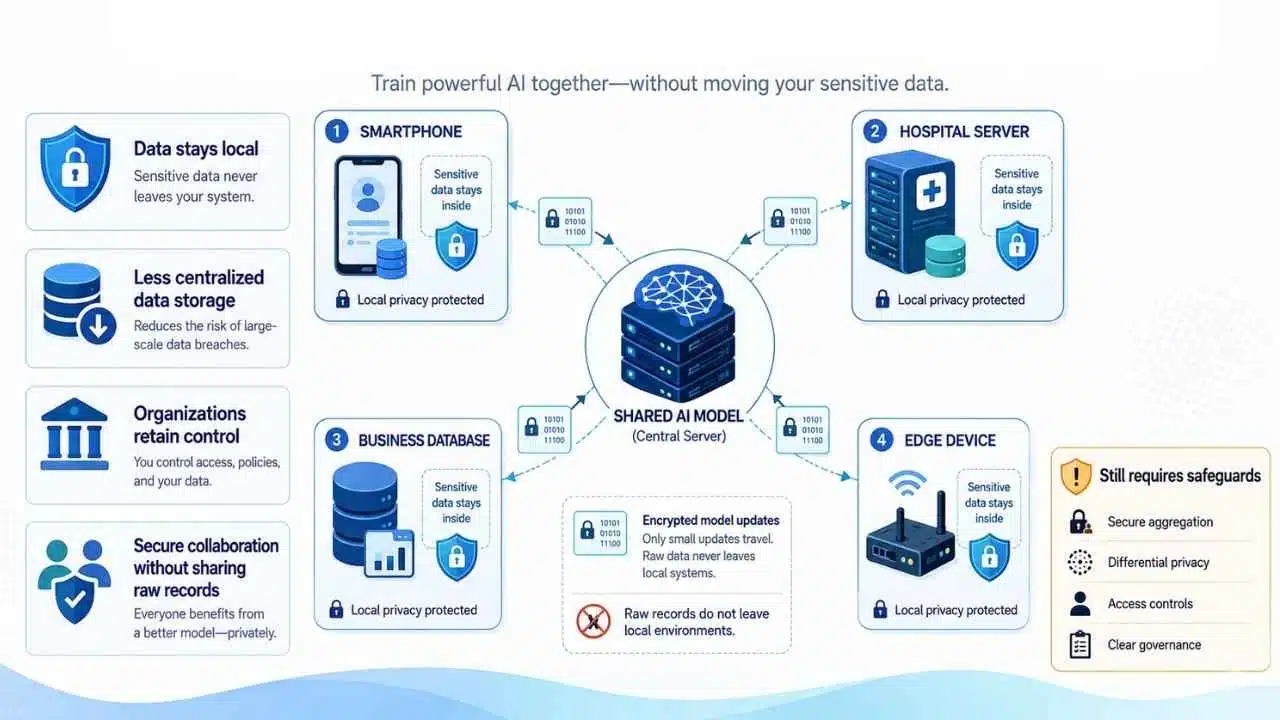
The strongest privacy argument is data minimization.
Traditional centralized training may create another full copy of sensitive records. That repository must then be secured, governed, audited, retained, and eventually deleted. Federated learning can reduce the need for that copy because the source data remains within the local environment.
This can help data owners retain more practical control. A hospital can keep records within its existing infrastructure. A business unit can participate without handing its complete customer database to a central team.
A breach of the coordinator may also expose less raw source data than the compromise of a conventional training lake. The benefit depends heavily on implementation. A server that retains client identifiers, detailed logs, individual updates, model checkpoints, and extensive metadata may recreate part of the exposure the architecture was meant to reduce.
Federated learning also creates a useful technical boundary between participants. Organizations can collaborate on a shared model without granting one another direct access to their records.
It does not remove the need for contracts, consent, access controls, retention rules, or regulatory review. It changes the mechanics of collaboration; it does not settle whether the training is lawful or appropriate.
Why Federated Learning Is Not Private by Default
“The data never leaves the device” is an incomplete privacy claim.
The raw records may stay local, but information derived from them still moves through the system.
Model updates can expose training data
Gradients and parameter changes encode information about the examples used during local training. Under certain conditions, attackers may infer labels, test whether a record participated, or reconstruct parts of an input.
The risk changes with the model architecture, batch size, update format, number of participating clients, and attacker access. A large aggregate from thousands of clients is not equivalent to one detailed update from a single hospital.
The important point is simpler: an update should not be treated as anonymous merely because it is not a raw record.
The coordinator holds considerable power
The server may choose participants, set training parameters, distribute different model versions, observe timing information, and decide which records to retain.
A credible design should state whether the coordinator is trusted, honest-but-curious, compromised, or potentially malicious. A privacy promise that depends entirely on the server operator choosing not to inspect available information is fragile.
A malicious participant may submit an update designed to reduce accuracy, favour a chosen outcome, or create a hidden backdoor that activates only when a specific pattern appears.
Defending against these attacks is difficult because legitimate client updates can differ sharply. An unusual update might come from an attacker, a malfunctioning client, poor-quality data, or a genuine minority population that the global model represents badly.
Rejecting every outlier may improve security while worsening fairness.
The final model creates a separate risk
Protecting client updates does not prove that the trained model is safe.
Models can memorize rare examples or support membership and inference attacks after deployment. Input privacy during training and output privacy in the finished model are different problems. Both belong in the threat model.
The Controls That Make the Privacy Claim Credible
Keeping records local is only the first layer.
Secure aggregation protects individual updates
Secure aggregation allows the server to calculate a combined result without viewing each participant’s update separately. Practical protocols can continue operating when some clients drop out before the round finishes.
This is valuable when the coordinator should learn only the aggregate.
It does not protect the finished model, guarantee that aggregates reveal nothing, or stop a malicious client from contributing a harmful update. It also limits visibility: the server cannot easily inspect an individual contribution for signs of poisoning if the protocol is designed to hide it.
Secure aggregation improves update confidentiality. It does not solve every security problem in the training process.
Differential privacy limits individual influence
Differential privacy limits how much one person or client can affect the released result. Federated implementations commonly clip contributions and add calibrated noise while tracking cumulative privacy loss.
The protection can be expressed through a privacy budget, which makes it more meaningful than a vague promise that updates have been “anonymized.”
There is a cost. Too little noise may provide weak protection. Too much can reduce model quality, particularly for rare classes or underrepresented groups. Privacy loss also accumulates across repeated training rounds and releases.
Secure aggregation and differential privacy are complementary. The first hides individual updates from the coordinator; the second limits what the aggregate or final model can reveal about one participant.
Confusing the two leads to weak system designs.
Identity and access controls still matter
Cross-silo deployments need verified identities, certificates, role separation, audit trails, and rules governing which organizations may submit updates or retrieve models.
Cross-device systems need safeguards against fake clients, compromised devices, replayed updates, and attempts to dominate client selection.
Federated architecture does not make ordinary cybersecurity controls optional.
Poisoning requires active monitoring
Teams may clip unusually large updates, compare aggregation methods, test for sudden model changes, monitor participant behaviour, and evaluate the model against known attack patterns.
No defence removes every poisoning risk. The system needs an incident process for suspicious updates and harmful model behaviour rather than assuming the aggregator will handle everything automatically.
When Federated Learning Is Worth Using
Federated learning deserves serious consideration when several conditions are present:
- Valuable training data is already distributed.
- Centralizing it would create a meaningful privacy, security, regulatory, or commercial risk.
- Participants share a useful modelling objective.
- Local environments can support training.
- Repeated communication and coordination are feasible.
- The expected model improvement justifies the added infrastructure.
Potential applications include on-device language models, collaborative medical research, institutional fraud detection, industrial monitoring, and learning across regional operations.
It is usually a poor first choice when all data already sits inside one adequately governed platform. It also adds little when each client holds too few useful examples or when participants cannot agree on labels and evaluation.
Federating an unclear data problem produces a distributed version of the same confusion, with higher operating costs.
The Engineering Cost Is Easy to Underestimate
A federated deployment must deal with uneven datasets, unavailable clients, interrupted rounds, incompatible model versions, bandwidth constraints, local compute limits, identity management, and limited visibility into remote failures.
Debugging is particularly awkward. In centralized training, an engineer can inspect the batch that caused an error. In federated training, the coordinator may see only an aggregate failure or a missing update from an environment it cannot access.
Reproducibility is also harder. A later training run may involve a different set of clients with different local data and availability.
The privacy benefit is purchased with orchestration, monitoring, and governance work. That trade may be justified, but it should appear in the project plan and budget from the beginning.
Choosing a Federated Learning Framework
Several open-source frameworks can reduce the amount of infrastructure a team must build.
TensorFlow Federated is most suitable for research teams and engineers developing federated algorithms around TensorFlow models. Its documentation emphasizes simulation, custom federated computations, training, and evaluation.
Flower is the more flexible starting point for teams using several machine-learning libraries. It supports simulation and deployment workflows and provides examples for PyTorch, TensorFlow, scikit-learn, and other stacks.
NVIDIA FLARE is aimed more directly at controlled multi-party and cross-silo deployments. Its documentation covers administration, authentication, authorization, simulation, and adaptation of existing workloads.
The choice should follow the operating environment:
- Choose TensorFlow Federated when algorithm research and TensorFlow integration are central.
- Compare Flower first when framework flexibility and a gradual path from simulation to deployment matter.
- Consider NVIDIA FLARE for structured cross-organization projects that need stronger administrative controls.
None of these frameworks defines the privacy threat, aligns incompatible datasets, sets an acceptable privacy budget, or decides who owns an incident. Those remain architecture and governance responsibilities.
What to Check Before Building
Before selecting a framework, answer the harder questions:
- Why would centralized training create unacceptable risk?
- Who controls the coordinator?
- What can that coordinator learn from updates and metadata?
- Can clients be malicious or compromised?
- Will secure aggregation protect individual contributions?
- Is differential privacy required for the aggregate or final model?
- How different are the participants’ datasets?
- What happens when clients fail or disconnect?
- How will performance be assessed across participant groups?
- Who investigates leakage, poisoning, or harmful output?
A team that cannot describe the threat should not claim that federated learning solves it.
Final Thoughts
Federated learning is attractive because it challenges the assumption that effective machine learning requires collecting everyone’s raw data in one place. That can produce a real privacy improvement. It can reduce unnecessary transfers, preserve local control, and limit the growth of centralized data stores.
The architecture still exposes updates, metadata, infrastructure, and a trained model. Secure aggregation, differential privacy, authentication, poisoning defences, monitoring, and governance are part of the core system—not optional additions to be considered after deployment.
Start with the threat model rather than the framework. Identify which data movement creates unacceptable risk, what each participant is permitted to learn, and how the system will respond when a client or coordinator behaves badly.
Federated learning earns its complexity when keeping data local produces a specific, measurable privacy benefit that a simpler architecture cannot provide.