

People open an AI tool to complete one fairly ordinary task. They want to summarize a document, improve a paragraph, research a question, generate an image, clean up some data, or get help with code. Instead, they increasingly meet a product trying to become an entire operating system. The chat box now sits beside model selectors, research modes, image tools, project spaces, agents, connectors, canvases, notebooks, app builders, scheduled tasks, marketplaces, memory controls, collaboration features, and several subscription tiers with different usage limits.
Some of these additions are genuinely useful, but collectively, they can make a once-simple tool harder to understand.
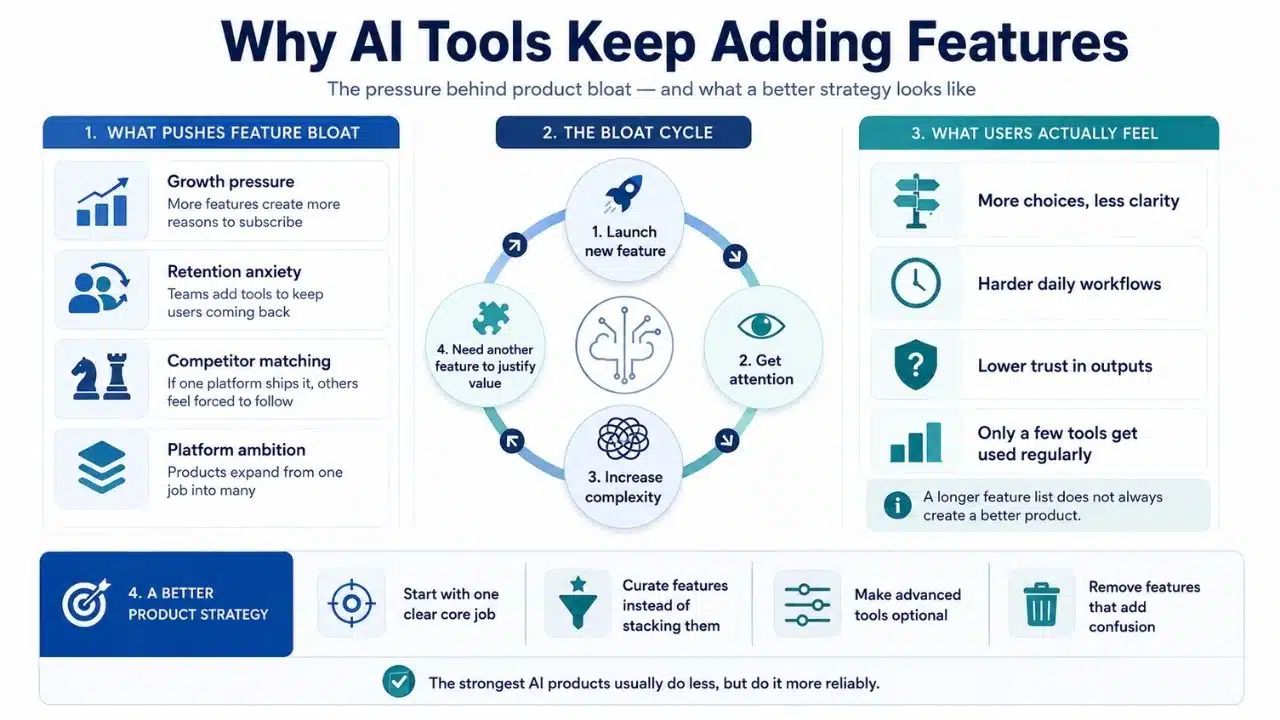
AI tool features bloat is usually explained as the natural result of rapid technical progress. Models can do more, so companies give users more capabilities, but that explanation is incomplete. The stronger force is growth pressure, as AI companies need to attract new users, keep existing subscribers, justify higher-priced plans, appeal to businesses, match competitors, and persuade investors that they are building a durable platform rather than a replaceable chat interface. Adding another feature creates a visible announcement and a fresh reason to upgrade, whereas improving an existing feature from unreliable to dependable is far less dramatic. This is how a useful product gradually loses its identity.
How AI Tool Features Bloat Expanded Beyond the Chatbot
The leading AI assistants are converging on a remarkably similar destination. ChatGPT has expanded beyond conversation into projects, deep research, file analysis, image creation, coding, connected apps, scheduled work, plugins, and longer-running agent tasks. OpenAI’s product materials describe ChatGPT Work as capable of researching information, working across connected apps, and producing documents, spreadsheets, presentations, reports, and websites.
Similarly, Gemini now covers research, image and video generation, Canvas, custom Gems, connected Google services, personalization, quizzes, audio overviews, app creation, and multi-step actions across supported Android apps, making Google’s help center a long directory of distinct workflows rather than documentation for a single assistant. Claude has moved from a writing and reasoning assistant toward shareable apps, tools, visualizations, code execution, reusable content, and integrations across desktop and workplace software, with its Artifacts feature developing into a separate creation environment. Meanwhile, Microsoft 365 Copilot includes agents, notebooks, research tools, content creation, workplace search, podcast-style summaries, automation, and integrations across Microsoft’s business software.
None of these features is automatically useless. Deep research solves a different problem from ordinary chat, a coding workspace can be valuable, and connected files make workplace answers more relevant. The problem appears when every major tool starts absorbing every available use case simultaneously. A product that tries to become a researcher, designer, developer, analyst, browser, meeting assistant, automation system, tutor, shopping guide, and workplace knowledge layer is no longer expanding around one clear job. It is competing for ownership of the user’s entire digital routine, driving AI feature creep on a platform scale.
Growth Pressures Driving AI Tool Features Bloat
Subscription software faces a basic economic problem: acquiring a paying user is not enough, because that user must continue finding enough value to renew month after month. Bloated AI products appear particularly exposed to this retention pressure. RevenueCat’s 2026 subscription-app report found that AI apps converted downloads into paying customers more effectively at the median and generated more revenue per payer. Their long-term retention was weaker, however, across weekly, monthly, and annual subscriptions, while median refund rates remained higher. The report’s broader finding was that AI products were good at creating early commercial interest but had more difficulty sustaining user value.
ChartMogul found a similar pattern among AI-native software companies. Its analysis of 2025 retention data reported that lower-priced AI products experienced especially weak gross and net revenue retention, describing many customers as experimental buyers who started paying before establishing how the product would fit into their work over the long term. These reports do not prove that every new AI feature is a reaction to churn, but they do explain why constant expansion looks irresistibly attractive inside an AI vendor’s executive meeting.
When users are easy to acquire but difficult to retain, a broader product offers several tempting commercial promises. It promises more reasons to return during the week, more workflows that become dependent on the platform, and more features reserved for paid plans. It also creates more opportunities to sell business subscriptions, more announcements to restart public attention, and more protection against a competitor copying the original product. This is the real engine behind software inflation: a narrow tool may solve one problem extremely well, but a platform can make a much larger claim about its future market cap, causing the product roadmap to serve financial claims rather than user needs.
Feature Parity and AI Tool Features Bloat is Getting Sold as Innovation
AI competition has created an unusually aggressive form of feature imitation where competitors race to copy custom assistants, editing canvases, and cloud integrations just to match checklist requirements on enterprise procurement forms. Feature parity is easy to demonstrate in a marketing video, whereas product judgment is far harder to market. As a result, product roadmaps keep moving in only one direction: outward.
AI Has Made Feature Creep Cheaper
Traditional software features can require months of interface design, backend development, testing, documentation, and support preparation. Generative AI changes that calculation because a general model can often be repackaged into several apparent features simply by changing the prompt structure, attaching a tool, adding access to external data, or placing the same capability inside a new interface. A single underlying model may become a document summarizer, research assistant, presentation generator, spreadsheet analyst, study tutor, writing coach, coding agent, and customer-support assistant.
These can be worthwhile products when they are built around the details of the job, but too often the new feature is little more than a thin workflow wrapped around the same model. That makes launching far easier than finishing. The demonstration may work under controlled conditions or straightforward requests, but real use introduces the difficult parts: malformed files, ambiguous instructions, permission failures, long conversations, conflicting sources, regional restrictions, inconsistent output, unsupported formats, and users who do not phrase requests the way the product team expected.
By then, the company has already announced the next capability. Cheap experimentation is good, but cheap permanent expansion is not, because every feature that remains inside a product creates an obligation to maintain it, explain it, secure it, and make it work predictably with everything added later. AI companies often behave as though model intelligence will absorb that complexity, but users experience the opposite. They must learn which mode to choose, which model supports which tool, where their files can be accessed, what consumes usage limits, and why a task that worked yesterday behaves differently today.
Paying the Complexity Tax of AI Tool Features Bloat
Feature bloat does not always look like a crowded toolbar, as AI products can hide complexity behind a clean prompt box. The complexity reappears when the user tries to complete a task and must decide whether the request should go through normal chat, deep research, an agent, a project, a canvas, a notebook, or a specialized assistant. Each decision may seem minor, but together they weaken one of the original benefits of generative AI: the ability to ask for something directly without learning a complicated interface.
There is also a major trust cost. A text assistant that generates a poor paragraph creates limited damage, but an agent connected to email, company files, calendars, browsers, or workplace systems requires a much clearer understanding of permissions and actions. As the product absorbs more capabilities, users must reason not only about what it can do, but what it can access and what it may do without further approval, meaning more capability can make a tool feel less dependable even when its underlying model improves.
Research on feature fatigue identified this wider problem long before the current AI wave. Studies on consumer behavior show that buyers value capability while choosing a product, but place far greater value on usability after they begin using it. Researchers found that maximizing the number of features that attracts an initial purchase can reduce satisfaction and customer lifetime value later, suggesting that companies consider more specialized products with limited feature sets rather than loading every capability into one product. That finding fits AI software uncomfortably well: the feature list helps sell the subscription, but the daily experience determines whether it survives renewal.
Core Quality Is Harder to Announce
Constant expansion creates another problem by changing what counts as progress inside a development team. For most users, valuable improvements are not glamorous. They want fewer fabricated details, better instruction-following, more consistent formatting, clearer citations, dependable file processing, lower delay, sensible memory, and outputs that require less correction.
Those core improvements matter far more than another mode in the sidebar, but they are difficult to communicate. Announcing reliable tables produced from messy documents sounds modest beside building an app from a sentence, and promising consistent tone sounds mundane next to a cinematic feature launch. This is where AI product strategy starts drifting away from user value, as the company points to a growing number of capabilities while the ordinary user experience remains unpredictable and broad without becoming calm.
Simplicity Does Not Require Weak Software
Criticizing bloated AI products does not mean every assistant should return to a bare chat window, because powerful software naturally contains complexity. Professional tools often need advanced controls, specialized workflows, and deep integrations, making artificial simplicity frustrating when it hides necessary information or forces experienced users through restrictive defaults. The better approach is curated complexity, where a well-designed AI product supports broad capabilities without presenting them as one undifferentiated pile, keeping the main workflow clear while revealing advanced tools only when they become relevant.
The difference between a growth-led approach and a curated approach comes down to fundamental product discipline. A growth-led strategy adds features primarily because competitors have them, gives every new capability immediate interface visibility, measures success by launch traffic and upgrades, and leaves old features in place indefinitely to avoid upsetting niche user cohorts. In contrast, a curated strategy adds features only when they strengthen a clearly defined user task, keeps advanced tools contextual, measures success by repeat task completion and long-term retention, and actively prunes or merges outdated workflows so the product identity remains understandable in a single sentence.
What AI Companies Should Do Instead
The software industry needs to stop treating every technically possible workflow as a permanent product feature. A better strategy would begin with a harder question: what repeated job does this product deserve to own? Whether that job is deep research, software development, or workplace knowledge, the model underneath can remain capable of much more, but the product itself must retain a disciplined, readable center.
New features should then face strict operational tests before shipping. Product teams must evaluate whether a feature makes the core job substantially easier, safer, or more dependable, whether users will return to it after the novelty disappears, whether it can be explained without a complex decision tree, and whether it belongs inside the main product or as an optional module. Companies should also remove features more confidently, measuring depth of repeat usage rather than launch-day attention, because curation requires saying no when adding something would be easier.
The Next Winning Product Will Beat AI Tool Features Bloat
The largest AI companies are racing to become universal platforms, and some may succeed due to their massive scale, data access, and enterprise distribution. However, universal capability does not guarantee a satisfying product. People do not remain loyal to software merely because it can theoretically do everything; they stay because it handles an important part of their work with less effort, less uncertainty, and fewer irritating decisions.
That is why AI tool features bloat represents a product strategy failure long before it becomes an interface problem. The workspace clutter is only the visible symptom of a business convinced that continuous expansion is the safest route to continuous growth. Enterprise buyers and daily users choosing an AI subscription should ignore the size of the feature list and identify the tasks they complete repeatedly. A product that performs those core tasks reliably is worth far more than a platform filled with impressive options that remain unused, and the most valuable feature a company can add next is better judgment about what not to add.