
Have you ever stopped to think about how much of your company lives inside apps like Salesforce, Microsoft 365, Google Workspace, and Slack? Your customer records, your financial data, your private conversations. It’s all in there. And hackers know it.
One weak password or one missed setting can open the door to data breaches. Shadow IT makes things worse, because employees download unapproved apps and your security team never finds out. Unauthorized access happens fast.
Here’s what I’ve noticed: most companies simply don’t have a clear SaaS security posture. They don’t know what apps their teams use, who accesses what, or whether anyone is watching for threats in real time. That gap costs money and trust.
But here’s the encouraging part. KarmaCheck recovered 150% of its annual investment in SaaS security solutions within six months. Strong security practices really do pay for themselves.
So let’s walk through the basics together. I’ll explain what SOC 2 and ISO 27001 actually mean in plain language, why compliance matters, and the practical steps you can take right now: multi-factor authentication, access controls, continuous monitoring, and identity and access management.
SaaS Security Basics
Your SaaS applications hold everything from customer information to financial records. Threats come from many angles, so it helps to understand what attacks look like and where your defenses might fail.
What is SaaS security?
Organizations use cloud applications every single day. These apps store files, manage projects, handle payments, and run business operations. Threats hide inside these applications, waiting to attack.
The stakes are higher than most people realize. According to IBM’s 2025 Cost of a Data Breach Report, the average breach now costs US companies $10.22 million, an all-time high and the 15th straight year the US has led the world in breach costs. Regulatory fines and detection costs drive much of that number. That’s why watching your apps closely isn’t optional anymore.
So what is SaaS security, exactly? It’s the set of measures and protocols that organizations put in place to block threats from infiltrating their cloud applications.
Think of it like protecting your digital office. You need strong locks on the doors, cameras in the hallways, and guards at the entrances. In practice, that looks like:
- Identity and access management (IAM): controls who gets inside your systems in the first place.
- Multi-factor authentication (MFA): adds extra layers beyond a password.
- Data encryption: protects information while it sits in storage and while it travels across the internet.
- Threat detection: spots suspicious activity before damage happens.
SaaS Security Posture Management, or SSPM, takes this one step further. It means actively watching over your cloud applications and making your defenses stronger over time.
Common SaaS security challenges
Your SaaS applications face real threats every single day. Shadow IT and unauthorized tools create big security gaps that most teams miss. Here are the challenges I see most often:
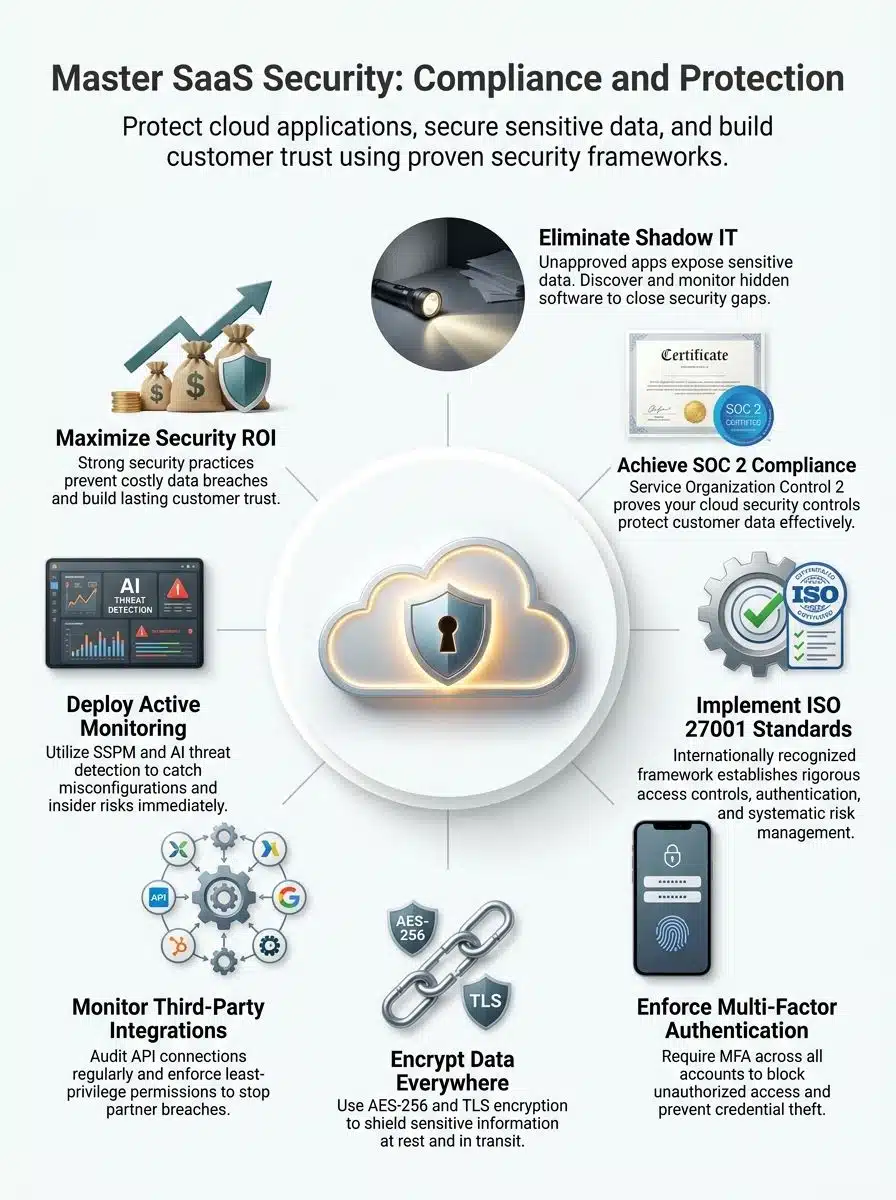
- Shadow IT expands your attack surface. Employees download unapproved SaaS tools, leaving you blind to data flows and compliance violations. Discovery and continuous monitoring help you spot these hidden risks before they cause damage.
- Dormant accounts sit idle and vulnerable. Profiles left behind by former employees become easy targets for unauthorized access. Regular reviews and quick deactivation stop attackers from exploiting forgotten credentials.
- Shared logins hide who did what. When multiple people use the same credentials, you can’t track who changed or accessed sensitive data. Identity and access management systems let you monitor and control this risky habit.
- Redundant tools pile up across departments. Overlapping apps create compliance gaps and widen your vulnerability surface. Keeping an inventory of every tool prevents blind spots and wasted spending.
- Third-party integrations get too much power. OAuth scopes and API access often grant more permissions than needed. Audits and least-privilege access controls close off these entry points.
- Weak identity controls invite attackers in. Gaps in SaaS identity risk management leave accounts exposed. Multi-factor authentication and strong access controls block most common attack paths.
- Compliance violations stack up quietly. Without SaaS security posture management tools, unmonitored changes lead to audit failures. Automated remediation catches and fixes problems before they get serious.
Overview of SOC 2 and ISO 27001
SOC 2 and ISO 27001 are the two main standards SaaS companies adopt to show they take cloud security and data security seriously. Let’s look at each one, then talk about how they fit together.
What is SOC 2?
SOC 2 stands for Service Organization Control 2. It’s an industry standard that guides SaaS companies in building strong security controls to protect application data and customer information.
SOC 2 compliance means setting up systems to monitor and manage compliance gaps and risks across your entire cloud security infrastructure. Tools like SSPM make this easier by tracking your security posture in real time.
Think of SOC 2 as a roadmap. It shows you where your defenses stand and what needs fixing.
Companies that follow SOC 2 prove strong security practices to customers and stakeholders, which builds real trust. It signals that you take data security seriously and have proper identity and access management controls in place. Customers feel more confident working with you because they know their data gets real protection.
What is ISO 27001?
ISO 27001 is an internationally recognized security standard. It gives you a full set of security controls and best practices for companies using SaaS applications, IaaS, and PaaS services.
Organizations use ISO 27001 to build a security framework covering access control, user authentication, and data protection. The standard works for every type of business, from small startups to large enterprises. Tools like Vanta help teams track their progress toward compliance.
Under ISO 27001, several practices become part of daily life:
- Access controls decide who can view or change important data.
- Multi-factor authentication verifies people are who they claim to be.
- Data encryption at rest and in transit shields sensitive information from attackers.
- Third-party integration monitoring closes off security gaps at the edges.
ISO 27001 also asks you to keep improving. Security teams review their measures regularly and use identity threat detection and response systems to watch who touches their data. Platforms like Orca Security and Grip Security help spot vulnerabilities in cloud infrastructure, and AI security tools scan for threats humans might miss.
The payoff goes beyond safety. Cloud platforms like Snowflake benefit from these structured approaches; everyone on your team understands their role, and compliance becomes a real competitive advantage in your market.
Here’s a quick side-by-side to keep the two standards straight:
| SOC 2 | ISO 27001 | |
|---|---|---|
| Scope | US industry standard for service organizations | Internationally recognized standard |
| Focus | Security controls for protecting application and customer data | A full security framework covering access control, authentication, and data protection |
| Best for | Proving trust to US customers and stakeholders | Global markets and businesses of any size |
The good news? Small SaaS teams can align controls to both standards over a focused six-month period:
- Months 0 to 2: Inventory existing systems and baseline current controls.
- Months 2 to 4: Implement role-based access control, multi-factor authentication, and encryption for data at rest and in transit.
- Months 4 to 5: Document policies, run internal audits, and verify control effectiveness.
- Months 5 to 6: Fix identified gaps and prepare for an external readiness review.
Importance of Compliance for SaaS Security
Compliance with standards like SOC 2 and ISO 27001 gives your customers real proof that you take their data seriously. Meet these standards, and you build a foundation of trust that keeps customers coming back and protects your company from costly breaches.
Building customer trust
Your customers want to know their data stays safe. SOC 2 and ISO 27001 certifications tell them exactly that.

And this isn’t just a feel-good claim. According to Gartner’s Digital Markets research on 2025 software buyer journeys, security ranks second only to price among software buyers’ purchase criteria, at 48% versus 49%. Even more striking, 45% of businesses have stopped using a software platform specifically because of security concerns. In other words, weak security doesn’t just risk a breach. It actively loses you customers.
When you display these credentials, you signal that your platform meets rigorous requirements. Your customers feel confident sharing sensitive information with you. That confidence turns into loyalty, and loyalty turns into growth.
Compliance also separates you from competitors who skip these steps. Companies that achieve SOC 2 or ISO 27001 back their promises with identity threat detection and response tools, multi-factor authentication, and security service edge technology. Customers notice, and they recommend you to others. You earned that trust with concrete certifications, not just words.
Protecting sensitive data
Protecting sensitive data takes a two-part strategy. First, encrypt all data at rest and in transit, so only people with the right keys can read it. Second, set strict controls that limit who accesses what.
Multi-factor authentication stops unauthorized people from getting in. It works like a double lock on your front door.
One password is not enough anymore. According to Verizon’s 2025 Data Breach Investigations Report, stolen or abused credentials factor into roughly a third of breaches, and infostealer malware compromised credentials on 30% of corporate devices in the past year. Passwords leak. Plan for it.
That’s why layered monitoring matters so much:
- Routine vulnerability scans catch weak spots before hackers find them.
- Real-time user activity monitoring watches for unusual behavior so you can act fast.
- Identity threat detection and response flags suspicious logins and odd data access patterns, like security guards on duty around the clock.
- Security service edge (SSE) filters traffic before it reaches your systems, like a bouncer checking IDs at the door.
Data breaches cost companies millions, so these protections pay off. Watch your third-party integrations closely too, since attackers often slip through partner connections. Each tool supports the others, creating a defense system that keeps sensitive information safe.
Best Practices for SaaS Security
Getting your SaaS security right means putting real defenses in place: access controls, multi-factor authentication, data encryption, and a security service edge to block threats before they hit your systems.
Your team should also watch third-party connections closely and use identity threat detection & response tools to catch suspicious activity fast. AI-powered security posture management helps you spot weak spots and fix them before attackers find them.
Implementing access controls and multi-factor authentication
Access controls and multi-factor authentication form the backbone of SaaS security. These tools stop attackers from getting into your systems, even if they steal a password.
- Set up role-based access control to limit what each team member can see and do. This keeps employees from accessing data beyond their job requirements.
- Require multi-factor authentication for every user in your organization. According to Microsoft’s identity security research, enabling MFA reduced the risk of account compromise by more than 99.2%, even when a password had already leaked. Few security moves give you that much protection for so little effort.
- Turn on Single Sign-On so people log into multiple apps with one credential set. This cuts password fatigue while keeping security strong.
- Apply strict password policies that follow NIST’s latest guidelines to defend against brute-force attacks.
- Run regular permission reviews to catch and remove access that employees no longer need. This stops former or transferred staff from keeping old privileges.
- Deploy identity threat detection and response tools to spot suspicious login attempts in real time.
- Add security service edge technology to monitor and control all traffic entering your network.
- Use AI-powered security posture management to scan for weak access points automatically before attackers find them.
- Combine biometric verification with password entry for sensitive accounts. Fingerprints or facial recognition add layers that passwords alone cannot provide.

Worried about the cost? The math usually works in your favor. One organization-wide rollout projected $8,400 in one-time implementation costs for SSO connector work and MFA integrations, plus $4,200 in annual licensing fees. The analysis also counted productivity gains: 0.4 hours saved per user per month across 210 users equals 1,008 hours annually. At $40 per hour, that’s $40,320 in yearly savings.
Monitoring and managing third-party integrations
Third-party applications connect your SaaS tools, but they also create security gaps. Monitoring these connections in real time stops threats before they spread.
- Track every third-party app your team uses and keep an updated list of each connected tool.
- Audit integrations regularly to find risky connections or redundant software that widens your attack surface.
- Set up alerts that flag suspicious behavior across all linked applications instantly.
- Apply least-privilege access rules so third-party tools only get the permissions they truly need.
- Review data-sharing between your platform and external apps on a consistent schedule, including sharing links and permissions.
- Use security service edge technology to inspect and filter traffic flowing through integrations.
A few more habits close the loop. Remove duplicate or outdated apps that no longer serve your business. Require authentication for every third-party connection. Document each integration point and the data types that flow through it. And use AI-SPM tools to track permission changes across your ecosystem continuously.
How bad is the overpermission problem in practice? One field audit of API permissions across sales and finance apps reviewed 54 integrations. It found 31 with excessive read or write scopes, 9 using long-lived tokens that never expire, and 18 where least-privilege rules were not enforced in provisioning scripts.
Final Words
SaaS security is not optional anymore. It’s your business lifeline. SOC 2 and ISO 27001 give you the roadmap, and they show customers you take their data seriously.
Start with the basics: turn on multi-factor authentication, monitor who accesses what, and clean out old accounts. A security service edge protects your applications from threats before they reach you.
Companies like KarmaCheck proved that investing in real SaaS security pays off fast. Your team, your tools, and your compliance work together.