A full task list can make a day look productive. It does not prove that the work that mattered most actually moved forward.
That distinction is why I find the 80/20 rule useful. It pushes us to ask whether a relatively small share of our work creates a much larger share of the result. It can expose high-leverage work, but only if we use it as a question rather than force every workload into a perfect ratio.
Some jobs may show a 70/30 pattern. Others may look closer to 90/10, or reveal no dramatic concentration at all. The exact numbers are not the point. What matters is learning which activities deserve more of our attention, which ones simply keep the system running, and which continue mainly because we have never challenged them.
What the 80/20 Rule Really Means
The idea is linked to Italian economist Vilfredo Pareto, who studied unequal patterns of income and wealth in the 1890s. Pareto was not trying to create a personal productivity method. Quality-management expert Joseph M. Juran later applied the broader pattern to defects, causes, and business problems.
Juran described the smaller group responsible for much of an effect as the “vital few.” He eventually preferred the phrase “vital few and useful many,” a reminder that work outside the highest-impact group is not automatically trivial. Payroll, backups, documentation, quality checks, and compliance may create few visible wins, yet they keep the system dependable.
I see the 80/20 rule as a diagnostic lens. It helps us examine whether certain tasks, clients, products, decisions, or channels contribute more than others. It does not give us permission to neglect the less glamorous work that keeps everything dependable.
High-Leverage Work Is Not the Same as Busy Work
High-leverage work creates a disproportionately valuable, durable, or multiplying effect compared with the time, attention, or resources it requires.
The effect may be direct: a strong sales page can generate qualified inquiries. But leverage is often less obvious. Fixing a confused approval process may prevent the same delay every week. A useful template can improve dozens of future assignments. One well-made decision may allow an entire team to move.
Urgency can hide this kind of work. An inbox offers quick closure, constant movement, and visible proof that we are responding. A difficult plan or strategic decision may sit quietly on the calendar with no notification demanding attention. Yet it may shape the next six months.
Valuable work often asks for concentration, judgment, or an uncomfortable conversation. Its result may take weeks or months to appear. Counting completed tasks cannot capture that difference.
Define the Result Before You Rank the Work
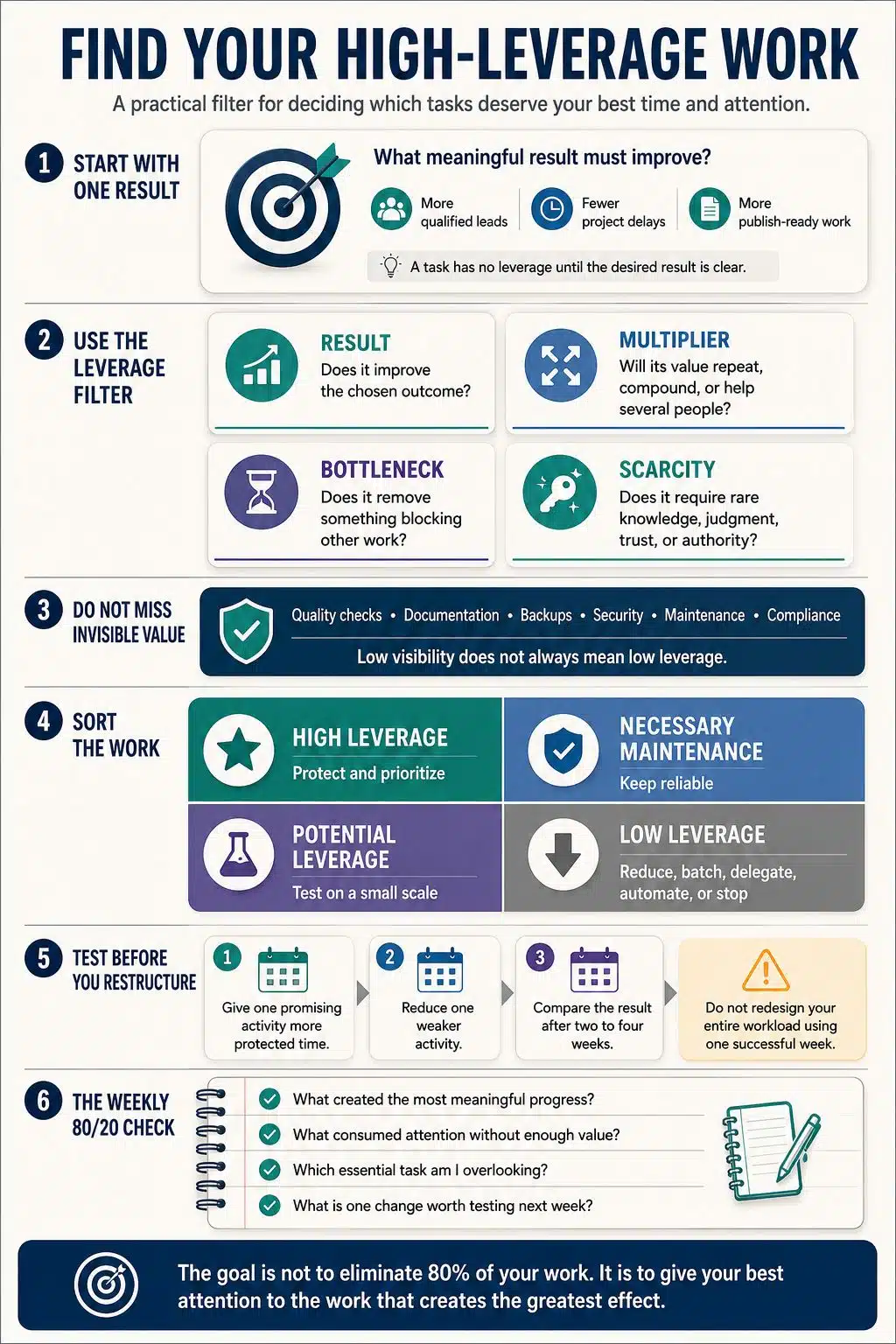
A task has no fixed level of leverage. Its value depends on what we are trying to accomplish.
“Grow the business” is too vague. “Generate ten qualified sales conversations this quarter” gives the work a clearer direction. A writer might aim to complete four publish-ready articles this month. A manager may want to reduce delays caused by slow approvals. Each result changes which activities deserve attention.
Before tracking anything, I would choose one meaningful outcome, a realistic timeframe, and one or two credible measures. Revenue may be the final result, while qualified conversations provide an earlier signal. If the goal is sales, raw page views are not enough.
This step is easy to skip, but without it the audit becomes a record of activity rather than an analysis of value.
Run a Short 80/20 Work Audit
Memory is a weak tool for judging contribution. Urgent or frustrating tasks feel important because they occupy mental space, while quiet work that improves outcomes is easier to overlook.
A two-to-four-week audit is long enough to reveal useful patterns without turning self-observation into another permanent job.
Group the Work Into Meaningful Categories
Track categories rather than every small action. A writer could use research, drafting, editing, meetings, promotion, and administration. A manager might track planning, coaching, approvals, reporting, hiring, and coordination.
Estimate the time or focused attention each category receives. A simple, consistent record is more useful than a detailed tracker abandoned after two days.
Note What Actually Moved the Result
At the end of each day or week, record which categories appeared to make a meaningful contribution. Look beyond immediate output. Did the work remove a bottleneck? Did it help several people? Did it create an asset that can be reused?
Be careful about assigning credit. A published article depends on research, writing, editing, and distribution. Connected activities often work as a chain, and cutting one link may weaken everything that follows.
Look for Repeated Patterns
After the tracking period, compare effort with contribution. A few activities may stand out. They do not need to account for exactly 20 percent of the work or 80 percent of the result.
One successful campaign is not proof. Look for repeated contributions and a believable connection to the outcome. The data can suggest an explanation, but it cannot always prove the cause.
Change One Thing, Then Watch
Give a little more protected time to the strongest candidate and reduce one weak activity. Avoid redesigning the entire week after a short audit.
A modest change is easier to evaluate and reverse. If improvement does not follow, the supposedly low-value task may have provided invisible support, or the assumption may have been wrong.
How I Recognize Work With Real Leverage
The clearest sign is a credible connection to an important result. A flattering metric is not enough. More clicks mean little if they never produce the readers, customers, or decisions the work was meant to attract.
I also look for bottlenecks. Clarifying ownership, approving a budget, fixing a broken handoff, or giving someone the access they need can release far more value than the action takes to complete.
Repeat value is another clue. Research, a good process, a useful template, or clear training can improve future work instead of helping only once. Automating a poor process, however, only allows it to fail faster.
Some decisions also require knowledge, trust, context, or authority that few people have. When that person spends the day on routine work others could handle, the rarest part of the role is wasted.
Finally, prevention can carry enormous leverage. Security reviews, contract decisions, backups, quality control, and compliance checks may produce no visible reward. Their value lies in the plausible loss they prevent. A quiet result is still a result.
What to Do With the Rest of the Work
Finding a vital few does not make the useful many disappear. It simply gives us a more honest way to handle them.
Some activities should stop because they no longer support a current goal. Repetitive tasks can be batched, standardized, delegated, or automated. Delegation only helps when the transfer does not create more oversight than it saves. Automation suits stable, predictable steps, not changing work that still needs judgment.
Necessary maintenance deserves its own category. It should be completed to a reliable standard rather than starved because its return is difficult to display.
I would sort the workload into four practical groups:
- High leverage: Protect it and increase it when the evidence is convincing.
- Necessary maintenance: Keep it reliable and proportionate.
- Potential leverage: Test it within clear limits before committing heavily.
- Low leverage: Reduce, batch, standardize, delegate, automate, or stop it.
This avoids the most careless interpretation of the rule: pretending that most work is worthless.
What the 80/20 Rule Looks Like in Real Roles
For a writer, leverage may sit in choosing the right angle, finding decisive evidence, or making one structural edit that strengthens the entire article.
A manager may create more value by setting priorities, coaching, hiring, and resolving ownership problems than by joining every meeting. Constant involvement can become a bottleneck if the team waits for approval on routine decisions.
A marketer may find that a few themes or channels produce the most qualified leads. That is a reason to test further investment, not abandon every other channel overnight.
For a freelancer or consultant, positioning, referrals, proposals, and client retention may matter more than polishing minor administrative details. Administration still has to be dependable, but it should not consume the best hours for difficult thinking.
These categories do not stay fixed. A portfolio may be high leverage early in a career and routine maintenance later. Detailed reporting may be essential during a troubled launch but add little once the work stabilizes.
Where the 80/20 Rule Goes Wrong
False precision is the most obvious problem. Forcing an exact 80/20 split onto weak data creates a confident-looking answer that may not be true.
Measuring the wrong result is more dangerous. A team that rewards clicks instead of qualified demand may become very efficient at attracting people who never buy. Short reviews can also favor quick wins while undervaluing trust, capability, and risk prevention.
Invisible support work is especially vulnerable. Cut documentation, mentoring, maintenance, or backups, and the savings appear immediately. The cost arrives later, often in a more expensive form.
Concentration requires judgment too. If one client produces most of a company’s revenue, increasing that relationship may look like the obvious 80/20 decision. It may also make the business dangerously dependent on a single account. High contribution and healthy diversification are not the same thing.
We also tend to reward the task closest to the outcome. Sales may close a contract, but product quality, reputation, referrals, and earlier conversations may have made it possible. The rule should improve judgment, not replace it with a convenient story.
Protect High-Leverage Work Without Overengineering the Day
Once valuable work is identified, it needs space. That does not require an elaborate productivity system.
Use calendar blocks that fit the task and the role. A writer may need one long, quiet session. A manager may benefit more from shorter windows reserved for decisions, coaching, or difficult conversations. Give each block a concrete finish line. “Work on strategy” is vague; “draft the pricing recommendation and list the unresolved assumptions” is usable.
Batching routine work reduces attention shifts. When interruption is unavoidable, leave a restart note: what is finished, what comes next, and which question remains open.
The goal is not to build a perfect schedule. It is to stop offering the best attention of the day to whatever asks first.
Use the Rule to See Work More Clearly
The 80/20 rule cannot identify what matters until we define a result, observe the work, and examine the relationship between the two. Treated as a slogan, it can justify careless cuts. Treated as a serious question, it can reveal where attention has drifted away from value.
I would not use it to eliminate most of a workload. I would use it to protect the work that creates meaningful progress, keep essential support work dependable, and become less generous with activities that survive only because they are familiar. That is a more realistic way to find high-leverage work.
Frequently Asked Questions on 80/20 Rule
1. What Is the 80/20 Rule in Simple Terms?
The 80/20 rule suggests that a relatively small share of causes can produce a much larger share of results. At work, it helps us investigate which tasks, decisions, clients, or channels contribute disproportionately to a chosen outcome. The numbers are approximate, not guaranteed.
2. How Long Should an 80/20 Work Audit Last?
Two to four weeks is a useful starting point. Work with long sales cycles or delayed outcomes may require a longer review and credible leading indicators.
3. Can a Time-Consuming Task Still Be High Leverage?
Yes. Leverage compares value with the resources required; it does not mean a task must be quick. Research, hiring, system design, or a major decision may take time and still create a large or durable effect.
4. Is the 80/20 Rule the Same as the Eisenhower Matrix?
No. The Eisenhower Matrix sorts tasks by urgency and importance. The 80/20 rule examines how unevenly different activities contribute to a result. A task can be urgent without being high leverage, or high leverage without feeling urgent.
5. Should I Automate All Low-Leverage Work?
No. Automate stable, repeatable work with clear rules. Other low-leverage activities are better batched, simplified, delegated, or stopped. Judgment-heavy or sensitive work can become worse when automated carelessly.
6. How Often Should I Reassess My High-Leverage Work?
A brief weekly review can catch obvious changes, while a deeper audit every few months can test whether the pattern still holds. Reassess sooner when your role, goals, customers, team, or main constraint changes.