

Ever wonder how sites like Yelp and TripAdvisor rank for thousands of search terms while you struggle to publish just a few solid pages? I get it. Watching competitors soak up all that traffic is frustrating, and it keeps plenty of marketers up at night.
So what is programmatic SEO? It’s a method that uses automation to build large numbers of web pages targeting specific search queries. Companies like Yelp and TripAdvisor use it to generate thousands of pages quickly.
The recipe is simpler than you might think. They scrape data from the web, pull information from APIs, or organize everything in Google Sheets. Then they feed that data into templates that create pages at scale.
The result? Serious organic traffic potential from long-tail keywords.
I’m going to walk you through how programmatic SEO actually works, with real examples from travel sites, e-commerce platforms, and business directories. We’ll also look at the tools that power this strategy, like WP All Import, Semrush, and Ahrefs. Let’s go through it together.
What is Programmatic SEO?
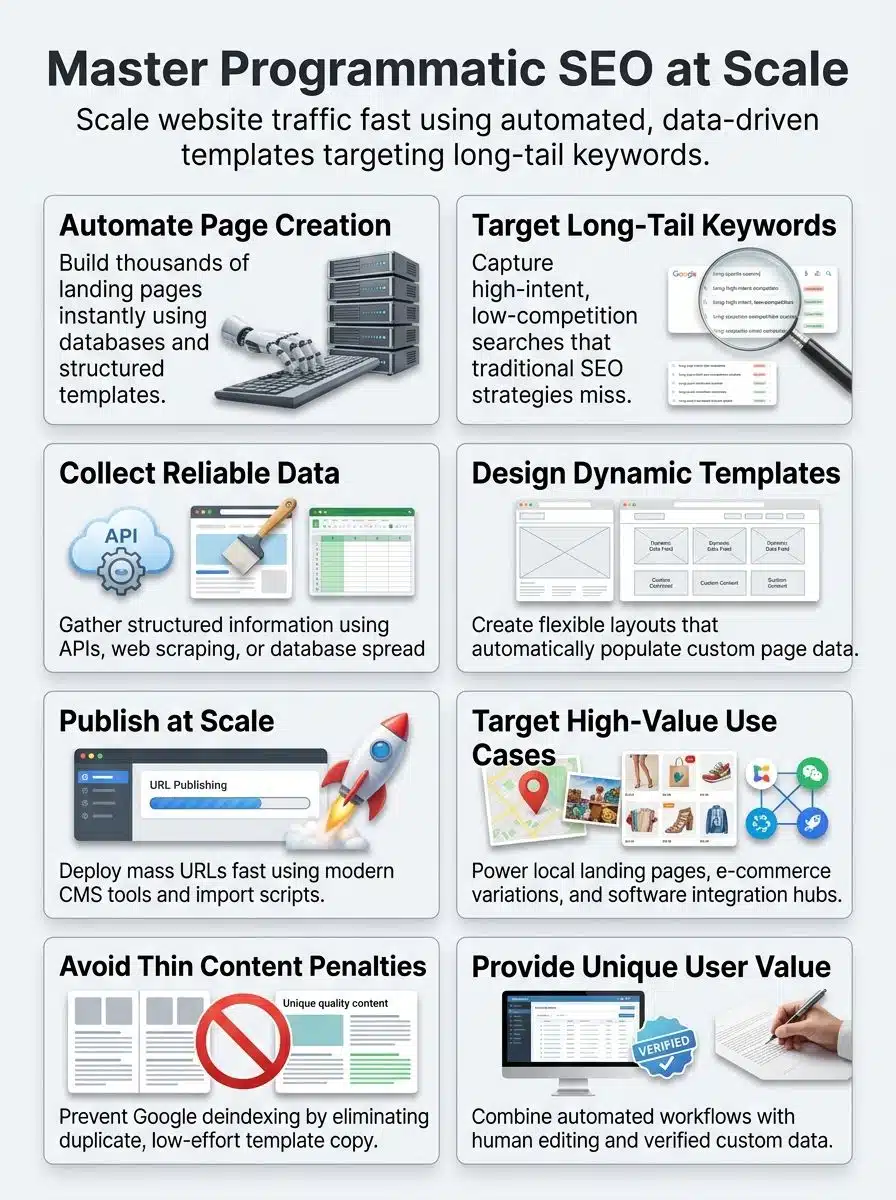
Programmatic SEO takes the manual work out of building landing pages. Software and templates create hundreds or thousands of pages at once. Think of it like a factory assembly line. Data feeds into a content management system, templates shape the output, and pages publish automatically across your site.
Definition and Core Components
At its heart, programmatic SEO is the automated creation of search-optimized web pages using data and templates. Ryan Law described it as the automated or semi-automated creation of keyword-targeted pages.
Three concepts power this whole approach:
- Automation: No-code tools and content management systems create pages at scale with minimal effort. You don’t need coding knowledge to get started.
- Long-tail keywords: These phrases usually contain three or more words. They target niche searches with lower keyword difficulty, which means less competition.
- User intent alignment: Pages must match what searchers actually want. A digital nomad searching for cost of living data in different cities needs real numbers, not fluff.
Structured data holds everything together. It organizes information so search engines understand your content. Think of it like building with blocks; each block fits into a specific spot, creating a solid foundation.
The workflow follows a clear order. Data collection and structuring come first; you gather information about locations, products, or services. Templates shape how that data appears on each page, and your system publishes automatically from there.
Marketing automation platforms like HubSpot help manage this flow. The payoff is organic search traffic growth from long-tail queries your competitors ignore.
Key Differences from Traditional SEO
Programmatic SEO and traditional SEO work like two different tools in your toolbox. One builds at lightning speed, while the other takes time with careful precision.

| Aspect | Traditional SEO | Programmatic SEO |
|---|---|---|
| Scale & Speed | Focuses on fewer, highly targeted pages. Creates content manually, page by page. Takes weeks or months for rollout. | Generates hundreds or thousands of pages efficiently. Creates pages quickly after setup. Deploys at massive scale in days. |
| Cost Structure | Requires extensive hands-on content creation. Demands ongoing manual optimization. Higher labor costs per page. | Reduces costs due to less manual work. Automates repetitive tasks. Saves money per page produced. |
| Keyword Strategy | Targets broad, competitive keywords. Aims for high-volume search terms. Pursues a limited number of keywords. | Targets highly specific long-tail keywords. Captures niche search intent at scale. Reaches thousands of keyword variations. |
| Content Updates | Requires updating each page individually. Changes demand separate edits. Takes significant time to implement. | Allows easy updates across all pages. Changes in the database or templates are reflected everywhere. Modifications happen instantly. |
| Technical Requirements | Minimal technical knowledge needed. Focuses on content and links. Straightforward implementation process. | Requires knowledge of structured data. Demands understanding of internal linking. Needs ongoing data accuracy. Involves higher technical complexity. |
| Competitive Edge | Widely used across industries. Many competitors use this approach. Less differentiation possible. | Provides an advantage. Few competitors adopt this method. Creates separation in search results. |
| Conversion Potential | Builds authority slowly. Generates leads over extended periods. Requires patience for ROI. | Creates highly converting content quickly. Produces results cost-effectively. Delivers faster business impact. |
Think of traditional SEO as crafting a single masterpiece. You spend months perfecting one page and building authority through careful work. Programmatic SEO operates more like that factory assembly line, producing volume through templates and data feeds.
Traditional methods chase broad keywords with high search volume. Programmatic approaches hunt down thousands of specific, long-tail searches that competitors miss. Those niche queries add up to serious traffic.
Database-driven systems give programmatic SEO its power. Change one template, and hundreds of pages update instantly. Try that with traditional SEO and you’ll spend weeks making individual edits.
The knowledge gap is real, though. Traditional SEO requires content skills and link-building tactics. Programmatic SEO demands technical expertise in structured data, internal linking strategy, and data accuracy.
Here’s the upside: your competitors likely stick to traditional methods. Few have invested in programmatic approaches, so real market share waits for anyone willing to tackle the technical side.
How Does Programmatic SEO Work?
Programmatic SEO pulls data from multiple sources, then organizes that information into structured formats machines can read. Your content management system takes templates you design and generates pages by swapping in variables like location names, product specs, or integration details.
Data Collection and Structuring
Every programmatic SEO strategy starts with gathering the right data. You have three main paths:
- Web scraping: Pulls data from websites automatically, but it requires technical skills and legal compliance with site rules. You may need developer help here.
- APIs: Options like the Google Places API and OpenWeather API deliver structured, real-time data straight into your system without the legal headaches.
- Manual research: Takes more time, yet it works best for hard-to-find or specialized information that other sources miss.
Your choice depends on your budget, technical ability, and the type of data you need.
Organizing that data comes next, and this step makes or breaks your entire project. Store everything in a database: Google Sheets works for small projects, Airtable suits medium-sized work, and larger operations benefit from SQL databases or warehouses like BigQuery or Snowflake.
Your database must include a few key fields: title tag, H1 tag, meta description, and body text. Tools like ChatGPT can help populate spreadsheets fast, but you still need to edit manually for accuracy and brand voice.
Keep your database fresh. Stale data kills your rankings and frustrates readers.
A small test project I reviewed shows why this matters. The pipeline fed 1,200 location rows from Google Sheets into page templates through WP All Import and published all 1,200 pages in just 22 minutes. Speed like that is the whole appeal of automation.
But 7 rows contained malformed address fields that needed manual correction, and 18 pages launched with missing meta descriptions because of a single mapping error. Most problems traced back to bad source data and one unchecked mapping step. That’s why field validation matters before you hit publish on hundreds or thousands of pages.
Automated Publishing at Scale

Mass publishing scripts launch thousands of URLs at once, turning hours of work into minutes. Tools like WordPress with WP All Import read data from CSV files and generate posts automatically. You click “CONFIRM & RUN IMPORT,” and the system springs into action.
A content management system such as HubSpot CMS or Webflow handles the heavy lifting too. Airtable can connect to your publishing pipeline and feed new information straight into your site. Custom scripts work as well, especially if you have a developer on your team.
Each post gets its own H1 tag and unique identifiers, so search engines treat them as separate pages. This approach powers location-specific landing pages like “Best coffee shops in [City]” or e-commerce variations across hundreds of product listings.
Monitoring your work matters just as much as publishing it. Tools like Semrush’s Position Tracking watch your keyword rankings and page performance over time so you spot winners and losers quickly. AI bots crawl your pages to check for quality issues.
John Mueller from Google has warned that thin content gets penalized, so your templates must deliver real value. In fact, Google now has an official name for this failure pattern. According to Google Search Central’s Spam Policies for Google Web Search documentation, “scaled content abuse” means generating many pages primarily to manipulate search rankings, with little or no value added for users.
Google broadened this policy in March 2024 and reinforced it through the 2025 and 2026 core updates. That gives you an exact term to search for and a clear standard to check your own pages against.
Even with generative AI helping you write, hallucinations happen, and poor content tanks your rankings. Your technical SEO foundation must be solid, and Slack notifications can alert you when something goes wrong.
Amazon and Zillow both use programmatic approaches, but they pair automation with genuine data and user-generated content. Scale without substance backfires hard.
Use Cases for Programmatic SEO
Programmatic SEO shines when you need hundreds or thousands of pages fast. That’s especially true for e-commerce sites selling product variations or service companies targeting multiple locations.
A content management system paired with solid keyword research lets you generate landing pages at scale. Raw information becomes pages that search engines and readers actually want to find.
Location-Specific Landing Pages
Location-specific landing pages hit different when you’re chasing local search traffic. Yelp operates as a business directory with over 150 city-specific top-level pages, featuring content like “Restaurants in New York” and “Shopping in Phoenix.” Each page includes business listings, addresses, hours, and ratings.
Tripadvisor takes the same approach with pages like “Things to Do in [City],” listing attractions and activities travelers actually want to find. These pages work because they target geographic long-tail searches, the kind people type when they know exactly where they want to go.
Your content management system can generate hundreds of these pages from structured data. The keyword research phase matters here; you need to understand what digital nomads, locals, and tourists search for in each location.
One pilot project put this to the test with 240 city pages split into two groups. Half the pages included a feed of 10 user reviews plus a custom one-paragraph local tip written by hand. The other half used only database facts and a generic templated description.
The results after eight weeks were hard to argue with:
- Pages with reviews averaged an 18% higher click-through rate
- They earned 42% more indexed pages than the generic versions
- Generic pages saw 60% of their URLs marked as low value in testing logs
Even a small dose of genuine reviews and one human-written tip turned thin pages into indexable assets. Search engines and users both noticed the difference.
Building location pages with real value keeps everyone happy. TripAdvisor users can click on attractions for dedicated programmatically generated pages with details and ticket booking links, which adds layers of usefulness. User-generated content, like reviews and ratings, makes pages feel alive rather than robotic.
Tools like Notion help you organize your location data, while your CMS automates publishing across hundreds of cities or neighborhoods. The AI engine powering your system should pull fresh information regularly so pages stay current.
The pattern is clear: scraped business hours and generic descriptions fail fast, but pages packed with real reviews, accurate information, and booking options climb rankings and convert visitors into customers.
Software Integration Pages
Software integration pages help companies reach customers searching for ways to connect different tools. Zapier uses this strategy to show how their platform links apps like Trello, Canva, and G2 together.
These pages answer real questions people ask, like “How do I connect Trello to Canva?” or “Does G2 work with my CMS?” By creating a page for each possible pairing, companies grow their organic reach without writing every page by hand.

Does this actually pay off? According to a 2026 Zapier programmatic SEO case study analysis, Zapier’s app-to-app integration pages now drive over 50% of the company’s total organic traffic, with more than 90% of that traffic coming from non-branded search queries. That’s a huge share of the business riding on templated pages built the right way.
The pages typically include step-by-step guides, feature comparisons, and links to related resources that explain the integration process. Funnel.io follows a similar playbook with connector pages that pull from databases to explain how different software works with their system.
These pages succeed because they solve actual problems for users hunting for connection solutions. Userpilot builds comparison pages, positioning their platform as an alternative to other tools, while Funnel.io creates x2y pages that explain data transfer between two platforms using combined databases.
Technology companies turn “Connect [Tool A] to [Tool B]” into hundreds of searchable pages that match exact search intent. The strategy works best when each page offers real value, like actual setup instructions or honest feature breakdowns, rather than the same content with tool names swapped in.
When Does Programmatic SEO Backfire?
Programmatic SEO can crash and burn when you chase volume over quality. Let’s look at what goes wrong and how to spot the warning signs before your rankings tank.
Thin Content and Search Engine Penalties
Google penalizes pages that lack real value, and this happens fast when you generate hundreds of similar pages through PSEO without adding substance. Search engines view redundant, low-effort text as spam.
Your pages get deindexed or lose ranking power when Google’s algorithm judges them as duplicative templates rather than helpful resources. Large portions of your site can disappear from search results, leaving you with nothing to show for the effort.
One programmatic travel directory learned this the hard way. It launched 4,800 templated attraction pages that reused the same paragraph across cities with only name swaps.
Within six weeks, Search Console showed all 4,800 pages crawled, but 3,920 were marked as discovered but not indexed. Organic impressions dropped 28% for the entire site during that period. Search engines recognized the pattern, refused to index most pages, and dragged down the authority of the whole domain.
This penalty risk applies across your entire site, not just individual pages. AI shopping sites, location pages from NomadList, and software integration pages all face this danger when templates dominate over authentic information.
Lack of Unique Value for Users
Many programmatic SEO projects fail because they produce pages that feel like copies of each other. Search engines notice fast. Users notice faster.
If a programmatic page does not provide a real answer or a fresh perspective, both search engines and readers will ignore it. Your CMS might generate hundreds of pages, but if they all say the same thing in slightly different ways, the approach backfires hard.
The pattern shows up whenever automation runs without a human check. When tools like ChatGPT churn out thin content without editing, you get pages that lack personality and depth. They fail to match what users actually search for; your site’s credibility takes a hit, and your rankings suffer with it.
Building real value takes more than running data through templates. Integrators like Peloton face this challenge directly; they have limited product data, so they must build databases that make each page meaningfully different from the last.
Manual editing for brand voice and accuracy becomes non-negotiable when you use automation tools. You need humans in the loop to add context, verify facts, and inject genuine perspective into each page. Competitive niches demand this extra work even more, because users expect specific, actionable information they can’t find anywhere else.
The best setup is a hybrid one: automation handles the heavy lifting, and people handle the thinking. Without that balance, your strategy becomes a content factory producing pages nobody wants to read.
Final Words
Programmatic SEO can work like a well-oiled machine when done right, but it crashes hard when you skip the quality checks.
Google punishes thin pages that waste users’ time, and its scaled content abuse policy spells that out plainly. Your content management system must generate pages with real value, not keyword stuffing.
Building pages at scale requires solid technical SEO skills, structured data setup, and honest data from APIs or web scraping. The smartest teams use AI search tools and large language models to create pages that actually help people, not just fill search results.
My advice? Start small, test your templates, and watch your metrics before you send thousands of pages out into the world.