
Oil markets have entered a volatile phase as escalating military conflict between Israel and Iran triggers renewed fears of energy supply disruptions. Prices for both major crude benchmarks jumped sharply amid concerns that the crisis could widen and draw in the United States, threatening critical oil infrastructure and chokepoints in the Middle East.
Global Oil Benchmarks Climb on Geopolitical Concerns
On Tuesday, Brent crude surged by 4.4%, closing at $76.45 per barrel, while West Texas Intermediate (WTI) rose by 4.3%, reaching $74.84 per barrel. These increases are among the steepest daily gains in recent months. In early Wednesday trading, both benchmarks continued their upward movement, gaining an additional 0.5% by 03:30 GMT.
This surge reflects growing anxiety among investors and traders about the potential for a major disruption to oil supplies from the Gulf region, especially if the conflict spreads beyond its current scope.
Airstrikes Target Iranian Energy Infrastructure
The sharp rise in oil prices comes on the heels of Israel’s recent military actions against Iran. Since Friday, Israeli forces have targeted several strategic energy facilities across Iran. These include one of the world’s largest gas reserves—South Pars gas field—as well as the Fajr Jam gas plant, the Shahran oil depot, and the Shahr Rey oil refinery.
These facilities play vital roles in both Iran’s domestic energy supply and export operations. The strikes, therefore, pose a direct threat to Iran’s ability to produce and export oil and gas.
U.S. Pressure Intensifies the Crisis
The situation was further aggravated by U.S. political pressure. President Donald Trump’s recent statement demanding unconditional surrender from Tehran has led to speculation about possible U.S. military action against Iran’s nuclear facilities.
This added an additional layer of uncertainty for global markets, raising concerns about a broader military confrontation in the region that could destabilize not only Iran but also neighboring oil-producing countries.
Oil Supply Still Flowing, But Risks Are Rising
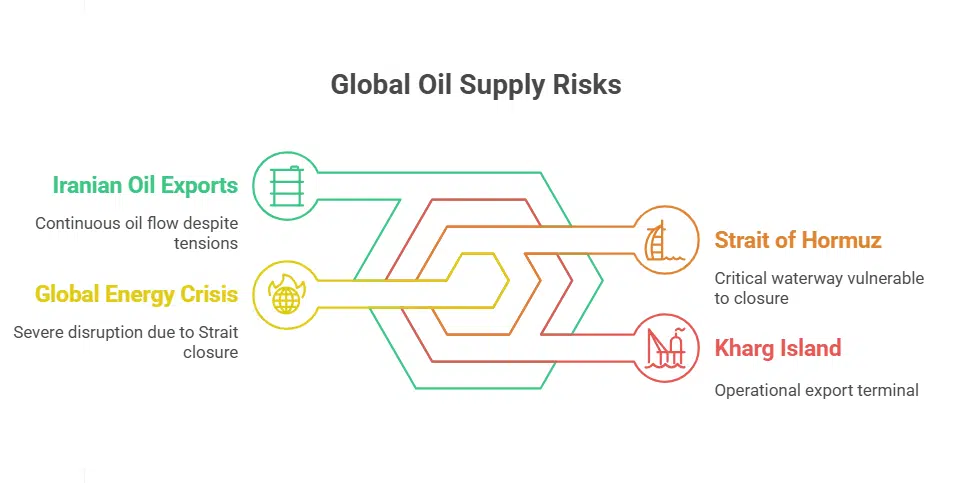
Despite the strikes and harsh rhetoric, there has been no immediate disruption to global oil flows. Iranian oil continues to be exported through Kharg Island, the country’s main oil export terminal. This facility remains operational and has not been targeted by Israeli forces as of yet.
Another major concern is the Strait of Hormuz, a narrow waterway through which 20% to 30% of the world’s oil shipments pass. Although the Strait is currently open and functioning, any military escalation that threatens its closure could cause a severe global energy crisis.
Iran’s Role in the Global Energy Market
Iran holds the third-largest proven oil reserves and the second-largest natural gas reserves globally. In 2023, the country produced approximately 3.99 million barrels of oil per day, representing 4% of the world’s crude supply.
However, longstanding U.S.-led sanctions have significantly limited Iran’s ability to export oil to the global market. Even so, any additional restrictions or physical damage to infrastructure could tighten supply conditions considerably.
Potential for Supply Shortages and Price Surges
Energy experts believe that if the conflict remains focused on Iran’s nuclear infrastructure, global oil supply may remain relatively stable. In that case, oil-producing nations within OPEC and OPEC+, such as Saudi Arabia and the United Arab Emirates, could increase their output to compensate for Iranian shortfalls. Additionally, U.S. shale oil producers may also ramp up production if prices rise further.
However, if Israel expands its operations to target Iran’s export terminals, such as Kharg Island, or if Iran retaliates by closing the Strait of Hormuz or attacking Saudi oil infrastructure, the global oil market could face a severe shock. In such scenarios, oil prices could climb to $100–$150 per barrel, depending on the level and duration of the disruption.
Financial Markets Show Signs of Strain
The geopolitical tension is not limited to energy markets. On Tuesday, U.S. stock markets declined, with the S&P 500 dropping by 0.84% and the Nasdaq Composite falling by 0.91%. Investors are growing increasingly cautious, shifting capital toward safer assets such as gold and U.S. Treasury bonds, while oil and energy stocks are seeing increased interest as potential hedges against conflict.
Airlines and transport firms are under pressure as rising fuel costs and regional flight disruptions begin to affect operations.
OPEC+ and U.S. Fracking Could Ease Shortfalls
OPEC+ countries have historically played a key role in stabilizing oil prices during global disruptions. If the crisis remains limited, these nations, along with American fracking companies, have the capacity to increase supply and avoid prolonged shortages.
The combination of strategic petroleum reserves, spare production capacity, and market intervention tools may be sufficient to prevent long-term market destabilization, provided there is no major escalation.
What Lies Ahead for the Global Oil Market?
| Potential Scenario | Market Impact |
|---|---|
| Limited conflict targeting nuclear sites | Moderate price increase; manageable supply gaps |
| Attack on Kharg Island | Significant supply loss; prices may cross $100/barrel |
| Strait of Hormuz blockade | Major global oil crisis; prices could reach $120–$150 |
| Regional war involving multiple states | Severe disruptions, recession risk, energy shock |
Oil prices have surged as the Israel-Iran conflict escalates, raising the risk of a major global supply disruption. While exports from Iran continue for now and the Strait of Hormuz remains open, the threat of broader military action involving the U.S. and other regional players looms large. The coming days will be crucial in determining whether this crisis evolves into a major energy shock—or remains a contained geopolitical confrontation.