
Constantly publishing content without gaining visibility is a common frustration. Instead of chasing random keywords, establishing Topical Authority For Your Blog is the missing piece. A focused content system builds reader trust and clearly defines site relevance for search engines.
Achieving Topical Authority For Your Blog requires moving beyond isolated articles and developing interconnected topic clusters around core pillar pages. This strategic approach ensures comprehensive coverage of a specific niche, signaling deep expertise to both ranking algorithms and target audiences.
Implementing smart, contextual internal linking further strengthens this architecture, seamlessly distributing ranking value across the entire domain. Whether managing a digital platform on WordPress, Shopify, Wix, Webflow, or PrestaShop, utilizing the right optimization tools accelerates this essential structural work. Streamlining the planning process allows modern content creators to map out semantic relationships and scale production. Mastering these foundational elements transforms a scattered digital footprint into an authoritative, high-ranking industry resource.
What is Topical Authority?

Topical authority means your blog covers one subject with real depth. You answer the big questions, the small questions, the comparisons, the mistakes, and the next-step questions that readers ask after the first click.
That matters because Google’s people-first content guidance asks creators to publish original, helpful material that gives a substantial and complete description of the topic. In plain English, thin one-off posts are a weak signal, while connected coverage is easier for search engines to trust.
Depth beats scattered publishing because it gives readers a complete path, not just a single answer.
A strong topical authority setup usually includes three parts: a pillar page, several supporting articles, and smart internal linking. Your pillar page covers the broad topic, while the supporting pages go deep on subtopics like tools, examples, templates, and common problems.
Names and entities help too. Tools like Semrush Keyword Magic Tool, Ahrefs Content Gap, Google Search Console, and ChatGPT can each play a role, but they solve different problems. Semrush helps you expand seed keywords into groups, Ahrefs helps you spot terms competitors rank for that you do not, Search Console shows real clicks and impressions, and ChatGPT helps you outline or summarize patterns faster.
- Pillar page: your main guide on the topic
- Satellite articles: focused posts on subtopics and long-tail keywords
- Internal links: the paths that connect the cluster and pass context
- Author and brand signals: clear bylines, profile pages, and consistent publishing
If you want better organic traffic, do not think in isolated blog posts. Think in connected topic clusters that make your site easier to crawl, easier to understand, and more useful to readers.
Why is Topical Authority Important for SEO?
Topical authority matters for SEO because search engines do not rank pages in a vacuum. They look at the page, the site, the surrounding content, and how well your content matches search intent.
A site with ten focused articles around one niche topic often has a better shot than a site with fifty unrelated posts. That is especially true when the focused site uses better content hierarchy, stronger internal linking, and clearer expertise signals.
Topical authority also lowers your dependence on domain authority alone. Backlinks still matter, but relevance helps smaller sites compete. If your blog covers a niche topic from beginner questions to advanced comparisons, you give Google more reasons to rank you for related searches.
Search Console is useful here because it shows four decision-driving metrics in one place: clicks, impressions, average CTR, and average position. Those numbers help you judge whether a topic cluster is getting more visibility, not just whether one post had a lucky week.
- It improves website visibility: you appear for more related searches, not just one exact term.
- It supports content marketing: each new article strengthens older articles in the same cluster.
- It helps with semantic search: your site sends a clearer topical relevance signal.
- It makes link building easier: complete resources attract more citations than thin posts.
If you publish on Shopify or WordPress, this approach is especially practical. Ecommerce and blog platforms tend to accumulate orphan pages, tag pages, and scattered content over time, so a cluster strategy gives your site structure again.
How Topical Authority Works
Topical authority grows when three things happen together: you cover the topic broadly, you organize the pages clearly, and you keep improving the cluster over time.
Start with keyword research, but do not stop there. A tool like Semrush can show keyword groups, search intent, trend data, and difficulty, which helps you turn one broad term into subtopics. Ahrefs Content Gap adds another layer by showing terms competitor sites rank for that your site does not.
Then use those findings to map content by intent. One page may answer “what is topical authority,” another may cover “how to build topic clusters,” and another may compare Semrush vs Ahrefs for content strategy work. That mix is what creates content depth.
Internal linking turns those pages into a system. According to Screaming Frog, an orphan page is a page that cannot be found by crawling internal links from the start page. If an article sits alone with no real links pointing to it, it is harder for users and crawlers to discover, understand, and rank.
Author signals add another layer of clarity. Google’s article structured data documentation recommends using the author field, and its profile page documentation supports author pages for a single person or organization affiliated with the site. So if you publish expert content, a basic author page is not fluff, it is part of your SEO infrastructure.
| Signal | What it tells search engines | What you should do |
|---|---|---|
| Topic coverage | Your site understands the niche from multiple angles | Plan clusters around one pillar page and several subtopics |
| Internal linking | Your pages belong to one content system | Link satellites to the pillar and to related supporting posts |
| Authorship | Real people or brands stand behind the content | Add bylines, profile pages, and clear expertise notes |
| Freshness and updates | The topic is maintained, not abandoned | Refresh key pages when Search Console shows slipping CTR or position |
That is why topical authority is slow to build but hard to replace. You are creating a body of work, not a single optimized page.
Steps to Build Topical Authority for Your Blog
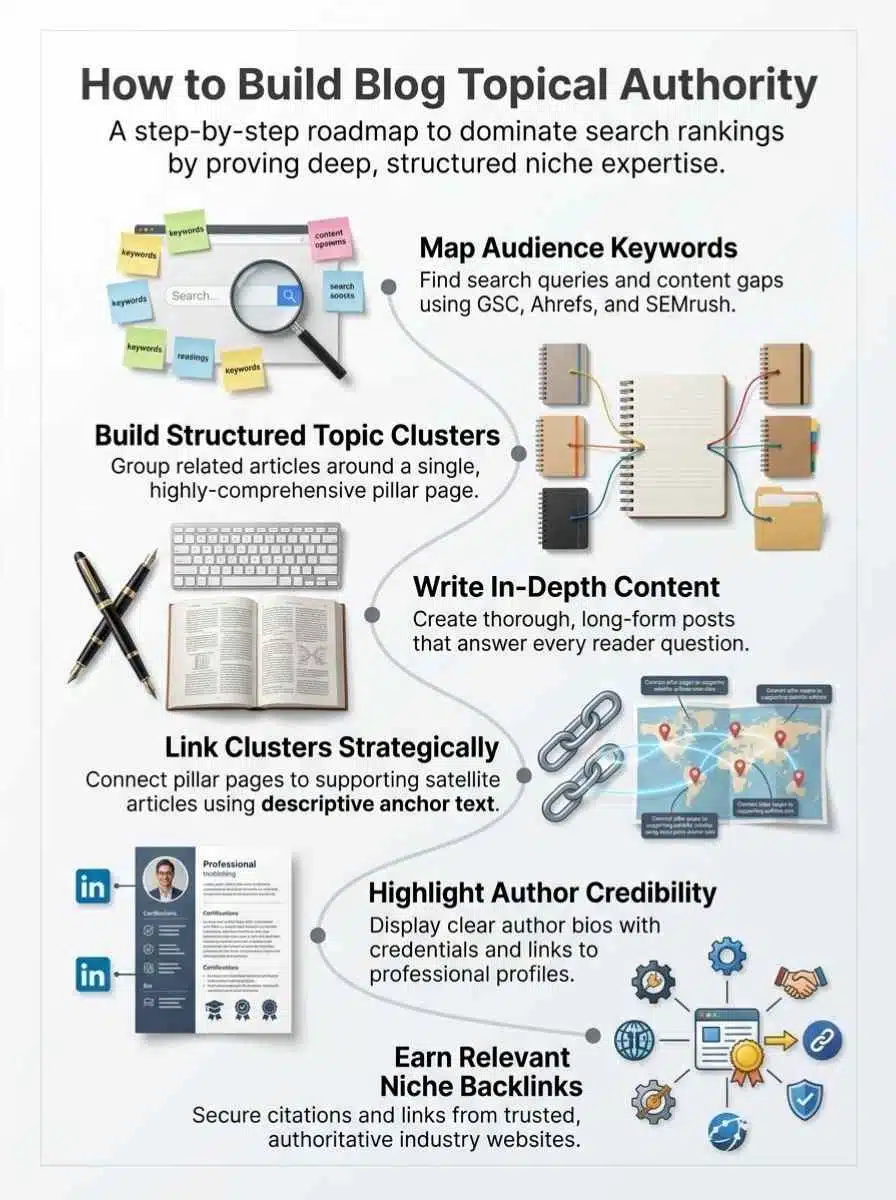
You do not need a huge site to start. You need a repeatable process. The best results usually come from five connected moves: research the full topic, build a clean cluster plan, publish high-quality content, strengthen internal linking, and make your expertise easy to verify.
Conduct Comprehensive Keyword & Topic Research
Start with one seed topic and expand it into real subtopics. Semrush’s Keyword Magic Tool says its database now covers more than 27 billion keywords, and the practical value is not the big number itself. It is the ability to sort by intent, search volume, trends, and groups so you can build an editorial map instead of a random list.
Use Search Console next. Its performance reports show clicks, impressions, CTR, and average position, which lets you find pages that already have traction. If a post has impressions but weak CTR, improve the title and intro. If it ranks on page two, expand the section depth and add internal links from stronger articles.
- Start with 1 broad topic
- Break it into 5 to 15 subtopics
- Match each subtopic to search intent
- Group nearby long-tail keywords into one article, not five thin ones
Good research saves you from publishing ten articles when three stronger ones would do the job better.
Create Topic Clusters
A good cluster has one pillar page and a set of supporting articles that each solve a distinct question. If every post targets the same intent, you create overlap and cannibalization. If each post has a clear job, the cluster becomes stronger.
One simple rule helps here: keep the pillar broad and the satellites narrow. Your pillar page might cover topical authority as a whole. Your supporting posts can focus on internal linking, author pages, content gap analysis, or how to build clusters on Shopify and WordPress.
Use a spreadsheet or project board with these fields: target keyword, search intent, pillar or satellite, linked-from pages, and update date. That small system keeps your content strategy organized as the cluster grows.
Develop High-Quality, In-Depth Content
High-quality content is not just longer content. It is content that answers the next question before the reader has to search again.
Google’s people-first guidance specifically asks whether content provides original information, reporting, research, or analysis, and whether it gives a substantial, complete description of the topic. That is your writing test. If a competitor gives a shallow definition, add a process. If they list tools, add the exact feature each tool helps with.
For example, use Ahrefs Content Gap to discover missing keywords, then use ChatGPT to turn those missing ideas into draft outlines and FAQs. After that, add your own examples, screenshots, and business context. AI can speed up content creation, but your insight is what makes it publishable.
Build a Strategic Internal Linking Structure
Internal linking is where many blogs waste easy wins. Links should help readers move through the topic naturally, not just satisfy an SEO checklist.
Screaming Frog connects with Google Analytics and Search Console during a crawl and can surface orphan URLs, which is useful because orphan pages often still get impressions while sitting outside your main content hierarchy. If a page matters, link it from the pillar, a related satellite, and one older relevant post.
- Link every satellite back to the pillar page
- Add 2 to 4 contextual links from older posts into new cluster pages
- Use descriptive anchor text instead of vague phrases like “click here”
- Audit orphan pages monthly on larger sites
A practical target is simple: each important cluster page should have clear incoming links, clear outgoing links, and an obvious role in the topic.
Leverage Author Expertise and Credibility
If your content covers YMYL topics, author clarity matters even more. Even on regular business blogs, clear authorship helps readers trust what they are reading.
Google’s documentation for article markup recommends author information, and its profile page guidance supports dedicated author or organization pages. So add author bios, publish profile pages, and keep expertise descriptions specific. “SEO writer” is generic. “Technical SEO editor for ecommerce brands” tells both readers and search systems more.
If your business has specialists, use them. Let your content strategist write cluster planning guides. Let your developer explain technical SEO fixes. That makes your blog sound more useful because it is more useful.
Earn Quality Backlinks from Relevant Sites
Backlinks still strengthen topical authority when they come from relevant sites that actually fit your niche. The easiest linkable assets are original research, benchmark posts, templates, and practical how-to guides.
Ahrefs positions Content Explorer as a way to find content ideas and link prospects across a database of 17.9 billion pages. That matters because outreach works better when you pitch a page that already links to similar studies or guides. Do not ask for links to a generic blog post. Pitch a resource with a clear hook, such as new data, a framework, or a useful template.
One tip that comes up again and again in SEO teams: send outreach only after the page is genuinely strong. Link building amplifies value. It rarely fixes weak content.
Using Content Clusters to Strengthen Authority
Content clusters are how you turn a blog into a resource instead of a pile of articles. They give readers a path and give search engines context.
Create Comprehensive Pillar Pages
Your pillar page should be broad enough to own the main keyword, but structured enough to send readers into deeper pages. That means definitions, process, examples, common mistakes, and links to related articles all belong on the same page.
- Cover the main keyword and the biggest subtopics in one guide
- Use short sections so readers can scan fast
- Link out to deeper supporting articles where more detail helps
- Refresh the page as your cluster expands
- Add a visible last-updated date so readers know the page is maintained
Write Supporting Satellite Articles
Satellite articles give you room to rank for narrow terms with strong intent. This is where long-tail keywords do the heavy lifting.
A useful way to choose them is to look for one problem per page. Write one article for “topic clusters for Shopify stores.” Write another for “how to find content gaps in Ahrefs.” Write another for “internal linking audit with Screaming Frog.” Those narrow posts support the pillar page and often convert better because the search intent is clearer.
Interlink Articles for Maximum SEO Impact
Once the cluster is live, do not leave the linking until later. Add it right away.
| Page type | Should link to | Main goal |
|---|---|---|
| Pillar page | All priority satellites | Show breadth of coverage |
| Satellite article | Pillar page plus 2 relevant satellites | Show depth and relationship between subtopics |
| Older blog posts | New cluster pages where relevant | Pass context and revive older traffic |
This is also where tools like Sedestral can help if you want AI-assisted SEO workflows. It focuses on audits, optimization, topic clusters, and publishing support, which can save time on larger content operations. Just make sure the system supports your strategy, instead of replacing it.
Tools and Metrics to Measure Topical Authority

You cannot improve what you do not track. The trick is to measure the cluster, not just the single article.
Analytics for Topic Performance
Start with Search Console and GA4. Search Console tells you what Google is showing. GA4 tells you what users do after the click.
In GA4, an engaged session is one that lasts longer than 10 seconds, has a key event, or has 2 or more page or screen views. That makes engagement rate more useful than old-school bounce thinking for many blogs, especially when readers may stay on one page to read a full article.
| Metric | Why it matters | Best action |
|---|---|---|
| Organic sessions by cluster | Shows whether the topic is growing as a group | Compare cluster pages month to month |
| Impressions | Shows search visibility | Expand coverage if impressions rise but clicks stay flat |
| CTR | Shows whether titles and intros earn the click | Rewrite headlines and meta descriptions |
| Average position | Shows ranking progress | Strengthen pages stuck in positions 8 through 20 |
| Engagement rate | Shows whether readers actually use the content | Add examples, visuals, and clearer next steps |
| Referring domains | Shows external validation | Promote your strongest research and pillar assets |
Identifying Content Gaps
Gap analysis is where topical authority usually jumps forward. You find the missing subtopics, then fill them before competitors do.
Ahrefs Content Gap helps by showing keywords other sites rank for that your site does not. Semrush helps you sort those gaps by search intent and difficulty. Search Console adds the final clue by showing which pages already get impressions, which means you may only need a better section or better internal linking to win more traffic.
- Look for missing subtopics inside the same cluster
- Check whether your content matches the real search intent
- Expand weak sections before creating brand-new posts
- Create new satellites only when the gap is truly distinct
If a page already ranks on page two, that is often the best place to work first. It is closer to a result than a completely new post.
Final Thoughts
Building topical authority comes down to a simple system: do smarter keyword research, organize your content into topic clusters, publish a strong pillar page, and support it with useful articles and internal linking.
Track the cluster with Search Console, GA4, and audit tools so you can see what actually lifts website visibility and organic traffic. Small, steady improvements usually beat random bursts of content marketing.
If you start with one clear niche and build it well, your blog can become the trusted resource readers, search engines, and even AI-driven discovery systems are looking for.
Frequently Asked Questions (FAQs) About Building Topical Authority for Your Blog
Topical authority means your blog knows one subject well, it acts like a lighthouse for readers. It helps with seo (search engine optimization), more clicks, and better trust.
Pick a main subject your readers care about, then list related angles and questions. Write focused posts that link to each other, use clear search phrases that match what people type, this boosts seo (search engine optimization).
3. How often should I update my posts?
Update core posts when facts change, or when traffic drops, keep them fresh.
Answer real questions, talk to readers, use data to guide topics, and be consistent. Optimize headings, use clear search phrases, and follow seo (search engine optimization) best practices.