Conversational AI rocks! It rocks big time.
The ability infused into the machines— making them capable of interacting in the most humane ways possible— has a different kind of high to it. Yet, the question remains, how does conversational AI work in real-time and what kind of technology is powering its very existence.
Let’s find out:
Simply put, Conversational AI is a segment or sub-domain of Artificial Intelligence— aimed at enabling humans to interact more seamlessly with computing entities.
Remember those quirky website chatboxes that return specific answers to even some of the trickiest questions! Well, those are exactly the Conversational AI products we are talking about. Yet, the question remains: how come these chatbots become so perceptive. Surely, it isn’t just about feeding raw training data, like human voice and text, into the relevant models. There has to be more.
The answer is NLP or Natural Language Processing.
Understanding NLP
Often touted as a computer science vertical, NLP or natural language processing focuses on helping computers understand voice and text better— allowing them to better interact with the world or rather us, the humans.
The power of NLP allows humans to communicate with intelligent systems using specific languages, like English. Also, NLP helps a computer get better at machine learning, which is a pathway for computing entities to develop ‘artificial’ intelligence.
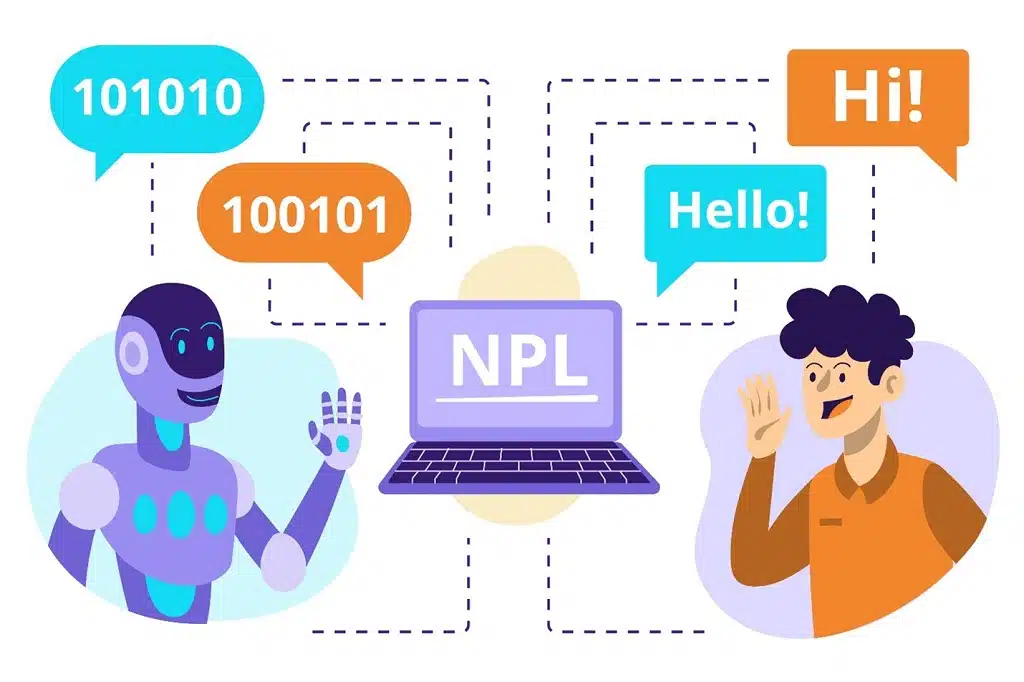
NLP-based intelligence is fed using NLP engines, which is the core prepping component— responsible for interpreting speech and text— and eventually feeding the structured inputs right into the system. But there is a lot more to an NLP engine.
What can Natural Language Engines do?
As mentioned, NLP engines are important. Why, you ask? Keep reading on:
- Vocab enhancement: Every conversational approach must keep the training stream open for new words. NLP engines can help with that— assisting with word, phrase, synonym, and descriptor additions.
- Context determination: Every conversation is made of multiple stages. At one stage, the customer might just throw a random question, whereas, at any other stage, it might be a specific query to close the deal. A natural language processing engine helps the computer determine the context associated with every stage.
- Entity identification: Imagine a customer typing the following command: ‘How can I procure the mentioned offer that is to start on 25th July 2022’? As you can see, the statement comprises a date, numbers, and even a description. Powerful NLP engines help machines identify these disparate entities to perfection.
- Utterance detection: A question like ‘When can I expect the email?’ can be asked as ‘Where is my email?’ NLP engines help intelligent machines get accustomed to every variation of specific questions for added relevance by factoring in the nature of utterance— both verbal and textual.
- Intent: ‘I would like my coupon code now’ looks a tad different than ‘Where the heck is my coupon code?’ While the first is a standard statement showing desire, the next might be borne out of frustration. Top-of-the-line machines are great at differentiating based on intent, thanks to the efficient natural language processing engines.
Yet, analyzing the intent requires us to dig deeper.
How does NLP help to analyze the Intent?
Before we delve deeper, it is important to understand that conversational intent can be Casual (including every emotion) or Business. And that is exactly when ‘NLP-powered’ Intent Analysis is looked at as an important tool used by NLP engines.
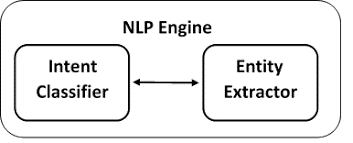
In simple words, intent analysis helps machines assess the exact or near-exact intention of any user input— often by extracting the relevant entities. And that is how a chatbot actually learns to pick up a suggestion, news, or even a complaint.
As far as the approach is concerned, NLP tools (precisely the engines) help parse multiple intents— feeding them into the machine as high-quality training data. A structured dataset, therefore, helps with intent analysis. On top of that, the structured dataset is further fragmented to include some tricky words.
Output-wise, the NLP engine analyzes the sentence and tries to analyze intent based on the data fed, plurality, positioning (position of words in a sentence), and conjugation. For speech, other factors are also taken into consideration. And that’s more or less how intent analysis takes place in the background.
Conclusion
According to detailed research conducted by Market & Markets, the NLP market is expected to be valued at $26.4 by the year 2024. That is a CAGR of 21%.
And their role in enhancing the quality of conversational AI isn’t limited to emotion, utterance, entity, or even intent analysis. NLP is also relevant to aspect mining, topic modeling, text summarization, and more— helping chatbots software, self-driving cars, home automation setups, and digital assistants get more intelligent over time. With NLP, the possibilities are virtually endless.
Author Bio

Vatsal Ghiya is a serial entrepreneur with more than 20 years of experience in healthcare AI software and services. He is the CEO and co-founder of Shaip, which enables the on-demand scaling of our platform, processes, and people for companies with the most demanding machine learning and artificial intelligence initiatives.