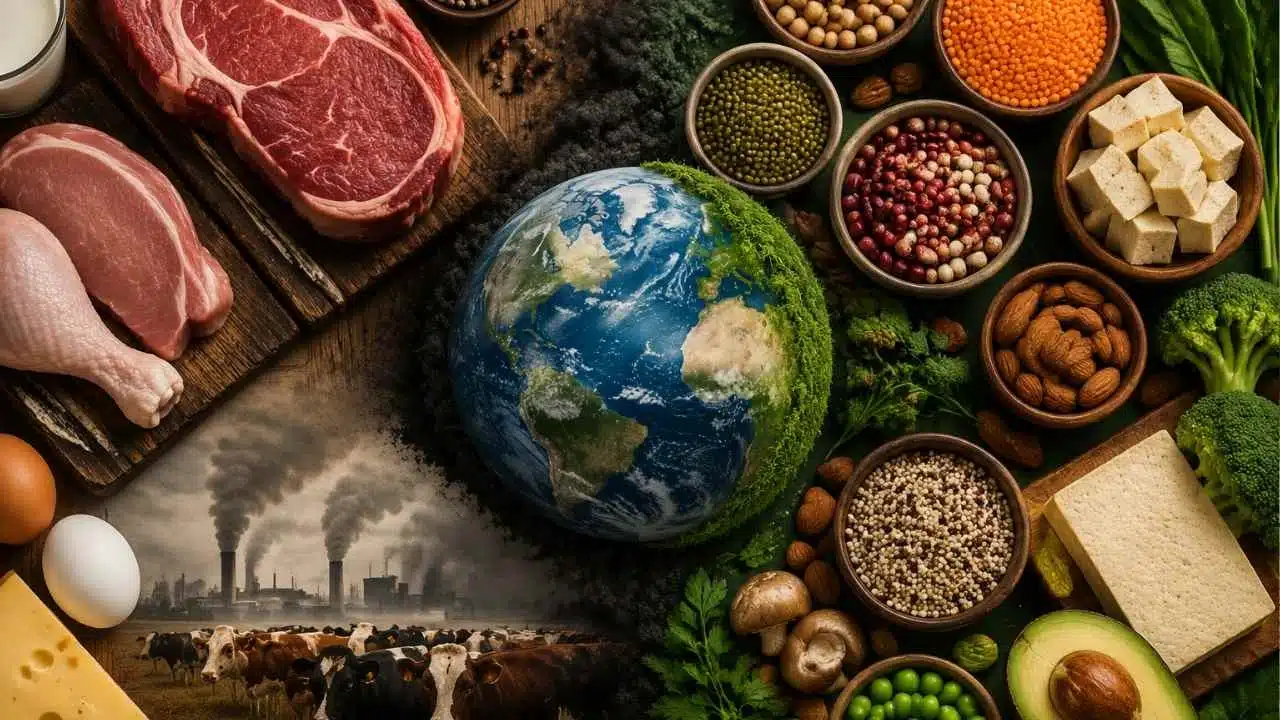
A climate-friendly diet can get confusing quickly. One person says to buy local meat. Another says to go vegan. A third says plant-based burgers are processed, so they cannot be much better. Then someone points out that almond milk uses water, soy farming affects forests, and not every family can afford specialty meatless products.
The useful question is narrower: which everyday food choices create the biggest environmental pressure, and which swaps actually reduce it?
The environmental impact of meat consumption is not evenly distributed among all animal foods. Beef and lamb usually sit at the high end because cattle and sheep need large areas of land and release methane during digestion. Chicken, pork, eggs, and dairy have different footprints. Beans, lentils, peas, tofu, tempeh, and many plant-based meals usually require far less land and produce fewer greenhouse gas emissions per serving.
That does not mean everyone has to make the same diet change. A realistic approach starts with the foods that do the most damage and appear most often on the plate.
The Basic Problem: Animals Eat Food Before We Eat Them
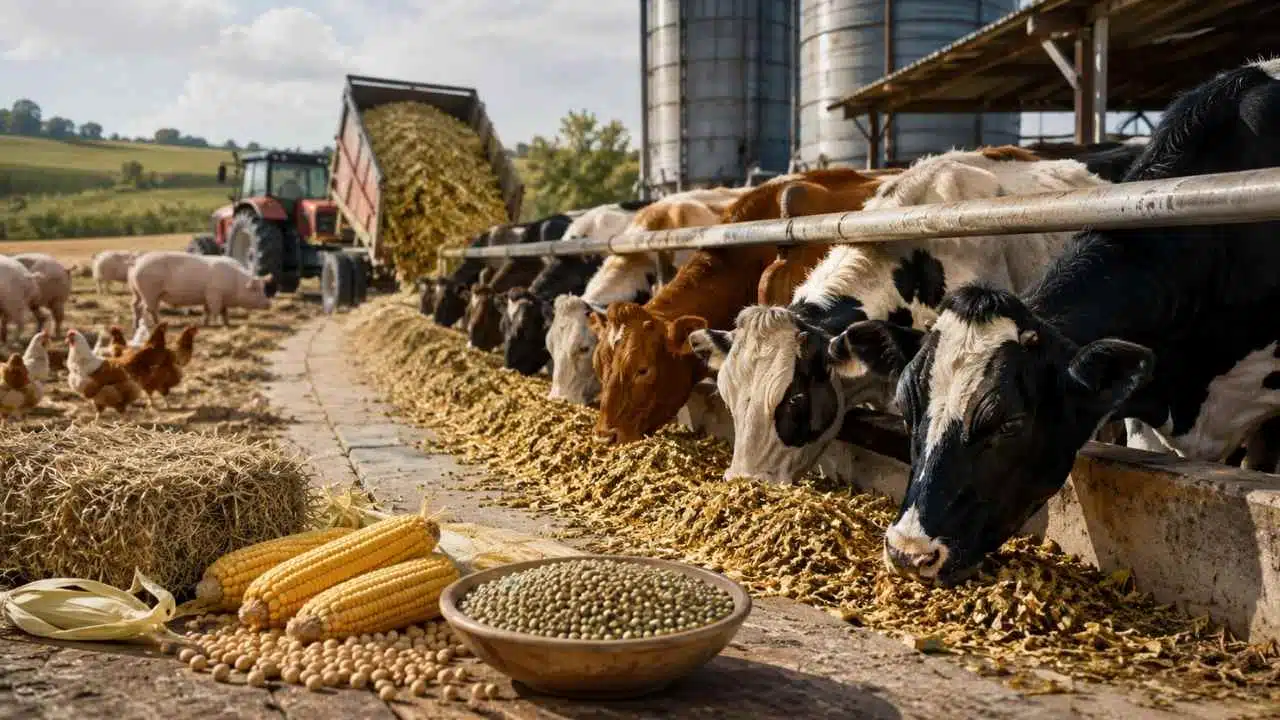
Most meat involves an extra step that plant foods do not. Crops are grown, harvested, transported, and fed to animals. The animals then use part of that energy to grow, move, digest, stay warm, and reproduce. Only part of the original feed becomes meat, milk, or eggs.
That conversion loss is one reason animal products often need more land, water, feed, and energy than plant foods eaten directly by people. A bowl of lentils uses crops directly. A beef burger usually represents pasture, feed crops, water, manure management, and methane before it reaches the plate.
Ruminant animals make the footprint heavier. Cows, sheep, and goats digest grass and other fibrous plants in a way that produces methane. Methane has a much stronger warming effect than carbon dioxide over the short term, although it does not stay in the atmosphere as long. This is why beef and lamb tend to stand apart from most other foods in climate comparisons.
Chicken and pork are usually lower-impact than beef and lamb, mainly because pigs and chickens convert feed more efficiently and do not produce methane in the same way. But they still require feed crops, housing, transport, energy, and manure management. They are not impact-free. They are simply not in the same category as beef.
Land is Where Meat’s Hidden Cost Becomes vVisible
A steak does not show the land behind it. The pasture, the feed crops, the cleared forest, the lost stored carbon, the wildlife habitat that disappeared, and the fertilizers used on animal feed are all outside the supermarket package.
This is one of the biggest environmental issues with meat. Livestock uses a very large share of agricultural land, both for grazing and for growing feed. That land could otherwise support forests, grasslands, wetlands, carbon storage, wildlife corridors, or food crops for direct human use.
The picture is not identical everywhere. Some animals graze on land that is difficult to crop. Some mixed farms use livestock manure to support soil fertility. Some traditional grazing systems are part of local livelihoods and landscapes. Those details matter.
But they do not erase the global pattern. Producing meat, especially beef and lamb, usually needs far more land per gram of protein than producing beans, lentils, peas, tofu, or grains. When demand for high-impact meat rises, pressure on land rises with it.
That pressure is especially serious in regions where forests or biodiverse grasslands are converted for pasture or feed crops. Once land is cleared, the damage is not only about one year’s emissions. Carbon storage falls, habitats shrink, and ecosystems become harder to restore.
Water Use is Not just About the Biggest Number
Water comparisons can be misleading if they treat every liter as equal. Rainwater falling on pasture is different from irrigation water pumped from a stressed aquifer. A crop grown in a rainy region does not have the same water burden as the same crop grown in a dry area.
Still, meat production can put heavy pressure on water systems. Animals need drinking water, feed crops often need irrigation, and slaughtering and processing require water. The larger issue is not only how much water is used, but what happens to rivers, lakes, and groundwater afterward.
Feed crop fertilizers and manure runoff can carry nitrogen and phosphorus into waterways. When too many nutrients enter rivers or lakes, algal growth can increase and oxygen levels can fall. This can harm fish, damage freshwater ecosystems, and contribute to dead zones in coastal areas.
Manure can be useful when it is handled well. It can return nutrients to soil and reduce the need for synthetic fertilizers. The problem starts when too many animals are kept in one area and the manure load exceeds what nearby land can safely absorb. In those systems, waste becomes a pollution risk rather than a farm resource.
Buying Local Helps Sometimes, But It Does Not Fix High-impact Meat
Local food can be valuable. It may support nearby farmers, reduce some transport emissions, improve freshness, and shorten supply chains. For fruits and vegetables, local and seasonal buying can be a sensible choice.
But with meat, local sourcing is often overrated as a climate solution. A local beef burger usually still has a far larger footprint than beans, lentils, tofu, or peas transported from another region. The emissions from producing the food usually matter more than the emissions from moving it, except for unusual cases such as air-freighted perishables.
This is where many shoppers get caught. They compare a local steak with imported lentils and assume the local option must be greener. In most climate comparisons, the lentils still win. The animal’s methane, feed, land use, and manure burden are much larger than the shipping emissions for many plant foods.
A better rule is simple: choose lower-impact foods first, then think about local and seasonal options within that category. Local beans, vegetables, grains, and pulses are excellent when available. Local beef is still beef.
Meatless Alternatives are Not All the Same Food
A chickpea curry, a tofu stir-fry, a mushroom-lentil pasta sauce, and a plant-based burger are all “meatless,” but they are not the same choice nutritionally, environmentally, or financially.
The lowest-impact options are often ordinary plant proteins: lentils, beans, peas, chickpeas, soybeans, tofu, tempeh, nuts, seeds, and whole grains. They do not always imitate meat, but they can replace meat in many everyday meals without needing special products.
Then there are plant-based meat substitutes, such as burgers, sausages, mince, nuggets, and deli slices made from soy, pea protein, wheat gluten, oils, starches, and flavorings. These products can be useful because they fit into familiar meals. A family that already eats burgers or spaghetti with mince may find it easier to use plant-based mince than to redesign dinner completely.
Fermentation-based proteins, including mycoprotein, are another category. These use fungi or microbes to produce protein-rich foods. Some are already common in supermarkets in certain countries, while others are still developing.
Cultivated meat is different again. It is made from animal cells rather than raising a whole animal. It may reduce land use and some animal welfare concerns if it can be produced efficiently. Its climate case is still tied to energy use. If production depends on high-carbon electricity, the benefit becomes less convincing. If it scales with clean energy, the picture improves.
The practical message: meatless does not automatically mean one thing. A bean stew and a highly processed plant-based sausage should not be judged as if they are identical.
The Most Useful Swaps are Meal-level Swaps
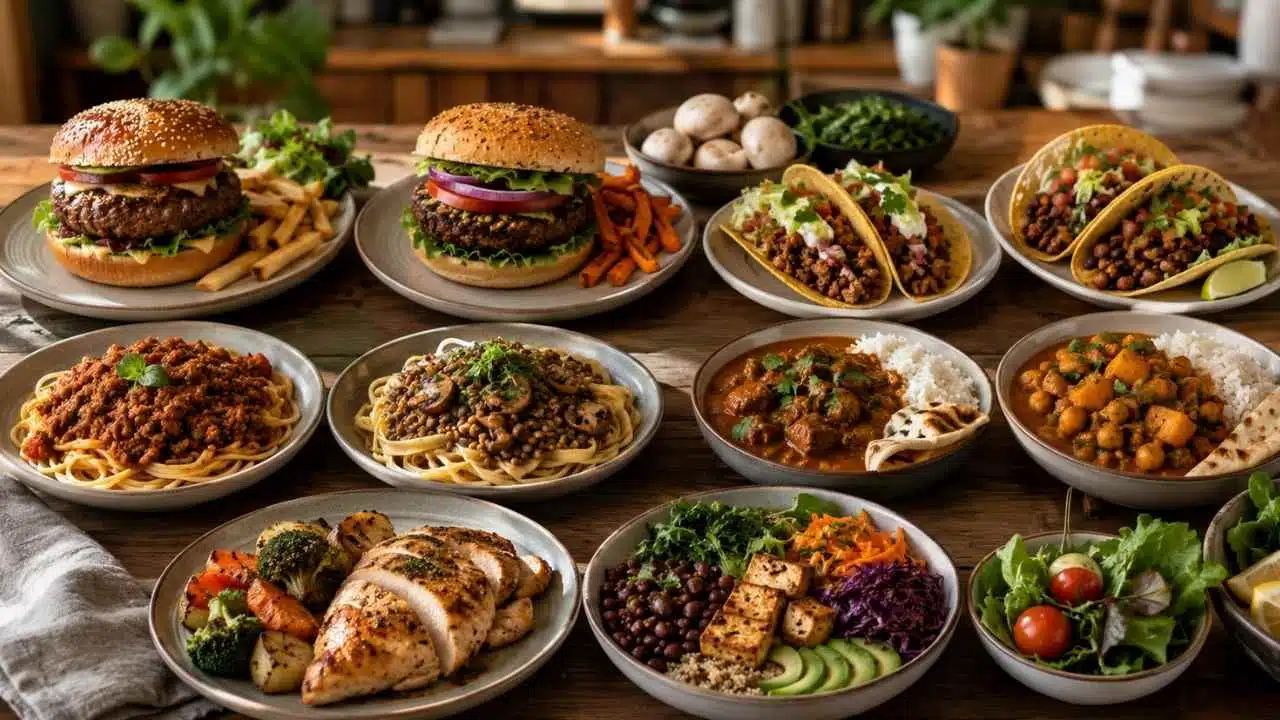
Most people do not eat “agriculture systems.” They eat the same meals repeatedly: burgers, rice bowls, curries, pasta, sandwiches, tacos, stir-fries, breakfast plates, and takeaway.
That is where the better decisions happen.
A beef mince sauce can be partly replaced with lentils and mushrooms. A chili can use beans instead of beef. A burger night can shift from beef patties to a plant-based patty, grilled mushroom, bean burger, or chicken if the household is not ready for a fully plant-based meal. A curry that normally uses mutton can be made with chickpeas, lentils, paneer, tofu, or mixed vegetables, depending on local food habits and nutritional needs.
Some swaps reduce impact more than others:
| Common meal habit | Lower-impact direction | Practical note |
|---|---|---|
| Beef burgers every week | Plant-based burger, bean burger, mushroom burger, or less frequent beef | The biggest gain comes from reducing beef frequency |
| Beef mince in pasta or tacos | Lentils, beans, mushrooms, soy mince, or plant-based mince | Mixing half meat and half lentils can be a realistic first step |
| Lamb or mutton curry often | Chickpeas, lentils, tofu, paneer, vegetables, or less frequent mutton | Paneer is still a dairy product, so lentils and chickpeas usually have a lower footprint |
| Chicken several times a week | Beans, tofu, eggs, lentils, or some chicken-free meals | Chicken is lower-impact than beef but still relies on feed crops |
| Cheese added by default | Use less cheese, choose stronger-flavored cheese, or replace some meals with non-dairy proteins | Cheese can carry a higher footprint than many people expect |
This approach avoids the all-or-nothing trap. A person may not become vegetarian, but they can still reduce the heaviest parts of their diet.
Plant-based Meat Can Help, But It is Not the Whole Answer
Plant-based burgers and sausages get criticized from both sides. Some meat-eaters see them as strange substitutes. Some environmental eaters see them as too processed. Both views miss part of the point.
These products are not necessary for a lower-impact diet. A person can eat very well with lentils, beans, tofu, tempeh, grains, nuts, vegetables, and fruit. In many countries, those foods are cheaper and more available than branded meat alternatives.
But plant-based meat can still be useful. It solves a real behavior problem. People do not choose food only by emissions data. They choose what fits their cooking habits, family expectations, time, taste, and budget. A plant-based mince that works in tacos or pasta may help someone reduce beef more consistently than a recipe they admire but never cook.
The caution is nutrition. Some meatless products are high in sodium or rely on refined ingredients. Some are expensive. Some taste good only when cooked with plenty of oil or sauces. A lower climate footprint does not automatically make a product the best everyday food.
The strongest diet pattern is usually a mix: mostly simple plant proteins, with processed meatless alternatives used where they genuinely make the switch easier.
Soy is Often Misunderstood
Soy is one of the most debated ingredients in meatless eating. The common claim is that eating tofu or soy milk destroys forests. The reality is more specific.
A large share of global soy is used for animal feed, not direct human foods such as tofu, tempeh, edamame, or soy milk. That does not mean every soy product is perfect or that sourcing never matters. It does mean that tofu is not the main driver of soy expansion, contrary to what many people assume.
For most readers, replacing beef with tofu or tempeh is likely to reduce environmental impact, even if the soy has been transported. If a brand provides sourcing information, that is worth checking. But avoiding tofu while continuing to eat beef frequently is not a strong environmental trade-off.
Nutrition Should Not be Treated as an Afterthought
Environmental advice becomes weak when it ignores nutrition. Meat provides complete protein, iron, zinc, vitamin B12, and other nutrients. People who reduce meat need practical replacements, not just climate motivation.
Beans, lentils, tofu, tempeh, peas, nuts, seeds, eggs, dairy, and fortified foods can all play different roles depending on the diet. Someone moving toward a fully plant-based diet should pay particular attention to vitamin B12. Iron, calcium, iodine, omega-3 fats, and overall protein intake may also need planning.
This matters more for children, pregnant people, older adults, athletes, and anyone with medical needs. A lower-impact diet should still be a good diet. Replacing meat with plain refined carbs, snack foods, or poorly planned meals may lower one part of the footprint but create other problems.
A practical plate is not complicated: a protein source, a grain or starchy food, vegetables, healthy fats, and enough total calories. The exact foods can change by country, culture, budget, and taste.
Food Waste can Erase some of the Benefit
Throwing away food wastes all the land, water, fertilizer, fuel, packaging, labor, and emissions that went into producing it. Meat waste is especially damaging because the footprint per kilogram is often high.
Buying less meat but wasting more food is not a good trade. The lower-impact approach is to plan meals realistically. Use leftovers. Freeze what will not be cooked in time. Buy perishable meat, dairy, tofu, and vegetables in amounts the household can actually finish.
This is less exciting than a new diet trend, but it matters. A simple lentil meal eaten fully is better than an ambitious plant-based meal that ends up in the bin.
Farmers and Food Companies Still Carry Major Responsibility

Individual choices matter, especially in high-consuming households and countries. But consumers do not design the whole food system.
Farmers, food companies, retailers, and governments shape what is affordable, visible, subsidized, advertised, and served in schools, hospitals, offices, restaurants, and public programs. If lower-impact foods are expensive, inconvenient, badly cooked, or culturally unfamiliar, people will not adopt them at scale.
Livestock producers can reduce emissions through better manure management, improved feed, healthier animals, better pasture management, and protection of forests and peatlands. These changes do not make high-impact meat harmless, but they can reduce damage.
Food companies can improve plant-based products by lowering sodium, using cleaner energy, sourcing ingredients responsibly, and making products affordable. Governments can support farmers during transitions, fund research, update dietary guidance, protect natural land, and make nutritious lower-impact foods easier to access.
The burden should not fall only on shoppers reading labels in a crowded supermarket.
A Realistic Lower-impact Eating Pattern
The most practical first step is to look at the meals repeated every week. Not holiday meals. Not one special dinner. The routine meals.
If beef or lamb appears often, reduce that first. Replace some meals with beans, lentils, tofu, tempeh, peas, eggs, chicken, or plant-based alternatives, depending on what fits the household. If the household uses a lot of cheese, use it more deliberately rather than adding it out of habit. If meatless products are too expensive, start with pulses and soy foods rather than branded substitutes.
A simple weekly pattern might include:
- one or two meals based on lentils or beans
- one tofu, tempeh, or chickpea meal
- fewer beef or lamb meals
- smaller portions of meat when it is used
- less food waste through better planning
- plant-based burgers or mince only where they make the switch easier
The environmental impact of meat consumption is large enough to justify change, but the best changes are usually repeatable rather than dramatic. Beef and lamb deserve the most attention. Chicken and pork are lower-impact but still resource-intensive. Whole plant proteins are the strongest everyday alternatives. Plant-based meat can help when it replaces high-impact meat, especially beef, but it should not be treated as the only path.
A better diet for the planet is not built on a single perfect product. It is built from regular meals that use less land, produce fewer emissions, waste less food, and still make sense for the people who have to cook and eat them.