

A mental wellness guide should not make your life feel like another performance target. That is where many wellness articles lose real people. They make mental wellness sound like a perfect morning routine, a silent meditation corner, a clean diet, a polished journal, a flexible body, a cold shower, eight hours of sleep, and a calm personality that somehow survives deadlines, family pressure, late-night messages, bad posture, traffic, social media, and 47 unread emails without reacting.
Real life is not that clean.
Most people trying to improve mental wellness are not sitting around with unlimited time. They are working long hours, sitting at desks, managing stress, scrolling too much, sleeping too little, eating inconsistently, and trying to stay healthy without turning wellness into another unpaid job. Some are beginners. Some are returning to fitness after years. Some are high-performing professionals who look fine from the outside but feel mentally tired inside.
That is why mind-body health matters. Your mind and body do not operate separately. Poor sleep affects mood. Stress affects digestion. Low movement affects energy. Too much screen time affects focus. Food affects recovery. Breathing affects the nervous system. Exercise affects confidence. Your mental health fitness is shaped by the daily signals you give your body and mind.
I have learned that most people do not need more wellness pressure. They need a clearer system. They need to understand why they feel drained, why their body feels stiff, why they cannot focus after hours of screen work, why they snack when stressed, why they skip sleep and then struggle with workouts, and why motivation disappears when recovery is ignored.
Mental Wellness Guide is built as a practical roadmap for beginners and busy professionals. It connects meditation, breathwork, fitness tracking, stress management, sleep hygiene, habit building, yoga, journaling, nutrition, protein, digital detox, and mindful eating into one complete mind-body health system.
One important note before we begin: This article is educational. It is not a replacement for therapy, medical care, crisis support, or professional mental health treatment. If someone is dealing with severe distress, persistent depression, panic, trauma symptoms, addiction concerns, self-harm thoughts, or anything that interferes with daily life, professional help matters. Wellness practices can support mental well-being, but they should not replace proper care.
Why Mental Wellness and Mind-Body Health Belong Together
Mental wellness is not only about feeling happy or calm. It includes how you handle stress, recover from pressure, focus, sleep, move, eat, connect, and make decisions. When people reduce mental wellness to “positive thinking,” they miss the body’s role completely. A tired, underfed, dehydrated, inactive, overstimulated body will not make mental clarity easy.
I have seen this mistake many times in real life and content work. Someone tries to fix burnout with motivation, meditation, or productivity tools, but they are sleeping five hours, drinking coffee all afternoon, skipping meals, sitting ten hours, and training too hard once they finally exercise. Then they wonder why they still feel anxious, foggy, or emotionally flat. The mind is not always the only problem. The full system is overloaded.
Mind-body health means looking at the whole pattern. Your brain needs sleep. Your muscles need recovery. Your nervous system needs calm signals. Your mood needs movement, sunlight, connection, and structure. Your body needs meals that support energy. Your mind needs breaks from constant input. When those pieces are ignored, mental wellness becomes harder than it has to be.
For busy professionals, this connection is very real. Work stress does not stay inside the head. It can show up as tight shoulders, headaches, jaw tension, shallow breathing, digestive discomfort, poor sleep, low patience, sudden cravings, and low motivation. A person may say, “I am just stressed,” but the body is usually carrying part of that stress.
A strong mental wellness guide should help readers notice these loops and build better ones. You do not need to change everything at once. You need to understand which daily habits are quietly shaping your mental and physical state. Once you see the connection, small changes start making more sense.
| Mind-Body Area | How It Affects Mental Wellness | Practical Beginner Fix |
| Sleep | Affects mood, focus, appetite, and recovery | Build a consistent sleep routine |
| Movement | Supports energy, confidence, and stress relief | Walk daily or train lightly |
| Breath | Influences stress response and calmness | Practice slow breathing |
| Nutrition | Affects energy stability and workout recovery | Build balanced meals |
| Digital habits | Shape attention and emotional overload | Use screen boundaries |
| Stress response | Affects tension, sleep, and decision-making | Use small reset routines |
| Journaling | Helps organize thoughts and emotions | Write short daily reflections |
| Recovery | Prevents burnout from work and training | Plan rest, breaks, and downtime |
Mental wellness becomes easier when you stop treating the mind and body as separate problems. The goal is not to become perfect. The goal is to understand your system and support it better.
The Corporate Athlete Approach to Mental Wellness

The Corporate Athlete is not trying to win an Olympic medal. The goal is different. It is about building enough energy, focus, posture, resilience, and recovery to perform well in a demanding work life without sacrificing health. That matters because many modern professionals are mentally overworked and physically under-moved.
A desk professional has a unique wellness problem. The body is often still, but the brain is constantly switching tasks. Emails, calls, dashboards, content calendars, deadlines, social media, reports, meetings, and personal responsibilities all compete for attention. By evening, the body may feel stiff while the mind feels overstimulated. That combination is exhausting.
The solution is not always harder workouts or stricter routines. Sometimes the better answer is rhythm. You need movement breaks, sleep hygiene, practical meals, fewer digital interruptions, short recovery practices, and stress resets you can actually use between real work demands.
From experience, the biggest mistake busy professionals make is copying wellness routines designed for people with flexible schedules. A 90-minute morning ritual sounds beautiful until your workday starts early, your phone rings, and your deadline moves closer. A realistic wellness system uses micro-practices: 5 minutes of breathing, a 10-minute walk, a simple lunch, a phone-free wind-down, a short journal note, or a mobility break between tasks.
For Editorialge Media LLC’s Corporate Athlete audience, this topic fits naturally with ergonomic gear, recovery tools, desk wellness, mental health fitness, and practical health systems. HappinessFit.com can support this wider mission by helping readers connect fitness, recovery, nutrition, and mental wellness in a realistic way.
This approach is not about doing every wellness practice daily. It is about building a working system. A professional who sits for long hours may need an ergonomic setup, movement breaks, water, screen boundaries, sleep consistency, and a short stress reset more than another motivational quote.
| Corporate Athlete Challenge | What It Does | Better Wellness Practice |
| Long sitting | Creates stiffness and low movement | Use walking and mobility breaks |
| Screen overload | Reduces focus and increases fatigue | Add digital detox windows |
| Work stress | Keeps nervous system alert | Use breathwork and recovery pauses |
| Irregular meals | Causes energy crashes | Build simple meal structure |
| Poor sleep habits | Weakens mood and recovery | Use sleep hygiene basics |
| Overtraining after inactivity | Increases soreness and frustration | Start with realistic fitness goals |
| No mental reset | Builds emotional pressure | Use journaling or meditation |
| No boundaries | Work leaks into recovery time | Create work shutdown rituals |
A Corporate Athlete does not chase perfection. A Corporate Athlete builds systems that protect performance and health. That is the practical bridge between productivity and wellness.
The Real Beginner Pain Points Nobody Talks About
Most beginner wellness advice assumes the person only needs information. In reality, beginners usually need less confusion. They are not short on tips. They are drowning in them. Meditation apps, fitness trackers, diet trends, productivity systems, yoga videos, sleep hacks, supplements, morning routines, and “dopamine detox” advice all compete for attention.
The first pain point is overwhelm. A beginner wants to improve mental wellness but does not know where to start. Should they meditate, walk, sleep earlier, eat better, reduce phone use, stretch, journal, or track habits? The answer is usually not “do everything.” The answer is “start with the habit that removes the most friction.”
The second pain point is inconsistency. People start strong, miss a day, feel guilty, and then quit. This is not laziness. It is often poor habit design. If your wellness practice only works on perfect days, it is not built for real life.
The third pain point is emotional pressure. Some people turn wellness into another way to judge themselves. They feel bad for not meditating, not sleeping enough, not eating clean, not exercising, not journaling, and not being calm. That kind of wellness becomes anti-wellness.
The fourth pain point is physical discomfort. Desk workers may try yoga, breathwork, or workouts but feel stiff, awkward, or frustrated. Their body has been shaped by sitting and screen posture. They need gentle re-entry, not shame.
The fifth pain point is unclear progress. Mental wellness changes slowly. You may not notice improvement in one day. But after a few weeks, you may sleep better, react less sharply, recover faster, eat with more awareness, or feel less mentally scattered. Tracking these softer wins matters.
| Beginner Pain Point | What It Looks Like | Better Starting Point |
| Too much advice | Jumping between trends | Choose one core habit |
| Low consistency | Starting and stopping often | Use smaller daily actions |
| Wellness guilt | Feeling behind all the time | Remove perfection rules |
| Physical stiffness | Body resists movement | Start with gentle mobility |
| Poor sleep | Tired but wired at night | Build wind-down routine |
| Digital overload | Constant checking | Set simple screen boundaries |
| Stress eating | Eating from tension | Use mindful pause before meals |
| No clear progress | Feeling nothing is changing | Track mood, sleep, energy, and focus |
Beginners do not need a harder wellness plan. They need a kinder, clearer, more realistic one.
Meditation for Beginners Complete Guide: Start Smaller Than You Think
Meditation for Beginners is one of the most recommended wellness practices, but beginners often make it too complicated. They think meditation means emptying the mind, sitting perfectly still for 30 minutes, or reaching a peaceful state every time. That expectation makes people quit quickly because the first few sessions do not feel calm at all.
A better beginner approach is simple: sit, breathe, notice, return. Your mind will wander. That is not failure. That is the practice. Meditation trains your attention by bringing it back gently, again and again. The value is not in having no thoughts. The value is in noticing when attention has drifted.
I usually suggest beginners start with 2 to 5 minutes. That may sound too short, but it removes friction. A short meditation you repeat is better than a long session you avoid. You can sit in a chair, keep your feet on the floor, close your eyes if comfortable, and focus on your breath, body, or sounds around you.
Meditation also helps people notice mental patterns. You may see how often you rush, judge yourself, replay conversations, plan the next task, or grab your phone when silence appears. That awareness creates a small pause between stimulus and reaction. For a busy professional, that pause can be valuable.
For desk workers, meditation does not need to be separate from the workday. You can take one minute before opening your inbox, three breaths before a meeting, or a short body scan after lunch. These small moments help shift the brain out of constant reaction mode.
Meditation becomes more useful when it is connected to a routine. Try it after waking, before work, after lunch, or before sleep. Do not wait for the perfect calm moment. Use it to create one.
| Beginner Meditation Type | Best For | How to Start |
| Breath awareness | Focus and calm | Notice inhale and exhale for 3 minutes |
| Body scan | Tension awareness | Move attention from head to feet |
| Sound meditation | Busy minds | Notice sounds without judging |
| Walking meditation | Restless beginners | Walk slowly and feel each step |
| Guided meditation | Beginners needing structure | Use short guided audio |
| Loving-kindness | Emotional softness | Repeat kind phrases quietly |
| One-minute pause | Workday reset | Breathe before switching tasks |
| Sleep meditation | Evening wind-down | Use gentle body awareness |
Meditation is not about becoming a different person. It is about meeting your mind with less panic and more awareness.
Breathwork Practices Explained: The Fastest Reset Tool

Breathwork is one of the simplest mind-body health tools because breathing is always available. You do not need equipment, a gym, a mat, or a quiet room. You can use breathing before a meeting, after a stressful email, during a workout, while sitting in traffic, or before sleep.
The main idea is that breathing can influence your stress response. Fast, shallow breathing often appears when you are tense, rushed, anxious, or overloaded. Slower, more controlled breathing can help signal safety and calm. It does not erase the problem, but it can create enough space to respond better.
Beginners should avoid extreme breathwork. You do not need intense breath holds, aggressive breathing, or advanced techniques. Start with safe, gentle methods. The goal is calm control, not a dramatic experience.
One useful method is slow nasal breathing. Inhale gently through the nose, exhale slowly, and let the exhale be slightly longer than the inhale. Another simple method is box breathing: inhale, hold, exhale, hold for equal counts. Some people prefer 4-6 breathing: inhale for 4, exhale for 6.
Breathwork Practices is especially useful for Corporate Athletes because it fits between tasks. You can use a 60-second breathing reset before switching from writing to meetings, from calls to creative work, or from work mode to home mode. It gives your nervous system a clear transition.
Breathwork becomes powerful when used consistently. A 3-minute breathing break before work, after lunch, or during evening wind-down can change the tone of the day. The habit is small, but the signal is strong.
| Breathwork Practice | How It Works | Best Use |
| Slow breathing | Gentle inhale and longer exhale | Stress reset |
| Box breathing | Equal inhale, hold, exhale, hold | Focus before work |
| 4-6 breathing | Inhale 4, exhale 6 | Calm after stress |
| Diaphragmatic breathing | Belly expands gently | Tension reduction |
| Coherent breathing | Slow steady rhythm | Daily regulation |
| Breath counting | Count each breath cycle | Mental focus |
| Pause breathing | One slow breath before reacting | Emotional control |
| Bedtime breathing | Slow breathing in bed | Sleep preparation |
Breathwork is not a performance. It is a reset button you can practice quietly.
Tracking Fitness Progress Without Obsession
Tracking fitness progress is helpful until it becomes another source of stress. Many beginners start fitness and immediately track weight, calories, steps, sleep, heart rate, macros, workouts, body measurements, streaks, and app scores. Then the data starts controlling their mood.
A healthier approach is to track what helps, not everything possible. For mental health fitness, the goal is awareness, not obsession. Tracking should show patterns and support better choices. It should not make every day feel like a pass-or-fail test.
For beginners, I prefer tracking habits first. Did you walk today? Did you sleep enough? Did you train twice this week? Did you eat protein with meals? Did you take a screen break? Did you feel better after meditation? These questions build awareness without turning wellness into surveillance.
Weight and calorie tracking can be useful for some goals, but they are not mandatory for everyone. If tracking increases anxiety, simplify it. Use weekly reflections, energy ratings, workout notes, or mood check-ins instead. The method should reduce confusion, not increase pressure.
A good progress system includes body and mind signals. Track strength, stamina, mood, sleep quality, stress, focus, and recovery. This gives a fuller picture than weight alone. A person may not see scale changes quickly, but they may notice better sleep, fewer cravings, easier walks, improved posture, or calmer workdays.
Tracking should also include context. A poor workout after three nights of bad sleep is not proof that you are failing. It is evidence that recovery matters. The more context you collect, the better decisions you can make.
| What to Track | Why It Helps | Low-Stress Method |
| Workouts completed | Shows consistency | Weekly checkmark |
| Walking or movement | Shows activity pattern | Minutes walked |
| Sleep | Shows recovery quality | 1-5 rating |
| Mood | Shows mental patterns | One-word note |
| Energy | Shows lifestyle impact | Morning rating |
| Stress | Shows workload effect | 1-5 rating |
| Nutrition basics | Shows meal structure | Protein, water, vegetables |
| Meditation or breathwork | Shows practice consistency | Short daily note |
Progress should make you more informed, not more anxious. If tracking starts hurting your mental wellness, simplify the system.
Avoiding Common Beginner Fitness Mistakes
Fitness supports mental wellness, but beginners can accidentally turn it into another source of stress. The most common beginner fitness mistake is doing too much too soon. A person decides to fix everything at once: daily workouts, strict diet, early mornings, meditation, supplements, sleep tracking, and zero sugar. It feels powerful for a few days, then reality pushes back.
The better approach is gradual. Start with simple movement, realistic workouts, good warm-ups, basic nutrition, and recovery. Your body and mind need time to adapt. A beginner does not need a perfect routine. A beginner needs a repeatable routine.
Another mistake is using exercise as punishment. If every workout is about burning off food or fixing guilt, fitness becomes emotionally heavy. Movement should support health, strength, mood, and confidence. It should not become a daily apology.
Beginners also compare too much. They look at advanced people and assume they are behind. But fitness is built from your own baseline. Your first goal is not to match someone else. It is to become more consistent than you were last month.
A common hidden mistake is ignoring recovery. Beginners often think rest days slow progress. In reality, poor recovery makes workouts harder, soreness worse, sleep weaker, and motivation lower. Rest is not laziness. It is part of training.
For mind-body health, the goal is not only physical transformation. It is a better relationship with your body. When fitness feels like punishment, it can damage that relationship. When fitness feels like skill-building, it supports both confidence and mental wellness.
| Beginner Mistake | Why It Hurts | Better Practice |
| Doing too much too soon | Causes burnout and soreness | Start with small repeatable habits |
| Skipping recovery | Weakens consistency | Plan rest days |
| Chasing soreness | Encourages overtraining | Track form and consistency |
| Copying influencers | Ignores personal baseline | Build your own plan |
| Punishment workouts | Creates guilt cycle | Move for energy and strength |
| Ignoring sleep | Reduces progress | Treat sleep as training support |
| All-or-nothing thinking | One mistake becomes quitting | Restart at the next choice |
| No warm-up | Increases discomfort | Prepare the body first |
The best beginner plan is the one you can repeat without resenting your life. That is where physical fitness and mental wellness begin to support each other.
Stress Management Techniques That Work in Real Life
Stress management does not mean removing all stress. That is not realistic. Work deadlines, family responsibilities, money pressure, health concerns, digital overload, and difficult conversations are part of modern life. The goal is to manage stress before it manages your body.
A practical stress management system has three layers: reduce unnecessary stress, recover from unavoidable stress, and respond better in stressful moments. Most people only focus on the third layer. They try to breathe through stress while keeping every other stressful pattern unchanged.
Start by reducing avoidable stress. Turn off non-essential notifications. Stop checking news every 10 minutes. Keep your workspace cleaner. Plan meals. Prepare workout clothes. Reduce morning chaos. These small changes lower friction before stress builds.
Then build recovery from unavoidable stress. Walk, sleep, journal, talk to someone, stretch, meditate, or spend time outside. Recovery is what lowers the stress load over time. Without recovery, even normal stress starts feeling heavier.
Finally, use in-the-moment tools. Take three slow breaths before replying to an annoying message. Walk for 5 minutes after a difficult call. Write down the problem before reacting emotionally. Stretch your shoulders after long screen work. Drink water before the next meeting.
For Corporate Athletes, stress management is a performance skill. A calm nervous system improves decision-making, creativity, patience, and communication. You are not managing stress only to feel better. You are managing stress to function better.
| Stress Tool | Best Use | Practical Example |
| Slow breathing | Immediate reset | 3 minutes after stressful email |
| Walking | Mental decompression | 10-minute walk after work |
| Journaling | Thought organization | Write what is bothering you |
| Meditation | Attention training | 5 minutes before work |
| Movement breaks | Desk stress | Stand and stretch hourly |
| Digital boundaries | Input overload | No phone during meals |
| Social connection | Emotional support | Call a trusted person |
| Work shutdown ritual | Evening recovery | Write tomorrow’s top tasks |
Stress management is not one big solution. It is many small exits from overload.
Sleep Hygiene Fundamentals Explained
Sleep hygiene means the habits and environment that support better sleep. It is not about making sleep perfect every night. It is about giving your body better conditions to rest. For mental wellness, this is one of the most important foundations.
Poor sleep affects nearly everything in this guide: mood, cravings, workout recovery, focus, emotional control, appetite, and motivation. A beginner can have a good workout plan and still feel terrible if sleep is chaotic.
Start with consistency. Try to sleep and wake around the same time most days. Your body likes rhythm. If your sleep and wake times change constantly, your energy may feel unpredictable. Even small improvements in timing can help.
Then look at light and screens. Bright screens late at night can keep your brain alert. A phone in bed can turn bedtime into another work and entertainment session. It is very easy to lose 45 minutes scrolling and then wonder why sleep feels delayed.
Caffeine timing matters too. Some people can drink coffee late and sleep fine. Many cannot. If sleep is poor, move caffeine earlier. Heavy meals, alcohol, and intense late-night work can also affect sleep quality.
A short wind-down routine helps. It could include stretching, a warm shower, reading, journaling, breathing, or preparing tomorrow’s clothes. The goal is to signal that the day is ending. You are not trying to force sleep. You are making sleep easier to arrive.
| Sleep Hygiene Practice | Why It Helps | Beginner Tip |
| Consistent schedule | Supports body rhythm | Keep similar wake time |
| Screen cutoff | Reduces mental stimulation | Stop scrolling before bed |
| Caffeine boundary | Helps falling asleep | Avoid late caffeine |
| Dark room | Supports sleep quality | Reduce light exposure |
| Cool room | Helps comfort | Adjust bedding and fan |
| Wind-down routine | Signals rest | Use 20-minute calm routine |
| Sleep diary | Reveals patterns | Track sleep and caffeine |
| Morning light | Supports rhythm | Get daylight early |
Sleep is not separate from wellness. It is one of the foundations that makes every other habit easier.
Building Healthy Habits That Stick
Healthy habits stick when they are small, specific, and attached to real life. They fail when they depend only on motivation. Motivation is useful, but it changes. Habits need design.
The first rule is to make the habit easy enough to start. If meditation for 20 minutes feels hard, start with 2 minutes. If a gym workout feels impossible, start with a walk. If meal prep feels overwhelming, prepare one protein option. Starting small is not weakness. It is strategy.
The second rule is to attach the habit to something you already do. Breathe after opening your laptop. Stretch after brushing your teeth. Walk after lunch. Journal before bed. Habits become easier when they have a trigger.
The third rule is to make success visible. Use a checkmark, short note, calendar, or habit tracker. Do not track too much. Just enough to see consistency. Visible progress helps your brain understand that the habit is becoming part of your identity.
The fourth rule is to recover from misses quickly. Missing one day is normal. Missing one day and quitting for two weeks is the real issue. A strong habit system expects imperfect days.
For Corporate Athletes, habit design must respect workload. A habit that only works on peaceful days is not strong enough. Build short versions for busy days: 2-minute breathing instead of 10-minute meditation, 10 squats instead of a full workout, one balanced meal instead of a perfect diet day.
| Habit Principle | What It Means | Example |
| Start small | Make it easy to begin | 2-minute meditation |
| Attach to routine | Use an existing trigger | Stretch after coffee |
| Reduce friction | Make habit convenient | Keep mat visible |
| Track lightly | Show consistency | Calendar checkmark |
| Repeat often | Build identity | Walk after lunch daily |
| Allow flexibility | Adjust on busy days | Short version of workout |
| Recover quickly | Avoid all-or-nothing | Restart next day |
| Celebrate progress | Build motivation | Notice small wins |
A habit that survives real life is better than a perfect routine that collapses. That is the difference between inspiration and sustainability.
Yoga Styles and Benefits Compared
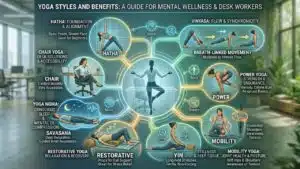
Yoga can support mind-body health because it combines movement, breathing, attention, and body awareness. But beginners often feel confused by different styles. Hatha, Vinyasa, Yin, Restorative, Power Yoga, Chair Yoga, and Yoga Nidra are not the same experience.
The best yoga style depends on your goal. If you want gentle movement and basic poses, Hatha is a good start. If you want flowing movement, Vinyasa may fit. If you want deep stretching and stillness, Yin is different. If you want recovery, Restorative or Yoga Nidra may be better.
For desk workers, yoga can help with stiffness, breathing, posture awareness, and stress. It can also reveal where the body holds tension. Many professionals do not realize how tight their hips, chest, shoulders, and back are until they slow down and move intentionally.
Yoga should be approached carefully. Do not force deep poses. Flexibility takes time. Yoga should not become another way to compete with your body. If a pose causes sharp pain, numbness, dizziness, or joint discomfort, stop or modify.
Beginners should start with short sessions, clear instruction, and basic poses. Ten to twenty minutes is enough. You do not need advanced poses to benefit from yoga. You need consistency, breath, and awareness.
For mental wellness, yoga is useful because it gives the mind something physical to focus on. Instead of thinking about everything at once, you coordinate movement, breathing, and attention. That is why many people find it calming.
| Yoga Style | Best For | Beginner Note |
| Hatha | Basic poses and slower pace | Good starting point |
| Vinyasa | Flow and movement | Can be moderate to intense |
| Yin | Long-held stretches | Go gently, avoid forcing |
| Restorative | Relaxation and recovery | Great for stress relief |
| Power Yoga | Strength and intensity | Better after basics |
| Yoga Nidra | Deep relaxation | Useful for wind-down |
| Chair Yoga | Desk workers and limited mobility | Very accessible |
| Mobility-focused yoga | Stiff hips and shoulders | Good for professionals |
Yoga is not about making impressive shapes. It is about building awareness, control, mobility, breath, and calm.
Journaling for Mental Health Guide
Journaling is not only for people who love writing. It is a simple tool for organizing thoughts, noticing patterns, and reducing mental clutter. For busy professionals, journaling can help separate work stress from personal identity.
Many beginners avoid journaling because they think it needs to be deep, poetic, or emotional. It does not. A useful journal entry can be five lines. What happened? What did I feel? What do I need? What can I do next? What can I let go of?
Journaling for mental health is especially helpful when thoughts repeat in your head. Writing them down makes them more concrete. Once they are visible, they often feel easier to manage. A worry that feels huge in your mind may become clearer once it is on paper.
You can journal in the morning, after work, before bed, or after a stressful event. Use prompts if blank pages feel difficult. A beginner does not need a beautiful notebook or perfect grammar. The goal is clarity.
For mental wellness, journaling works best when it is honest but not obsessive. Do not use it only to criticize yourself. Use it to understand yourself. If journaling makes you spiral, shorten it and focus on practical prompts.
A simple evening journal can also help sleep. Write tomorrow’s top tasks, one thing that went well, and one thing you are releasing for the night. This creates closure before bed.
| Journaling Method | Best For | Prompt Example |
| Daily check-in | Emotional awareness | “How do I feel today?” |
| Stress dump | Mental clutter | “What is taking up space in my mind?” |
| Gratitude note | Perspective | “What went right today?” |
| Problem-solving | Decision clarity | “What is one next step?” |
| Body journal | Mind-body awareness | “Where do I feel tension?” |
| Sleep journal | Sleep patterns | “What affected my sleep?” |
| Workout reflection | Fitness mindset | “How did my body respond?” |
| Evening shutdown | Work boundaries | “What can wait until tomorrow?” |
Journaling does not need to be beautiful. It needs to be useful, honest, and repeatable.
Macronutrients Explained Simply for Mental and Physical Energy
Macronutrients explained are protein, carbohydrates, and fats. Beginners often hear about them in fitness content, but they are not just body composition tools. They also affect energy, recovery, hunger, focus, and mental steadiness.
Protein supports muscle repair, fullness, and recovery. Carbohydrates provide energy for the brain, workouts, and daily movement. Fats support fullness and many normal body functions. A balanced diet uses all three instead of treating one as the enemy.
The mistake is demonizing one macronutrient. Some people fear carbs. Others fear fats. Some over-focus on protein and forget fiber, vegetables, hydration, and meal enjoyment. A beginner does not need macro obsession. They need macro understanding.
For a simple plate, include protein, carbs, vegetables or fruit, and healthy fats. This keeps meals more stable than random snacking or single-food meals. A rice meal with protein and vegetables is stronger than rice alone. A salad with protein and healthy fats is more satisfying than plain leaves. Oats with yogurt and fruit are more useful than a sugary snack alone.
For mental wellness, stable eating matters. Skipping meals, overusing caffeine, and eating only quick snacks can affect mood and focus. Many people think they are emotionally unstable when they are actually under-fed, dehydrated, overstimulated, and tired.
This does not mean food fixes everything. It means food is one of the daily inputs that shapes how your body and brain feel.
| Macronutrient | Main Role | Beginner Foods |
| Protein | Repair, fullness, muscle support | Eggs, fish, chicken, tofu, lentils |
| Carbohydrates | Energy for brain and movement | Rice, oats, fruit, potatoes |
| Fats | Fullness and body functions | Nuts, seeds, olive oil, avocado |
| Fiber | Digestion and fullness | Vegetables, beans, whole grains |
| Fluids | Hydration and function | Water, milk, unsweetened drinks |
| Micronutrients | Support body systems | Colorful whole foods |
| Balanced meals | Energy stability | Protein + carb + vegetable |
| Snacks | Prevent energy crashes | Fruit, yogurt, nuts |
Food is not only fuel for workouts. It is also support for mood, focus, recovery, and daily stability.
Protein Requirements for Active People
Protein requirements are important for active people because training creates repair needs. Strength workouts, cardio, walking, yoga, and daily movement all place demands on the body. Protein helps with muscle maintenance, recovery, and fullness.
Beginners often make two mistakes. Some ignore protein completely because their meals are mostly carbs, snacks, tea, or convenience foods. Others think protein powder is mandatory before they even build a regular workout routine. The practical middle ground is better: get protein from regular meals first, then use supplements only if needed.
Protein needs vary based on body size, age, training type, goals, and diet pattern. A beginner does not need to calculate everything perfectly on day one. A practical starting point is to include a protein source in most meals.
For desk workers who train after work, protein at breakfast and lunch can help reduce random snacking and evening hunger. It also supports recovery after workouts. A person who eats almost no protein until dinner often feels hungrier and less stable during the day.
Good sources include eggs, fish, chicken, lean meat, dairy, yogurt, tofu, tempeh, lentils, beans, chickpeas, soy, nuts, and seeds. Plant-based eaters may need more planning, but it is absolutely possible.
Protein should not become another obsession. It is one part of a balanced diet. Pair it with carbohydrates, vegetables, healthy fats, fluids, and enough total food.
| Protein Source | Best Use | Practical Meal Idea |
| Eggs | Breakfast or quick meal | Eggs with toast and vegetables |
| Fish | Main meal | Fish with rice and greens |
| Chicken | Lunch or dinner | Chicken bowl or wrap |
| Yogurt | Snack or breakfast | Yogurt with fruit and oats |
| Lentils | Budget protein | Lentil curry or soup |
| Tofu | Plant-based meals | Tofu stir-fry |
| Beans | Fiber and protein | Bean bowl |
| Protein powder | Convenience | Smoothie when meals are hard |
Protein should support your routine, not become another source of pressure.
Digital Detox Practical Guide
Digital detox does not mean disappearing from the internet. For most professionals, that is unrealistic. It means building boundaries with screens so your attention and nervous system get breaks.
Digital overload affects mental wellness because your brain is constantly processing information. News, messages, work apps, social media, ads, short videos, notifications, and emails all compete for attention. Over time, that can make focus feel harder and rest feel less restful.
A practical digital detox starts with small boundaries. No phone during meals. No phone in bed. Turn off non-essential notifications. Use app limits. Keep one screen-free block each evening. Start with one change, not ten.
For Corporate Athletes, digital detox is not anti-technology. It is pro-recovery. Technology is useful, but without boundaries, it can consume every quiet moment your mind needs. If every pause becomes scrolling, the brain rarely gets real rest.
One powerful practice is a work shutdown ritual. At the end of the day, write tomorrow’s top tasks, close work tabs, clear the desk lightly, and step away. This tells your brain that work has ended. It is a small but useful boundary.
Digital detox also supports sleep. Late-night scrolling can keep the brain alert and emotionally activated. Reducing screen stimulation before bed helps the body shift into rest mode.
| Digital Detox Practice | Why It Helps | Beginner Version |
| Notification control | Reduces interruptions | Turn off non-essential alerts |
| Phone-free meals | Improves presence | Keep phone away while eating |
| No phone in bed | Protects sleep | Charge phone outside bed |
| App limits | Reduces scrolling | Set time limits |
| Screen-free walk | Improves mental reset | Walk without headphones sometimes |
| Work shutdown | Creates boundary | Write tomorrow’s tasks |
| Social media windows | Reduces checking | Use set times |
| Evening dimming | Supports wind-down | Lower brightness and stimulation |
Digital wellness is not about quitting screens. It is about getting your attention back.
Mindful Eating Practices Explained

Mindful eating means paying attention to food, hunger, fullness, taste, and emotions without turning meals into a strict rulebook. It is especially useful for people who eat while distracted, stressed, rushed, or emotionally overloaded.
Many busy professionals eat at their desks, during calls, while scrolling, or while thinking about the next task. The meal disappears, but the body barely registers it. That can lead to overeating, poor digestion, constant snacking, or feeling unsatisfied even after eating.
Mindful eating starts with slowing down. Take a breath before eating. Notice the food. Chew properly. Put the phone away. Ask whether you are hungry, stressed, tired, bored, or rushed. These small questions create awareness.
This does not mean every meal must be silent and perfect. Real life is messy. The goal is to bring more attention into eating, not to make food ceremonial or awkward. Even eating the first five minutes without a phone can change the experience.
Mindful eating also supports mental wellness because it reduces guilt-based eating. You learn to make food choices with awareness instead of reacting automatically. You stop labeling every choice as good or bad and start asking what your body actually needs.
For fitness and mind-body health, mindful eating helps connect nutrition with energy. You begin to notice which meals help you train, focus, sleep, and recover better.
| Mindful Eating Practice | What It Does | Simple Start |
| Pause before eating | Creates awareness | Take 3 breaths |
| Remove distractions | Improves meal attention | No phone for first 5 minutes |
| Notice hunger | Reduces automatic eating | Rate hunger 1-10 |
| Slow chewing | Helps digestion and fullness | Put fork down sometimes |
| Notice emotions | Separates stress from hunger | Ask “What do I need?” |
| Balanced plate | Supports satisfaction | Protein, carbs, vegetables |
| Stop before stuffed | Builds body awareness | Pause mid-meal |
| No guilt language | Improves food relationship | Avoid “good/bad food” labels |
Mindful eating is not eating perfectly. It is eating with more awareness, less guilt, and better connection to your body.
How All Wellness Practices Work Together
The biggest mistake in wellness is treating every habit as separate. Meditation, exercise, food, sleep, breathwork, yoga, journaling, and digital detox all connect. When one area improves, others often become easier.
Better sleep makes workouts easier. Better workouts improve mood and confidence. Better meals reduce energy crashes. Less screen time improves sleep. Journaling lowers mental clutter. Breathwork helps stress response. Yoga improves body awareness. These habits support each other.
You do not need to master all of them at once. That would be overwhelming. Start with the weakest link or easiest win. If you sleep poorly, start there. If stress is high, use breathing and walking. If food is chaotic, build simple meals. If your mind feels overloaded, reduce screens and journal.
A pillar approach works because each cluster topic becomes one part of the system. The main guide gives the roadmap. The clusters give deeper instruction. This structure helps readers understand the full wellness ecosystem without feeling lost.
For Editorialge and HappinessFit.com, this creates natural topical authority. The pillar explains the whole mind-body health framework, while each cluster answers a focused search intent in detail. Readers can move from broad understanding to specific action.
The real goal is not to become a “wellness person.” The real goal is to build a life where your body and mind are not constantly fighting your schedule.
| Wellness Practice | Supports | Best Beginner Start |
| Meditation | Attention and calm | 3 minutes daily |
| Breathwork | Stress regulation | 4-6 breathing |
| Fitness tracking | Awareness | Simple weekly notes |
| Beginner fitness | Energy and confidence | Walk and strength train |
| Stress management | Recovery and mood | Daily reset routine |
| Sleep hygiene | Energy and focus | Consistent bedtime |
| Habit building | Long-term change | Start tiny |
| Yoga | Mobility and body awareness | Gentle beginner class |
| Journaling | Emotional clarity | 5-line reflection |
| Macronutrients | Energy stability | Balanced plate |
| Protein | Recovery and fullness | Add to meals |
| Digital detox | Focus and sleep | No phone in bed |
| Mindful eating | Food awareness | Phone-free meal |
Wellness works best when it becomes a system, not a collection of random hacks.
A Simple 30-Day Mental Wellness Plan for Beginners
A 30-day plan gives beginners structure without demanding a full life makeover. The goal is not to become perfectly calm in one month. The goal is to create a few reliable habits that support mind-body health.
Week one should focus on awareness. Notice sleep, stress, movement, food, and screen use. Do not judge everything. Just observe. Many people try to fix habits before they understand them. Awareness comes first.
Week two should add small practices. Try short meditation, breathwork, walking, or journaling. Keep the sessions short so they are easy to repeat. This is not the time to build a complicated wellness routine.
Week three should improve recovery and structure. Add better sleep hygiene, balanced meals, movement breaks, and screen boundaries. These habits support energy and make emotional regulation easier.
Week four should refine. Keep what worked, remove what felt forced, and choose the next cluster topic to explore deeper. The best plan is not the one with the most habits. It is the one you can continue.
For busy professionals, this 30-day plan should have flexible versions. A full day may include walking, journaling, balanced meals, and sleep hygiene. A busy day may include 3 breaths, one walk, water, and no phone in bed. Both count if they keep the system alive.
| Week | Focus | Practical Actions |
| Week 1 | Awareness | Track sleep, mood, movement, stress |
| Week 2 | Calm practice | Add 3-minute meditation and breathing |
| Week 3 | Recovery | Improve sleep, food, and digital boundaries |
| Week 4 | Integration | Keep best habits and adjust routine |
| Daily | Small reset | Walk, breathe, stretch, or journal |
| Workdays | Corporate Athlete support | Move between desk blocks |
| Evenings | Wind-down | Reduce screens and prepare sleep |
| End of month | Review | Keep what actually helped |
A 30-day plan should make wellness easier, not heavier. The goal is practical momentum.
Final Thoughts
A mental wellness guide should not make you feel behind. It should help you see the system clearly.
Your mind is affected by sleep, movement, food, stress, breathing, screens, work rhythms, recovery, and relationships. Your body is affected by your thoughts, emotions, habits, and environment. That is why mind-body health matters so much.
You do not need to master every wellness practice immediately. Start with the basics. Sleep a little better. Move a little more. Breathe when stress rises. Eat meals that support energy. Put the phone away before bed. Write down what is cluttering your mind. Stretch when your body feels locked from sitting. Take recovery seriously.
For the Corporate Athlete, mental wellness is not a luxury. It is part of performance, creativity, leadership, health, and long-term sustainability. Editorialge Media LLC and HappinessFit.com can naturally support this mission by helping busy people build practical wellness systems that fit real life.
Start small. Repeat what works. Drop what feels performative. Build habits that support the mind and body you actually live with every day.
That is where real wellness begins.
Frequently Asked Questions (FAQs) About This Mental Wellness Guide
What Is a Mental Wellness Guide?
A mental wellness guide is a practical roadmap for supporting emotional, psychological, and daily life well-being. It can include stress management, sleep, movement, meditation, breathwork, nutrition, journaling, digital boundaries, and healthy habits. A good guide does not replace professional mental health care, but it can help people build supportive routines.
What Is Mind-Body Health?
Mind-body health means understanding that mental and physical health influence each other. Sleep, food, exercise, stress, breathing, posture, and screen use can all affect mood, focus, energy, and recovery. It is not about treating the mind and body as separate systems.
How Do Beginners Start Improving Mental Wellness?
Start with one or two habits. A short daily walk, 3 minutes of breathing, a consistent sleep routine, or a quick journal note can be enough. Beginners should avoid trying to fix everything at once because that usually creates pressure instead of progress.
Can Exercise Improve Mental Health Fitness?
Exercise can support mood, energy, confidence, sleep, and stress management. It should be realistic and recoverable, especially for beginners. Overtraining or punishment-based workouts can add stress instead of reducing it.
Is Meditation Necessary for Mental Wellness?
Meditation is useful, but it is not the only path. Breathwork, walking, journaling, yoga, sleep hygiene, social connection, and digital boundaries can also help. The best practice is the one you can repeat.
How Does Nutrition Affect Mental Wellness?
Nutrition affects energy, focus, recovery, hunger, and mood stability. Balanced meals with protein, carbohydrates, healthy fats, fiber, and fluids can support both physical and mental performance. Food does not fix everything, but chaotic eating can make wellness harder.
What Is the Best Wellness Practice for Busy Professionals?
The best practice is usually the smallest one that reduces daily friction. A 10-minute walk, phone-free meal, 3-minute breathing break, consistent bedtime, or short mobility routine can be more useful than an unrealistic long routine.
When Should Someone Seek Professional Help?
If someone experiences persistent sadness, severe anxiety, panic, trauma symptoms, self-harm thoughts, addiction concerns, or distress that interferes with daily life, professional help is important. Wellness habits can support care, but they should not replace proper treatment.