India’s tech industry has already proved it can execute. That is not the problem. The harder question is whether the sector is building enough original technology to shape what comes next, or whether it is still too comfortable improving systems, scaling delivery, and serving global demand created elsewhere.
That tension sits at the center of the future of Indian technology. From the outside, the industry looks powerful, skilled, and commercially important. It has talent, scale, digital infrastructure, startup energy, IT services depth, and a large domestic market that can test products under real pressure.
But power and direction are not the same thing.
The Indian technology sector is excellent at doing things right. It can deliver software at scale. It can manage enterprise systems. It can train large teams. It can support global clients. It can reduce costs, improve workflows, and keep complicated digital machinery running.
That has built a serious industry.
The concern is whether too much of that industry is still focused on optimizing the present instead of building the future.
The Execution Machine Is Still Impressive
India’s IT services story deserves respect. It helped move the country into the center of global technology work. It created careers for millions of people and gave Indian engineers a strong place in enterprise software, cloud migration, support systems, consulting, cybersecurity, analytics, and business process modernization.
A country does not become a global technology force by accident. Indian companies spent years earning trust through delivery discipline.
They became good at things global clients cared about:
- Turning vague requirements into working systems
- Scaling large engineering and support teams
- Running enterprise technology across time zones
- Reducing cost without completely sacrificing quality
- Training workers quickly
- Supporting complex legacy systems
- Building repeatable delivery processes
None of this should be dismissed. Too many critics talk about IT services as if execution is easy. It is not. Running large technology operations for global clients takes structure, talent, patience, and management discipline.
But execution has a ceiling.
A company that implements another firm’s cloud strategy is not in the same position as the company that owns the cloud platform. A team that customizes AI tools for clients is useful, but it is not the same as owning the model, the product, the infrastructure, or the data layer. A delivery center can be valuable without being strategically dominant.
That is where the next question begins.
Doing Things Right Is Not the Same as Choosing the Right Things
The central issue is not whether India’s tech industry works hard. It clearly does.
The issue is whether the industry is aiming high enough.
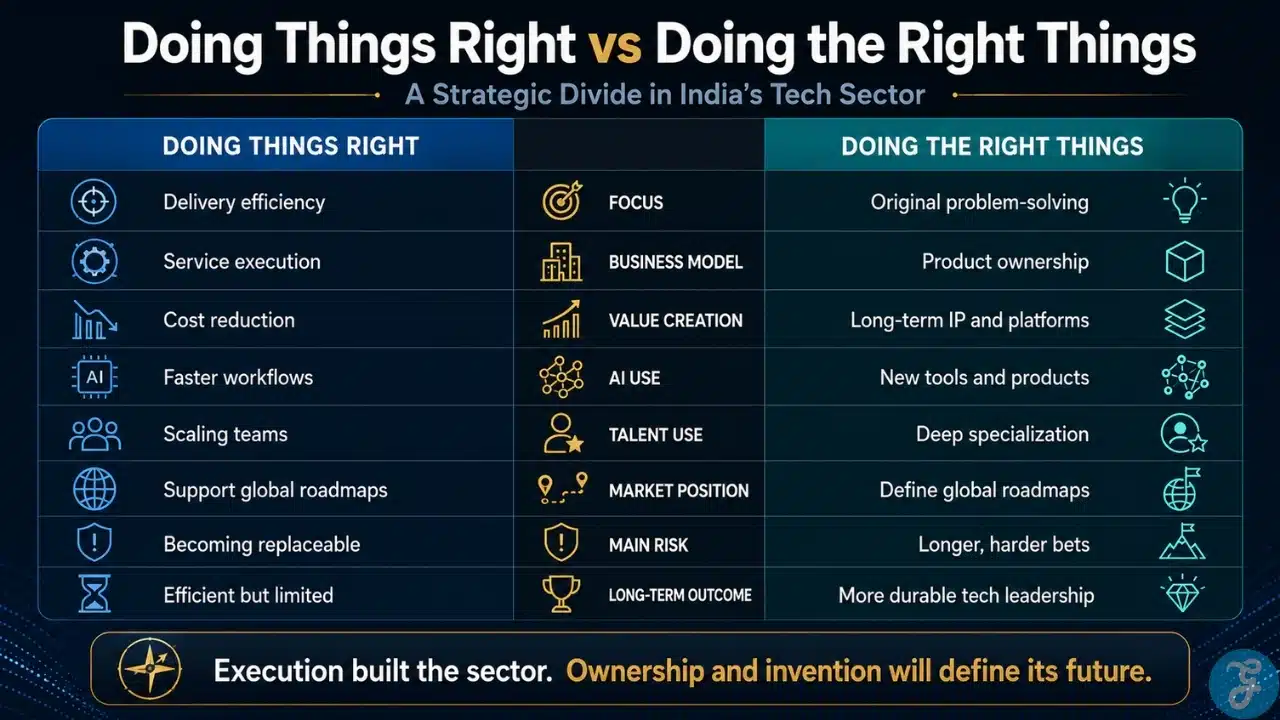
There is a real difference between doing things right and doing the right things. One is about execution quality. The other is about strategic choice. Indian tech has built much of its global reputation around the first one. The next stage demands more of the second.
The difference looks like this:
| Doing Things Right | Doing the Right Things |
|---|---|
| Improving delivery speed | Building original products |
| Reducing client costs | Owning intellectual property |
| Scaling support teams | Creating technology platforms |
| Automating existing workflows | Solving new technical problems |
| Serving global roadmaps | Defining product roadmaps |
| Competing on efficiency | Competing on invention |
Both sides matter. A country cannot build serious technology without execution. But execution alone rarely creates long-term power.
The strongest technology companies do not only complete tasks. They decide which problems are worth solving. They create products others rely on. They build platforms, standards, ecosystems, and habits. They own the layer where value compounds.
That is the leap India’s tech industry still has to make more consistently.
The Service Mindset Can Become Too Comfortable
The Indian services model was built around reliability. That made sense. Global companies needed dependable partners, and Indian firms became extremely good at providing them.
The problem starts when a business model becomes an identity.
Service work often rewards predictability. Clear requirements. Defined scope. Delivery timelines. Client satisfaction. Margin control. Repeatable processes. Large teams. Better utilization.
Product invention rewards a different type of behavior.
It needs patience with unclear demand. It needs tolerance for failure. It needs user research, design judgment, technical risk, long product cycles, and the courage to build before the market fully agrees. It also needs capital that does not panic when a hard technical problem takes longer than a dashboard forecast suggested.
That is a difficult cultural shift.
It is much easier to add AI to an old service package and call it innovation. It is much harder to build AI-native products with defensible value. It is easier to create a proof of concept for a client. It is harder to build a product that thousands of companies choose without a custom sales deck explaining every line item.
This is where the Indian tech sector has to be careful. If AI becomes only a way to make service delivery cheaper, the industry may protect short-term revenue while weakening its long-term position.
AI Is Pressuring the Old Model
AI is not just another trend for the Indian tech industry to package into consulting slides. It directly challenges the economics of implementation-heavy work.
A lot of coding, testing, documentation, support, analytics, migration assistance, quality checks, and workflow automation can now be accelerated by AI tools. That does not remove the need for engineers or service firms. It does change what clients are willing to pay for.
If AI helps smaller teams produce more output, the old equation becomes weaker: more projects, more people, more billable hours, more revenue.
Clients will still need technical partners. But they will expect faster delivery, leaner teams, stronger automation, and clearer business outcomes. The routine parts of software work will face pricing pressure.
That creates two possible paths.
Indian tech firms can use AI mainly to defend the old services model. That means faster delivery, lower cost, and better margins on familiar work.
Or they can use AI to build new products, new infrastructure, specialized tools, better platforms, and stronger intellectual property.
The first path keeps them useful.
The second makes them harder to replace.
Future of Indian Technology Depends on Product Ownership
The future of Indian technology cannot be built only on service contracts, offshore teams, and global delivery strength. Those will remain important, but they should not be the whole story.
Product ownership matters because it changes the value equation.
A service firm earns when it delivers work. A product company can earn from repeated use, brand trust, data advantage, platform control, ecosystem growth, and long-term customer dependence. Services can scale through people and processes. Products can scale through adoption.
India has strong product examples, especially in fintech, SaaS, digital commerce, enterprise software, and public digital infrastructure. The point is not that product innovation is absent.
The point is that it is not yet dominant enough to define the global image of Indian technology.
From the outside, India is still often described as a talent base, delivery hub, outsourcing market, startup ecosystem, or large consumer market. Those labels are not false. They are just incomplete.
The next phase should make those labels feel too small.
India’s Scale Is an Advantage, but Not a Strategy
India’s scale gives its technology sector a rare testing ground. A product built for India may have to survive different languages, low-cost devices, patchy connectivity, price-sensitive users, dense cities, rural markets, trust barriers, and huge transaction volume.
That is a serious advantage.
Digital public infrastructure shows what scale can do when policy, platforms, private companies, and user behavior move in the same direction. UPI is the clearest example. It turned digital payments into a daily habit across a massive population and gave India a technology story that other countries study.
But scale can also become a distraction.
A huge user base does not automatically create global product leadership. Large transaction volume does not automatically build deep AI capability. A busy startup market does not automatically mean the ecosystem is solving hard technical problems. A massive developer base does not automatically produce foundational research or world-class product design.
Scale gives India room to build.
It does not decide what the industry builds.
The Product Gap Still Shows
India has produced serious technology companies, but the product gap remains visible.
Too many startups still look like local versions of proven global models. That can be commercially valid. Local adaptation can solve real problems. Not every business needs to invent a category.
But if the discussion is about technology leadership, adaptation is not enough.
The industry needs more companies building products that can travel beyond India because they are technically strong, not only because they are cheaper or locally optimized. It needs more products that global customers choose because the product is better, not because the engineering team is affordable.
The weak spots are familiar:
- Too many companies build around distribution before defensibility.
- Too many pitch decks use technology language without deep technical advantage.
- Too much engineering talent gets absorbed into services, support, and implementation work.
- Research and commercialization do not connect smoothly enough.
- Deep-tech founders often face longer funding cycles and less patience.
- Product design and documentation quality can still lag behind engineering effort.
These are fixable problems. But they are not small problems.
The industry cannot solve them with another innovation summit and a few dramatic keynote lines about disruption. It needs different incentives.
GCC Growth Is Useful, but Ownership Still Matters
Global Capability Centers have become a major part of India’s tech story. Many multinational companies now use India-based teams for engineering, analytics, cybersecurity, AI, product support, internal platforms, and business operations.
That is a strong signal of trust in Indian talent.
It also needs careful interpretation.
A global company expanding a technology hub in India does not automatically mean India owns the innovation. Sometimes Indian teams lead important work. Sometimes they handle core systems. Sometimes they move much closer to product decisions than old outsourcing models allowed.
That is progress.
But the ownership question still matters:
- Who controls the product roadmap?
- Who owns the intellectual property?
- Who sets the platform direction?
- Who captures the long-term value?
- Who becomes known as the creator?
If Indian teams execute global ideas at scale, the sector remains important. If Indian teams define and own more of those ideas, the sector becomes more powerful.
That difference should not be blurred.
The best version of the GCC boom would move Indian talent closer to research, architecture, product strategy, and platform ownership. The weaker version would celebrate headcount expansion while leaving strategic control somewhere else.
Semiconductors Need Discipline, Not Just Optimism
India’s semiconductor push is important because it targets a harder layer of the technology stack. Software services can be scaled with talent and process. Semiconductors demand manufacturing discipline, supply chains, capital, design capability, equipment access, materials knowledge, policy stability, and years of patient execution.
That is why the sector should discuss semiconductors with caution.
India has announced and approved major semiconductor investments, and the policy direction is serious. That matters. But chip ecosystems are not built through announcements alone.
The real tests are less glamorous:
- Can facilities reach reliable production?
- Can suppliers develop around them?
- Can talent pipelines support long-term growth?
- Can domestic design companies mature?
- Can India compete in specific layers of the chip value chain first?
- Can policy support survive beyond headline cycles?
India does not need to pretend it can dominate every semiconductor layer immediately. That would be poor strategy. The smarter path is sequencing: choose the right entry points, build credibility, support design capability, strengthen packaging and testing, learn from partners, and gradually move up the stack.
In this area, doing things right matters deeply.
But choosing the right things matters even more.
Startups Need Fewer Easy Copies and More Hard Problems
India’s startup ecosystem has energy. That is obvious. What it needs now is more depth.
A market can produce many startups and still not produce enough original technology. Growth alone does not prove defensibility. Fast hiring does not prove product quality. Fundraising does not prove invention. A clever app does not automatically become a technology moat.
Some startup categories solve practical local problems, and those should not be dismissed. But a country that wants to shape the next phase of technology needs more companies working on difficult problems.
The stronger opportunities are not always the easiest ones to explain in a 30-second pitch.
They may include:
- Applied AI for healthcare, finance, agriculture, education, logistics, and manufacturing
- Cybersecurity products built for global threat environments
- Developer tools and infrastructure software
- Semiconductor design support and testing systems
- Industrial automation and robotics
- Climate and energy technology
- Health technology with credible clinical integration
- Space technology and geospatial platforms
- Enterprise products that can sell globally
Some of these areas are slow. Some need specialized teams. Some need patient capital. Some will fail before the market understands them.
That is normal.
If every idea is easy to copy, there is no real moat. There is only temporary speed.
Talent Volume Is Not Enough Anymore
India’s talent base is one of the sector’s biggest strengths. But the next phase needs more than volume.
The industry needs deeper specialists. Engineers who can design systems, not only complete tasks. Product leaders who understand user behavior, not only feature lists. AI teams that can evaluate models, not only connect APIs. Cybersecurity researchers, chip designers, technical writers, UX researchers, hardware engineers, data governance experts, and architecture leaders.
This is where my editorial background shapes how I read the issue.
In content, producing more drafts does not mean the work is better. Speed helps, but judgment decides quality. A good editor asks what belongs, what should be removed, what is accurate, what helps the reader, and what only looks useful because it fills space.
Technology has a similar problem.
Shipping more code is not the same as building better technology. Hiring more engineers is not the same as creating stronger products. Running more delivery centers is not the same as owning more of the future.
The next advantage will belong to companies that combine execution with judgment.
Where the Sector Is Already Getting It Right
A fair critique should not pretend India’s technology sector is failing. It is not.
The sector has real strengths. Its IT services base remains globally important. Its digital payments infrastructure has become a major case study. Its SaaS companies have shown that Indian firms can sell internationally. Its startup ecosystem is active. Its digital public infrastructure gives builders a strong foundation. Its GCC growth shows that multinational companies trust Indian technical depth. Its AI and semiconductor ambitions have moved from vague aspiration to visible policy support.
That is a serious foundation.
The risk is not failure.
The risk is comfort.
A sector can become successful enough inside one model that it delays the harder transition to the next one. That is the problem Indian tech has to avoid.
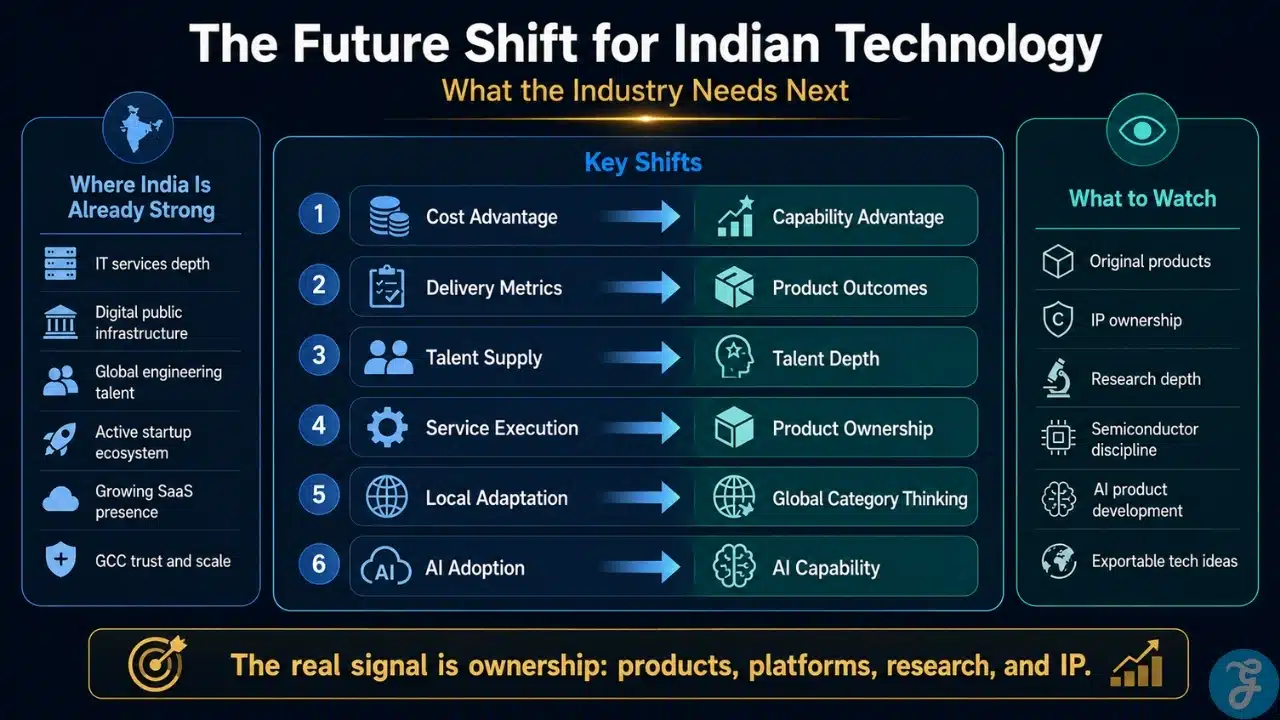
The Shifts That Matter Now
The Indian tech industry does not need to abandon services, delivery, GCCs, or enterprise work. Those strengths built the sector and will keep generating value.
But the balance has to change.
From Cost Advantage to Capability Advantage
Competing mainly on cost is not durable. AI, automation, wage pressure, and other global delivery markets will keep weakening that advantage.
Capability is harder to replace. That means specialized knowledge, stronger products, domain expertise, better research, and clearer ownership of technical assets.
From Delivery Metrics to Product Outcomes
Delivery metrics are comfortable: project completed, ticket closed, client satisfied, cost reduced.
Product outcomes are harder: did the product solve a real problem, retain users, improve over time, create trust, build defensibility, and compete beyond one market?
The second set of questions matters more for the future.
From Talent Supply to Talent Depth
The sector already has talent supply. The next challenge is talent depth.
That means better technical education, stronger university-industry links, more research culture, more practical specialization, and more respect for roles that turn engineering into usable products.
From Local Adaptation to Global Category Thinking
Building for India matters. The domestic market is large enough to support serious companies.
But the strongest firms should also ask whether their products can travel. Can they win global customers? Can they define a category? Can they become infrastructure for others? Can they export technology ideas, not only technical labor?
That is the bigger test.
The Pivot Cannot Stay Optional
The Indian tech industry already knows how to do things right. That ability built the sector and gave it global relevance.
The harder question is whether they are willing to do the right things more often.
That is the real tension behind the future of Indian technology. The sector can keep optimizing delivery, adding AI to services, scaling global support systems, and improving old business models. That path will still generate revenue. It will still create jobs. It will still matter.
But it may not create leadership.
Leadership will require more original products, stronger intellectual property, deeper research, patient capital, better product design, serious AI capability, disciplined semiconductor execution, stronger technical education, and founders willing to solve hard problems instead of fashionable ones.
India’s tech industry is not failing. That is why the question matters.
They have reached the point where success inside the old model could become the reason to postpone the next one. That would be the real mistake.
For readers watching the sector, the next signal is not how many companies claim to be AI-led or how many delivery centers expand. The better signal is ownership. Who owns the product? Who owns the platform? Who owns the research? Who owns the IP? Who creates something others later depend on?
That is where the future will be decided.
Not in optimization alone.