Your AI agent is stuck in the past. It only knows what it learned months ago. But the world keeps changing every day. Web search APIs fix this problem. They help AI agents find fresh information right now, not yesterday’s news. This guide shows you the 10 best search API for AI agents. You’ll learn what makes each one special. Some cost less. Others work faster. A few do things the rest can’t touch. By the end, you’ll know exactly which one fits your project.
AI agents work better when they can search the web. Think about it. They answer questions with current facts. They check information in seconds. They pull fresh data without making you wait. Search APIs make all this possible.
Regular search engines like Google were built for people, not machines. They show web pages with pretty pictures and ads. Your AI agent doesn’t care about those things. It needs clean data it can read fast. It needs facts without the fluff. The right search API gives your agent exactly that.
This article walks through 10 powerful search APIs. Each one works differently. Some focus on speed and keep things simple. Others go deep and find more content. Some save you money on every search. Others pack in extra features that might save you time later. You’ll discover which API matches your workflow, fits your budget, and helps you reach your goals.
What Criteria Should You Use to Evaluate Search APIs for AI Agents?
Choosing the right search API starts with knowing what your AI agent really needs. Tool type sits at the foundation. SERP APIs pull results from search engines like Google or Bing. AI-focused APIs build their own search from scratch. LLM-integrated providers connect directly to language models like GPT-4 or Claude. Your choice here shapes everything else about your project.
Next, check the search index behind each API. Some wrap Google’s massive index, which gives you tons of coverage. But you lose control. Others maintain their own indexes. These might offer fresher content or better privacy. The difference matters because it affects how good your results are and how current they stay.
Content size per result varies a lot between providers. Some APIs return tiny snippets of 160 characters. Others deliver full pages of data in JSON format. Larger content helps AI agents understand context better. But it costs more and takes longer to process.
Pricing changes dramatically across the market. Extra features can make your costs jump fast. Rate limits matter too. Your agent might need to run searches all day long. Some APIs handle this fine. Others slow you down when you need speed most.
Speed becomes critical for real-time agents. APIs that rely on web scraping usually run slower. Those using their own indexes move faster. Your workflow decides how much speed matters.
Privacy policies deserve your attention. Server locations matter too. This counts extra if you work in certain regions or handle sensitive data. Advanced features vary widely between providers. Domain filtering lets you search specific sites. Geo-targeting focuses results by location. News search finds recent stories. Some providers include these features. Others charge extra or don’t offer them at all.
Test a few APIs with your real use cases before you commit. What works great for RAG might fail for research agents. Your workflow tells you which features matter most.
The Top 10 Search APIs for AI Agents
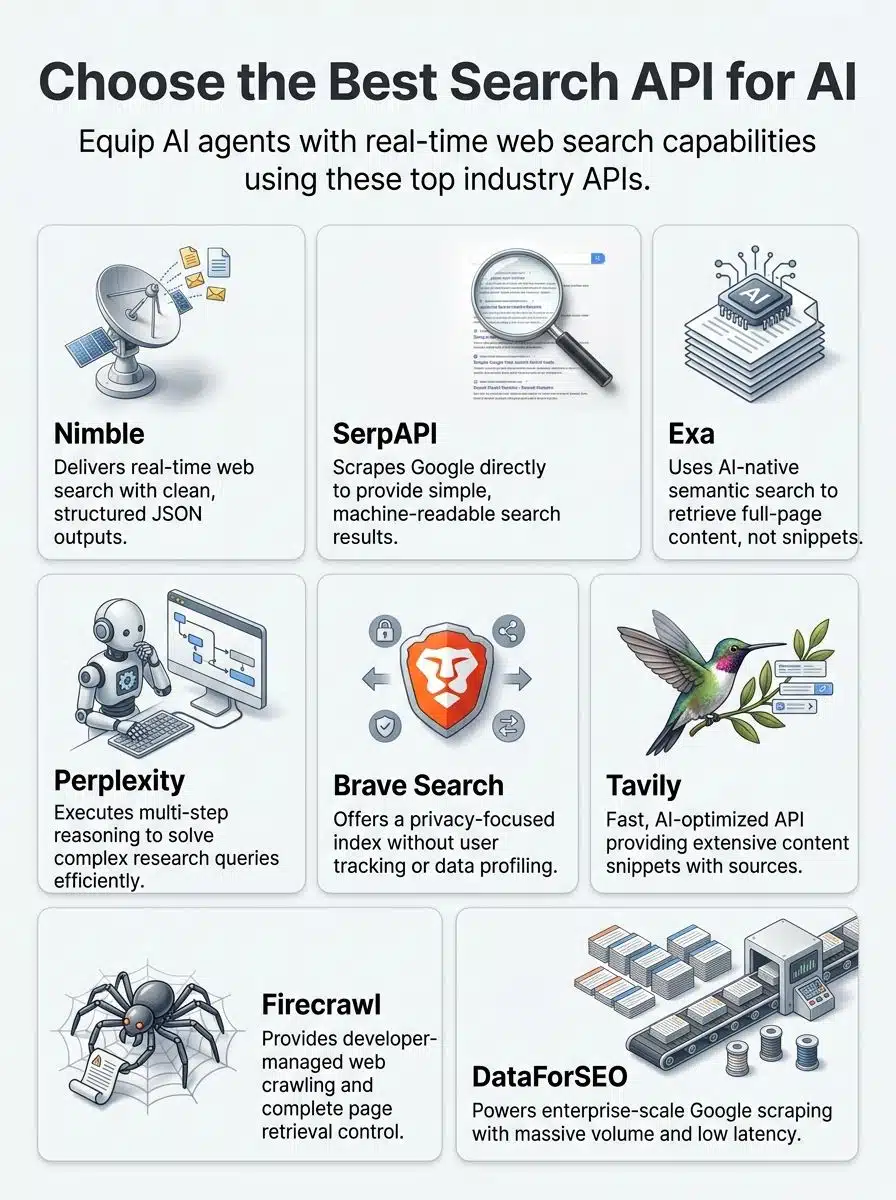
AI agents need strong tools to search the web fast and smart. We picked ten search APIs that excel at AI workflows. Each one gives you different ways to boost how your AI finds and uses web data.
1. Nimble
Nimble stands out by giving you real-time web search with clean, structured outputs. This matters for developers who want to build AI workflows without fighting messy data. The service takes live web information and turns it into organized formats. Your language models and AI agents can actually use this data right away.
The structured output means your AI gets exactly what it needs. Nothing extra to slow it down. This efficiency keeps your latency low and your accuracy high. Developers love that Nimble handles the hard work of parsing and organizing search results. You can focus on building smarter apps instead of fixing data problems.
Structured outputs form the backbone of good AI agent search. Regular SERP APIs dump raw results in your lap. Nimble gives you machine-readable data that fits smoothly into AI systems. Your agents process information faster. They make better decisions. They give users more accurate answers.
The real-time search keeps your app current with fresh information. This matters for everything from finance research to business intelligence. Nimble removes friction from integration. Developers can deploy AI apps with confidence and speed.
2. SerpAPI
SerpAPI wraps Google search in a simple package. It scrapes search engine results and gives you machine-readable data for your AI agents. You skip building your own search index, which saves tons of work.
The platform offers a free tier with 250 calls monthly. Perfect for testing your ideas. Paid plans start at $75 per month for 5,000 searches. At scale, you pay just $5.50 per 1,000 calls. Each result includes a 160-character content snippet. That’s enough context for your AI to understand what it found.
The rate limit lets you use 20% of your monthly volume per hour. This keeps your workflows steady and predictable. No surprise slowdowns when you need speed.
SerpAPI shines because it handles SERP data extraction without making you maintain a search index. Your AI agents get reliable, consistent results. The tool focuses on one job and does it well. The simple approach keeps costs lower than alternatives with their own indexes. You get clean data in a format your language models can use. No confusion, just data flowing into your AI system.
Teams building agent search solutions find SerpAPI removes friction from queries. You can focus on what your agents do best.
3. Exa
Exa works differently from other search APIs. It’s built for AI agents from the ground up. The service runs its own search index instead of relying on Google or Bing. This lets AI systems find web content through semantic search. Your agents understand meaning, not just keywords.
Exa returns full-page content, not snippets. This makes it perfect for RAG workflows. Your AI agents get rich context for every search. They reason better and produce smarter answers.
The pricing stays affordable for most projects. The free tier gives you 1,000 calls monthly for testing. Paid tiers cost $7 per 1,000 calls at scale. That’s the lowest advertised price in the market. Semantic searches cost $5 per 1,000. Keyword-only searches run $2.50 per 1,000. Adding full content costs an extra $1 per 1,000 pages.
The API handles 10 calls per second. Your web crawling stays fast and smooth. This pricing makes Exa ideal for AI research and data retrieval. You can build AI-focused search tools that need real machine-readable data. All without breaking your budget.
4. Perplexity
Perplexity excels when AI agents tackle complex research tasks. It handles multi-step reasoning with ease. The system breaks hard problems into smaller parts. Your AI can ask follow-up questions. It digs deeper into topics without losing track. This approach works like human thinking.
Perplexity pulls data from across the web. Then it puts it together into clear answers. Language models like Claude and Gemini benefit from this structured retrieval. The platform works great for tasks that need more than quick searches. It provides context and reasoning chains. These help agents make better decisions.
Perplexity shines when your AI needs to understand connections between different information. It goes beyond regular search engines. The service offers neural search that grasps meaning, not just keywords. Your agent explores topics from many angles in one workflow.
The search feels natural because Perplexity thinks like an AI. It reduces latency and gives you outputs that feed straight into your systems. This makes it perfect for automation where speed matters. Agents using Perplexity handle research that would take humans hours.
5. Brave Search API
Brave Search API operates its own search index, separate from Google and Bing. The company built a privacy-focused index that gives AI agents web search data without tracking users. They don’t sell user information. This approach means your AI apps get fresh, accurate results while respecting privacy.
Brave delivers different answers than Google. This matters when you need diverse perspectives for AI workflows. The free tier gives you 2,000 calls monthly with 1 call per second. Perfect for testing and prototyping. Paid plans cost $5 per 1,000 calls. No volume discounts at scale. Your rate limit jumps to 50 calls per second on paid tiers. You can handle serious traffic easily.
AI agents work better with multiple search indexes. Brave fills this gap nicely. Each result includes a 400-character snippet. Your agent gets enough context to understand each page. The privacy-focused setup means no tracking cookies. No user profiling. No data selling. This makes Brave ideal for AI apps where privacy matters to users.
Organizations building chatbots and research tools find real value here. The generous free tier, affordable pricing, and different search index make Brave a solid choice. Developers can add web retrieval to AI agents without compromise.
6. Tavily
Tavily was built for AI agents and RAG applications. It makes integration simple for developers who want to skip the headaches. The platform offers a free tier with 1,000 calls monthly. You can test without spending money. Need more power? Paid tiers start at $8 per 1,000 calls. At scale, the price drops to $5 per 1,000 calls. This credit-based pricing means you only pay for what you use. No surprise bills.
Integrating Tavily into AI workflows feels easy compared to regular search engines. Each result delivers over 3,000 characters of content with citations. Your language models get plenty of material to work with. The rate limit hits 1,000 calls per minute. That’s about 17 calls per second on average. Your agents move fast without getting stuck.
Tavily’s simple API cuts setup time dramatically. You focus on building smart agents instead of reading complicated docs. Web search queries get answered with structured outputs and comprehensive content. This makes LLM consumption more efficient than ever.
7. Firecrawl
Firecrawl gives developers full control over web crawling and data retrieval. It uses its own search index. You manage the crawling process yourself. You pick what gets extracted. You decide how it gets used in AI workflows. The platform returns entire page content for each result. Your AI agents get rich, complete information. This hands-on approach works great for projects needing full-page data, not just snippets.
Developers like this control. They can fine-tune retrieval strategies for their specific needs. The pricing makes Firecrawl accessible for any team size. The free tier offers 500 calls monthly for testing and small projects. Paid plans start at $19 monthly for 2,500 calls. At scale, you pay just $1.50 per 1,000 calls. That’s the lowest advertised cost in its category.
Firecrawl handles up to 2,500 calls per minute. Your web crawler won’t slow down during heavy use. This mix of developer control, affordable pricing, and strong rate limits makes Firecrawl solid. AI agents get reliable web data extraction without breaking the bank.
8. DataForSEO
DataForSEO works as a SERP API that scrapes Google results at scale. It pulls data directly from search engine results pages. This makes it ideal for AI agents needing real search metadata and accurate information. The service costs $0.60 per 1,000 calls. You pay $50 minimum upfront. No free tier exists. You pay from day one.
The rate limit hits 2,000 calls per minute. That equals about 33 calls per second on average. Content snippets come in at 160 characters. Your AI agents get enough context without bloat. This approach works well for data extraction and keyword search tasks needing quality outputs.
AI agents on complex research projects benefit from DataForSEO’s scalable solutions. The platform handles massive data collection that would crush regular search APIs. Your agents pull results, parse metadata, and feed information into language models for analysis.
The $50 upfront cost might seem steep. Yet it opens doors to enterprise-grade coverage and reliability. DataForSEO excels when you need consistent performance across thousands of calls. Organizations building AI for SEO, market research, or competitive intelligence find this service delivers power. The architecture supports high-volume queries without breaking. Perfect for teams scaling AI operations fast.
9. Parallel Web Systems
Parallel Web Systems stands out for AI agents that need speed without heavy infrastructure. This platform orchestrates web searches with minimal overhead. It’s perfect for teams building AI-native APIs that demand fast responses.
10. Bright Data
Bright Data serves companies that need to scrape Google at a massive scale. Their SERP API pulls data from search engines. It delivers everything in a machine-readable format. This service works best for enterprise clients with high-volume operations.
The platform charges $1.50 per 1,000 calls at the lowest tier. When you scale up, it drops to $1 per 1,000 calls. No free tier exists. You pay from the start. Each result includes 160 character content snippets. You get enough information to understand findings.
The real power shows with unlimited concurrent requests. You never hit a wall running multiple searches at once. Bright Data built this for companies that live on data. You get no rate limits on concurrent usage. Your AI agents fire off queries without waiting. This enterprise setup handles reliability and speed better than smaller tools.
If your AI workflow needs constant access to fresh search data across thousands of queries, Bright Data delivers. The platform turns web browsing into systematic data collection. Perfect for AI agents needing real-time information from the web.
What Features Should You Consider When Choosing a Search API?
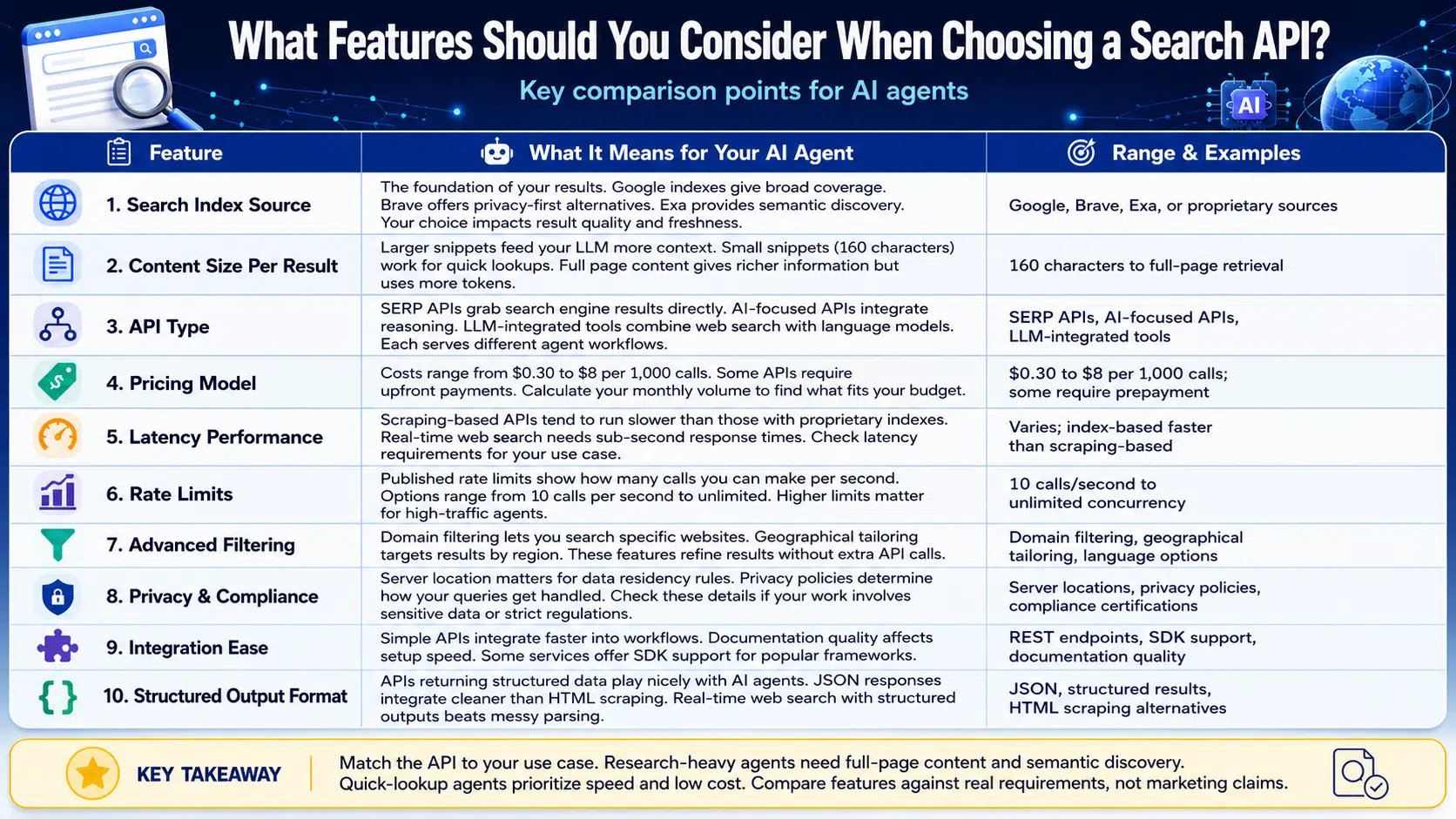
Picking the right search API can make or break your AI agent’s performance. Let’s talk about what actually matters when comparing options.
| Feature | What It Means for Your AI Agent | Range & Examples |
|---|---|---|
| Search Index Source | The foundation of your results. Google indexes give broad coverage. Brave offers privacy-first alternatives. Exa provides semantic discovery. Your choice impacts result quality and freshness. | Google, Brave, Exa, or proprietary sources |
| Content Size Per Result | Larger snippets feed your LLM more context. Small snippets (160 characters) work for quick lookups. Full page content gives richer information but uses more tokens. | 160 characters to full-page retrieval |
| API Type | SERP APIs grab search engine results directly. AI-focused APIs integrate reasoning. LLM-integrated tools combine web search with language models. Each serves different agent workflows. | SERP APIs, AI-focused APIs, LLM-integrated tools |
| Pricing Model | Costs range from $0.30 to $8 per 1,000 calls. Some APIs require upfront payments. Calculate your monthly volume to find what fits your budget. | $0.30 to $8 per 1,000 calls; some require prepayment |
| Latency Performance | Scraping-based APIs tend to run slower than those with proprietary indexes. Real-time web search needs sub-second response times. Check latency requirements for your use case. | Varies; index-based faster than scraping-based |
| Rate Limits | Published rate limits show how many calls you can make per second. Options range from 10 calls per second to unlimited. Higher limits matter for high-traffic agents. | 10 calls/second to unlimited concurrency |
| Advanced Filtering | Domain filtering lets you search specific websites. Geographical tailoring targets results by region. These features refine results without extra API calls. | Domain filtering, geographical tailoring, language options |
| Privacy & Compliance | Server location matters for data residency rules. Privacy policies determine how your queries get handled. Check these details if your work involves sensitive data or strict regulations. | Server locations, privacy policies, compliance certifications |
| Integration Ease | Simple APIs integrate faster into workflows. Documentation quality affects setup speed. Some services offer SDK support for popular frameworks. | REST endpoints, SDK support, documentation quality |
| Structured Output Format | APIs returning structured data play nicely with AI agents. JSON responses integrate cleaner than HTML scraping. Real-time web search with structured outputs beats messy parsing. | JSON, structured results, HTML scraping alternatives |
Your agent’s success depends on matching these features to your needs. A research-heavy agent needs full-page content and semantic discovery. A quick-lookup agent prefers speed and low costs. Compare what each API offers against your actual requirements. Skip the marketing claims.
Final Words
Your AI agents need web search APIs to stay sharp and current. The ten options we covered give you real choices. Serper keeps budgets tight at $0.30 per 1,000 calls. Exa delivers full-page content for serious RAG work.
Your decision comes down to three things. How much do you want to spend? What speed do you need? Do you prefer a regular search engine wrapper or an AI-native index?
Start with your specific use case. Test a free tier first. Scale up once you find your match. The right API turns your AI agents into information powerhouses. They’ll search faster, answer better, and handle tasks that used to take hours. Pick the API that fits your workflow, and watch your AI agents transform.
Frequently Asked Questions (FAQs) on Search API for AI Agents
1. What are web search APIs for AI agents?
Web search APIs for AI let programs, like chatbots or smart assistants, pull fresh information from the World Wide Web. These tools help AI use cases by making a single API call to get data fast.
2. How do best web search APIs improve accuracy and precision in results?
The best web search APIs tap into big data sets and strong data models. This helps them deliver answers with high accuracy and precision, unlike traditional search engines that may miss context.
3. Which popular brands offer top-notch AI web search services?
Big names like Microsoft Bing, Google Search API, Perplexity AI, Claude language model, and Gemini language model all provide powerful providers’ built-in web search options for developers.
4. Why is latency important when picking an API key for AI agents?
Latency means how long it takes to get a response after sending a query string through the API key. Low latency keeps your machine-readable medium running smooth so users don’t wait forever.
5. Can these APIs help with the management of risk or brand reputation online?
Yes, using advanced AI web interfaces lets you monitor what’s said about your brand across the internet quickly so you can manage risk before small problems turn big.
6. Do I need special skills to connect my app to these AI-powered browser tools?
Not really; most providers make it simple with clear docs on connecting via a single API call right from your app or browser interface—no rocket science needed!