

Navigating the landscape of psychological support in 2026 requires more than just a standard doctor’s note. As the national healthcare system faces record-breaking demand, the traditional referral pathways often result in months of silence. Understanding how to pull the right administrative levers can drastically change your experience. This guide provides the strategic insights you need to navigate the current system and secure the care you deserve.
How We Selected Our 7 Best NHS Therapy Waiting Times 2026 Tips
To provide you with actionable advice for 2026, we analyzed the latest NHS England performance data and legislative changes from the Mental Health Act 2025. Our selection focuses on legal rights and digital shortcuts that many patients are never told about in a standard consultation. We prioritized methods that are currently achieving the highest success rates for early intervention.
The following criteria were used to evaluate which strategies offer the most reliable path to reducing your wait.
-
Statutory Rights: Focusing on legal frameworks like the Right to Choose that mandate provider flexibility.
-
Digital Accessibility: Prioritizing services with 24/7 online entry points to bypass physical bottlenecks.
-
Clinical Efficacy: Ensuring that “faster” routes still lead to evidence-based, high-quality therapeutic outcomes.
-
System Integration: Evaluating how well third-party partners are linked into the official NHS record system for seamless care.
By filtering these strategies through current 2026 resource allocations, we identified the most effective ways to bypass the traditional queue.
7 Proven Strategies to Shorten Your NHS Therapy Waiting Times 2026
The current targets for NHS Talking Therapies aim for 75 percent of patients to be seen within six weeks. However, the reality on the ground often varies depending on your local Integrated Care Board. These seven tips are designed to give you an advantage by utilizing every available pathway in the 2026 mental health framework.
1. Bypass the GP with Direct Online Self-Referral
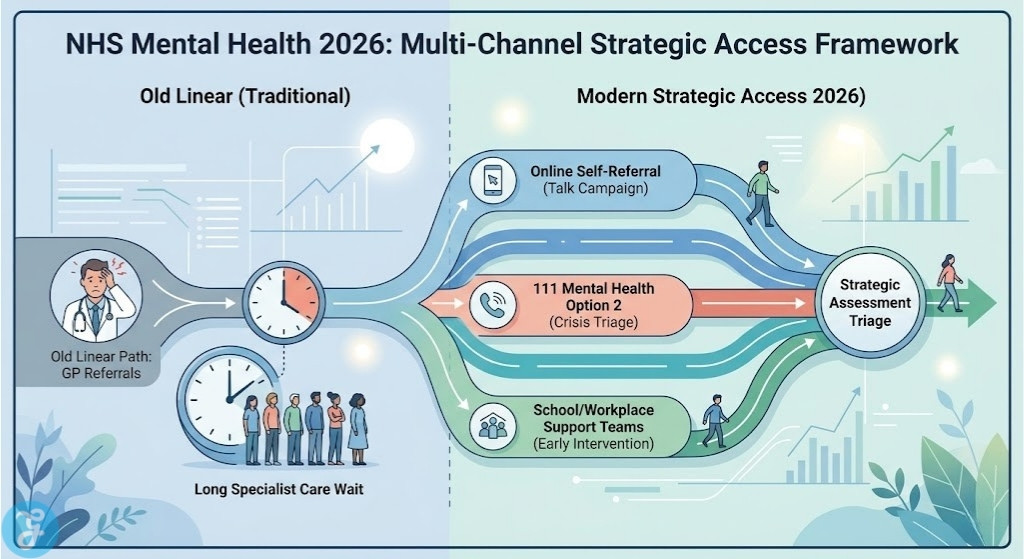
In 2026, the fastest way to enter the system is often to skip the primary care appointment entirely. The national “Talk” campaign launched in February encourages patients to refer themselves directly through the central NHS portal. This places you immediately onto the triage list of your local Talking Therapies provider without waiting for a GP to process paperwork.
Best for:
-
Individuals with common conditions like anxiety, depression, or PTSD who want to start the clock immediately.
Why We Chose It:
-
It removes the administrative delay of waiting for a doctor’s appointment and a subsequent referral letter.
-
Direct entry ensures your data is captured instantly by the specialist team rather than sitting in a GP inbox.
-
Self-referral portals are available 24/7, allowing you to take action the moment you feel ready.
Things to consider:
-
Self-referral is primarily for “common” mental health conditions and might not be suitable for complex psychiatric needs.
Once you have entered the system, you have legal powers regarding who actually provides your treatment.
2. Exercise Your Legal Right to Choose
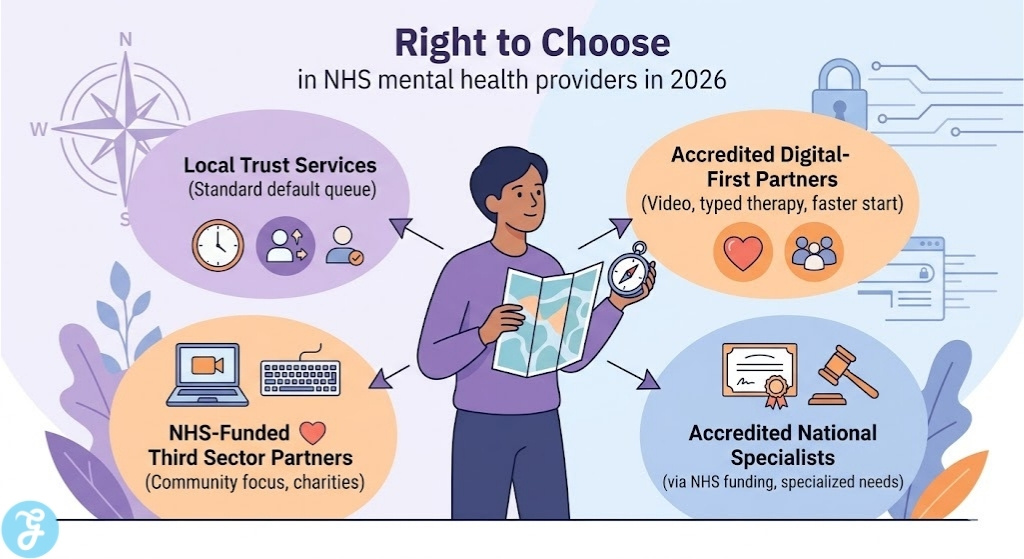
Under the NHS Choice Framework, patients in England have a legal right to choose which consultant-led team or organization provides their mental health care. If your local NHS trust has a wait that exceeds 18 weeks, you can request to be referred to a different provider—including private companies that have NHS contracts.
Best for:
-
Patients facing long local waiting lists who are willing to use a different, often digital-first, provider.
Why We Chose It:
-
It is a statutory right that many patients are unaware they possess.
-
It allows you to access providers with much shorter lead times while the NHS still covers the cost.
-
This strategy is particularly effective for specialized assessments like adult ADHD or autism.
Things to consider:
-
Your GP must still complete the referral to the specific provider you have chosen.
If you find yourself in a more urgent situation, there is a dedicated national shortcut for immediate assistance.
3. Utilize the 111 Mental Health Option 2
The national rollout of “Option 2” on the 111 phone line is fully operational in 2026, providing 24/7 access to local crisis teams. While this is designed for urgent needs, these teams have the power to “fast-track” individuals into community mental health hubs if they identify a risk of rapid deterioration.
Best for:
-
Individuals experiencing a significant escalation in symptoms who cannot wait for a routine appointment.
Why We Chose It:
-
It provides an immediate clinical assessment without an initial triage delay.
-
The service is staffed by mental health professionals rather than general call handlers.
-
It acts as a safety net that can bypass standard community waitlists during an acute phase.
Things to consider:
-
This service should be reserved for those in genuine distress to ensure resources remain available for emergencies.
Beyond the core NHS trusts, a vast network of partner organizations often has shorter queues.
4. Leverage NHS-Funded Third Sector Partners
Many local authorities in 2026 subcontract their mental health services to large charities and non-profit organizations. These partners often operate with different staffing models and may have significantly more capacity than the main hospital-based psychiatric units.
Best for:
-
People looking for community-based, less clinical environments for their therapy sessions.
Why We Chose It:
-
These organizations often offer specialized support for specific groups like veterans or the LGBTQ+ community.
-
They frequently have “low-intensity” options that can start much sooner than traditional CBT.
-
The referral process is often more flexible and approachable for those wary of clinical settings.
Things to consider:
-
You should always verify that the partner is officially accredited and funded by your local NHS board.
Educational and professional environments also offer hidden lanes for support that do not appear on the general NHS dashboard.
5. Access Support Teams in Schools and Workplaces
By the spring of 2026, the government has expanded Mental Health Support Teams to cover an additional 900,000 students. Similarly, many large employers now have direct “occupational health” links to NHS-funded fast-track pathways designed to keep people in the workforce.
Best for:
-
Students and full-time employees who want to access support within their existing daily environment.
Why We Chose It:
-
These teams are specifically designed for early intervention before a condition becomes debilitating.
-
Workplace-linked pathways often prioritize speed to prevent long-term sickness absence.
-
It removes the “travel barrier” by bringing the care directly to where the patient spends their time.
Things to consider:
-
Availability depends heavily on the specific policy of your school or employer.
If you are comfortable with technology, the “digital-first” route is almost always the fastest way to get started.
6. Request Digital-First IAPT Pathways
Most Talking Therapies providers in 2026 offer a choice between in-person sessions and digital platforms. Choosing a digital-first option, such as typed therapy or video calls, can often cut your waiting time by several weeks because these platforms have a higher turnover of available appointments.
Best for:
-
Tech-savvy individuals who prefer the convenience and privacy of therapy from their own home.
Why We Chose It:
-
Digital providers can draw from a national pool of therapists rather than just local staff.
-
Typed therapy often has the shortest waiting times in the entire system.
-
It allows for more flexible scheduling, including evenings and weekends.
Things to consider:
-
Digital therapy is highly effective for many but might not suit those who value physical presence.
While you are inevitably stuck in a queue, you can still advocate for support that stabilizes you in the meantime.
7. Ask for Interim Support While You Wait
Being on a waiting list does not mean you are entitled to zero help. In 2026, many trusts offer “pre-therapy” workshops, stabilization groups, or access to high-quality self-help apps that are clinically monitored by the waitlist team.
Best for:
-
Patients who feel they need some level of guidance to prevent their symptoms from worsening during the wait.
Why We Chose It:
-
It ensures you are “in the loop” and monitored while you wait for your main course of treatment.
-
Stabilization techniques can actually make your eventual therapy more effective.
-
It gives you a point of contact if your situation changes or becomes more urgent.
Things to consider:
-
These are supplementary tools and are not a replacement for a full course of clinical therapy.
Overview Of NHS Therapy Waiting Times 2026
The current state of mental health access is defined by a push for efficiency through digital tools and legal choice. The table below summarizes the expected performance and access points for the current year.
The data provided reflects the national averages and target metrics for the 2026/27 financial year.
| Service Type | Target Wait (6 Weeks) | Target Wait (18 Weeks) | 2026 Entry Point |
| Talking Therapies | 75% Access Rate | 95% Access Rate | nhs.uk/talk (Self-Referral) |
| Child & Youth (CYP) | 95% (Urgent cases) | 80% (Routine cases) | School Support Teams |
| Community Hubs | 78% Access Rate | N/A | GP or 111 Option 2 |
| Right to Choose | Varies by Provider | Varies by Provider | GP (External Referral) |
Our Top 3 Critical Factors and Why?
While all tips are helpful, these three are the most likely to result in a significantly shorter wait for the average patient.
-
Self-Referral: This is the most direct way to eliminate the “GP bottleneck” and start your treatment clock.
-
Right to Choose: This legal lever is the only way to officially leave a failing local list and join a faster national one.
-
Digital-First Options: Opting for tech-led therapy is the most consistent way to secure an appointment within the target window.
How to Find the Right NHS Support by Yourself?
Navigating the system requires you to be an active participant in your care rather than a passive recipient. By understanding the available tools and your legal protections, you can ensure that you are not forgotten in the administrative shuffle.
-
Check Local Targets: Use the My Planned Care platform to see the actual waiting times for your specific trust.
-
Request an Advocate: If you struggle with the referral process, ask for a mental health advocate to help you speak with your GP.
-
Verify the Clock: Ensure you know exactly when your “Referral to Treatment” clock started so you can track the 18-week limit.
-
Keep a Paper Trail: Always save copies of your referral confirmation and any correspondence from the waiting list team.
The following table helps you decide which entry point is most appropriate for your current mental health state.
| Choose Self-Referral if… | Choose GP/Right to Choose if… |
| You have mild to moderate anxiety or depression. | You need a formal diagnosis for a complex condition. |
| You want to start a course of CBT or counseling. | You have been waiting more than 18 weeks locally. |
| You prefer to manage your own appointments online. | You need specialized support for ADHD or Autism. |
The Final Checklist
-
[ ] Visit nhs.uk/talk to see if your local area allows direct self-referral today.
-
[ ] Save the 111 Option 2 details in your phone for emergency use.
-
[ ] Identify a “Right to Choose” provider if your local wait is quoted as 18+ weeks.
-
[ ] Check if your employer or university offers an internal EAP or support team.
-
[ ] Ask your GP specifically for a “digital-first” pathway to speed up your start date.
The hurdles of the mental health system in 2026 are real, but they are not insurmountable for an informed patient. By utilizing self-referral, exercising your legal rights, and embracing digital-first options, you can cut months off your wait and begin your journey to recovery much sooner. The system is designed to reward those who understand its inner workings, and taking these steps ensures you are at the front of the line for the care you need.
Frequently Asked Questions About NHS Therapy Waiting Times 2026
How long is the actual wait for therapy in 2026?
Answer: The national target is for 75 percent of people to start treatment within 6 weeks, but some areas still report waits of several months for specific “high-intensity” therapies.
Can I use Right to Choose for any mental health condition?
Answer: Yes, you can technically use Right to Choose for any consultant-led mental health service, though it is most commonly used for ADHD assessments and specialized therapy.
What happens if my local wait is longer than 18 weeks?
Answer: If the NHS cannot offer you a start date within 18 weeks, they have a legal duty to take all reasonable steps to offer you a range of suitable alternative providers.
Does self-referral mean I don’t need to see my GP at all?
Answer: For most Talking Therapies services, you do not need to see your GP first. However, your GP will usually be notified that you are starting treatment to keep your medical records updated.
Are digital therapies as good as meeting in person?
Answer: Clinical data shows that for common conditions like anxiety and depression, digital-first CBT is just as effective as face-to-face sessions for the majority of patients.