

When you think of a nation famous for drilling and exporting oil, sustainable transport is rarely the first thing that comes to mind. Yet this cold Scandinavian country has completely transformed its roads. The streets of Oslo and Bergen now hum quietly with battery-powered motors instead of loud combustion engines.
This massive shift did not happen by accident or overnight. It required decades of planning, aggressive financial moves, and a public willing to change its habits. If you want to understand how a whole country switches away from fossil fuels, you have to look at the data and the laws that made it possible. This guide breaks down the core elements of Norway EV adoption and what everyday life looks like when almost everyone drives an electric vehicle.
The Driving Forces Behind Norway EV Adoption
Financial incentives are the absolute core of how this country changed its driving habits. The government decided early on that the easiest way to make people buy clean cars was to make them cheaper than dirty ones. They stripped away heavy taxes on electric models and stacked daily driving perks on top of the savings. This approach made buying an electric car the smartest economic choice for the average family.
1. Over 80 Percent of New Car Sales are Electric
To grasp the true scale of this transition, you only need to look at the monthly sales charts from local dealerships. While other progressive nations celebrate reaching a ten percent market share for electric vehicles, this nation left those numbers behind years ago. Battery electric vehicles regularly account for over four-fifths of all new passenger car registrations. If you add plug-in hybrids to the mix, that number pushes near total market saturation.
Buying a pure petrol or diesel car today is considered highly unusual and almost a poor financial decision. Traditional dealerships are actively removing gas-powered cars from their showroom floors because nobody wants to buy them. The waiting lists for new electric models from brands like Tesla, Volkswagen, and Hyundai can stretch for months, while the few remaining gas cars sit on lots gathering dust. The public mindset has completely shifted, making the electric motor the default standard for private transportation.
| Market Share Metric | 2015 Percentage | 2020 Percentage | Current Percentage |
| Pure Battery Electric (BEV) | 17 Percent | 54 Percent | Over 80 Percent |
| Plug-in Hybrid (PHEV) | 5 Percent | 20 Percent | 10 Percent |
| Petrol and Diesel (ICE) | 78 Percent | 26 Percent | Under 10 Percent |
2. Massive Tax Exemptions Made EVs Affordable
The main engine driving this massive market transition is basic math. Electric cars carry expensive battery technology, making them cost more to build than gas cars at the factory level. The government solved this problem by manipulating the tax code to benefit the consumer. They waived the incredibly high import duties and registration taxes typically placed on foreign vehicles. More importantly, they removed the standard twenty-five percent Value Added Tax from the purchase price of battery-powered cars.
By heavily taxing polluting cars and removing taxes from clean ones, they created instant price parity. When a brand-new electric SUV costs the exact same amount as a comparable gas-powered SUV, the consumer choice becomes incredibly easy. Drivers realized they could get newer, quieter technology with cheaper running costs without having to pay a premium upfront.
| Tax Category | Petrol/Diesel Vehicle | Battery Electric Vehicle |
| Import Duty | High, based on weight and emissions | Fully Exempt |
| Value Added Tax (VAT) | 25 Percent applied to total price | Exempt up to 500,000 NOK |
| Annual Road Tax | Full standard rate | Significantly reduced rate |
3. Generous Toll Road Discounts and Free Ferries
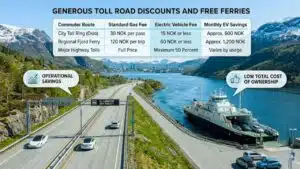
The financial wins do not stop when you drive the car off the dealer lot. The local geography features deep fjords, mountains, and endless toll roads that connect rural towns to major cities. For years, electric cars passed through toll gates and boarded regional ferries completely free of charge. These daily commute savings were a massive incentive for people living in the suburbs who drove into the city for work.
Policies have shifted slightly recently due to the high volume of electric traffic congesting the roads. However, electric drivers are legally guaranteed to pay no more than half the standard rate on these routes. Over five or ten years of vehicle ownership, these operational savings add up to thousands of dollars, making the total cost of ownership incredibly low compared to gas vehicles.
| Commuter Route | Standard Gas Fee | Electric Vehicle Fee | Monthly EV Savings |
| City Toll Ring (Oslo) | 30 NOK per pass | 15 NOK or less | Approx. 600 NOK |
| Regional Fjord Ferry | 120 NOK per trip | 60 NOK or less | Approx. 1,200 NOK |
| Major Highway Tolls | Full Price | Maximum 50 Percent | Varies by usage |
Infrastructure and Grid Reliability
Range anxiety stops many people around the world from making the electric switch. Drivers worry about getting stranded on a lonely road with an empty battery. The government addressed this by partnering with private companies to blanket the landscape with fast and reliable power stations. They also leaned heavily on their natural geography to keep the power clean. Norway EV adoption relies on an energy grid that is built to handle heavy demand without producing smog.
4. A World-Class Charging Infrastructure Network
You cannot sell millions of electric cars without giving people a reliable place to plug them in. The country built a dense network of fast chargers that cover every single region, from urban centers to remote mountain passes. You will find massive charging hubs at supermarkets, gas stations, shopping malls, and rural highway stops. Even if you drive far north into the freezing Arctic Circle, you will find active, working power stations spaced at regular intervals.
The government mandated that major highways must have fast chargers every fifty kilometers. This setup gives drivers the absolute confidence to take long road trips across rugged terrain without constantly checking their battery gauge in a panic. Furthermore, housing laws were updated to give apartment residents the legal right to install charging points in shared parking garages.
| Charging Infrastructure | Typical Location | Average Charging Speed | Main Use Case |
| Home Wallbox | Private garages, apartments | 3 to 11 kW | Overnight daily charging |
| Public Destination | Shopping malls, street parking | 11 to 22 kW | Topping up while shopping |
| DC Fast Chargers | Highway rest stops, gas stations | 50 to 350 kW | Long distance road trips |
5. Almost 100 Percent Renewable Hydropower
A common argument against electric cars is that they just shift tailpipe pollution to a coal power plant. That argument completely fails here. The country pulls nearly all of its domestic electricity from massive hydroelectric dams hidden deep in the mountains and fjords. A small but growing amount of power also comes from coastal wind farms. When a driver plugs their car into the wall at night, the electricity flowing into the battery comes directly from falling water.
This means the entire lifecycle of the daily commute is genuinely green from start to finish. The power grid is also incredibly robust, meaning the massive influx of electric vehicles has not caused blackouts or grid failures, which is a major concern in other nations trying to electrify their transport sectors.
| Energy Source | Percentage of National Grid | Environmental Impact |
| Hydropower | Approx. 88 to 90 Percent | Zero direct emissions |
| Wind Power | Approx. 8 to 10 Percent | Zero direct emissions |
| Thermal/Fossil | Under 2 Percent | Minimal regional emissions |
6. Defeating the Cold Weather Myth
Many car buyers around the world believe electric batteries fail in freezing temperatures. The harsh, punishing winters here prove that myth wrong every single day. Cold weather does temporarily reduce driving range because the battery has to use energy to keep itself warm, but drivers adapt easily to this reality. They use home chargers to keep the battery warm overnight and utilize mobile apps to turn on pre-conditioning systems before they even step outside.
This means the car is defrosted and the battery is at optimal temperature before it uses its own power reserves. Furthermore, modern battery packs sit flat at the bottom of the car chassis. This extra heavy weight creates a very low center of gravity, which gives these cars excellent traction and stability when driving on thick ice and heavy snow.
| Winter Driving Challenge | Electric Vehicle Solution | Driver Benefit |
| Range Loss in Cold | Thermal management systems | Predictable battery performance |
| Freezing Cabin | App-controlled pre-heating | Warm car before unplugging |
| Icy Road Traction | Low center of gravity from battery | Superior handling in snow |
Long-Term Policy and Market Impact
You cannot rush a nationwide energy transition. It requires steady hands at the political wheel for a long time. Lawmakers from different political parties agreed to keep the rules stable so car buyers and manufacturers knew what to expect. This long-term thinking built a strong foundation for the future. Today, the Norway EV adoption rate is reshaping the global automotive industry, forcing foreign companies to adapt their production lines to meet these strict new standards.
7. The Unprecedented 2025 Target
The government set a hard, aggressive deadline that sent shockwaves through the global auto industry. They established a national goal that by the year 2025, every single new passenger car and light van sold in the country must produce zero tailpipe emissions. Places like California and the European Union are aiming for 2035 to implement similar rules, meaning this country is moving a full decade faster than the rest of the developed world.
It is important to note that this is not a strict legal ban on selling gas cars, but rather a target achieved by making gas cars so expensive through taxation that nobody will buy them anyway. Based on current monthly sales tracking, industry analysts agree they will actually hit this target, practically ending the era of internal combustion engines within their borders.
| Region | Zero Emission Target Year | Policy Approach |
| Norway | 2025 | Taxation and heavy incentives |
| European Union | 2035 | Mandated sales bans on ICE |
| California (USA) | 2035 | Phased percentage mandates |
8. Bipartisan Political Support Over Decades
One of the most unique and crucial aspects of this story is the solid political agreement behind it. Environmental groups pushed for early electric car perks back in the 1990s, famously highlighted when the pop band A-ha imported a converted electric Fiat and refused to pay road tolls to prove a point. As different political parties took power over the last thirty years, nobody canceled the program.
Both conservative and progressive leaders kept the core tax breaks intact because the public supported them. This level of predictability is incredibly rare in modern politics. It allowed foreign car makers to treat the country as a primary test market for their newest technology, and it gave everyday citizens the financial confidence to buy into an entirely new way of driving.
| Decade | Political Action | Market Consequence |
| 1990s | Toll exemptions introduced | Early experimentation by activists |
| 2000s | VAT exemptions solidified | First mass-market EVs arrive |
| 2010s to Present | Cross-party agreement to keep perks | Market achieves total dominance |
9. The Used EV Market is Booming
Because these cars have been selling in massive, record-breaking numbers for well over a decade, the country now has a massive and mature second-hand market. Brand new cars are expensive, even without sales tax, which usually locks lower-income families out of the transition. The booming used market makes clean driving accessible to students, young professionals, and single-parent households.
As battery technology proves it can last well over a decade with very minimal degradation, buyers feel entirely safe purchasing older models like the early Nissan Leafs or Volkswagen e-Golfs. Independent shops now offer battery state-of-health tests, giving second-hand buyers total peace of mind. This trickle-down effect ensures that the financial benefits of cheap charging and low maintenance are finally spread across every economic class.
| Used Vehicle Type | Typical Age | Primary Buyer Demographic |
| Early Generation EVs | 8 to 12 Years Old | Students, budget commuters |
| Mid-Range EVs | 4 to 7 Years Old | Young families, second cars |
| Premium EVs | 1 to 3 Years Old | Professionals seeking upgrades |
Beyond Passenger Cars and Future Shifts
The overall goal is to remove emissions from all forms of transport, not just the cars parked in suburban driveways. The heavy transport sector is currently undergoing a massive overhaul using the exact same strategy. Meanwhile, the government is looking at the reality of a fully electric road network. They are slowly adjusting the rules to ensure they still have enough tax revenue to fix potholes and build bridges.
10. Electrifying Ferries, Buses, and Heavy Transport
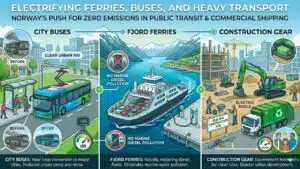
The push for zero emissions extends deep into public transit and commercial shipping. The capital city of Oslo recently replaced its entire fleet of noisy, polluting diesel buses with quiet electric models, instantly cleaning up the local air quality in the city center. Even garbage trucks and construction site excavators are being converted to run on battery power. More importantly, the vital coastal ferry network is changing rapidly.
Massive vessels that carry hundreds of cars and passengers across the deep fjords now run entirely on huge battery packs. They charge up rapidly while docked and run silently across the water. This removes thousands of tons of marine diesel pollution from the sensitive aquatic environment every year and creates an incredibly smooth ride for daily commuters.
| Transport Sector | Electrification Status | Environmental Benefit |
| City Buses | Near total conversion in major cities | Reduced urban smog and noise |
| Fjord Ferries | Rapidly replacing diesel fleets | Eliminates marine water pollution |
| Construction Gear | Government mandates for clean sites | Quieter urban development |
11. The Polluter Pays Principle
The national tax code uses a very heavy stick alongside the financial carrots. The law operates on a very clear principle which states that whoever pollutes the environment the most must pay the most to fix it. If you want to buy a large, inefficient gas-guzzling truck today, you will pay massive upfront penalties based directly on the vehicle’s weight and its measured carbon and nitrogen oxide output.
Furthermore, fuel taxes at the local gas station are incredibly high compared to other nations, making a simple fill-up painfully expensive. This massive financial punishment makes it very hard for a normal family to justify buying or keeping a dirty vehicle when the clean alternative is sitting right next to it for half the running cost.
| Penalty Type | How It Is Calculated | Impact on Consumer |
| CO2 Tax | Based on factory emission ratings | Massive price hike on gas cars |
| NOx Tax | Based on nitrogen oxide output | Punishes heavy diesel engines |
| Fuel Duty | High taxes per liter of petrol | Makes daily driving very expensive |
12. Adjusting Perks for the Future
The political landscape is changing right now because the original mission is almost complete. With so many electric cars dominating the road network, the government is losing out on the billions of dollars in tax revenue they used to collect from gas car sales and fuel taxes. They still need money to maintain the highways, build new tunnels, and fund public services.
To balance the national budget, they are slowly rolling back the most extreme perks. They recently added a weight tax that applies to all cars, which heavily targets massive luxury electric SUVs. They also re-applied the standard sales tax to the portion of any car price that exceeds half a million kroner. The market is finally maturing and must now stand on its own two feet without endless state subsidies.
| Policy Adjustment | Previous Rule | New Maturation Rule |
| VAT Exemption | 100 Percent tax-free on all EVs | Tax applied on price over 500k NOK |
| Weight Tax | EVs were exempt from weight fees | New tax applied to heavy EVs |
| Toll Discounts | EVs traveled completely free | EVs pay up to 50 percent of toll |
What the World Can Learn?
The main lesson here is that average citizens will adapt very quickly if you make the environmentally friendly choice the cheapest choice. Drivers did not abandon their traditional gas cars purely out of a desire to save the planet. They bought electric models because the math made sense for their monthly household budgets.
Other nations must also learn the critical importance of building the charging infrastructure before the cars actually arrive. By funding power stations early, the government prevented the massive charging bottlenecks that are currently frustrating drivers in North America and parts of Europe. Norway EV adoption proves that if you combine heavy taxes on fossil fuels with a solid, reliable public charging network, the public will eagerly embrace the future of driving.
Final Thoughts
The streets of this Scandinavian nation provide a clear, actionable blueprint for the rest of the world. They proved that ending a modern society’s reliance on fossil fuel vehicles is entirely possible with the right mix of aggressive policy, public investment, and reliable technology.
By taxing emissions heavily and making clean energy the cheap default, they completely flipped their entire automotive market in less than fifteen years. As other nations struggle to meet their fast-approaching climate goals, studying Norway EV adoption remains the best way to understand exactly how a successful, large-scale energy transition actually works in the real world.
Frequently Asked Questions (FAQs) About Norway EV Adoption
1. Do electric car drivers in Norway pay any road tax?
Yes, the rules have changed recently to reflect the maturing market. While they used to be completely exempt from standard road fees, electric vehicle owners now pay a reduced annual traffic insurance tax. They also pay for regional toll roads, but the national law guarantees they will never pay more than half the exact rate charged to a gas or diesel car on the same route.
2. What happens to the old and degraded EV batteries in Norway?
The country established heavy recycling regulations very early on. Companies operate massive local recycling plants that safely crush old battery packs and recover up to ninety-five percent of the core metals like lithium, nickel, and cobalt. These valuable raw materials are then sold back to manufacturers to build brand new batteries, creating a closed-loop system.
3. Can tourists easily rent and drive an electric car there?
Yes, it is incredibly easy for visitors to participate in the electric transition. Almost all major rental car agencies at the airports offer a fleet that is heavily dominated by electric models. The rental cars usually come with a specialized charging chip attached to the key ring that gives you instant, seamless access to the major national charging networks.
4. Are there enough mechanics trained to fix these vehicles?
The vocational training system adapted very quickly to the changing market. Mechanics across the entire country are now highly trained in high-voltage battery systems, thermal management, and complex software diagnostics. Traditional oil-change shops have rapidly transformed into tech-focused service centers to keep up with the overwhelming market demand for electric maintenance.
5. How does Norway generate the electricity for all these cars?
Norway is in a unique and highly fortunate position regarding clean energy. Nearly ninety percent of their domestic electricity production comes from massive hydroelectric dams built into their mountain ranges. This makes the power used to charge their massive electric vehicle fleet entirely renewable and genuinely clean.






















