
You feel uneasy around someone you trust. Your gut tells you something is off, but you cannot quite put your finger on it. They say they love you, yet their actions hurt you. You start to doubt yourself, your memory, and your own judgment. This feeling creeps in slowly, like fog rolling across a field. By the time you notice it, you are already lost in the haze.
Many people experience this confusing situation without realizing what is happening. Research shows that emotional abuse affects millions of Americans every year. The tricky part is that manipulation hides in plain sight. It does not always look like abuse. It looks like love, concern, or friendship. The person doing it might not even realize they are hurting you.
I am going to walk you through the hidden signs of emotional manipulation before it damages your relationships. So, grab a cup of coffee, and let us go through it together. I will show you everything you need to know.
What is Emotional Manipulation?
Emotional manipulation is a form of coercive control that one person uses to influence another person’s thoughts, feelings, or actions. The manipulator twists facts, hides the truth, or shifts blame to gain power over their target.
This type of psychological manipulation happens in many relationships, from romantic partnerships to family dynamics and workplace interactions. The manipulator often makes their victim question reality itself, creating deep confusion.
According to the Centers for Disease Control and Prevention (CDC), over 43 million women and 38 million men in the US experience psychological aggression by an intimate partner in their lifetime. This staggering number proves how common this issue truly is. Gaslighting is one common tactic where the manipulator denies events that actually happened. This leaves the victim feeling crazy and full of insecurity.

Emotional manipulation is a silent thief that steals your confidence, one doubt at a time.
The goal is always the same: control. The manipulator wants to keep their victim dependent, confused, and unable to trust their own mind. Manipulation thrives on power imbalances and boundary violations. A manipulator uses emotional abuse as their weapon, attacking through guilt, shame, and fear rather than physical force. They might shower you with excessive flattery one day, then withdraw affection the next. This keeps you off balance and desperate to please them.
Dr. Susan Forward, a renowned therapist, famously identified this dynamic using the “FOG” acronym, which stands for Fear, Obligation, and Guilt. Manipulators use this FOG to obscure your vision and keep you trapped. Understanding these tactics helps you spot the problem early and protect your mental health.
Common Signs of Emotional Manipulation
Emotional manipulators often leave you feeling confused, guilty, or questioning your own mind. You might notice patterns where someone’s actions contradict their promises. They might also consistently blame you for problems they create. Let us look at the most frequent signs so you can spot them quickly.
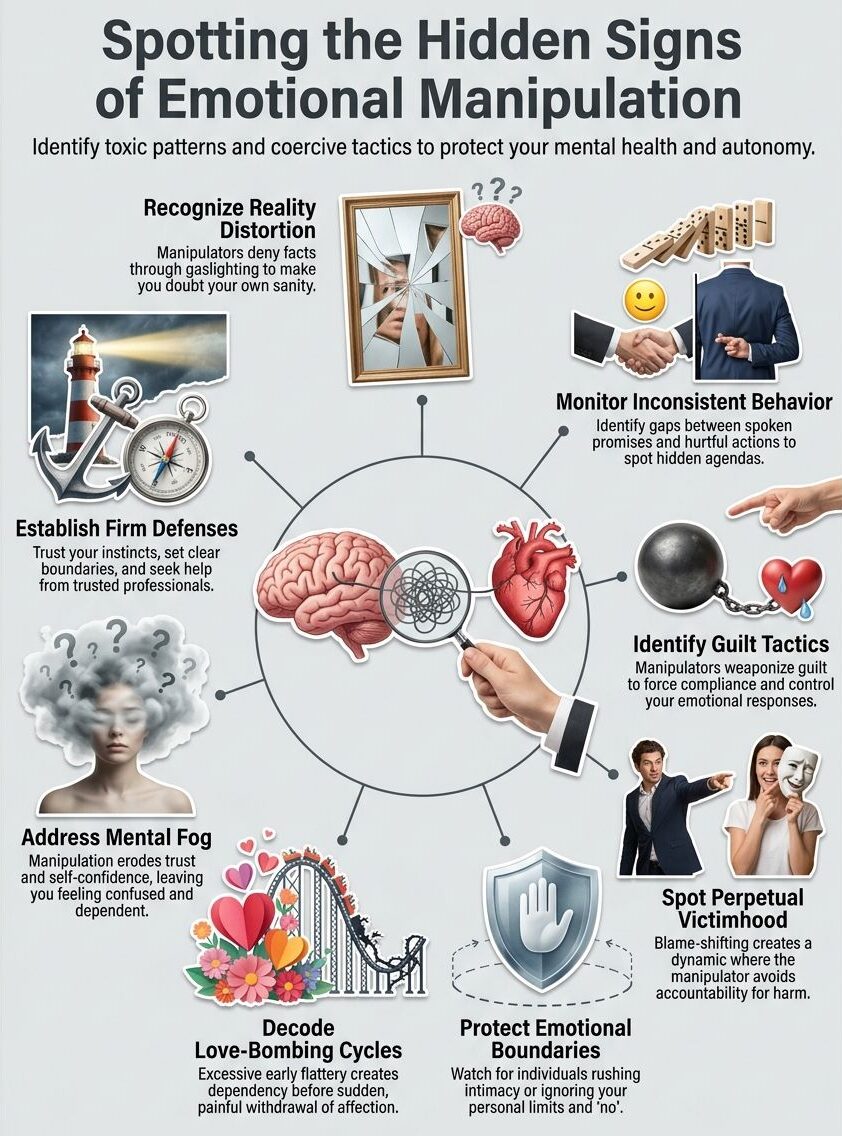
Undermining your sense of reality
Your manipulator makes you question what you saw, heard, or felt. They deny things that actually happened and tell you that your memory is faulty. This tactic is called gaslighting, and it is one of the most damaging forms of covert aggression. You start to doubt yourself constantly, and your instincts become fuzzy.
The term actually comes from the 1938 play “Gas Light,” where a husband manipulates his wife into believing she is losing her mind by secretly dimming their home’s gas-powered lights. Dr. Robin Stern expanded on this in her book “The Gaslight Effect,” explaining how it slowly erodes your core identity.
The manipulator plants seeds of insecurity in your mind, and those seeds grow fast. You find yourself asking if you are overreacting or if an event really happened.
Gaslighting works because it attacks your foundation. Your sense of reality is like the ground you stand on. Manipulators typically use a few go-to phrases to pull that ground away:
- “You are being too sensitive about this.”
- “I never said that, you are imagining things.”
- “You have a terrible memory.”
- “I was just joking, you take everything too seriously.”
They twist facts to fit their story. They use selective memory to their advantage, conveniently forgetting promises they made. You start keeping mental notes of everything to prove yourself right. Exhaustion sets in quickly, and your emotional abuse becomes invisible because they convince you that you are the problem.
Actions that do not match words
A manipulator’s words paint one picture, but their actions tell a completely different story. Someone might say they love you deeply, yet they ignore your calls for days. They promise to show up for important events, then bail at the last minute without explanation.
Psychologists often refer to this specific behavior as “future faking.” A 2024 survey of relationship therapists highlighted future faking as a top indicator of narcissistic manipulation in modern dating. The manipulator promises a beautiful future, like a wedding or a big trip, simply to get what they want in the present moment.
The greatest glory in living lies not in never falling, but in rising every time we fall.
This pattern of misaligned words and actions is a classic sign of psychological manipulation. A person might claim they respect your boundaries, yet they constantly push past them anyway. They say they are sorry for hurting you, but they repeat the same hurtful behavior over and over. The inconsistency chips away at your confidence bit by bit.
You find yourself making excuses for them, rationalizing their behavior, and accepting less than you deserve. Recognizing this disconnect between their promises and their actual conduct is crucial for protecting yourself.
Using guilt as a weapon
Guilt becomes a powerful tool in the hands of someone who wants to control you. Manipulators use guilt to make you feel responsible for their emotions, their choices, and their happiness. They twist your sense of responsibility and make you feel like a bad person for having your own needs.
This is the core of the drama triangle, a social model developed by Dr. Stephen Karpman. In this triangle, the manipulator often casts you as the “Persecutor” while they play the “Victim,” forcing you to overcompensate and become their “Rescuer.”
Manipulators use specific tactics to exploit your kindness and compassion:
- They make you feel obligated to fix their personal problems.
- They force you to manage their daily emotions.
- They pressure you to sacrifice your own mental health.
Over time, guilt-tripping erodes trust completely. Recognizing this pattern of coercive control is the first step toward breaking free.
Playing the victim consistently
Manipulators play the victim card over and over. They twist events to make themselves look innocent, while you become the bad guy. This covert aggression tactic works like a charm because people naturally feel empathy and want to help.
Researchers use the acronym DARVO to describe this behavior. Coined by Dr. Jennifer Freyd, DARVO stands for Deny, Attack, and Reverse Victim and Offender. When you confront a manipulator, they will deny the behavior, attack your credibility, and claim they are the one being abused.
This victim mentality creates a highly toxic relationship dynamic where they control the conversation. You end up defending yourself constantly against their specific behaviors:
- They cry and tell everyone how badly you treat them.
- They completely ignore their own hurtful actions.
- They refuse to take responsibility or acknowledge how they hurt you.
Over time, this pattern destroys trust and builds deep resentment. The power dynamics shift in their favor because everyone sees them as the wounded party.
Pushing emotional boundaries too quickly
Healthy relationships grow at a natural, comfortable pace. Someone who pushes emotional boundaries too quickly wants you to move faster than feels right. They might ask you to share deep secrets on a first date. They might declare their love within weeks or expect you to drop everything for them.
According to a 2025 report from the National Domestic Violence Hotline, rapid attachment and isolating a partner from friends within the first three months of dating is a primary warning sign of future coercive control.
Boundary violation happens incredibly fast with these individuals. They test your limits constantly by:
- Ignoring your direct requests for physical or emotional space.
- Acting deeply hurt or offended when you try to set limits.
- Demanding you apologize for simply having standard boundaries.
Over time, this erodes your sense of what is acceptable in relationships. You start doubting yourself and wondering if you are being too cold.
Subtle Manipulation Tactics to Watch For
Manipulators use sneaky methods that hide just below the surface of normal conversation. These tactics work because they feel natural, yet they chip away at your confidence and sense of self. Let us break down the specific methods they use to keep you off balance.
Gaslighting and shifting blame
Gaslighting distorts your reality, making you question what you saw and heard. A gaslighter denies things that actually happened or insists you misremembered events. This coercive control tactic leaves you doubting your own mind completely. You start thinking maybe you are crazy, or maybe you overreacted.
Shifting blame is the gaslighter’s preferred escape route when caught in their own mess.
A classic example of blame-shifting is projecting. Psychologists define projection as a defense mechanism where someone takes their own unacceptable traits and attributes them to you. If they are lying, they will fiercely accuse you of being a liar.
Suddenly, you are apologizing for something they did. This psychological manipulation establishes a lopsided power dynamic. The silent treatment often follows when you push back. This leaves you isolated and desperate to fix things.
Selective memory and twisting facts
Manipulators excel at selective memory, a sneaky tactic that rewrites history to fit their narrative. They conveniently forget promises they made, events that happened, or conversations you shared.
You mention something they said last week, and they act confused or deny it entirely. This covert aggression leaves you questioning your own mind.
In family therapy, this tactic is sometimes called “revisionist history.” A 2025 article in Psychology Today noted that manipulators rewrite the past not just to avoid trouble, but to actively erode your confidence in your own cognitive abilities.
Twisting facts works alongside selective memory to create a completely distorted reality. A manipulator takes something true and bends it into something false:
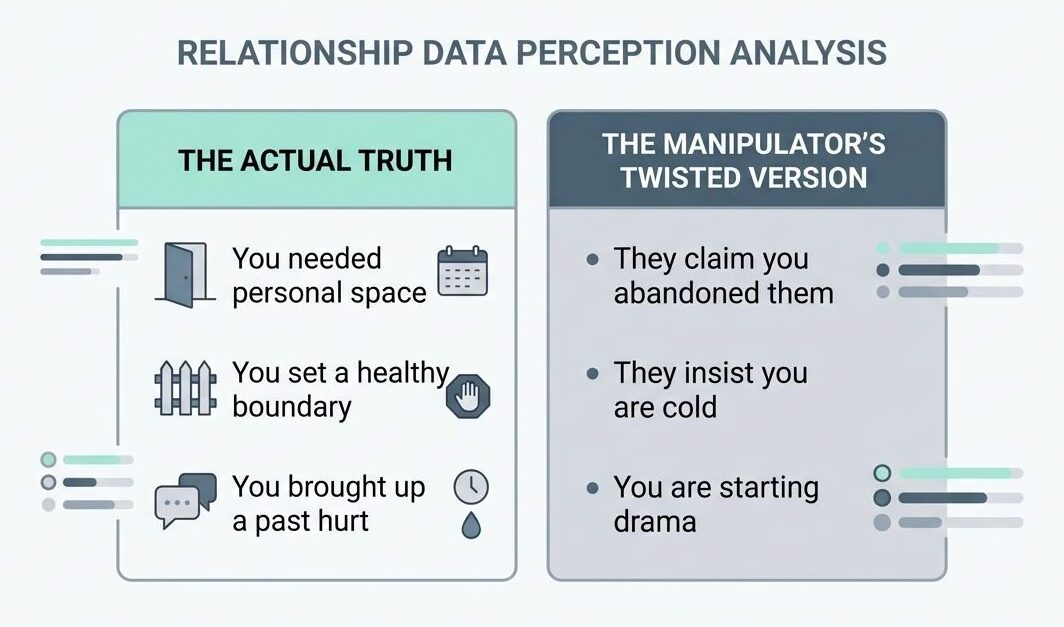
| The Actual Truth | The Manipulator’s Twisted Version |
|---|---|
| You said you needed some personal space. | They claim you cruelly abandoned them. |
| You set a healthy boundary. | They insist you are being cold and rejecting. |
| You brought up a past hurt. | They accuse you of always starting drama. |
The original truth gets buried under layers of their interpretation. Your protests fall flat because they have already planted seeds of doubt.
Emotional blackmail and guilt-tripping
Emotional blackmail operates like a puppet master pulling invisible strings. It forces you to act against your own interests to avoid emotional pain. Your manipulator dangles threats like abandonment, withdrawal of love, or public humiliation over your head.
Dr. Susan Forward breaks emotional blackmailers down into four clear types: The Punisher, The Self-Punisher, The Sufferer, and The Tantalizer. The “Self-Punisher” is especially dangerous because they threaten to harm themselves if you do not comply, holding your conscience hostage.
Guilt-tripping takes emotional blackmail one step further by weaponizing your past mistakes. They employ selective memory and use phrases like:
- “After everything I have done for you.”
- “I cannot believe you would do this to me.”
- “If you really loved me, you would understand.”
This psychological manipulation creates deep insecurity because you start questioning your own character. You end up trapped in a cycle where you constantly give more.
Love-bombing and excessive flattery
After a manipulator uses guilt-tripping to wear you down, they often switch tactics fast. Love-bombing comes next, a tactic where someone showers you with praise, attention, and affection all at once. This person acts like you hung the moon and stars. They text constantly, give lavish compliments, and make grand promises about your future together.
Love-bombing feels amazing at first, almost too good to be true, because it actually is a trap.
Research published by the University of Arkansas in 2024 found that love-bombing is highly correlated with narcissistic tendencies. The study revealed that love-bombers use excessive communication to manufacture a rapid, intense bond, making it incredibly difficult for the victim to leave once the abuse starts.
Here is the trap: manipulators use love-bombing to lower your guard and create dependency. Once you feel secure in their praise, they pull back suddenly. This cycle of excessive flattery followed by withdrawal keeps you emotionally off-balance. Your boundaries weaken because you are chasing the high of their approval.
Emotional Manipulation in Different Relationships
Emotional manipulation shows up differently depending on who you are dealing with. Spotting these patterns matters for your safety and peace of mind. Let us look at how these behaviors change based on the type of relationship.
Romantic relationships
Romantic partners often use covert aggression to control their significant others without appearing obvious. Your partner might shower you with excessive flattery and love-bombing at first.
The Gottman Institute, a leading relationship research organization in the US, identifies “Stonewalling” as one of the most destructive behaviors in a marriage. Stonewalling happens when your partner completely withdraws from a conversation, giving you the silent treatment to punish you and assert dominance.
This coercive control happens slowly, so you barely notice it. One day, you realize they have isolated you from people you care about. Their words do not match their actions anymore.
Gaslighting in romantic relationships destroys your sense of reality in the most painful ways:
- Your partner denies things they clearly said or did.
- They insist a hurtful comment never happened.
- They withdraw affection and communication as a weapon.
Manipulation tactics like guilt-tripping keep you apologizing for things that are not your fault. You stay because you hope they will change.
Friendships
Friendships can hide emotional manipulation in plain sight. Your friend might constantly criticize your choices, make you feel small, or use guilt to control your time. They say things like “if you were a real friend, you would drop everything for me.” They might twist what you said last week to make you look bad.
The friendship becomes exhausting because you are always walking on eggshells. You try desperately to keep them happy.
A 2025 survey by the American Psychological Association (APA) found that over 60% of adults in the US report having a “frenemy”, a friend who frequently uses subtle put-downs and competitive manipulation. These toxic friendships can actually elevate your resting cortisol levels, keeping you in a state of chronic stress.
Manipulative friends often play the victim consistently, making every conflict about their pain. They might give you the silent treatment when you set boundaries. You feel trapped in a drama triangle, never sure if you are the villain or the victim in their story. Real friendships should lift you up, not drain your energy.
Family dynamics
Family members often use emotional abuse and coercive control tactics that others completely miss. A parent might criticize a child’s choices constantly, then shower them with gifts.
This confuses the child about whether the behavior was wrong in the first place. Siblings can play the victim role repeatedly, making you feel guilty for setting boundaries.
In family systems psychology, the target of this manipulation is often called the “Identified Patient” or the “Scapegoat.” Therapists in the US note that toxic families will project their collective dysfunction onto one sibling, blaming them for every family problem to avoid dealing with their own faults.
Family manipulation thrives in silence because we are taught to keep problems private. A relative might use these specific tactics:
- They use the silent treatment as punishment.
- They twist facts about past events.
- They insist their version is correct until you abandon your own memories.
This psychological manipulation erodes trust slowly, like water wearing down a stone. Power dynamics shift constantly based on their current needs.
Workplace interactions
Emotional abuse at work takes many forms, and covert aggression often hides behind a professional mask. Your boss might undermine your confidence in meetings, then praise your work in emails to create confusion. Colleagues could twist your words during conversations, making you question what you actually said. This coercive control damages your sense of security at your job.
The 2024 US Workplace Bullying Institute (WBI) survey revealed that 30% of adult Americans experience bullying at work. In fact, 61% of bullies are bosses, and their primary weapon is psychological manipulation, such as withholding critical information or setting impossible deadlines to ensure you fail.
Manipulative behavior in the workplace erodes trust and creates deep insecurity. Gaslighting tactics often show up in specific ways:
| Workplace Tactic | How It Looks in Action |
|---|---|
| Conflicting Instructions | They give two different directives, then criticize you for failing. |
| Denying Conversations | They claim they never promised you a promotion or raise. |
| Professional Exclusion | They conveniently “forget” to invite you to important meetings. |
These mind games create power dynamics that strictly favor the manipulator. Recognizing these patterns helps you protect your mental health.
How Emotional Manipulation Impacts Relationships
Emotional manipulation tears apart the foundation of any relationship. It leaves you questioning yourself, doubting your worth, and feeling trapped in a cycle you never signed up for.
Creates dependency and insecurity
Manipulative people work hard to make you depend on them. They chip away at your confidence, so you start to doubt your own judgment. Over time, you feel lost without their approval or validation. Your sense of self shrinks, and their voice grows louder in your head.
The manipulator becomes your emotional anchor, even though they caused the damage in the first place.
Mental health professionals call this intense bond “Trauma Bonding.” Coined by Dr. Patrick Carnes, a trauma bond occurs when the manipulator alternates between abuse and positive reinforcement. Your brain becomes addicted to the cycle of punishment and reward, making it incredibly hard to break the dependency. Insecurity blooms in this highly toxic soil. Self-doubt replaces your confidence, and you question everything you think or feel.
Leads to self-doubt and confusion
Emotional manipulation creates a thick fog in your mind. You start questioning everything you do, say, and feel. The manipulator plants seeds of doubt about your own judgment, memories, and worth. Over time, you lose confidence in yourself entirely.
This severe confusion is a psychological state known as Cognitive Dissonance. The American Psychological Association describes this as the mental discomfort you feel when you hold two conflicting beliefs. You know your partner is treating you terribly, but you also believe they love you, which paralyzes your decision-making.
Confusion takes root when coercive control enters a relationship. Psychological manipulation works through these exact steps:
- The person denies things they clearly said.
- They smoothly shift the blame onto you.
- They make you feel crazy for simply pushing back.
You find yourself apologizing for things you did not do wrong. This tactic leaves you emotionally exhausted and trapped in a cycle of confusion.
Erosion of trust over time
Trust crumbles like old concrete when manipulation becomes a pattern in your relationship. Small lies stack up, broken promises pile high, and you start to question everything your partner says. The coercive control tactics wear you down, piece by piece. You feel uncertain about your own judgment.
Each time someone twists your words or denies something you clearly remember, another brick falls out of the trust wall.
Prolonged exposure to this kind of toxic environment can lead to C-PTSD (Complex Post-Traumatic Stress Disorder). Unlike standard PTSD from a single event, C-PTSD develops from chronic, ongoing emotional abuse, fundamentally altering your ability to trust anyone, including yourself, for years to come.
This unhealthy relationship dynamic leaves you walking on eggshells. You are never quite sure which version of them will show up.
How to Recognize and Address Emotional Manipulation
You spot the red flags when someone’s words and actions do not line up, when they make you question your own memory, or when guilt becomes their favorite tool. Once you see these patterns, you can take real steps to protect yourself. Let us look at the most effective ways to reclaim your power and establish healthy limits.
Trust your instincts and recognize red flags
Your gut feeling is your absolute best friend. That little voice inside your head matters immensely. Your body picks up on things your mind has not quite figured out yet. Emotional manipulation often leaves you feeling off balance, confused, or uneasy around someone.
A highly effective tactic for dealing with manipulators once you spot the red flags is the “Grey Rock” method. Psychologists recommend this technique, which involves making yourself as uninteresting and unresponsive as a plain grey rock. By giving short, non-emotional answers, you starve the manipulator of the drama they crave.
Your instincts catch these patterns before your logical brain does. Pay close attention to how you feel after talking with this person:
- Do they consistently make you doubt yourself?
- Do they turn things around so you are always the problem?
- Does your body feel tense or exhausted around them?
Recognizing the hidden signs of emotional manipulation means you can finally act on what you discover. Covert aggression and mind games lose their power when you shine light on them.
Set clear boundaries
Recognizing red flags gives you power, but acting on that power requires firm boundaries. Setting limits protects your emotional health and stops manipulators from controlling your life.
Dialectical Behavior Therapy (DBT), a widely practiced therapy in the US, teaches a skill called “DEAR MAN” for boundary setting. It helps you describe the situation, express your feelings, assert your needs, and reinforce the boundary without getting derailed by a manipulator’s guilt trips.
Here are specific ways you can start building those boundaries today:
- Identify what matters most to you, then communicate those values clearly to others.
- Say no without over-explaining your reasons. Manipulators twist explanations into weapons they use against you later on.
- Notice when someone pressures you to share personal information too fast.
- Refuse to engage in silent treatment games by staying calm and not chasing people who withdraw.
- Stop accepting criticism that feels designed to damage your confidence.
- Establish rules about how people can speak to you, including rejecting name-calling or yelling.
Creating physical and emotional distance is also necessary when boundaries are repeatedly crossed.
- Create space between yourself and people who constantly play the victim.
- Limit contact with those who gaslight you by questioning your memory or reality.
- Refuse guilt-tripping by recognizing emotional blackmail when it happens.
- Tell people directly when their behavior harms you, then follow through with consequences.
- Protect your time by declining requests that drain your energy.
- Practice saying phrases like “that does not work for me” without feeling obligated to justify yourself further.
Seek support from trusted individuals or professionals
Setting boundaries helps you protect yourself, yet you cannot do this work alone. Talking to people you trust makes a real difference in your recovery from emotional manipulation. A friend, family member, or therapist can help you see what happened clearly. They offer perspective when your mind feels foggy from gaslighting or coercive control.

These trusted people act as your reality check. This is vital when a manipulator has twisted your sense of what is real.
If you are in the US, immediate help is always available. You can contact the National Domestic Violence Hotline by calling 1-800-799-SAFE (7233) or texting “START” to 88788. They provide free, confidential support 24/7 for anyone experiencing psychological abuse and coercive control.
Professional help works best for many people dealing with psychological manipulation and toxic relationships. A therapist knows the patterns of manipulative behavior and can teach you tools to heal.
The Closing Thoughts
Recognizing emotional manipulation takes courage, but it gives you real power. You start to see the patterns and the subtle shifts in how someone treats you. Toxic relationships thrive in silence and confusion, so speaking up matters immensely. Talk to people you trust, get professional help if you need it, and listen to your gut. Your instincts know something is wrong before your mind catches up.
Coercive control and mind games lose their grip when you shine a light on them. The path forward looks different for everyone. Some people leave relationships, others set firm boundaries, and some choose to work through issues with professional support.
What matters most is that you take action. Your emotional intelligence grows stronger each time you spot The Hidden Signs Of Emotional Manipulation. You learn to spot covert aggression, recognize faultfinding patterns, and catch yourself before you slip into dependency.
Boundary violation stops when you decide it stops. Psychological manipulation thrives on secrecy, but you hold the power to end it. Moving forward means protecting your peace, valuing your worth, and refusing to accept less than you deserve. The hidden signs become obvious once you know what to look for, and that knowledge transforms everything.
Frequently Asked Questions (FAQs) on The Signs of Emotional Manipulation
Watch for gaslighting, where someone makes you question your own reality, or guilt trips that leave you feeling responsible for their emotions. According to psychology research, manipulators often use blame-shifting to avoid accountability while making you feel like you’re always the problem.
2. How does emotional manipulation affect friendships and family ties?
It erodes trust faster than you’d expect and can leave you feeling anxious even around people you once felt safe with. You might find yourself constantly apologizing for things that aren’t your fault or avoiding topics just to keep the peace.
3. Can emotional manipulators use kindness as a tool?
Yes, and psychologists call this “intermittent reinforcement” when someone alternates between warmth and coldness to keep you hooked. They might be incredibly generous one day, then give you the silent treatment the next, which creates confusion and makes you work harder for their approval.
4. What Phrases Do Manipulators Use Most Often?
Manipulators frequently use phrases designed to invalidate your reality or shift blame, such as “You’re overreacting” or “You’re too sensitive.” They also employ gaslighting tactics with statements like “I never said that,” or use guilt-tripping ultimatums like “If you really loved me, you would…” to maintain control.
5. How do I respond if I spot these signs in my life?
Start by talking to a trusted friend or reaching out to a counselor who can help you see the situation clearly. The National Domestic Violence Hotline offers free support if you need guidance on next steps.