A meta description will not save a weak page. It will not magically push thin content to the top of Google. It will not fix a vague title, poor search intent, or a page that says the same thing as every competitor. But it still matters. A good meta description can help a searcher understand why your page is worth opening. It can frame the page clearly, support the title tag, and improve the way your result appears when Google chooses to use it.
In a search environment filled with AI Overviews, featured snippets, videos, forums, ads, product panels, and competing brand results, that small summary can still influence a human decision. That is the practical point of this meta description guide.
In 2026, writing meta descriptions is less about squeezing keywords into 155 characters and more about creating a useful search pitch. The description should tell people what the page covers, what problem it helps solve, and why the result matches their intent.
The tricky part is that Google may not always show your written meta description. Sometimes it uses text from the page instead, especially when that text better matches the user’s query. That does not mean writing meta descriptions is pointless. It means the page itself and the metadata must work together.
Think of the meta description as your best suggested snippet. Google may accept it, adjust it, or replace it. Your job is to make it accurate enough, specific enough, and useful enough that it deserves to be used.
What Is a Meta Description?
A meta description is an HTML tag that summarizes the content of a page. It usually sits in the page’s head section and looks like this:
<meta name=”description” content=” Learn how to write meta descriptions that improve search snippets, match search intent, and support SEO clicks in 2026.”>
Most site owners do not need to edit the code manually. In WordPress, SEO plugins usually provide a field where you can add a custom meta description for each page or post.
The meta description can appear under the title link in search results. That visible summary is commonly called the snippet. But there is an important detail: the meta description and the snippet are not always the same thing. The meta description is what you write. The snippet is what Google or another search engine shows. Sometimes those match. Sometimes they do not.
That difference matters because many beginners think they fully control the search snippet. They do not. Search engines may use the written meta description, on-page text, structured data, or other content signals depending on the query and page.
Still, a strong meta description gives search engines a better option and gives readers a clearer reason to click.
Why Meta Descriptions Still Matter in 2026
Meta descriptions matter because search results are decision pages. A user scans a title, reads a short summary, notices the source, checks whether the result looks relevant, and decides whether to click. That decision can happen in seconds.
If your meta description is vague, duplicated, missing, or stuffed with keywords, your result may look less useful than a competitor’s result. If your description clearly explains the value of the page, you give the searcher one more reason to choose you.
That is where meta description SEO becomes practical. It is not about ranking tricks. It is about relevance, clarity, and click confidence.
A strong meta description can help:
- Confirm that the page matches the search intent
- Explain the article’s value quickly
- Support the SEO title tag
- Improve perceived relevance
- Encourage clicks from qualified users
- Reduce the mismatch between the title and page content
- Make similar pages easier to distinguish
For a content site, this matters across hundreds or thousands of articles. One weak description is not a disaster. Hundreds of weak descriptions create a poor search appearance pattern.
I have seen this happen on editorial sites. The articles were decent, but the snippets looked like generic introductions copied from the first paragraph. Some were too broad. Some started with background fluff. Some never told the reader what the article actually covered. After rewriting the meta descriptions for the highest-impression pages, the search results looked cleaner and more intentional.
That is not a miracle SEO trick. It is basic communication.
Meta Description vs Search Snippet: Know the Difference
A meta description is your suggested summary. A search snippet is the summary shown in search results. Google may use your meta description when it feels accurate and useful for the query. But when the user searches for something more specific, Google may pull a sentence from the body of your page that better answers that search.
For example, your meta description for this article might say:
“Learn how to write meta descriptions that improve search snippets, match search intent, and support SEO clicks in 2026.”
That works well for a broad query like “meta description guide.” But if someone searches “why Google rewrites meta descriptions,” Google may choose a section from the article that directly explains snippet rewriting. That is normal.
This is also why snippet optimization is not only about the meta description field. The body content matters too. Your headings, first paragraph, direct answers, examples, and clean structure can all influence what search engines use in snippets. The meta description is important, but it is not working alone.
Do Meta Descriptions Directly Improve Rankings?
Meta descriptions are not a magic ranking lever. The better way to think about them is this: meta descriptions help search presentation and user choice. They can support the click-through rate when your page appears in results. They can clarify relevance. They can make the result more attractive. But they do not replace strong content, clean indexing, good title tags, or proper search intent.
This is where many site owners get disappointed. They rewrite a meta description and expect rankings to jump overnight. That is the wrong expectation. If a page has no impressions, the description is probably not the main issue. Look at indexing, keyword targeting, content quality, internal links, authority, and search intent first.
If a page has strong impressions but weak clicks, then the title and meta description become more important. That is where snippet improvement can make a real difference. So do not treat the meta description as a ranking button. Treat it as a search result conversion asset.
What a Good Meta Description Should Do
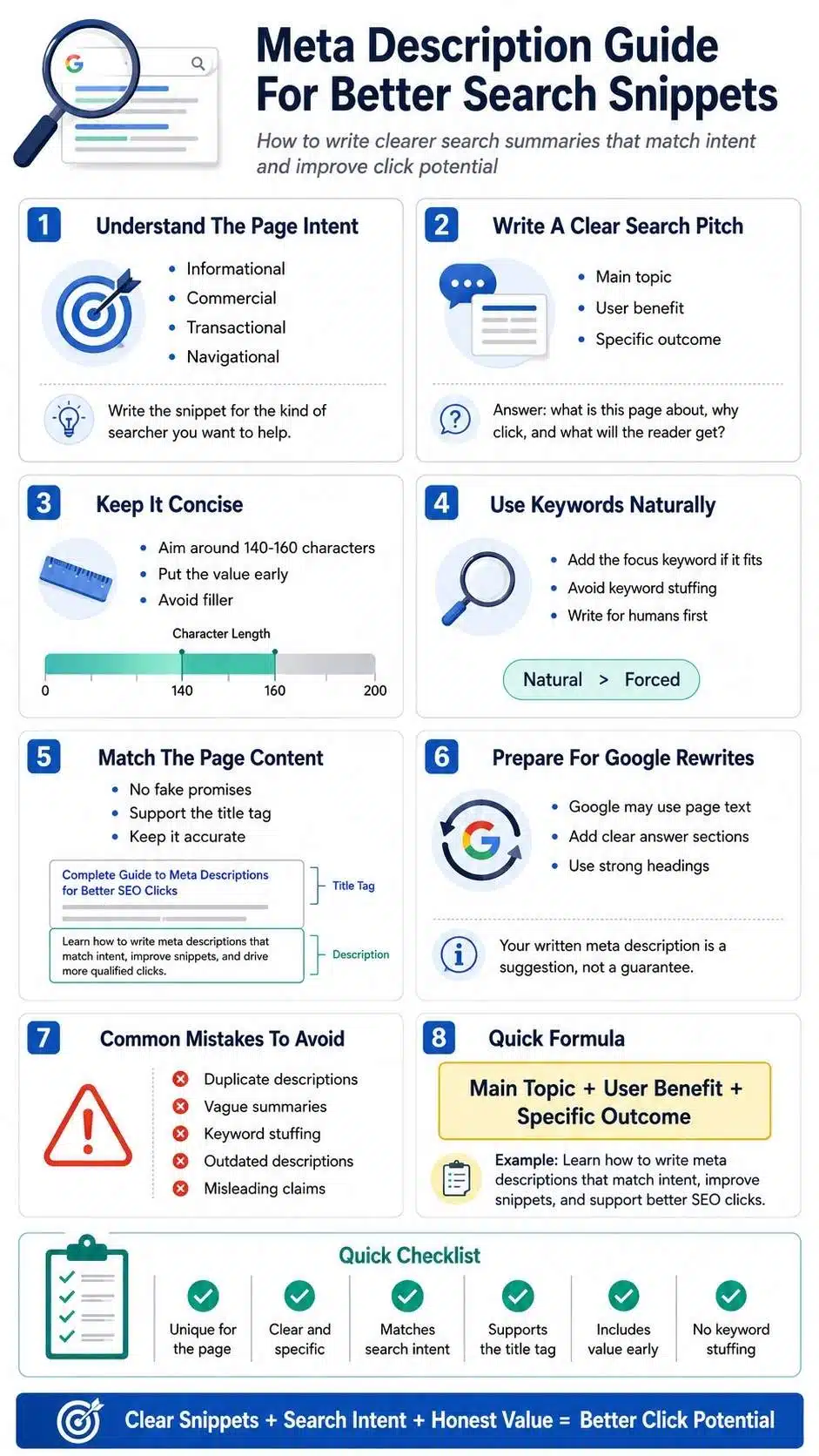
A good meta description should summarize the page in a way that helps the searcher decide. It should answer three quick questions:
- What is this page about?
- Why should I open it?
- Does it match what I searched?
If your description answers those three questions naturally, it is already better than most generic snippets.
A strong meta description usually includes:
- The main topic
- The page’s value or outcome
- A natural use of the focus keyword
- A clear match with search intent
- Specific details are helpful
- Honest wording
- No keyword stuffing
- No fake promises
- No duplicated boilerplate
For example, this article’s focus keyword is meta description guide. A description could be:
“Read this meta description guide to learn writing meta descriptions, snippet optimization, and meta description SEO best practices for 2026.”
That includes the keywords, but it sounds a little cramped.
A better version:
“Learn how to write meta descriptions that match search intent, improve snippets, and support better SEO clicks in 2026.”
The second version is smoother. It still covers the topic, but it sounds like a human wrote it for another human.
The Ideal Meta Description Length
There is no perfect meta description length that works everywhere. Search snippets can change by device, query, result type, language, and Google’s own formatting. A description that displays fully on one result may be shortened on another. Google may also ignore your description and show page text instead.
That said, most SEO teams still use a practical writing range because it keeps descriptions clear and manageable. A useful target is usually around 140 to 160 characters, but do not treat that like a law. Some descriptions can be shorter and still work well. Some may be slightly longer if the most important information appears early.
The real rule is this:
Put the important value first.
Weak:
“On this page, we are going to discuss a complete and detailed overview of how website owners can possibly think about writing better meta descriptions for their websites.”
Better:
“Learn how to write meta descriptions that match intent, improve snippets, and help searchers choose your page.”
The better version gets to the point quickly. A searcher does not owe you patience.
Where to Use the Focus Keyword
Use the focus keyword naturally in the meta description when it fits. For this article, the focus keyword is meta description guide. It can appear in the meta description, but it should not make the sentence awkward.
Good:
“Use this meta description guide to write clearer snippets, match search intent, and improve SEO click potential in 2026.”
Also good:
“Learn how to write meta descriptions that improve search snippets, support SEO, and help users choose the right result.”
The second version does not use the exact focus keyword, but it is still strong. If the exact phrase fits, use it. If it sounds forced, choose natural clarity.
Search engines are better at understanding meaning than they used to be. Readers are also better at noticing awkward SEO writing. The focus keyword should guide the description. It should not control every word.
Match the Meta Description With Search Intent
Search intent decides how the description should sound.
A beginner’s guide needs a clear learning promise.
A comparison page needs to mention the comparison.
A product page needs a key product value.
A local service page needs location and service clarity.
A troubleshooting page should mention the problem and the likely solution.
For example:
- Informational article:
“Learn what meta descriptions are, how snippets work, and how to write better SEO summaries for search results.” - Comparison article:
“Compare the best SEO tools for writing meta descriptions, improving snippets, and reviewing search appearance.” - Service page:
“Get SEO content support for title tags, meta descriptions, on-page SEO, and search snippet improvements.” - Product page:
“Explore a lightweight SEO plugin that helps write title tags, meta descriptions, and page summaries faster.”
The format changes because the searcher’s mindset changes. This is one of the simplest ways to improve snippet optimization. Do not write one style of meta description for every page.
Good and Bad Meta Description Examples
Examples are often more useful than theory, especially for editors and content teams.
Here are a few practical examples:
| Page Type | Weak Meta Description | Better Meta Description |
| SEO guide | This article explains everything about SEO and why it is important for websites today. | Learn modern SEO fundamentals, including crawling, keywords, title tags, metadata, and content strategy for 2026. |
| Meta description article | Read this article to know about meta descriptions and how they work in search engines. | Use this meta description guide to write clearer snippets, match search intent, and improve SEO click potential. |
| Product page | This is our best product with many features and benefits for all customers. | Compare features, pricing, and use cases for this project management tool built for remote teams. |
| Local service page | We provide the best dental services with experienced doctors and quality care. | Book same-day emergency dental care in Austin for tooth pain, broken teeth, and urgent treatment needs. |
| Listicle | Here are some tools that can help you do keyword research for your website. | Compare keyword research tools for SEO, content planning, search volume checks, and competitor analysis. |
The stronger examples are specific. They explain what the page gives the reader. They avoid empty claims like “best,” “complete,” and “everything” unless the page truly supports them.
Writing Meta Descriptions for Blog Posts
Blog post meta descriptions should help the reader understand the article’s value quickly. For evergreen guides, mention the core topic and practical outcome.
Example:
“Learn title tag optimization best practices, SEO title tag examples, and page title tips to improve search clarity in 2026.”
For opinion articles, the description should show the angle.
Example:
“Explore why generic AI content is weakening brand voice and how marketers can protect originality, trust, and audience connection.”
For listicles, mention the number of items and the selection angle.
Example:
“Explore 10 beginner-friendly SEO tools for keyword research, content optimization, rank tracking, and technical checks.”
For news content, prioritize the current event, date relevance, and key development.
Example:
“Google’s latest search update changes how site owners should review content quality, rankings, and traffic drops.”
A blog description should not sound like a diary introduction. It should tell the searcher what they will get.
Writing Meta Descriptions for Pillar and Cluster Content
Pillar and cluster content need slightly different descriptions. A pillar page covers a broad topic. Its description should explain the full scope.
Example for the pillar:
“Learn modern SEO fundamentals for 2026, including crawling, indexing, keyword research, title tags, metadata, URLs, and on-page SEO.”
A cluster page goes deeper into one topic. Its description should be more specific.
Example for this cluster:
“Learn writing meta descriptions, meta description SEO, and snippet optimization tips to improve search result clarity and clicks in 2026.”
The cluster description should also connect naturally to the broader SEO journey. It should not try to cover every SEO topic. That is the pillar’s job. This prevents overlap.
If the pillar, title tag, article, and meta description all use almost the same meta description, searchers and search engines get weak page differentiation. Every cluster page needs its own reason to exist.
Writing Meta Descriptions for Product and Service Pages
Product and service pages need sharper descriptions because the searcher may be closer to action.
A good product or service meta description should mention:
- The product or service
- The target user
- The core benefit
- Important differentiator
- Location, pricing, or use case if relevant
Weak:
“We offer high-quality digital marketing services for all kinds of businesses.”
Better:
“Get SEO content strategy, keyword research, on-page optimization, and editorial planning for growing digital publications.”
The better version tells the reader what the service actually includes. For e-commerce product pages, avoid generic manufacturer copy when possible. If every reseller uses the same description, the search result may look ordinary. Add specific product details that help users choose. For local service pages, include the location naturally.
Example:
“Book professional AC repair in Dallas for cooling issues, emergency breakdowns, and seasonal maintenance.”
That is more useful than “Best AC repair service at affordable prices.”
Snippet Optimization Starts Inside the Page
A meta description helps, but snippet optimization also depends on the visible content. Search engines often choose text from the page when it better matches the query. That means your article should include clear, well-written sections that can work as snippets.
For example, if your article has a section called “What Is a Meta Description?” and the answer underneath is direct, Google has better page text to use for definition-style queries.
If your article has a section called “Why Google Rewrites Meta Descriptions,” that section may support a more specific query.
This is why headings matter. This is why short answer paragraphs matter. This is why examples matter. Do not hide the answer under five paragraphs of background. Searchers want useful information quickly.
A good snippet-friendly section usually has:
- A clear heading
- A direct answer
- Supporting detail
- Examples or context
- No unnecessary opening fluff
That does not mean every paragraph should be robotic. It means the page should contain clear answer blocks where the reader needs them.
Why Google Rewrites Meta Descriptions
Google may rewrite a snippet when the written meta description does not match the query, is too vague, repeats boilerplate, stuffs keywords, or fails to summarize the page properly. Sometimes the rewrite is better. Sometimes it is worse. But it usually gives you a signal. If Google never uses your descriptions, review them.
Common problems include:
- Same description used across many pages
- Description too generic
- Description copied from the first paragraph
- Description stuffed with keywords
- Description not aligned with the actual page
- Description written like an ad but page is informational
- Description outdated after the page was updated
- Description too broad for a specific cluster page
One common mistake is using a sitewide template for every article.
Example:
“Read the latest news, updates, tips, and insights from our expert editorial team.”
That says almost nothing. It could describe any page. A better article-level description should describe the actual topic. Google may still rewrite it, but at least you are giving it a useful option.
Common Meta Description Mistakes
Meta description mistakes are easy to miss because they do not break the page visually. The article looks normal. The CMS field is filled. Everyone moves on. But in search results, the weakness shows.
Using the Same Description Everywhere
Duplicate meta descriptions make pages look less distinct. If several pages have the same summary, searchers cannot tell why one page is different from another. Every important indexable page should have a unique description.
Writing Empty Filler
Lines like “Learn everything you need to know” or “This guide covers important information” are not enough. They do not explain the specific value of the page. Specific beats broad.
Keyword Stuffing
Bad:
“Meta description guide, writing meta descriptions, meta description SEO, snippet optimization, SEO meta description tips.”
Better:
“Use this meta description guide to write clearer snippets, match search intent, and improve SEO click potential.”
The better version includes meaning, not just keywords.
Making Promises the Page Does Not Keep
If the description promises examples, include examples. If it promises a checklist, include a checklist. If it says “2026,” make the article reflect current search behavior. Search disappointment is still a trust problem.
Forgetting Search Intent
A meta description for a beginner’s guide should not sound like a sales page. A product page should not sound like a dictionary entry. Match the page type to the searcher’s mindset.
Ignoring Old Pages
Old descriptions often become outdated. If you update an article for 2026 but the description still says 2023, the search result looks neglected.
A Practical Meta Description Formula
Formulas are useful when you need speed, but they should not make every page sound identical.
Use this simple formula:
Main topic + user benefit + specific angle or outcome
Example:
“Meta description guide + write clearer snippets + improve SEO clicks in 2026”
Finished version:
“Use this meta description guide to write clearer snippets, match search intent, and improve SEO click potential in 2026.”
Here are a few other formulas:
For guides: Learn [topic] with [specific points] so you can [outcome].
Example: “Learn writing meta descriptions with examples, mistakes, and snippet optimization tips for better SEO clarity.”
For listicles: Explore [number] [items] for [audience/use case] with [selection angle].
Example: “Explore 12 SEO tools for keyword research, snippet checks, content planning, and technical optimization.”
For service pages: Get [service] for [target audience] with [main benefits].
Example: “Get SEO content strategy for digital publishers, including keyword research, metadata, internal links, and content updates.”
For product pages: Shop or compare [product] with [features/use case].
Example: “Compare lightweight standing desks for home offices, small rooms, and ergonomic work setups.”
A formula helps you start. Human editing makes it sound natural.
Meta Description Examples for This SEO Cluster
The meta description should be clear and educational.
Here are possible options:
| Option | Meta Description |
| 1 | Use this meta description guide to write clearer snippets, match search intent, and improve SEO click potential in 2026. |
| 2 | Learn writing meta descriptions, meta description SEO, and snippet optimization tips for stronger search result clarity. |
| 3 | Improve your search snippets with practical meta description examples, SEO writing tips, and common mistakes to avoid. |
| 4 | Learn how meta descriptions work, why Google rewrites snippets, and how to write better summaries for SEO pages. |
| 5 | Write better meta descriptions for blog posts, product pages, service pages, and SEO cluster content in 2026. |
My recommended final version:
Use this meta description guide to write clearer snippets, match search intent, and improve SEO click potential in 2026.
It is specific, clean, and focused. It includes the focus keyword naturally and explains the benefit without overpromising.
How to Write Meta Descriptions Faster Without Making Them Generic
If you manage a lot of content, writing meta descriptions one by one can feel repetitive. That is where process helps. Start by identifying the page type. Then write one sentence that explains what the page covers. Write a second sentence that explains why it matters. Now compress both into one clean description.
Example:
Page topic: Meta descriptions
What it covers: how to write descriptions, examples, mistakes, and snippets
Why it matters: helps searchers understand and choose the page
Final:
“Learn how to write meta descriptions with examples, common mistakes, and snippet optimization tips for clearer search results.”
This method keeps descriptions specific without making them too long. For large sites, templates can help, but they should include page-specific variables.
Weak template:
“Read our guide to learn useful tips and important information about [topic].”
Better template:
“Learn [topic] with practical examples, common mistakes, and [specific outcome] for [audience/use case].”
Even then, review important pages manually. Templates are useful for scale. They are not a replacement for editorial judgment.
How to Test Meta Description Performance
You cannot fully measure a meta description in isolation, but you can review performance signals. Google Search Console is the best starting point.
Look for pages with:
- High impressions but low click-through rate
- Strong ranking positions but weak clicks
- Important pages with outdated snippets
- Pages where Google appears to show poor snippet text
- Pages with generic or duplicate descriptions
- Pages updated recently, but still using old summaries
Before changing the meta description, also review the title tag. Often, the title and description need to work together.
Example:
Weak title: Meta Descriptions
Weak description: This article explains meta descriptions and why they are important.
Improved title: Meta Description Guide: Writing Better SEO Snippets
Improved description: Learn writing meta descriptions, snippet optimization tips, and common SEO mistakes to improve search result clarity.
The title gets attention. The description confirms value. After updating, give search engines time to recrawl and reprocess the page. Do not change metadata every few days. Track changes over a reasonable period. SEO testing needs patience, not panic.
How AI Search Changes Meta Description Writing
AI search does not remove the need for meta descriptions. AI-powered search experiences still rely on content that can be found, understood, and evaluated. Metadata helps describe the page, but it must be accurate and relevant. The same old trick of stuffing keywords into metadata does not become smarter just because AI search exists.
The bigger shift is that user questions are becoming more specific. People ask longer queries. They ask follow-ups. They compare options. They want context. That means your meta description should not be vague. A generic description like “Learn useful SEO tips for your website” is too weak.
A better description says exactly what the page helps with:
“Learn how to write meta descriptions that match search intent, improve snippets, and support better SEO clicks.”
Clear metadata supports both search systems and human readers. It does not need to sound robotic. In fact, robotic metadata is easier to ignore. The best AI-era metadata is accurate, specific, and people-first.
Meta Description Checklist Before Publishing
Use this checklist before publishing any important page.
- Is the meta description unique?
- Does it describe the actual page?
- Does it match search intent?
- Does it include the focus keyword naturally, if possible?
- Does it avoid keyword stuffing?
- Does it explain a clear benefit?
- Is the most important information near the beginning?
- Is it specific enough to distinguish the page?
- Does it support the title tag?
- Is it written for a human searcher?
- Does the page deliver what the description promises?
- Is it updated when the article is refreshed?
- Does it avoid vague phrases like “everything you need to know”?
- Would you click this result if you searched the topic?
The last question is simple, but useful. If you would not click it, why expect readers to?
How Meta Descriptions Support SEO Cluster
This cluster fits naturally after title tag optimization. The title tag earns attention. The meta description supports the decision. Together, they shape the search result before the reader reaches the page.
The broader cluster now has a clean flow:
- Modern SEO fundamentals explain the full foundation.
- How search engines crawl explains discovery and indexing.
- Keyword research fundamentals explain how to choose search targets.
- Title tag optimization explains how to write clickable page titles.
- This meta description guide explains how to write supporting snippets.
That order makes sense because metadata only works well after the page has a clear topic and intent. If the keyword is wrong, the meta description will be wrong. If the title is vague, the description has to work too hard.
If the page does not answer the query, the description becomes a promise the article cannot keep. Strong SEO is connected. Meta descriptions are one small field, but they sit inside a larger search system.
Frequently Asked Questions About Meta Description Guide
1. What Is a Meta Description?
A meta description is a short HTML summary that describes a web page. Search engines may use it as the snippet under the title link in search results, but they can also choose text from the page when it better matches the query.
2. Why Is Writing Meta Descriptions Important?
Writing meta descriptions is important because they help users understand what a page offers before clicking. A clear description can support the title tag, improve search result clarity, and encourage more qualified clicks.
3. Does Meta Description SEO Improve Rankings?
Meta descriptions are mainly useful for search appearance and click decisions. They do not replace strong content, indexing, internal links, or search intent. They are most useful when a page already gets impressions but needs a clearer search pitch.
4. Why Does Google Rewrite My Meta Description?
Google may rewrite snippets when the meta description is vague, duplicated, stuffed with keywords, outdated, or less useful for the specific query. It may pull text from the page when that text better answers the search.
5. Should Every Page Have a Unique Meta Description?
Important indexable pages should have unique meta descriptions. Duplicate descriptions make pages harder to distinguish and often fail to explain the specific value of each page.
6. What Should I Include in a Meta Description?
Include the main topic, user benefit, search intent match, and a natural keyword if it fits. Avoid empty claims, fake promises, repeated boilerplate, and keyword stuffing.
7. What Is Snippet Optimization?
Snippet optimization means improving the title tag, meta description, page structure, and on-page answer blocks so search results clearly explain why the page is useful for a query.
Write Meta Descriptions Like Search Pitches, Not SEO Fillers
A meta description is not just a box to fill before publishing. It is one of the first pieces of copy a searcher may see. That makes it important. Not because it tricks search engines. Not because it guarantees rankings. Not because every written description will always appear exactly as you wrote it. It matters because it helps clarify the page. A strong meta description tells the searcher: this result matches your question, and here is what you will get if you click.
That is the real purpose of a meta description guide in 2026. Write descriptions that are accurate, specific, and useful. Match the intent. Support the title tag. Avoid stuffing. Make every important page distinct. Review old snippets when performance drops. And remember that Google may use the page content too, so the article itself must contain clear answer sections.
Metadata cannot hide weak content anymore. It can only support strong content. So write the page well first. Then write the description like a clean search pitch. That is how writing meta descriptions becomes part of a smarter SEO workflow, not just another field inside your CMS.