


Italy’s competition authority has officially launched an in-depth investigation into Meta Platforms Inc. over its recent decision to integrate artificial intelligence services directly into WhatsApp, the popular messaging app used by billions globally. Italian regulators believe that this move may breach European Union competition laws by leveraging Meta’s dominant market position to unfairly push its AI technology onto users.
Meta, the parent company of Facebook, Instagram, and WhatsApp, has been under increasing scrutiny from regulators across Europe. This latest development could mark a significant escalation in the European Union’s regulatory response to Big Tech’s use of AI in consumer platforms, particularly in how AI is being introduced to users without transparent consent or competitive balance.
Meta AI Tool Quietly Added to WhatsApp in March 2025
According to a statement released on Wednesday by Italy’s antitrust regulator — known formally as Autorità Garante della Concorrenza e del Mercato (AGCM) — the decision to initiate the probe follows Meta’s March 2025 rollout of its Meta AI tool within WhatsApp. This AI-powered assistant began appearing on WhatsApp interfaces, providing users with chatbot capabilities such as answering queries, drafting messages, and summarizing content.
However, Italian authorities argue that the rollout was neither transparent nor consensual. The AI assistant was pre-installed, not offered as an optional feature. The AGCM believes this forced integration may amount to a form of imposition, wherein users are compelled to interact with the new technology as part of their everyday messaging experience without meaningful alternatives.
In March 2025, Meta, which holds a dominant position in the market for consumer communications apps, decided to pre-install its artificial intelligence service on the WhatsApp app,” said the AGCM.
This action could potentially violate Article 102 of the Treaty on the Functioning of the European Union (TFEU), which prohibits the abuse of a dominant position within the internal market.
Meta Accused of Bypassing Fair Competition
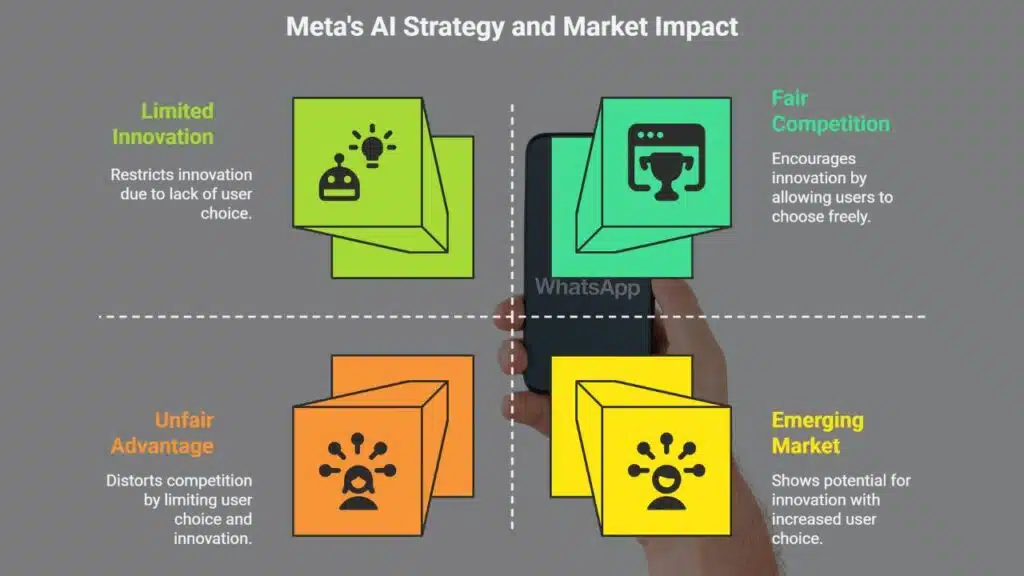
The Italian antitrust agency’s concerns go beyond the user experience. According to the AGCM, Meta may be using WhatsApp’s massive user base — which includes over 2 billion monthly active users globally — to gain an unfair advantage in the emerging AI sector. Rather than competing based on merit, the company is allegedly “channeling” its customers into using its AI tool simply because it is embedded in a platform they already rely on.
This type of bundling, the agency suggests, could distort fair competition, particularly for smaller or newer AI companies that lack access to such a large built-in audience. The AGCM argues that users are being denied the freedom to choose other AI tools that might better suit their preferences.
By merging Meta AI with WhatsApp, the company could be channeling its customer base into the emerging market, not through merit-based competition, but by imposing the availability of the two distinct services upon users,” the statement noted.
This strategy may limit innovation and block competing companies from gaining market share in a fair and open digital ecosystem.
Risk of “Lock-In” and User Dependency
Another major issue raised by the AGCM is the long-term effect of AI integration on user behavior. Italian authorities warn that users could become “functionally dependent” on Meta AI due to the nature of how the system works.
Meta AI, like other machine-learning tools, improves over time by collecting and analyzing user interactions. This process enables the chatbot to provide increasingly personalized and context-aware responses. While this may enhance user experience, it could also discourage users from exploring or switching to alternative AI services, essentially locking them into the Meta ecosystem.
The watchdog highlighted the risks of dependency, explaining that if a user continually engages with the AI assistant and receives better, more tailored responses, they may feel compelled to stay within the Meta environment, even if better services exist elsewhere.
This raises ethical and regulatory questions about data collection, behavioral nudging, and the broader implications of embedding AI in everyday communication tools without adequate oversight.
Italian Authorities Conduct On-Site Raid at Meta’s Local Office
To gather more evidence, Italian financial police, working alongside the AGCM, carried out an unannounced inspection on Tuesday at the offices of Meta’s Italian subsidiary. The inspection, often referred to as a “dawn raid” in regulatory language, was aimed at collecting documents, internal communications, and operational records that could support or disprove the allegations.
Such inspections are standard procedure in antitrust investigations and allow regulators to assess whether Meta acted in breach of EU law. The data collected during this raid will likely form the basis of the case as it develops.
Collaboration with European Commission Signals Broader Inquiry
In its statement, the AGCM also confirmed that the probe is being conducted in close coordination with the European Commission’s competition authorities in Brussels. This collaboration signals that the issue may escalate beyond Italy and become a pan-European investigation into Meta’s broader business practices concerning AI rollout.
The European Union has recently strengthened its digital market regulations with two major legislative frameworks:
- The Digital Markets Act (DMA), which targets large “gatekeeper” platforms like Meta to ensure fair competition.
- The Digital Services Act (DSA), focused on user protection, transparency, and platform accountability.
Meta has already been flagged under the DMA as a gatekeeper platform, and this probe could further test the limits of its compliance.
Broader Implications for AI Regulation in Europe
This investigation is part of a growing trend across Europe where regulators are taking a hard look at how Big Tech firms deploy AI in public-facing tools. As AI becomes a mainstream feature in social media, messaging, and search, concerns about transparency, fairness, and monopolistic behavior are rising sharply.
Regulators in other EU countries are watching Italy’s case closely, and it could set a precedent for future enforcement. If the Italian authority finds that Meta violated competition laws, the company could face hefty fines, mandated changes to how AI tools are deployed, or even be required to provide clear opt-out features for users.
Meta’s Response So Far
As of now, Meta has not publicly responded in detail to the allegations. The company may choose to cooperate with regulators to avoid escalating tensions, especially given the European Union’s increasing push for strict digital governance.
In past cases, Meta has maintained that its tools are designed to enhance user experience, and that integration of new features — such as AI assistants — are rolled out in accordance with user privacy and data policies.
However, given the scope of this investigation, the company will likely need to defend its strategy in greater detail, including whether users were adequately informed or offered meaningful alternatives.
What’s Next for Users and Competitors?
While the investigation unfolds, WhatsApp users in Italy and potentially across the EU may begin seeing changes in how AI services are presented within the app — such as clearer disclosures, opt-in options, or even temporary removals of certain features until the case is resolved.
For Meta’s competitors in the AI space, this investigation may offer a level playing field, forcing larger players to comply with fair practices and transparency requirements.
And for regulators, it is an opportunity to set strong guardrails as artificial intelligence becomes increasingly embedded in the digital products billions of people use every day.
The Information is Collected from The Hindu and MSN.





















