A brand can appear in dozens of AI answers and still receive no links, no qualified traffic, and no meaningful place in the buyer’s decision. It can also earn fewer mentions while being recommended prominently for the questions that matter most.
That is why marketers cannot measure brand visibility in AI with a single mention count. A useful system must show whether the brand appears, how it is described, which sources support the answer, how it compares with competitors, and what happens when users reach the website.
Traditional rank tracking remains useful for search results. It is not enough for ChatGPT, Google AI Overviews, AI Mode, Microsoft Copilot, Perplexity, Gemini, and other generative interfaces. These systems generate answers rather than return one fixed list of ranked pages.
A Mention Is Not Necessarily a Recommendation
Suppose a buyer asks:
Which project management platforms are suitable for a 30-person creative agency?
The answer could place a brand among its leading recommendations. It could bury the same brand in a long list, describe it as suitable only for enterprises, cite an outdated review, or omit it while naming three direct competitors.
Every outcome counts differently.
AI visibility should therefore be assessed at three levels:
- Answer presence: Is the brand mentioned, recommended, compared, or dismissed?
- Source presence: Does the answer cite an owned page or an independent source discussing the brand?
- Business impact: Does the exposure contribute to visits, branded searches, leads, sales conversations, or revenue?
A high mention rate is encouraging only when the brand appears in the right context. An inaccurate or poorly positioned mention can work against it.
Metrics That Deserve a Place in the Report
Start with raw counts and simple percentages. Complicated scoring can wait until the team understands what the underlying data represents.
Mention rate measures the percentage of valid responses that name the brand. Count the response once even when the name appears several times.
Owned citation rate measures how often an AI answer links to the company’s domain. Keep this separate from earned citations pointing to publishers, review sites, marketplaces, community discussions, or other outside sources.
Recommendation rate is narrower than mention rate. It records whether the answer actively suggests the brand for the user’s stated need.
Prominence shows where the brand appears. A leading recommendation should not carry the same weight as a passing reference near the end of the answer.
Competitive share of voice compares the brand’s presence with a defined group of competitors. The competitor set must remain stable between reporting periods. Adding a large market leader halfway through the quarter can reduce the score even if the brand’s own visibility has not changed.
Accuracy rate records whether checkable claims about the company, product, availability, audience, or features are correct.
Referral performance covers identifiable visits and what those visitors do: engagement, downloads, sign-ups, leads, purchases, or other meaningful actions.
Always show the numerator and denominator beside a percentage. “Mentioned in 42% of responses” is more useful when readers can also see that it means 21 mentions across 50 valid responses.
How to Measure Brand Visibility in AI With Better Prompts
Weak prompt selection is one of the quickest ways to produce an impressive but unhelpful report.
A test dominated by branded questions such as “Is Brand A good?” mostly measures what an AI system says after being handed the company name. It does not show whether the brand will surface during genuine product discovery.
A useful prompt panel should cover several types of customer need:
- Category discovery: “What are the best payroll platforms for distributed teams?”
- Problem-solving: “How can a retailer reduce inventory forecasting errors?”
- Product comparison: “Brand A vs. Brand B for a growing agency”
- Feature research: “Which CRM platforms include territory management?”
- Trust and suitability: “Which data platforms are suitable for a regulated financial company?”
- Alternatives: “What are the best alternatives to Brand B for a small business?”
- Branded fact-checking: “Where is Brand A available?”
- Purchase concerns: “What are the limitations of Brand A?”
Keep branded and unbranded results separate. The first group reveals how the platform represents a known company. The second is a harder test of whether the company is discovered at all.
For many teams, 30 to 50 carefully chosen prompts provide a manageable starting panel. That number is an editorial recommendation, not an accepted industry standard. A company serving several markets, languages, and product categories may need far more. A specialist B2B provider may learn more from 20 precise buying questions than from 500 loosely generated prompts.
Each prompt should have a topic, audience, country, language, and buying stage. Without that segmentation, a global average can conceal important gaps. Strong English-language visibility in the United States says little about how the brand appears to a buyer searching in Spanish from Mexico or German from Austria.
Keep the core panel stable. New questions can go into an experimental group until there is a reason to add them permanently.
Repeating a Prompt Does Not Produce a Fixed Ranking
Generative answers can change between runs. Results may also differ by model, location, language, account settings, search access, and product interface.
Record enough context to make the observation reproducible:
- Exact prompt
- Platform, product, and visible model or mode
- Date and market
- Language
- Signed-in or signed-out state
- Search or browsing status
- Brand position and description
- Recommendation status
- Owned and third-party citations
- Competitors present
- Material factual errors
- Saved answer or screenshot reference
Run commercially important prompts several times when resources allow. A single answer can reveal an error worth fixing, especially when it concerns security, regulatory compliance, pricing, availability, or product compatibility. It should not automatically be treated as evidence of a wider trend.
Prompt wording matters as well. “Best accounting software for a startup” and “Which accounting platform should a new company choose?” express similar intent but may produce different brands and sources. Use one stable version for reporting while testing paraphrases separately.
Automation helps with scale, but it does not remove this variability. Results generated through an API may not match the public product because the model, search system, location signals, instructions, and citation interface may differ. A sensible workflow combines automated collection with manual review of selected consumer-facing answers.
Start With First-Party Data
Before paying for a dedicated GEO platform, check the data already available from Google, Microsoft, OpenAI referral tags, and the company’s analytics setup. First-party reports are incomplete, but they provide a stronger baseline than a vendor score whose calculation nobody on the team has reviewed.
Google Search Console
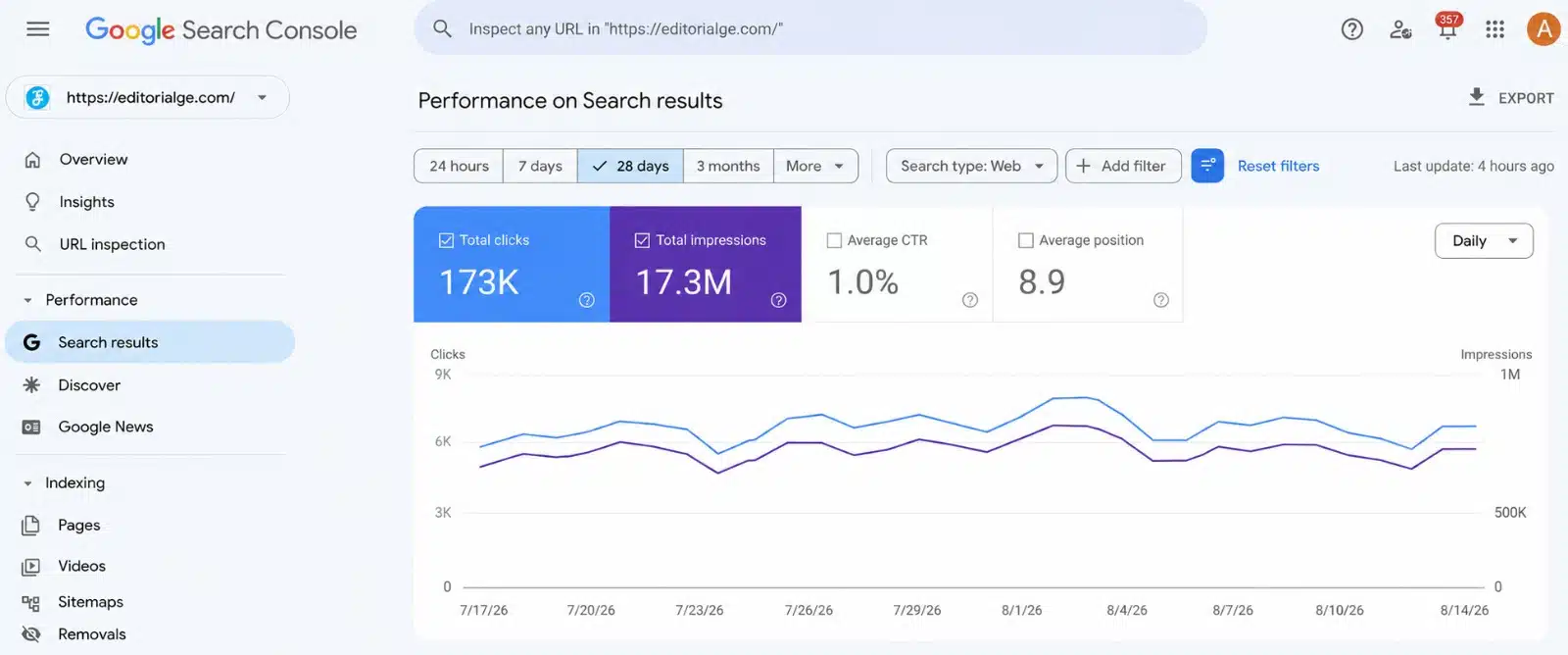
As of September 2026, Google’s generative AI performance reports have been rolled out worldwide. The Search report covers impressions from AI Overviews and AI Mode, with breakdowns by page, country, device, and date.
This can reveal which URLs are appearing, whether exposure is changing, and whether one market or device accounts for an unusual share of impressions.
There are limits. The dedicated report focuses on impressions. It does not provide AI-specific clicks, queries, recommendation context, or sentiment. It also does not show the wording around each citation.
Some properties may not see the report because they have not received enough qualifying impressions. Search Labs experiments are excluded. A missing report therefore does not prove that the site is technically broken, but it does leave the team with less first-party evidence.
Bing Webmaster Tools
Microsoft’s AI Performance report shows how a verified site is cited across supported Microsoft AI experiences. It includes citation activity, cited pages, grounding queries, and changes over time.
Its expanded preview views add more context:
- Intents classify the needs behind grounding queries.
- Topics group related queries.
- Citation Share shows relative citation presence for a grounding query.
- Compare helps examine differences between periods or dimensions.
These views are more useful than a raw citation total, though they still do not show how important a page was to an individual answer. A citation may support the main recommendation or a minor background detail.
Because these features remain under development, teams should confirm what is available in their own account before committing to a permanent reporting template.
ChatGPT Referrals in GA4
OpenAI currently adds utm_source=chatgpt.com to referral URLs from ChatGPT search results. That makes some visits identifiable in GA4 and other analytics platforms.
In GA4, open the Traffic acquisition report and inspect a session-level dimension such as Session source or Session source/medium. Filter for chatgpt.com, then review landing pages, engaged sessions, key events, leads, and revenue where relevant.
This measures attributable clicks from ChatGPT search links. It does not measure everyone who saw the company in an answer. A person might later search for the brand, type the address directly, use another device, or mention it to a colleague.
Analytics implementation creates further gaps. Consent choices, privacy controls, redirects, missing tags, and URL handling can all affect attribution. Test the journey rather than assuming the parameter will survive every redirect and appear correctly in every report.
When a Paid AI Visibility Tool Is Worth It
Manual checks become difficult once the program spans several platforms, countries, languages, and hundreds of prompts. That is where commercial GEO and LLM monitoring platforms become useful.
Ahrefs Brand Radar, for example, reports mentions, citations, estimated impressions, and AI share of voice. Its documentation counts one mention when a brand appears at least once in a response. Repeating the name several times in that answer does not create several mentions. A citation is recorded when a page appears at least once as a cited source.
Its AI share of voice compares the brand’s estimated impressions with those of the other tracked brands. Changing the competitor set, entity configuration, filters, or weighting can therefore change the result.
Other platforms use their own prompt collections and scoring systems. Their headline scores should not be compared as if they were standardized measurements.
Before subscribing, ask:
- Can the team inspect the prompts and complete answers?
- Are prompts checked daily, weekly, or less often?
- Which platforms, models, languages, and countries are covered?
- Are prompts based on search demand, customer research, or synthetic generation?
- Can the data distinguish the brand from unrelated products with similar names?
- How are failed responses, duplicates, and missing citations handled?
- Can raw and historical data be exported?
- What exactly determines the share-of-voice score?
Entity confusion deserves particular attention. A short brand name, common word, acronym, or product name shared by several companies can make automatic mention detection unreliable. Review a sample before trusting the total.
A paid tool is worthwhile when it reduces a real monitoring burden. It is premature when the team has not yet agreed on the prompts, competitors, markets, or actions that the report should support.
Read the Answer, Not Just the Dashboard
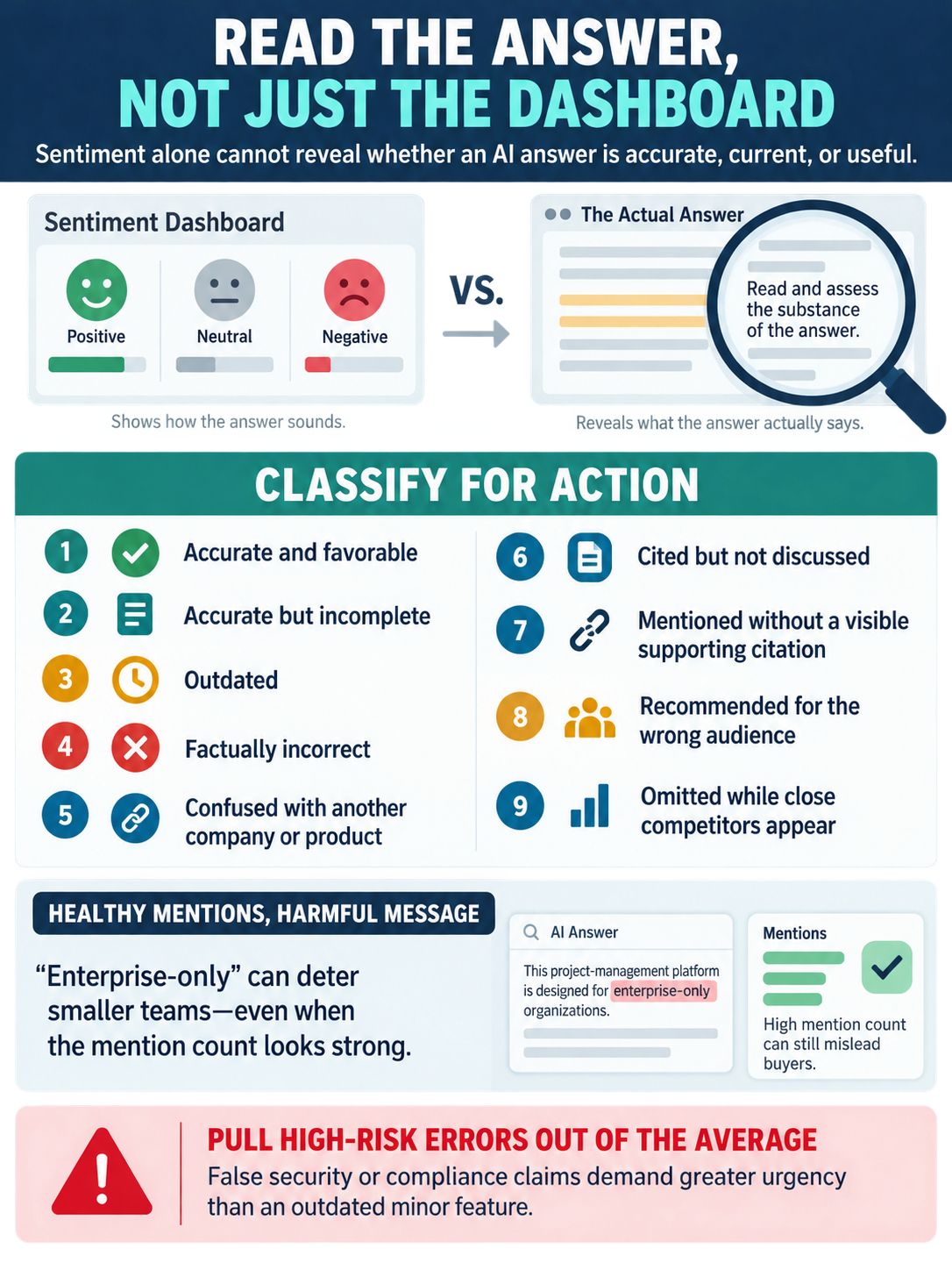
Positive, neutral, and negative sentiment labels are too blunt for many brand decisions. A neutral description can still contain an expired offer, incorrect feature claim, wrong market position, or mistaken availability detail.
For important prompts, classify responses in a way that leads to action:
- Accurate and favorable
- Accurate but incomplete
- Outdated
- Factually incorrect
- Confused with another company or product
- Cited but not discussed
- Mentioned without a visible supporting citation
- Recommended for the wrong audience
- Omitted while close competitors appear
Suppose an AI answer repeatedly describes a project-management platform as enterprise-only after it has introduced an offering for smaller teams. The mention count looks healthy, but the description could deter the very buyers the company wants.
High-risk errors should be pulled out of the average. A false claim about data security or regulatory compliance is not equivalent to an outdated description of a minor feature.
Connect Visibility to Business Outcomes Carefully
AI referrals are the most direct downstream signal, but clicks represent only part of the influence.
Supporting indicators may include:
- Conversions from identifiable AI referrals
- Growth in branded search impressions
- More brand-versus-competitor searches
- Direct visits to pages frequently cited by AI platforms
- Demo forms that ask how the prospect discovered the company
- Sales notes mentioning an AI assistant
- Leads that first arrived through an AI referral and converted later
These patterns can strengthen an analysis. They do not prove that AI visibility caused the result.
Product launches, media coverage, advertising, seasonal demand, pricing changes, and competitor problems can move several metrics at once. Annotate those events and look for sustained patterns across multiple reporting periods.
Turn Reporting Into Work
A useful AI visibility report should leave each team with a decision, not another chart.
SEO may need to resolve indexing or canonical problems on an important source page. Content teams may need to clarify a comparison or publish better supporting evidence. PR may need to address weak or outdated third-party coverage. Product marketing may need to make availability, audience, or feature language consistent across the website.
Monitor reputation-sensitive and high-value prompts often enough to catch serious errors. Use monthly reporting for broader movement and a quarterly review to reassess prompts, competitors, languages, and tools.
Do not publish thin pages merely to repeat phrases from tracked prompts. Clear product documentation, original research, consistent entity information, credible independent coverage, and accessible pages are more defensible investments.
Mistakes That Make the Numbers Look Better Than They Are
Watch for these problems:
- Testing mostly branded prompts
- Counting mentions as endorsements
- Changing the prompt panel between reporting periods
- Combining languages and countries into one unexplained average
- Ignoring independent sources that shape brand descriptions
- Treating one generated answer as a stable position
- Comparing vendor scores built with different methods
- Hiding raw counts behind a proprietary index
- Claiming revenue impact from correlation alone
- Optimizing for a vendor’s prompt library rather than customer needs
Final Thoughts
To measure brand visibility in AI properly, begin with a small, stable prompt panel and a clear set of competitors. Check Google Search Console, Bing Webmaster Tools, and identifiable AI referrals before investing in another platform. Record mentions, recommendations, citations, accuracy, and outcomes separately.
After one or two reporting cycles, the weak points usually become clearer: missing category visibility, incorrect descriptions, poor citation coverage, thin regional data, or exposure that never leads to meaningful action.
That diagnosis matters more than a polished visibility score. The strongest reporting system is the one that shows what changed, why it matters, and what the team should fix next.
Frequently Asked Questions
Can a company measure AI visibility without paying for a specialist tool?
Yes. Start with a fixed prompt list, manual checks across the platforms your customers use, Google Search Console, Bing Webmaster Tools, and session-level referral data in GA4. A paid monitoring platform becomes more useful when the number of prompts, countries, languages, and competitors makes manual tracking impractical.
How often should AI brand visibility be checked?
Monthly measurement is usually enough for general trend reporting. Check important commercial prompts and reputation-sensitive claims weekly, particularly after a product launch, pricing change, rebrand, major media story, or website migration. Use the same core prompts so changes remain comparable.
Should product names and the corporate brand be tracked separately?
Usually, yes. Buyers may know a product without recognizing its parent company, while an AI answer may recommend the corporate brand but omit the relevant product. Separate tracking helps reveal whether visibility belongs to the company, an individual product, or both.
What if the brand name is also a common word?
Add context to the tracking setup, such as the company domain, industry, product names, location, and common name variations. Then manually inspect a sample of matched answers. Automated tools can mistakenly count unrelated uses of a common word, acronym, or similarly named company as a valid mention.
Does low AI referral traffic mean the brand has poor AI visibility?
Not necessarily. Users can read a recommendation without clicking, return later through search, visit directly, or discuss the brand elsewhere. Low referral traffic should be read alongside mentions, recommendations, citations, branded search activity, and conversions. It should not be used as the only measure of AI visibility.