
The connection between the US election and global conflicts was visible within hours of Tuesday’s vote. Oil prices fell as traders considered whether President Donald Trump might seek an exit from the war with Iran. Ukraine’s president voiced hope that the new Congress would provide more support against Russia. In Israel, questions about the future of U.S. military aid grew sharper.
None of those reactions was a change on the ground. Ships still faced danger around the Strait of Hormuz. Fighting continued in Ukraine and Gaza. Sudan’s war was entangled in a worsening dispute with neighboring Ethiopia. The election changed who will control Congress in January; it did not settle the choices confronting any of the parties to those conflicts.
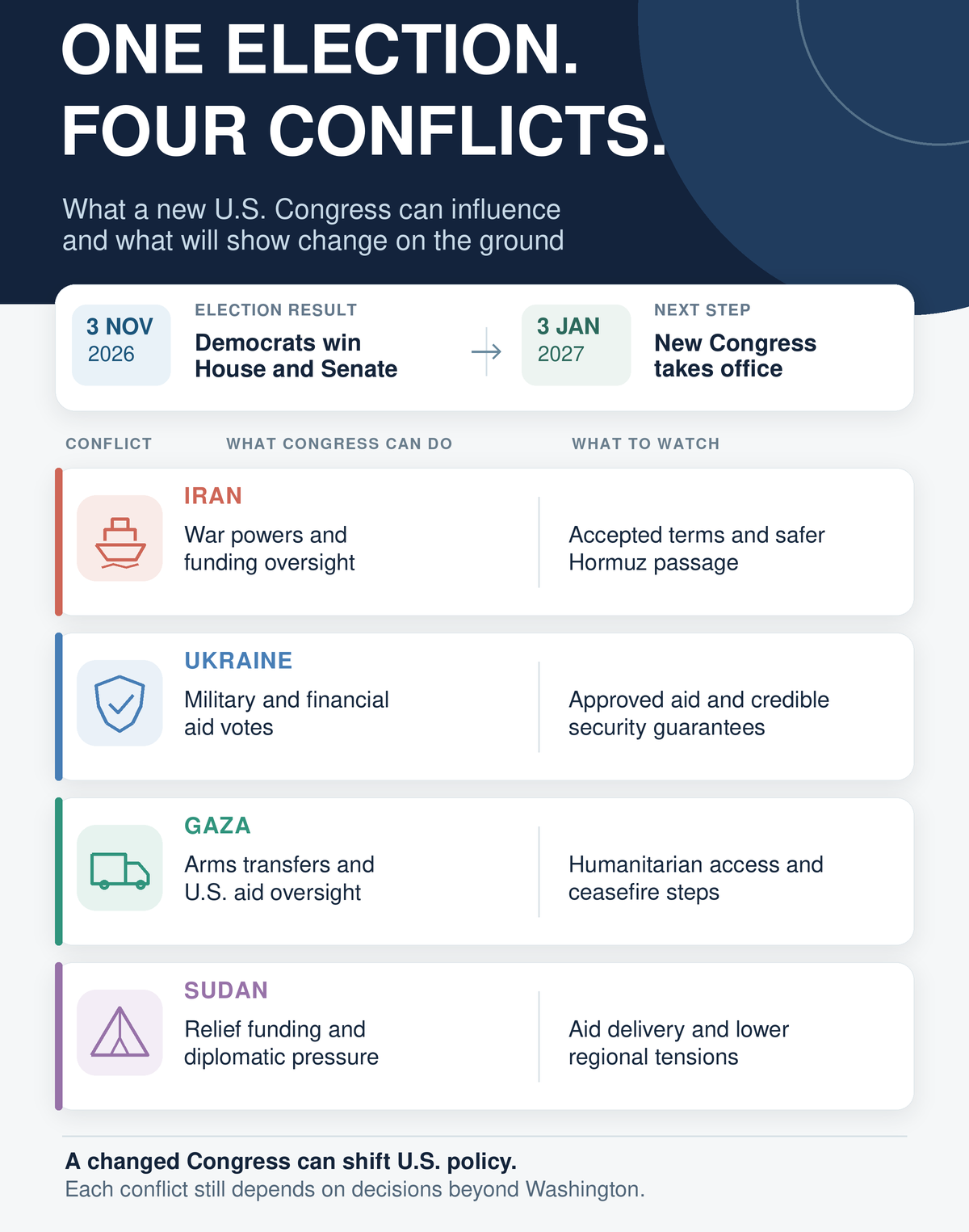
A new Democratic Congress can challenge U.S. decisions on Iran, Ukraine, and Israel. Whether those changes bring people closer to safety depends on more than Washington.
That is the question behind this analysis. Where can an American election alter the course of a war, and where does its influence run up against governments, armed groups and events that Washington cannot command?
What Did American Voters Decide?
Democrats won control of both the House and Senate, ending unified Republican control of Washington. The result gives them the power to set committee agendas, hold hearings, examine spending, scrutinize nominees and bring legislation to a vote when the new Congress takes office on 3 January 2027. Trump remains president in the meantime, and he will retain substantial authority over diplomacy and military operations afterward.
The election also needs to be read carefully. In the AP Voter Poll of about 80,000 voters, roughly four in ten named the economy as the country’s leading issue and three in ten named the state of democracy. About half called living costs and government corruption crucial to their congressional vote. The Iran war mattered, but fewer voters described it as crucial than those domestic concerns. A vote against the governing party is therefore not a single instruction on Iran, much less a detailed mandate on Ukraine, Gaza or Sudan.
The overlap is real, though. A war can become a domestic issue when it raises fuel bills or forces a government to defend how it spends public money. Trump’s acknowledgment that the Iran war hurt Republicans shows that the election has changed his political incentives. It does not tell us which decision he will make next.
Iran Is the First and Hardest Test
The connection between the election and Iran is unusually direct. The United States and Israel launched strikes on Iran on 28 February. The United States has maintained a naval blockade of Iranian ports, while Iran has restricted passage through the Strait of Hormuz. Qatar is mediating indirect talks, but Washington and Tehran remain divided over sanctions, the blockade, nuclear questions and the order in which each side would act.
Brent crude fell 8.7% on Wednesday, Reuters reported, as investors considered the prospect of less escalation. That price move registered an expectation, not an agreement. In the Gulf, a U.S. official said American forces had struck Iranian targets on Qeshm Island earlier in the week. On Thursday, Iran’s Revolutionary Guard said two oil tankers and a tugboat had caught fire near Hormuz; Reuters reported the claim without independently establishing its account of the cause. These developments make the safety of the waterway a better test than the market’s initial relief.
Democrats can demand clearer answers about the war’s objectives and costs. They can investigate military decisions, challenge funding and press for congressional authorization. A war-powers resolution concerning Iran passed both chambers earlier this year, but the administration did not change course, and its legal effect was disputed. A new majority strengthens oversight; it does not automatically give Congress control over Trump’s next strike or Tehran’s response.
Nor can the two countries simply announce peace and assume trade will return to normal. Shipowners and insurers need to believe passage is safe. Importers need fuel to move through refineries and distribution networks. A closer look at the Hormuz disruption shows how trouble at a narrow waterway can reach fuel, food, and household costs well beyond the Middle East. Lower crude prices do not immediately lower fuel bills for drivers and businesses.
Iran is the most immediate test of whether the election changes U.S. policy. A verifiable shift would be a proposal both sides accept, followed by changes to the blockade, restrictions on passage and the risk of further attacks. An election result alone supplies none of those steps.
Ukraine Sees an Opening, but Aid Is Still a Decision
Ukrainian President Volodymyr Zelenskiy said on Wednesday that he hoped the Democratic victory would bring more American help. His expectation has a concrete basis: the new majorities can put Ukraine assistance on the congressional agenda, and support for Kyiv has also come from many Republicans. But the amount, timing and conditions of any new package would still have to be negotiated and passed.
The question reaches beyond equipment and money. Washington has been involved in attempts to bring Ukraine and Russia to talks. U.S. officials said delegations were due to meet in Abu Dhabi on 10 and 11 November to discuss the war, security arrangements and de-escalation. A stronger congressional commitment to Ukraine could change the assumptions at that table. It cannot make Moscow accept terms or guarantee that a pause in fighting will hold.
Kyiv has long sought security guarantees with clear means of enforcement. That question remains important whether Congress increases assistance or a diplomatic opening emerges. Ukraine’s choices, Russia’s demands and Europe’s commitments all matter. Zelenskiy’s hope is evidence of how the vote is being received abroad; it is not yet evidence that the war has turned.
Gaza Raises a Different Question About U.S. Influence
For Gaza, the most immediate congressional question is how the United States funds and scrutinizes its relationship with Israel. Reuters reported that some incoming Democrats campaigned against unconditional military aid and that the new majority could hold hearings, examine arms transfers and press for limits. Trump said on Election Day that annual U.S. assistance to Israel would end after this year, but he did not explain how that would work under an existing arrangement extending to 2028. His announcement should not be treated as a completed policy change.
The situation in Gaza has its own urgent timetable. The U.S.-brokered ceasefire has not settled the dispute over Hamas disarmament or an Israeli withdrawal. Israeli strikes killed four Palestinians on Monday, according to Gaza medics cited by Reuters; Israel said it had targeted militants. The UN’s late-October humanitarian reporting described continuing attacks, displacement and shortages of essential supplies. Those conditions cannot wait for a new Congress to organize its committees.
Congress may influence future weapons sales, funding and the public terms of U.S. support. Relief for people in Gaza, however, also depends on decisions by Israel and Hamas, access for aid agencies, security at crossings and a political process that can outlast another temporary lull. Changes in Washington could create pressure. They cannot substitute for those steps.
Sudan Shows the Limits of an Election-Centered Story
Sudan is part of the same troubled world, but its war does not revolve around the U.S. ballot. It began in April 2023 as a struggle between Sudan’s army and the Rapid Support Forces. More than 14 million people have been displaced, according to UN figures cited by Reuters. The immediate concern this week is that the fighting may spread across another border.
On Wednesday, Ethiopia ordered six Sudanese diplomats to leave. Sudan accuses Ethiopia of allowing the Rapid Support Forces to use its territory for attacks; Ethiopia denies backing the group and accuses Sudan of supporting rebels in its own Tigray region. Sudan and the other governments named in Ethiopia’s allegations deny them. The competing claims are not established facts about who is arming whom, but the diplomatic expulsions are a real sign of deteriorating relations.
A Democratic Congress could examine U.S. humanitarian spending or press the administration to give Sudan more diplomatic attention. Those would be consequential choices for aid and diplomacy. They would not, by themselves, resolve the conflict between Sudanese armed groups or the escalating dispute with Ethiopia. This is why Sudan belongs in the analysis: it tests the temptation to treat Washington’s election as the center of every world crisis.
The US Election and Global Conflicts: What Would Count as Change?
The four conflicts do not share one cause or one route to peace. The election gives the incoming Congress a direct role in U.S. spending and oversight. Its reach is strongest where American forces, aid, or arms transfers are involved. Its effect is less direct where the decisive choices belong to other governments and armed groups.
The consequences still cross borders. A confrontation around Hormuz can affect energy importers far from Iran. Interrupted shipping and higher transport costs reach ordinary households. Violence elsewhere in the region can continue on its own track: the renewed Yemen war and attacks affecting travel through Riyadh are a reminder that a U.S.–Iran agreement would not settle every neighboring conflict.
The next evidence will come from decisions, not declarations. In Iran, watch whether talks produce enforceable steps and safer passage for ships. In Ukraine, watch for an actual aid measure and the terms discussed at the planned talks. In Gaza, watch what happens to assistance, arms oversight and humanitarian access. In Sudan, watch the neighboring governments’ actions and whether aid reaches displaced people.
Washington has changed. The wars beyond it have not yet changed with it. Whether they do will depend on what the new Congress can put into effect, what Trump chooses to do before and after January, and what the people with power on each front decide next.