AI agents could use blockchain and digital assets to pay for online services, work within spending limits, check counterparties, and leave records that other organizations can verify. The practical appeal is straightforward: software that completes a task may also need permission to spend money or access something its owner has paid for.
Some of the infrastructure already exists. Coinbase documents per-request payments through x402 and wallets with transaction controls. Other uses depend on emerging standards, custom contracts, and reliable ways to judge whether work was completed. A working payment tool is not proof that an entire autonomous business is ready to run.
The seven uses below focus on what each arrangement could accomplish, what makes it possible, and where human responsibility remains.
How the Pieces Fit Together
AI agents are software systems that can select tools and take actions toward a goal. In a typical blockchain setup, the model runs outside the network. A separate wallet authorization layer decides whether a proposed transaction can be signed.
Blockchain and digital assets supply different parts of that arrangement. The ledger records transactions; tokens can represent payment value or access rights; smart contracts execute programmed rules. None of these makes the model’s reasoning accurate.
The wider discussion of blockchain trends provides useful background, but the most revealing question is narrower: what specific problem does a shared ledger solve for this task?
1. Pay for Data, Computing, and Individual API Requests
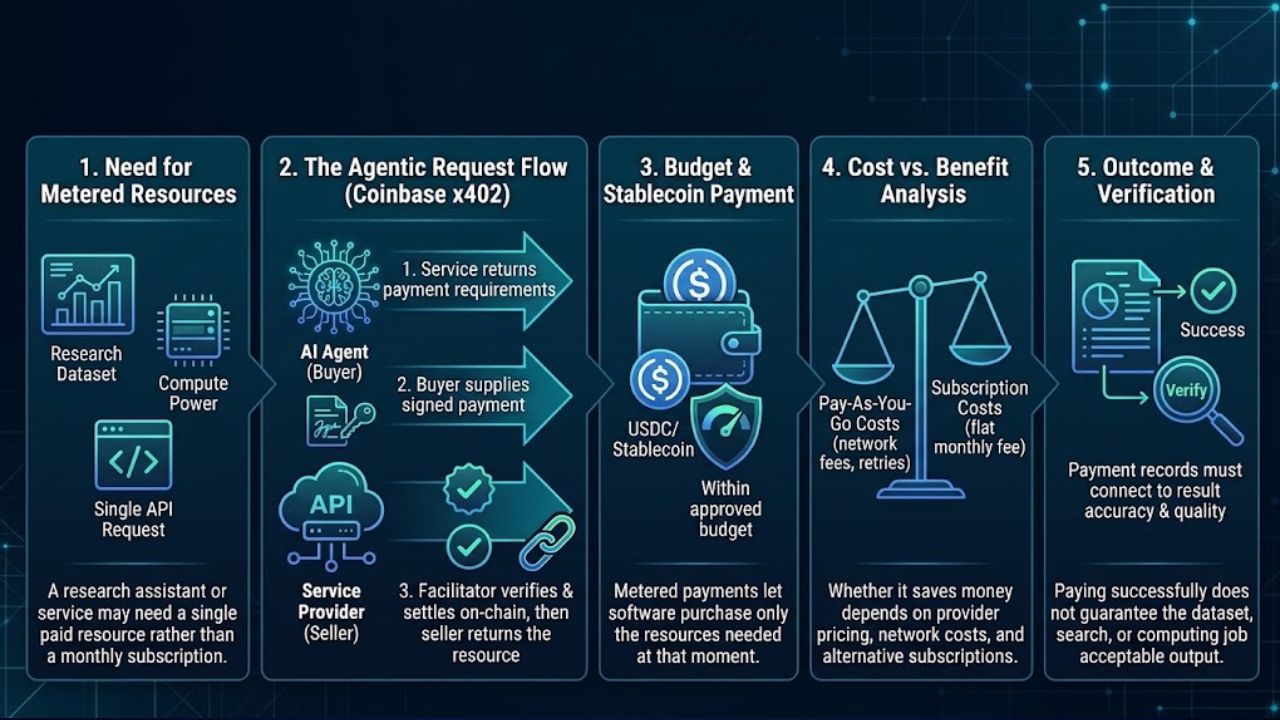
A research assistant may need one paid dataset rather than a monthly subscription. A scheduling service may need a single weather forecast. Metered payments could let software purchase that resource during a task, within an approved budget.
Coinbase’s x402 documentation describes a request flow in which a service returns payment requirements, the buyer supplies a signed payment, and a facilitator verifies and settles it. The seller then returns the resource. This gives AI agents a documented route to purchasing paid services through software interfaces.
Payment could use a supported stablecoin, a token designed to track a reference value such as the US dollar. For a business, the useful feature is purchasing only the resource needed at that moment. Whether it saves money depends on the provider’s price, network costs, retries, and the alternative subscription.
The payment record also needs to be connected to the result. Paying successfully does not establish that a dataset is accurate, a search result is useful, or a computing job produced acceptable output.
2. Hire Specialist Services Through Programmable Escrow
One general assistant cannot do every job well. AI agents could delegate a narrow task, such as extracting tables or translating a document, to a specialist service and arrange payment against agreed conditions.
Blockchain and digital assets could support this through escrow: funds held by a contract until an authorized approval or other defined condition permits release. This is a possible application design, not a built-in feature of every payment protocol.
An illustrative agreement might reserve payment for extracting 20 tables, release it after validation, and provide a refund route if the deadline expires. The difficult part is deciding what counts as successful extraction. A valid file can still contain incorrect numbers.
Ethereum’s documentation explains that smart contracts need oracles to use information from outside the chain. For subjective work, an agreed reviewer or dispute process may be more suitable. An automated contract cannot independently determine whether a translation is good merely because money is held on-chain.
3. Operate With Limited Wallet Budgets
Giving an assistant unrestricted access to a company wallet would create an unnecessary risk. A more useful arrangement gives it a small operating balance and narrowly defined authority.
In this use of blockchain and digital assets, a business could assign a dedicated wallet for approved service payments. Controls could cover individual purchases, cumulative spending, permitted recipients, and the period for which access remains valid. Each control must be enforced by the actual wallet or authorization system.
Coinbase’s Agentic Wallets product page describes spending caps per session and transaction, alongside private-key isolation from the language model. Those are vendor-documented capabilities, rather than an independent security assessment.
For example, a team could permit small purchases from approved data vendors while requiring human approval for a new recipient. A written instruction to “spend carefully” would not provide the same protection.
The operational questions resemble those involved in accepting stablecoin payments: network selection, custody, reconciliation, refunds, and responsibility when a transfer goes wrong.
4. Check Agent Identity and Reputation Across Platforms
Before hiring an unfamiliar service, a buyer needs to know which operator it is dealing with and whether previous work offers a useful signal. A display name alone provides little assurance.
AI agents could consult shared registries that connect an identifier with service information, feedback, and validation records. ERC-8004 proposes identity, reputation, and validation registries for this purpose. The specification was marked Draft when checked on November 4, 2026.
The practical benefit would be comparing service records across organizational boundaries. A buyer might inspect who provided feedback, what kind of task was assessed, and whether the evidence applies to the current job.
Registration is not certification. The proposal explicitly recognizes fake-identity attacks that could inflate reputation, and it does not guarantee that advertised capabilities work or are harmless.
Related work on decentralized identity and programmable wallets helps explain the infrastructure. A credential, a review, and proof of control over a wallet answer different questions; none should automatically substitute for the others.
5. Verify Token-Based Access and Licensing Permissions
A business assistant may need to confirm access to a paid dataset, digital membership, or other restricted resource before using it. Where the provider supports token-based access, software could check the relevant wallet and entitlement automatically.
Here, blockchain and digital assets could make an access record available to multiple compatible services. For example, a data provider might issue a token linked to a specific subscription tier. Its application would still need to enforce the tier, expiry date, and permitted uses.
Token ownership and copyright ownership can be separate, as Creative Commons explains. A token associated with an image does not, by itself, establish permission to reproduce that image commercially or use it for model training. The applicable license still matters.
This distinction also matters for real-world tokenization projects. A digital record may represent a claim or entitlement, while its practical value depends on the issuer, contractual terms, custody arrangements, and continued access to the underlying resource.
6. Monitor and Execute Approved DeFi Operations
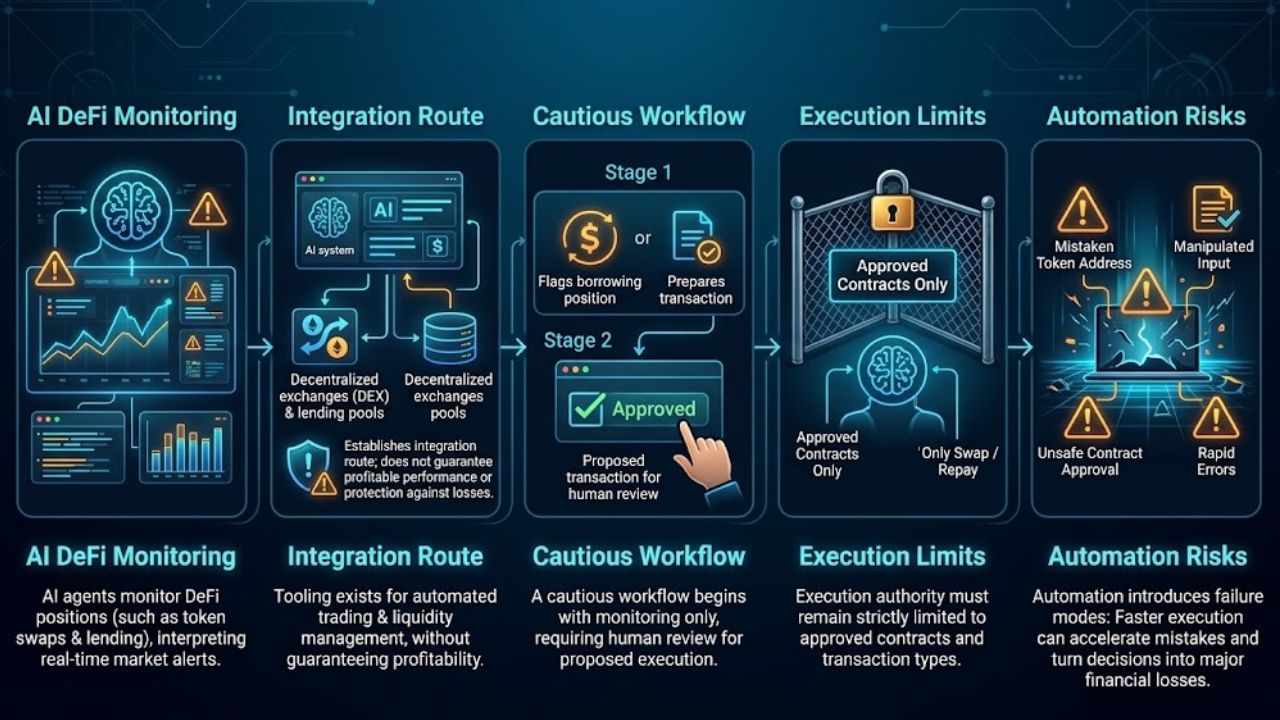
Decentralized finance, or DeFi, uses blockchain applications for activities such as token swaps and lending. AI agents could monitor positions, interpret alerts, and propose or execute transactions within a defined mandate.
For this application of blockchain and digital assets, Coinbase describes tooling for automated trading and liquidity management. That establishes an available integration route; it does not establish profitable performance or protection against losses.
A cautious workflow could begin with monitoring only. The software might flag a changing borrowing position or prepare a proposed transaction for human review. Execution authority could remain limited to approved contracts and transaction types.
Automation introduces its own failure modes. A mistaken token address, manipulated input, unsafe contract approval, or repeated retry can turn a bad decision into a financial loss. Faster execution can accelerate mistakes as readily as useful actions.
Teams assessing this use need to distinguish what requires AI interpretation from what a simpler rule can do. A fixed threshold alert may work perfectly well without a language model controlling funds.
7. Create Verifiable Records of Transactions and Deliverables
When several organizations share a workflow, each may need evidence of what was paid, submitted, or approved. A shared ledger could help them reconcile those events without relying entirely on one participant’s database.
Blockchain and digital assets could support records linking a task identifier, payment transaction, approval, and deliverable fingerprint. A cryptographic hash acts as a fingerprint of a particular file; comparing hashes can help detect whether that file changed.
Ethereum documents how smart contracts emit events that subscribing applications can process. An application could connect those events to its own task and approval records. This is a proposed workflow built on that capability.
The record has a limited meaning. It can help establish that a particular file matches a recorded fingerprint, but it cannot prove that the file’s claims were true. It also does not preserve the file unless a storage arrangement does so.
The privacy concerns discussed in crypto and blockchain trends matter here. Confidential documents should remain in appropriate storage; even public transaction metadata can reveal business relationships.
When Is a Blockchain Worth Adding?
The case is strongest when independent parties need a shared transaction record, compatible token-based access, or programmable settlement. A single company’s internal workflow may be easier to manage with ordinary billing and an access-controlled database.
| Situation | What to Evaluate First |
| One company controls the workflow | Existing APIs, billing, and internal logs |
| Independent providers sell metered services | Supported payment methods, total cost, and dispute handling |
| Several parties need to verify the same event | Shared records, privacy, and who supplies the evidence |
| A task requires judgment about quality | Validation criteria and an accountable reviewer |
Security controls also need to sit outside the model’s instructions. OWASP recommends limited tool permissions, independent authorization checks, and oversight for high-impact actions. Malicious instructions hidden in external content can redirect an assistant, so a wallet should reject unauthorized spending even when the model requests it.
Final Thoughts
AI agents could make blockchain and digital assets useful for specific jobs: buying a resource, proving an entitlement, or recording a transaction that several parties need to check. The value depends on solving one of those problems at an acceptable cost.
A sensible starting point is a narrow task with a small budget, enforced permissions, and a clear way to review results. Expand authority only after the workflow demonstrates reliable behavior. A successful transfer is one part of a completed task; someone still needs to be accountable for the outcome.
Frequently Asked Questions
Do AI Agents Need a Blockchain?
No. They can use ordinary APIs, databases, and payment services. Blockchain and digital assets become relevant when shared settlement, token-based access, or independently verifiable records solve a specific problem.
Can AI Agents Use Cryptocurrency Without a Dedicated AI Token?
Yes. A compatible wallet can use an asset accepted by the service. A separate project token is not inherently required; support depends on the payment system and network.
Does Paying for a Service Guarantee a Correct Result?
No. Payment confirmation and output quality are separate. Important results need validation, acceptance criteria, and a defined process for failures or disputes.
Can a Blockchain Record Prove an AI Answer Is True?
No. It can record a transaction or a fingerprint of submitted data. That does not establish the truth of the answer or the reliability of its sources.
Who Pays the Network Transaction Fees?
Depending on the setup, the wallet owner, service provider, or sponsor pays. A “gasless” experience shifts that cost; it does not eliminate the underlying fee.