

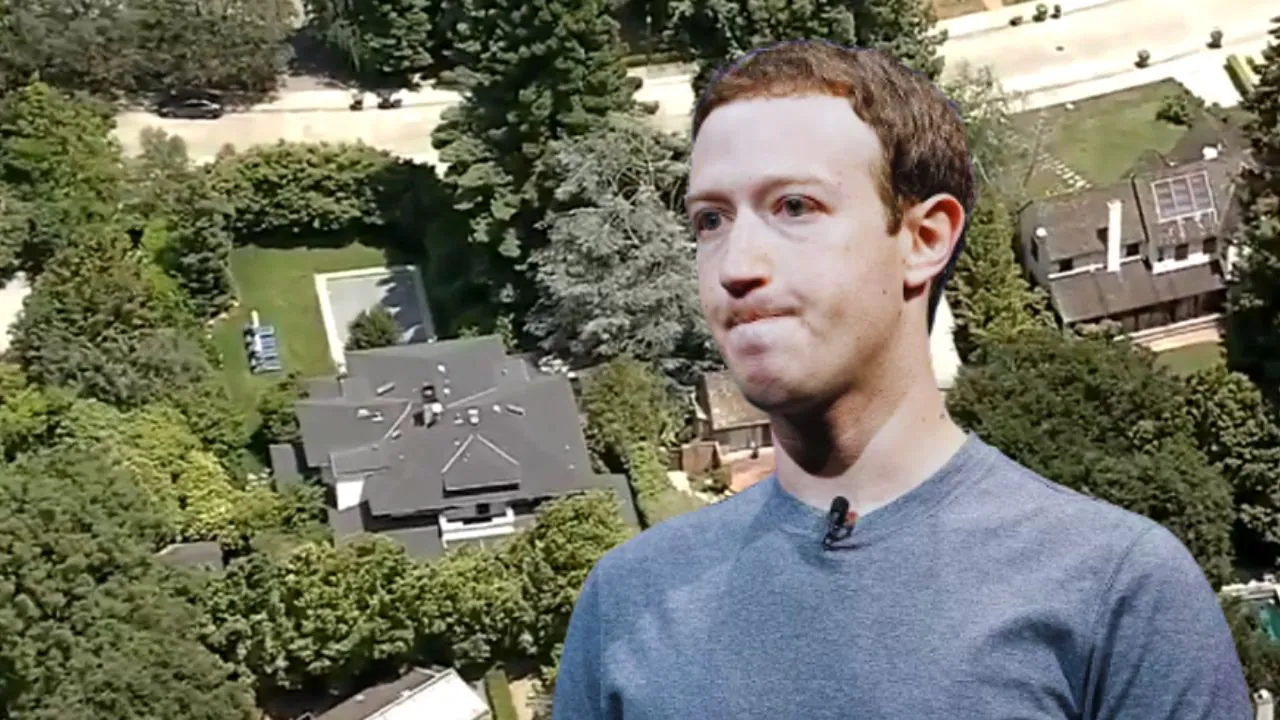
Mark Zuckerberg, the billionaire co-founder of Facebook and CEO of Meta, has been reshaping a once quiet neighborhood in Palo Alto’s Crescent Park for more than a decade. Since 2011, Zuckerberg and his wife Priscilla Chan have spent over $110 million to buy at least 11 properties along Edgewood Drive and Hamilton Avenue.
What was once a neighborhood of lawyers, professors, and executives has gradually turned into a semi-private zone dominated by Zuckerberg’s presence. Five homes have been merged into a single large compound, while others serve as guesthouses, storage, or remain empty despite the region’s severe housing shortage.
The compound now features private gardens, a hydrofloor swimming pool, a pickleball court, guest residences, and even a 7,000-square-foot underground facility. While described officially as “basements,” neighbors often call them “bunkers” or a “billionaire’s bat cave.”
Eight Years of Noise and Disruption
For nearby residents, the biggest problem has been the endless construction. Neighbors say they have lived with constant drilling, blocked driveways, dust, debris, and trucks for nearly eight years. Street closures have been frequent, and the presence of heavy construction vehicles has made commuting difficult for families living nearby.
Some of Zuckerberg’s properties have been temporarily used in controversial ways. At one point, a private micro-school for 14 children and six staff members operated on the grounds, raising zoning concerns since the properties were not originally approved for educational purposes.
Growing Tensions With the Community
Several neighbors have said their lives have been disrupted to the point where they no longer recognize their own community. Michael Kieschnick, a longtime resident whose home is surrounded on three sides by Zuckerberg’s acquisitions, described the feeling as living under “occupation.”
Other residents echo similar frustrations. They say security cameras monitor not only Zuckerberg’s homes but also parts of their properties. A regular private security presence, including patrols and guard vehicles, has added to the sense of surveillance and unease.
The issue isn’t only noise—it’s the character of the neighborhood itself, which has shifted from an open and communal setting into one dominated by walls, gates, and strict privacy.
Attempts to Smooth Relations: Headphones, Doughnuts, and Wine
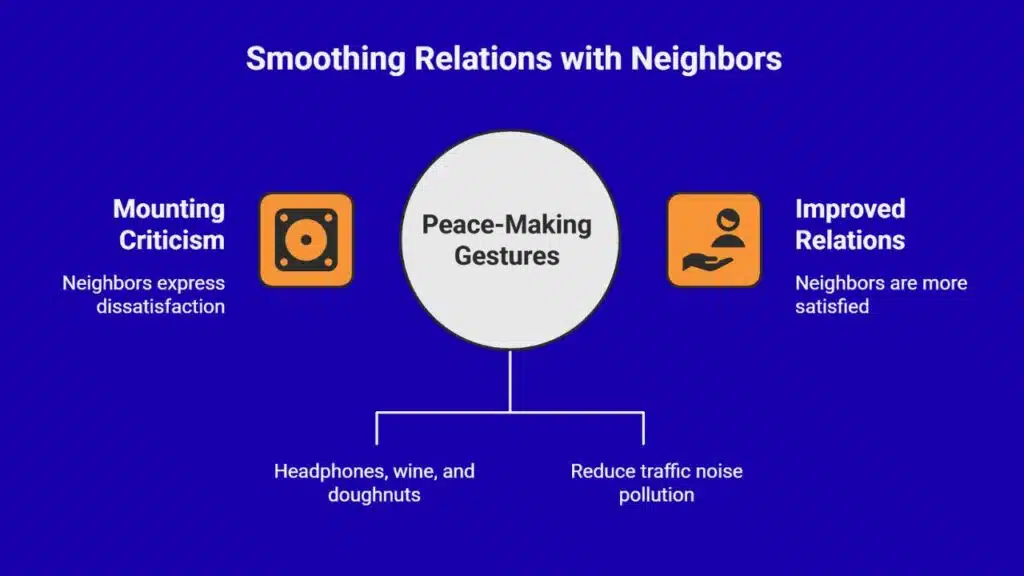
To address mounting criticism, Zuckerberg’s staff has at times tried to make peace. During periods of particularly loud construction, neighbors received gift baskets that included:
- Noise-canceling headphones
- Bottles of sparkling wine
- Boxes of Krispy Kreme doughnuts
The most recent gesture—the headphones—was seen as an acknowledgment of how disruptive the ongoing work has been. While some appreciated the thought, others felt the gesture highlighted the imbalance: rather than stopping the noise, Zuckerberg offered ways to block it out.
In addition, security teams have switched to electric cars to reduce traffic noise, a concession reportedly made after neighbor complaints.
Regulatory Battles and Zoning Loopholes
This is not Zuckerberg’s first clash with Palo Alto officials. In 2016, he proposed demolishing four homes and replacing them with smaller houses and massive basements as part of a unified compound. The city rejected that plan.
Instead, Zuckerberg has pursued a piecemeal approach—filing dozens of smaller renovation permits that add up to the same result without attracting the same level of scrutiny. To date, the city has reportedly approved at least 56 permits tied to his properties.
Some residents have also alleged that Zuckerberg’s team has attempted to buy their homes for well above market value—reportedly as much as $14.5 million for one house. Many, however, have refused to sell, preferring to stay despite the construction turmoil.
Not Just Palo Alto: Zuckerberg’s Property Controversies Elsewhere
The Palo Alto standoff isn’t isolated. Zuckerberg’s real estate projects in other regions have also sparked criticism:
- Hawaii (Kauai): He owns a 2,300-acre estate where reports surfaced of a 5,000-square-foot underground structure. Locals accused him of trying to wall off ancestral land, leading to protests and legal challenges. He has denied building a “doomsday bunker.”
- Lake Tahoe: In 2018, Zuckerberg purchased two large waterfront homes, raising concerns among residents about privacy and shoreline access.
- Washington, D.C.: He also owns a historic mansion, which underwent years of renovation that reportedly frustrated nearby homeowners.
These examples contribute to the perception that Zuckerberg’s personal projects often create friction with local communities.
Why the Headphones Story Resonates
The story of Zuckerberg gifting noise-canceling headphones resonates far beyond Palo Alto because it symbolizes the uneasy relationship between billionaires and local communities. While the headphones were a polite gesture, they also highlighted a broader reality: neighbors feel their lives have been disrupted for nearly a decade, while one man’s vision of privacy and security reshaped an entire neighborhood.
The issue goes beyond personal inconvenience. It raises questions about:
- Zoning laws and enforcement – Should cities allow piecemeal expansion that skirts original rejections?
- Housing equity – Is it ethical to hold multiple empty homes in a region facing a housing crisis?
- Power imbalance – What recourse do ordinary homeowners have when one individual wields immense financial and legal resources?
Mark Zuckerberg’s case in Palo Alto is a striking example of how wealth and urban living often collide. For neighbors, the frustration isn’t just about noise—it’s about watching their community slowly transformed into an extension of one billionaire’s private world.
The noise-canceling headphones may soften the blow, but they cannot mute the deeper debate: how far should the personal ambitions of the world’s richest individuals be allowed to reshape shared spaces?
The Information is Collected from Daily Mail and Yahoo.





















