

Local SEO used to sound simple. Claim your Google listing. Add your phone number. Get a few reviews. Mention your city. Wait for calls. That version of local search is gone. Today, a small business has to prove three things at once: it is relevant to the search, close enough to serve the customer, and trusted enough to deserve attention.
Google’s own local ranking guidance still centers on relevance, distance, and prominence, and it says complete, accurate Business Profile information helps Google better match a business to relevant local searches.
That is why effective local SEO tactics small business owners can use in 2026 need to go beyond old “GMB hacks.” Google My Business is now called Google Business Profile, but many business owners still search for GMB tactics because the old name stuck. The real strategy is not to game the profile. It is to make the business easier to understand, trust, compare, contact, visit, and choose.
That means your Google Business Profile matters. Reviews matter. Your website matters. Your service pages matter. Local citations matter. Photos, posts, products, links, schema, and measurement all matter too.
The small businesses that win local search are usually not the ones chasing tricks. They are the ones making every local signal clearer.
Why Local SEO Matters for Small Businesses
Local SEO is different from broad SEO because the customer is usually close to making a decision.
Someone searching “emergency plumber near me,” “best dentist in Queens,” “coffee shop open now,” or “roof repair Dallas” is not casually browsing. They are comparing nearby options, checking reviews, looking at photos, reading service details, and deciding whether to call, visit, book, or ask for a quote. That makes local SEO a visibility problem and a trust problem.
A business can rank well but lose the customer because the profile looks neglected. A business can have strong reviews but lose visibility because its category or service pages are weak. A business can have a beautiful website but lose local traffic because its name, address, phone number, hours, and service areas are inconsistent across the web.
Local SEO works best when all those pieces support each other.
BrightLocal’s January 2026 guide, summarizing the Whitespark 2026 Local Search Ranking Factors survey, reports that expert respondents weighted Google Business Profile signals as the largest Local Pack/Maps factor group at 32%, followed by reviews at 20%, on-page signals at 15%, behavioral signals at 9%, links at 8%, and citations at 6%. It also notes that the primary Google Business Profile category was rated the top individual Local Pack factor.
That is not Google’s official formula. It is an expert survey. But it lines up with what small businesses see every day: the profile, reviews, website, local authority, and customer behavior all have to work together.
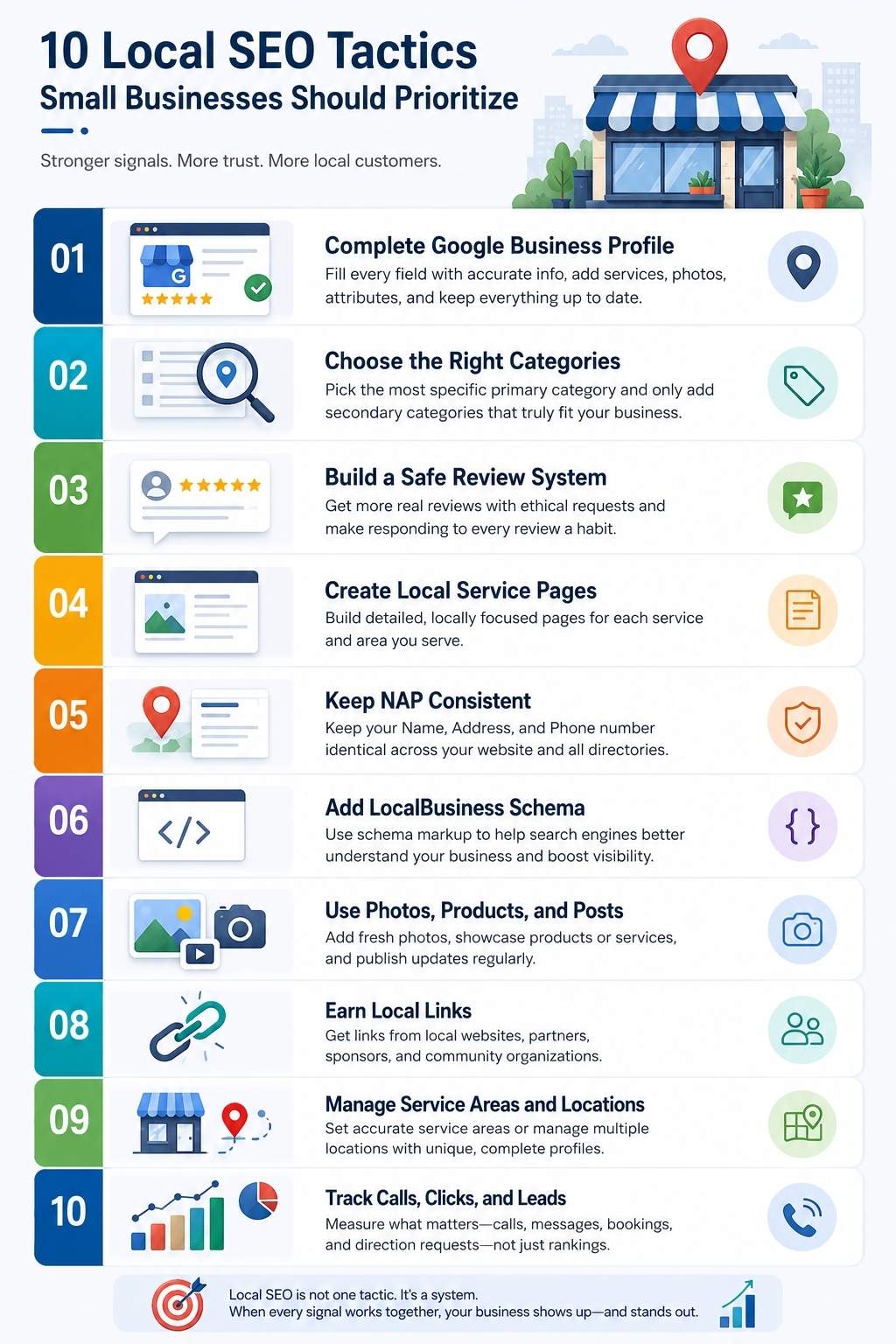
10 Local SEO Tactics Small Business Owners Should Prioritize
These tactics are arranged in a practical order. Start with the business profile and reviews, then strengthen the website, citations, local authority, and tracking.
1. Complete the Google Business Profile Properly
A complete Google Business Profile is still the foundation of local SEO.
This is where many customers first see your business name, address, phone number, hours, reviews, photos, services, booking options, products, questions, and updates. If the profile is incomplete, outdated, or confusing, customers may never reach your website.
Start with the basics: business name, address, phone number, website, hours, holiday hours, business category, service area, opening date where appropriate, accessibility details, attributes, products, services, appointment links, and photos. The important word is accurate.
Google says businesses with complete and accurate information are more likely to show in relevant local search results, and it specifically tells businesses to keep information such as physical address, phone number, category, and attributes updated.
Do not treat the profile as a keyword box. Treat it as the clearest public record of what your business is, where it serves, and how customers can act.
A small law firm should make practice areas clear. A plumber should list services accurately. A restaurant should keep hours and menus updated. A medical clinic should show appointment options and accessibility details. A retail store should add products where useful. A home service business should be clear about service areas and contact options.
Best for: Every local business, especially those that rely on calls, visits, bookings, or quote requests.
Why it works: A complete profile improves customer trust and gives Google clearer information to match the business with relevant searches.
What to avoid: Do not use a fake address, outdated hours, tracking numbers that break NAP consistency, keyword-stuffed names, or service areas you do not actually serve.
2. Choose the Right Primary and Secondary Categories
Your Google Business Profile category is one of the most important local relevance signals.
This is also where many small businesses make a costly mistake. They choose a broad category when a specific one fits better. Or they add too many categories because they assume more categories mean more rankings.
Google says categories should describe what the business is, not every product or service it sells. Google also advises businesses to use as few categories as possible, choose categories that are specific but representative, and avoid using categories purely as keywords.
That means a “personal injury attorney” should usually choose the most specific legal category that reflects the actual business. A “pizza restaurant” should not choose every food-related category nearby. A “roofing contractor” should not add unrelated home service categories just to appear in more searches.
The primary category matters most. Secondary categories can help, but only when they truly describe the business.
A good way to choose categories is to look at your core revenue-driving service, compare real competitors ranking in your area, and then choose the category that best describes your business type. After that, add only the secondary categories that genuinely fit.
Best for: Businesses in competitive local markets where category precision can change visibility.
Why it works: Categories help Google understand what type of business you are and which searches you should match.
What to avoid: Do not use categories as keyword stuffing. Do not add unrelated categories. Do not change categories constantly without tracking the effect.
3. Build a Review System Without Breaking Policy
Reviews influence both ranking and conversion. Google says review count and review score can factor into local ranking, and it encourages businesses to ask customers for reviews and respond to them. But the way you ask matters. A good review system should be steady, ethical, and easy for real customers.
Ask after a completed service, purchase, visit, appointment, or successful delivery. Use a simple review link or QR code. Train staff to ask naturally. Add the request to follow-up emails, receipts, SMS workflows, or thank-you pages where appropriate. Reply to both positive and negative reviews with context and professionalism.
Do not offer discounts, gifts, cash, loyalty points, or special treatment in exchange for reviews. Do not ask only happy customers. Do not discourage negative reviews. Do not pressure customers while they are physically at your location. Google’s Maps policy prohibits fake engagement and rating manipulation, including incentivized or biased reviews.
The legal risk is now bigger too. The FTC’s Consumer Reviews and Testimonials Rule went into effect on October 21, 2024, and addresses deceptive review practices, with civil penalties available for knowing violations.
The safest review strategy is simple: ask every real customer at the right moment, make the process easy, and never manipulate the outcome.
Best for: Any business where trust affects decisions, including restaurants, clinics, contractors, salons, lawyers, dentists, agencies, repair shops, and local services.
Why it works: Real reviews improve trust, support prominence, and help customers choose between similar local options.
What to avoid: No fake reviews, no review swaps, no employee reviews, no incentives, no review gating, and no “only leave us five stars” language.
4. Create Dedicated Local Service Pages
Your Google Business Profile can help you appear in Maps, but your website still matters. Local service pages help you rank for specific services, neighborhoods, cities, and customer problems. They also give customers the detail they need before contacting you.
A strong local service page should explain the service clearly, show where you provide it, answer common questions, include trust signals, mention pricing factors if possible, show real photos or examples, include internal links, and make the next step obvious.
For example, a roofing company should not rely on one generic “Services” page. It may need pages for roof repair, roof replacement, emergency leak repair, flat roofing, storm damage repair, and commercial roofing. Each page should explain the actual service, not just swap city names into the same paragraph.
BrightLocal’s 2026 local ranking guide lists a dedicated page for each service as the top local organic factor in its expert-survey summary, along with geographic keyword relevance, quality links, internal linking, and relevant product or service keywords across the website.
That does not mean you should create thin doorway pages for every suburb. It means each page should be useful enough for a real customer.
Best for: Contractors, clinics, law firms, home services, agencies, repair businesses, local consultants, and multi-service companies.
Why it works: Dedicated pages help search engines and customers understand exactly what you offer in a specific local context.
What to avoid: Do not publish dozens of nearly identical city pages with only the location name changed. Those pages look weak to customers and risky to search engines.
5. Keep NAP and Citations Consistent
NAP stands for name, address, and phone number. It sounds basic, but old addresses, duplicate listings, wrong phone numbers, inconsistent business names, and mismatched hours can create confusion across Google, directories, maps, social profiles, industry platforms, and AI-driven local discovery tools.
Citations are mentions of your business information across the web. They may appear on directories, chamber of commerce websites, Yelp, Apple Maps, Bing Places, Facebook, industry directories, local blogs, supplier pages, sponsorship pages, and niche platforms.
Citations are not the dominant local SEO lever they were years ago, but they still support trust and consistency. BrightLocal’s 2026 guide gives citations 6% of Local Pack/Maps factor weight and 7% of local organic factor weight in its expert survey, and it emphasizes that consistency matters for local business information.
Start with the major platforms first. Fix Google Business Profile, Apple Maps, Bing Places, Facebook, Yelp if relevant, industry directories, and any local chamber or association profiles. Then clean up duplicates and old addresses.
For service-area businesses, be extra careful. If you hide your address on Google because customers do not visit you, do not scatter a home address across random directories.
Best for: Businesses that moved, rebranded, changed phone numbers, opened new locations, or have old directory listings online.
Why it works: Consistent business information reduces confusion and reinforces trust across the local web.
What to avoid: Do not create fake office locations, virtual office listings, duplicate profiles, or inconsistent tracking numbers without a clear system.
6. Add LocalBusiness Schema and Fix Technical Basics
LocalBusiness schema can help search engines understand your business details, but it is not a magic ranking switch.
Structured data can clarify information such as business type, address, opening hours, phone number, department details, and other local business information when implemented correctly. Google’s LocalBusiness structured data documentation explains how local business markup can help Google understand business details for Search. Schema works best when the rest of the page is already solid.
That means your site should load quickly, work well on mobile, use clear title tags and headings, include crawlable service content, show accurate NAP details, include internal links, and make calls or booking actions easy. A small business website does not need to be complicated. It needs to be clear.
Each important page should answer basic customer questions:
- What do you do?
- Where do you do it?
- Who is it for?
- Why should someone trust you?
- What happens next?
- How can they call, book, visit, or request a quote?
Technical SEO supports those answers. It does not replace them.
Best for: Any business with a website, especially local service businesses, clinics, restaurants, stores, agencies, and multi-location brands.
Why it works: Schema and technical SEO help search engines understand the business while improving user experience.
What to avoid: Do not add fake review schema, incorrect business types, hidden content, or markup that does not match what users can see on the page.
7. Use Photos, Products, Services, and Posts to Improve Conversions
Photos and posts are often misunderstood in local SEO. They are not magic ranking buttons. They are customer decision tools.
Google says businesses can personalize their free Business Profile with photos, offers, posts, and more, and that posts can share announcements, offers, updates, and event details directly with customers on Search and Maps. That matters because local customers judge quickly.
A restaurant with updated food and interior photos feels more trustworthy. A dentist with clear office photos feels less intimidating. A contractor with real before-and-after project photos feels more credible. A store with product images helps customers decide whether to visit. A salon with current style photos gives people confidence. A clinic with accurate hours and appointment links reduces friction.
Use photos to show the real business. Use services to explain what you offer. Use products where they help buyers. Use posts for seasonal offers, events, announcements, new services, emergency updates, or timely promotions.
Do not upload generic stock images and expect customers to care. Local search is trust-heavy. Real photos usually win.
Best for: Restaurants, retail, salons, clinics, gyms, home services, event venues, auto services, and local professional businesses.
Why it works: Better profile assets can improve trust, engagement, and conversion from local search visibility.
What to avoid: Do not treat posts or geo-tagged photos as guaranteed ranking hacks. Use them to help customers choose.
8. Earn Local Links and Real-World Mentions
Prominence is not built only inside Google Business Profile. Google’s local ranking guidance includes prominence as a key local ranking concept, and BrightLocal’s 2026 guide discusses backlinks, reviews, listings, social mentions, and online references as signals that can support local prominence. For a small business, the best local links usually come from real community relationships.
Think about local chambers of commerce, business associations, sponsorships, charities, schools, local newspapers, neighborhood blogs, podcasts, suppliers, partner businesses, professional organizations, event pages, local guides, and industry directories.
A local bakery might get mentioned in a city food guide. A contractor might sponsor a youth sports team. A dentist might contribute to a local school health event. A law firm might publish a useful local legal resource that earns citations from community organizations. A gym might partner with a local wellness event. A florist might appear on wedding venue vendor lists.
The best local links do not feel like SEO tricks. They feel like proof that the business actually exists in the community.
Best for: Established small businesses, local service providers, professional firms, retail stores, restaurants, and community-facing brands.
Why it works: Local links and mentions support prominence and can send referral traffic from relevant local audiences.
What to avoid: Do not buy spam links, join irrelevant link farms, or chase high-volume guest posting that has nothing to do with your area or industry.
9. Handle Service-Area and Multi-Location SEO Carefully
Service-area and multi-location businesses have extra local SEO risks. A service-area business may visit customers at their homes or workplaces without receiving customers at a storefront. Examples include plumbers, roofers, cleaners, electricians, landscapers, mobile mechanics, and home healthcare providers. These businesses need accurate service areas and honest location settings.
Do not use fake addresses just to rank in more cities. Do not create profiles for places where you do not have real eligible locations. Do not create thin city pages that say the same thing with a different city name.
Multi-location businesses need a different approach. Each real location should have its own accurate Google Business Profile, unique location page, local phone number where appropriate, correct hours, local photos, reviews tied to that branch, and clear internal links.
A good location page should include more than a map and address. It should show services at that branch, parking or access details, local staff if appropriate, photos, nearby landmarks, reviews, FAQs, and a clear call to action.
The goal is to help customers choose the right location or service area without misleading search engines.
Best for: Home service companies, healthcare groups, franchises, restaurants, retail chains, agencies, multi-office firms, and local brands expanding into new markets.
Why it works: Accurate location and service-area signals help Google and customers understand where the business truly operates.
What to avoid: Fake offices, duplicate profiles, shared virtual addresses, doorway pages, and copy-paste location pages.
10. Track Calls, Directions, Clicks, Rankings, and Leads
Local SEO should not be measured only by one keyword ranking. Local results change by distance, device, search history, time of day, business hours, competition, and map location. A business may rank well near its office and poorly five miles away. It may rank differently when open versus closed. It may get more leads from “emergency repair” than from the broad keyword the owner checks every morning.
Google Business Profile Performance lets owners and managers see views, clicks, and customer interactions from Search and Maps over a selected date range. Google Search Console can also help measure the website side: queries, impressions, clicks, pages, and search performance.
Track the actions that matter:
- Calls
- Website clicks
- Direction requests
- Booking clicks
- Messages
- Form fills
- Quote requests
- Local landing page traffic
- Search terms from GBP
- Review growth and response rate
- Rankings from different map grid points
- Leads by service and location
Use UTM tags on your Google Business Profile website link so traffic is easier to separate in analytics. Use call tracking carefully if you understand how to preserve NAP consistency. Track leads by source when possible.
The point is not to drown in dashboards. The point is to know which local SEO tactics bring actual customers.
Best for: Every small business investing time or money into local SEO.
Why it works: Measurement keeps local SEO tied to calls, bookings, visits, and revenue instead of vanity rankings.
What to avoid: Do not obsess over one “near me” keyword checked from one phone in one location. Local ranking is geographic.
Quick Comparison: 10 Local SEO Tactics for Small Business
| Local SEO Tactic | Main Goal | Best For |
| Complete the Google Business Profile | Improve relevance and customer trust | Every local business |
| Choose the right GBP categories | Match the correct searches | Service businesses, clinics, stores, contractors |
| Build a policy-safe review system | Improve trust and prominence | Reputation-driven businesses |
| Create local service pages | Rank for specific services and locations | Service-area and multi-service businesses |
| Keep NAP and citations consistent | Reduce confusion across the web | Businesses with old or scattered listings |
| Add LocalBusiness schema and technical basics | Help search engines understand business details | Businesses with a website |
| Use photos, products, services, and posts | Improve customer decisions | Retail, restaurants, home services, clinics |
| Earn local links and mentions | Build real-world prominence | Established local businesses |
| Handle service-area and multi-location SEO carefully | Avoid duplicate or misleading pages | SABs and brands with multiple branches |
| Track calls, directions, clicks, and leads | Measure what actually works | Every business investing in local SEO |
A Simple 30-Day Local SEO Plan
In the first week, fix the Google Business Profile. Confirm the business name, category, address or service area, phone number, website, hours, services, products, photos, attributes, and appointment links.
In the second week, work on reviews. Create a policy-safe review request process, train staff, build a direct review link or QR code, and reply to existing reviews.
In the third week, improve the website. Create or update the most important service page, add local details, improve title tags and headings, add internal links, check mobile usability, and make calls or forms easy.
In the fourth week, clean up citations and tracking. Fix major directory inconsistencies, add UTM tags, check GBP Performance, review Search Console data, and decide which calls, clicks, bookings, or leads you will measure monthly.
This is enough to create momentum without overwhelming a small team.
Common Local SEO Mistakes to Avoid
- Keyword-stuffing the business name. Google says the business name should reflect the real-world name used on signage, stationery, and branding. Using extra city or service keywords in the name can create suspension risk and customer confusion.
- Chasing reviews the wrong way. Incentives, fake reviews, selective requests, and pressure can violate platform policy and may create legal risk.
- Treating Google Posts as the whole strategy. Posts can help customers see offers and updates, but they cannot replace categories, reviews, service pages, citations, and local authority.
- Creating thin city pages. If a location page does not help a real customer, it probably does not deserve to exist.
- Ignoring the website because the Google profile gets more attention. GBP may drive the first impression, but many customers still click through before deciding.
- Measuring rankings without leads. A better rank is only useful if it brings better calls, bookings, visits, or sales.
Wrapping Up
Local SEO for small businesses is not one trick. It is the combined work of making your business clearer, more trustworthy, more locally relevant, and easier to choose.
Start with the Google Business Profile. Choose the right categories. Build a real review system. Create useful local service pages. Keep NAP and citations consistent. Add schema and technical basics. Use photos, products, services, and posts to help customers decide. Earn local links and mentions. Handle service areas and multiple locations honestly. Track the actions that lead to revenue.
The best local SEO tactics small business owners can use are not shortcuts. They are proof signals that your business is real, customers trust you, services match the search, you serve the area, contacting you is easy. That is what local ranking is really about.
Frequently Asked Questions About Local SEO Tactics Small Business Owners Should Use
1. What are the best local SEO tactics for small businesses?
The best local SEO tactics for small businesses include optimizing the Google Business Profile, choosing accurate categories, collecting real reviews, building local service pages, keeping NAP consistent, adding LocalBusiness schema, using photos and posts, earning local links, managing service areas properly, and tracking calls and leads.
2. Are GMB tactics still relevant?
Yes, but the current name is Google Business Profile, not Google My Business. Many people still say GMB tactics, but the strategy should focus on accurate profile information, categories, reviews, photos, services, posts, and customer actions rather than outdated hacks.
3. How do reviews help small business local ranking?
Google says review count and review score can influence local ranking, and reviews also help customers decide whether to call, visit, or book. The safest approach is to ask real customers for honest reviews, respond professionally, and avoid incentives or review gating.
4. How many local service pages should a small business create?
A small business should create service pages for its main services, especially when each service has different customer needs, questions, pricing factors, or local search demand. The pages should be genuinely useful, not thin copies with only the city name changed.
5. Do citations still matter for local SEO?
Citations still matter, but they are not the only local SEO factor. Consistent business information across major directories, maps, social profiles, and industry platforms helps reduce confusion and supports local trust. Citations are especially important when a business has moved, rebranded, or changed phone numbers.
6. How long does local SEO take for a small business?
Local SEO timing depends on competition, location, business age, reviews, website quality, citations, and profile strength. Some fixes, such as correcting hours or adding services, can help quickly. Bigger gains from reviews, local pages, links, and authority usually take months of consistent work.





















