Local SEO looks simple from the outside: claim your profile, get reviews, add photos, and wait for phone calls. Reality is messier. Your rankings can change street by street, your Google Business Profile can be edited by someone else, reviews can make or break trust, and inconsistent listings can quietly confuse customers before they ever visit your website.
That is why the best local SEO tools matter. The right platform helps you manage local visibility, track map rankings, monitor reviews, audit listings, improve your Google Business Profile, and understand where competitors are beating you. This list compares local SEO software for small businesses, agencies, franchises, service-area businesses, and multi-location brands.
Our Selection Criteria
A local SEO tool should not only show where you rank. It should help you understand why visibility changes, what needs attention, and which actions can realistically improve calls, directions, bookings, and visits.
| Criteria | What We Looked For |
|---|---|
| Google Business Profile support | Ability to manage, audit, optimize, or monitor GBP activity |
| Local rank tracking | Map pack, Google Maps, local organic, grid tracking, mobile, and location-level tracking |
| Listings and citations | NAP consistency, citation discovery, listing distribution, and duplicate management |
| Review management | Review monitoring, response workflows, sentiment checks, and reputation support |
| Reporting | Clear dashboards, client reports, multi-location reporting, and historical visibility trends |
| Best-fit user | Whether the tool suits local businesses, agencies, franchises, enterprises, or beginners |
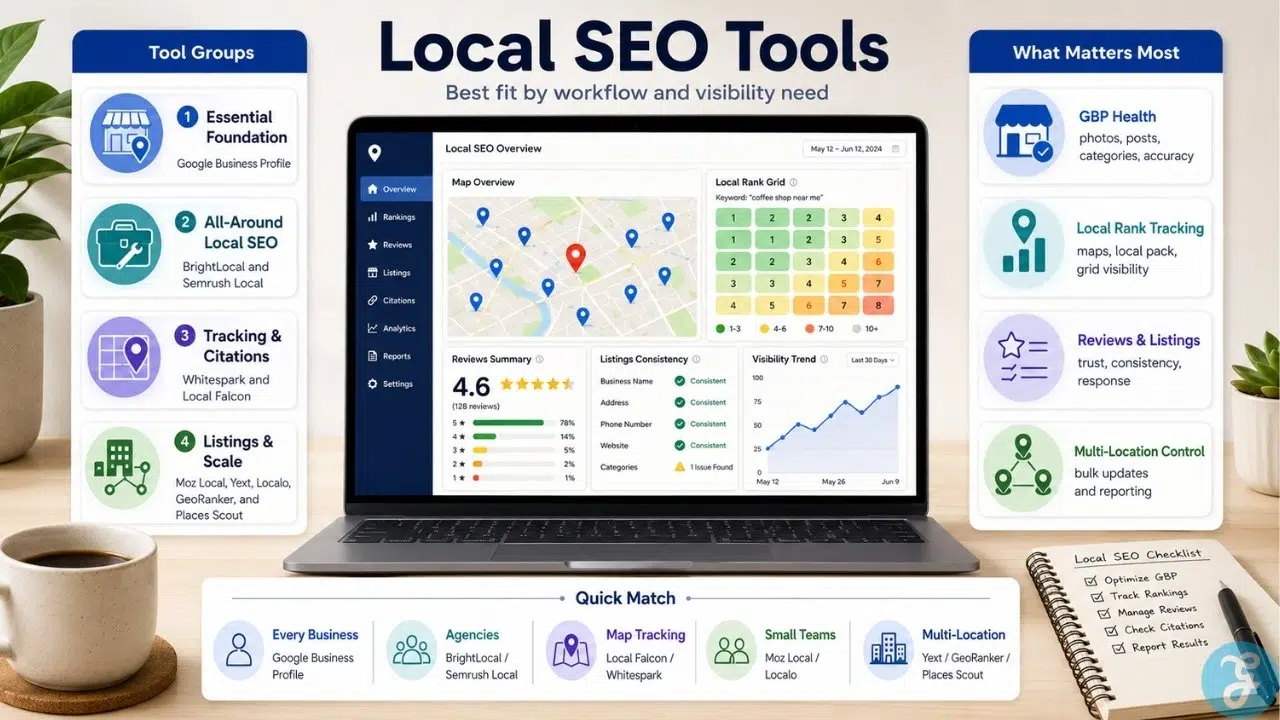
The ranking below focuses on practical usefulness. Some tools are strongest for map-grid tracking. Others are better for listings, review management, Google Business tools, agency reporting, or multi-location control.
Whom This Is For
This guide is for local businesses, SEO agencies, consultants, franchises, restaurants, clinics, home service companies, retail brands, and multi-location teams that want better local visibility. It is especially useful if you need to compare tools before paying for local rank tracker features, listing management, or review workflows.
If you only manage one small business, you may not need a large enterprise platform. But if local visibility drives calls, appointments, directions, bookings, or walk-ins, the right tool can quickly become less of a cost and more of a control system.
10 Best Local SEO Tools for Rankings, Listings, and Reviews
Before choosing from this list, remember that local SEO has several moving parts. A tool that is excellent for Google Maps ranking grids may not be the best tool for listings. A listings platform may not be the best tool for competitor map tracking.
1. Google Business Profile
Google Business Profile is the foundation of local SEO because it controls how a business appears across Google Search and Google Maps. It lets businesses manage key information such as address, hours, phone number, website, photos, posts, services, products, reviews, and performance insights. It is not a full local SEO software suite, but no local SEO workflow should skip it. It ranks first because every other local tool depends on the accuracy, activity, and health of your Google Business Profile.
Best Feature/For:
- Best for every local business that wants visibility on Google Search and Maps.
- Strong for managing business information, reviews, photos, posts, and basic performance insights.
Why We Chose It:
- It is the core platform customers see before visiting your website.
- Free access makes it essential even for small businesses with no SEO budget.
- It supports direct customer actions such as calls, directions, bookings, and messages.
- Profile completeness, accuracy, and activity affect local visibility and trust.
Things to consider:
- It does not replace a dedicated local rank tracker or listings platform.
- Businesses still need ongoing review, photo, post, and accuracy management.
2. BrightLocal
BrightLocal is one of the most complete local SEO platforms for agencies, consultants, and businesses that need rankings, citations, audits, reviews, and reporting in one place. It helps users track local rankings, audit citations, monitor reviews, connect Google Business Profile insights, and create reports for clients or internal teams. Its strength is balance: it covers many local SEO needs without feeling as enterprise-heavy as some larger location marketing platforms. It ranks second because it is one of the most practical all-around choices for local SEO work.
Best Feature/For:
- Best for agencies, consultants, and local businesses that need a complete local SEO workflow.
- Strong for rankings, citations, reviews, audits, GBP insights, and white-label reporting.
Why We Chose It:
- Covers the core local SEO jobs most teams actually need.
- Useful for managing multiple clients or locations.
- Citation and review tools make it more than a simple rank tracker.
- Reporting features are helpful for proving progress to clients and stakeholders.
Things to consider:
- Single-location businesses may not need every feature.
- Users who only need map-grid rank tracking may prefer a more specialized tracker.
3. Semrush Local
Semrush Local is a strong choice for teams that want local SEO tools connected to a broader SEO and marketing ecosystem. It includes local listing management, review management, and Map Rank Tracker features that help businesses understand visibility around specific areas. This is especially useful for teams already using Semrush for keyword research, technical SEO, rank tracking, content, or competitor analysis. It ranks third because it combines local visibility work with broader SEO campaign intelligence.
Best Feature/For:
- Best for marketers and agencies already using Semrush.
- Strong for map-rank heatmaps, listings, reviews, and broader SEO workflow integration.
Why We Chose It:
- Map Rank Tracker helps visualize ranking differences across local areas.
- Local listing and review tools support day-to-day visibility management.
- Works well when local SEO is part of a larger SEO strategy.
- Useful for agencies that want fewer separate platforms.
Things to consider:
- It may be more platform than a small business needs.
- Local specialists may still use dedicated tools for deeper citation or grid tracking work.
4. Whitespark
Whitespark is a respected local SEO platform especially known for local rank tracking, citation discovery, and local search research. Its Local Rank Tracker helps monitor Google local pack, Maps, and organic rankings across devices and specific locations. Its Local Citation Finder is useful for discovering where competitors are listed and finding realistic citation opportunities. It ranks fourth because it remains one of the strongest choices for local SEOs who care about citations and accurate local ranking visibility.
Best Feature/For:
- Best for local SEO specialists, agencies, and citation-focused campaigns.
- Strong for local rank tracking, citation discovery, and competitor citation research.
Why We Chose It:
- Strong local rank tracker features for Maps, local pack, and organic visibility.
- Citation research helps find practical listing opportunities.
- Good fit for agencies managing location-specific SEO.
- Useful for understanding visibility beyond a single broad ranking number.
Things to consider:
- It may feel more specialist than beginner-friendly all-in-one platforms.
- Review management and broader marketing workflows may require additional tools.
5. Local Falcon
Local Falcon is a strong local rank tracker for businesses and agencies that want to understand Google Maps visibility across a geographic grid. Instead of showing one average ranking, it helps reveal how rankings change by searcher location. That matters because a business can rank well near its address but poorly just a few streets away. It ranks fifth because map-grid tracking is now one of the clearest ways to diagnose real local visibility.
Best Feature/For:
- Best for Google Maps grid tracking and local visibility diagnostics.
- Strong for agencies, service-area businesses, franchises, and competitive local markets.
Why We Chose It:
- Shows ranking performance across a real local area, not one generic location.
- Helps identify weak zones where visibility drops.
- Useful for competitor comparisons and local coverage analysis.
- Great for explaining map rankings visually to clients.
Things to consider:
- It is more focused on tracking than full local SEO management.
- You may still need separate tools for listings, reviews, and GBP optimization.
6. Moz Local
Moz Local is useful for businesses that want cleaner local listings and reputation management without building a complicated local SEO stack. It focuses on managing business listings, improving consistency, and helping businesses maintain accurate local presence across important platforms. Moz Local is especially appealing to small businesses and marketers who want a familiar SEO brand with a simpler local workflow. It ranks sixth because it is approachable and useful for listing accuracy, even if it is not the deepest local rank tracking platform.
Best Feature/For:
- Best for small businesses and marketers focused on listing consistency.
- Strong for local listings, duplicate management, reputation workflows, and simpler local SEO maintenance.
Why We Chose It:
- Easy to understand for users who do not want complex local dashboards.
- Helps keep business information consistent across local platforms.
- Useful for small teams that need basic local SEO structure.
- Good fit for businesses already familiar with Moz tools.
Things to consider:
- Advanced local rank tracking may require another tool.
- Larger agencies may want deeper reporting, grid tracking, or multi-location controls.
7. Yext
Yext is a strong enterprise-level platform for brands that need centralized control over business information across many listings, maps, search engines, voice assistants, and digital services. It is especially relevant for multi-location businesses where wrong hours, addresses, phone numbers, or category information can create customer friction at scale. Yext is less of a simple local rank tracker and more of a location information management system. It ranks seventh because it is powerful for enterprise listing control, but it may be too much for smaller businesses.
Best Feature/For:
- Best for multi-location brands, franchises, and enterprises.
- Strong for centralized listing management, location data control, and large-scale presence management.
Why We Chose It:
- Helps manage business information across a wide local ecosystem.
- Strong fit for brands with many locations and frequent updates.
- Reduces the risk of inconsistent business data across platforms.
- Useful for teams that need operational control, not just SEO reports.
Things to consider:
- It may be expensive or excessive for single-location businesses.
- Local rank tracking and hands-on SEO analysis may require complementary tools.
8. Localo
Localo is a focused local SEO software platform built around Google Business Profile optimization, local ranking checks, reviews, audits, and reporting. It is especially useful for small businesses, freelancers, and agencies that want a guided workflow rather than a giant technical dashboard. Localo also leans into automation and AI-assisted recommendations, which can help less technical users understand what to improve. It ranks eighth because it is approachable, GBP-focused, and practical for users who want action steps.
Best Feature/For:
- Best for small businesses, freelancers, and agencies that want guided GBP optimization.
- Strong for local rank checks, GBP audits, review workflows, and local SEO tasks.
Why We Chose It:
- Focuses closely on Google Business Profile visibility.
- Helpful for users who want clear next steps rather than raw local SEO data.
- Useful free and paid tools support quick checks and ongoing improvement.
- Good option for businesses that want simpler local SEO execution.
Things to consider:
- Advanced agencies may need deeper multi-location reporting or grid tracking.
- It is more GBP-centered than broad enterprise listing management platforms.
9. GeoRanker
GeoRanker is useful for teams that need location-based SEO research, local rank tracking, and geo-specific data across many areas. It is a good fit for agencies, franchises, and businesses that care about how search results vary by country, city, or specific market. GeoRanker’s value is in making local search less abstract by showing performance across different geographic contexts. It ranks ninth because it is strong for geo-data workflows, though not always as mainstream as BrightLocal or Semrush Local.
Best Feature/For:
- Best for geo-specific local SEO research and multi-location visibility checks.
- Strong for agencies, franchises, and businesses comparing local markets.
Why We Chose It:
- Helpful for understanding search visibility across different locations.
- Useful for local keyword and competitor research.
- Good fit for teams managing multiple markets or franchises.
- API and scaling options can support more technical local SEO workflows.
Things to consider:
- It may feel more technical than beginner-focused local tools.
- Businesses wanting review and citation management may need additional software.
10. Places Scout
Places Scout is a local SEO analysis platform designed for agencies and enterprise teams that want deeper competitive and location-level intelligence. It can support automated local SEO analysis and business-level data gathering, which is useful when standard local reports do not provide enough detail. Places Scout is especially relevant for teams that want to investigate competitors, ranking factors, local opportunities, and performance signals across many data points. It ranks tenth because it is powerful, but better suited to serious local SEO operators than casual users.
Best Feature/For:
- Best for agencies and advanced local SEO teams.
- Strong for local SEO analysis, competitor research, and deeper business-level data.
Why We Chose It:
- Provides deeper local SEO intelligence than basic checkers.
- Useful for agencies that need more than simple listings and review monitoring.
- Helps investigate local competitors and visibility patterns.
- Good fit for advanced workflows where detail matters.
Things to consider:
- It may be too advanced for small businesses looking for simple guidance.
- Users may need local SEO experience to get the most value from it.
A Quick Overview
The main difference between these tools is not whether they help with local SEO. The difference is which local SEO problem they solve best: rankings, listings, reviews, Google Business tools, citations, map grids, or enterprise location control.
Here is a faster way to compare the tools by practical fit rather than feature overload.
| Rank | Tool | Best For | Main Strength | Biggest Limitation |
| 1 | Google Business Profile | Every local business | Core Search and Maps presence | Not a full SEO suite |
| 2 | BrightLocal | Agencies and local businesses | All-around local SEO workflow | May be more than a tiny business needs |
| 3 | Semrush Local | Semrush users and marketers | Map tracking plus broader SEO integration | Can feel complex for beginners |
| 4 | Whitespark | Local SEO specialists | Rank tracking and citation discovery | More specialist than generalist |
| 5 | Local Falcon | Map visibility analysis | Grid-based Google Maps tracking | Not a full local SEO platform |
| 6 | Moz Local | Small businesses | Listing consistency and reputation basics | Limited advanced rank tracking |
| 7 | Yext | Enterprises and franchises | Centralized listing control | Too much for many small businesses |
| 8 | Localo | Small teams and freelancers | Guided GBP optimization | Less enterprise-focused |
| 9 | GeoRanker | Multi-location research | Geo-specific local SEO data | More technical workflow |
| 10 | Places Scout | Advanced agencies | Deep local SEO analysis | Not beginner-first |
This is why tool choice should follow your local SEO problem. A dentist trying to improve one Google profile does not need the same software as a franchise managing 300 locations.
Our Top 3 Picks and Why?
A top-three view is useful here because local SEO tools can overlap, but their best use cases are very different.
| Pick | Best Match | Why It Stands Out |
| Google Business Profile | Best essential free tool | Controls the business presence customers see on Google Search and Maps |
| BrightLocal | Best all-around local SEO platform | Covers rankings, citations, reviews, audits, GBP insights, and reporting |
| Semrush Local | Best for integrated SEO teams | Connects local rankings, listings, reviews, and broader SEO workflows |
Google Business Profile is non-negotiable because it is the source of truth for Google’s local surface. BrightLocal is the best practical all-around platform for most local SEO teams. Semrush Local is the strongest fit when local SEO is part of a wider SEO and marketing system.
How to Choose the Right Local SEO Tool for Your Business
Choosing the right local SEO tool starts with one honest question: what is currently hurting visibility the most? Some businesses have weak Google Business Profiles. Others have inconsistent listings, poor reviews, no ranking visibility, or no idea how far their map presence actually reaches.
The Selection Framework
- Start with the core problem: Choose GBP-focused tools for profile optimization, citation tools for listing consistency, and map-grid tools for local ranking visibility.
- Match the tool to business size: A single-location shop needs simplicity, while franchises need bulk controls, reporting, and listing governance.
- Look for review workflows: Reviews affect trust and conversion, so review monitoring and response tools matter for most local businesses.
- Check reporting clarity: Agencies and multi-location teams need reports that explain calls, rankings, visibility, and local progress without confusing clients.
The right local stack may include more than one tool. For example, a local agency might use Google Business Profile for profile management, BrightLocal for reporting and citations, and Local Falcon for map-grid ranking diagnostics.
The Final Checklist
Before choosing local SEO software, run through these five checks:
- Does it help manage or improve Google Business Profile visibility?
- Can it track local rankings by location, device, map area, or keyword?
- Does it support listings, citations, reviews, or reputation workflows?
- Can you understand what to fix next without digging through confusing reports?
- Does the pricing make sense for your number of locations, clients, and local search goals?
If a tool cannot help you take action, it is not enough. Local SEO is not about collecting dashboards; it is about helping nearby customers find, trust, and choose the business.
Local SEO Is Getting More Local, Not Less
The uncomfortable truth is that local SEO is not becoming easier. Google Maps results can change block by block. Reviews carry real trust weight. Spam listings still distort some local markets. AI answers, map interfaces, and zero-click behavior are making the business profile even more important than the website in many local journeys.
That means the best local SEO tools will matter more, not less. Businesses need visibility tracking, review discipline, profile accuracy, local content, listing consistency, and competitive intelligence working together. One neglected profile can cost real calls. One wrong address can break trust. One weak review pattern can send customers to a competitor.
My practical view is simple: start with Google Business Profile, then add tools based on your biggest bottleneck. Do not buy enterprise local SEO software because it looks impressive. Buy the tool that helps you fix the local visibility problem that is costing you customers right now.
Frequently Asked Questions (FAQs) About Best Local SEO Tools
What are the best local SEO tools for small businesses?
Answer: Google Business Profile, BrightLocal, Localo, Moz Local, and Whitespark are strong options for small businesses. The best choice depends on whether you need profile optimization, listings, reviews, local ranking checks, or citation support.
What is a local rank tracker?
Answer: A local rank tracker shows where a business ranks for local keywords in Google Maps, local pack, or organic search. More advanced tools show rankings across different map grid points because local visibility can change by street, neighborhood, or searcher location.
Are Google Business tools enough for local SEO?
Answer: Google Business Profile is essential, but it is usually not enough by itself for serious local SEO. Businesses often need additional tools for map-grid tracking, citation audits, competitor analysis, review monitoring, and multi-location reporting.
Which local SEO software is best for agencies?
Answer: BrightLocal, Semrush Local, Whitespark, Local Falcon, and Places Scout are strong choices for agencies. They support local rank tracking, reporting, citations, audits, competitor analysis, or map visibility workflows.
Do local SEO tools guarantee better rankings?
Answer: No tool can guarantee local rankings. Local SEO tools help identify problems, monitor visibility, manage listings, improve profiles, and guide decisions, but rankings also depend on relevance, distance, prominence, reviews, competitors, website quality, and real-world business trust.