

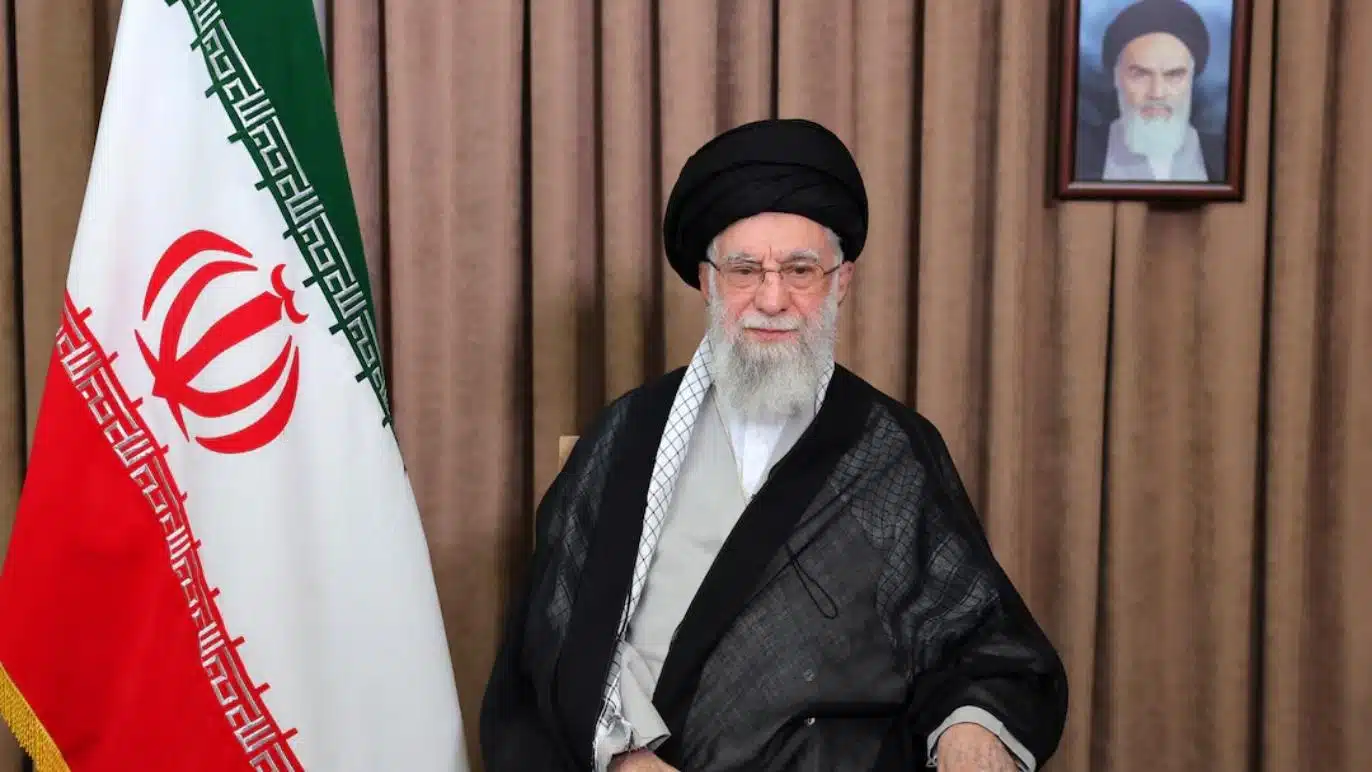
In a marked shift of rhetoric that reframes decades of geopolitical tension, Iran’s Supreme Leader Ayatollah Ali Khamenei declared on Saturday that the hostility between the Islamic Republic and Western powers is not rooted in the protracted dispute over Tehran’s nuclear program, but rather in a fundamental ideological clash over the “global order.”
Speaking in a message addressed to the 59th annual meeting of the Union of Islamic Student Associations in Europe, the 86-year-old cleric asserted that the West’s primary fear is not Iranian centrifuges or uranium enrichment, but the potential rise of a “national and international Islamic order” that challenges Western hegemony.
The statement comes at a precarious moment for the region, following what officials and observers are calling the “12-Day War”—a fierce exchange of hostilities earlier this month that reportedly inflicted significant damage on Iran’s military infrastructure and resulted in the loss of several senior commanders. By pivoting the narrative away from material losses and the nuclear file, Khamenei appears to be rallying his base around a broader, spiritual struggle, signaling that the confrontation with the United States and its allies is entering a new, perhaps more volatile, ideological phase.
The Ideological Pivot: “It Is Not About the Nuclear Issue”
For years, the international community has viewed the Joint Comprehensive Plan of Action (JCPOA) and the subsequent diplomatic stalemates as the fulcrum of West-Iran relations. Sanctions, summits, and covert operations have largely revolved around the monitoring of Iran’s atomic capabilities. However, Khamenei’s latest remarks seek to dismantle this framework.
“The problem between the Islamic Republic and Western powers is not the nuclear issue and things like that,” Khamenei wrote in the message published Saturday. Instead, he defined the conflict as a battle against an “unjust global order and the system of domination.”
This re-characterization is significant. By dismissing the nuclear dispute as secondary, the Supreme Leader is effectively telling both his domestic audience and Western adversaries that concessions on atomic energy will not resolve the underlying enmity. The conflict, in his view, is existential. He argues that the West opposes Iran because Tehran offers an alternative to the “coercive dominance system” led by the United States.
“This is a war of narratives as much as it is a war of missiles,” said Dr. Sohrab Azari, a geopolitical analyst based in Geneva. “Khamenei is telling his followers that the suffering caused by sanctions and war is not a punishment for a policy choice regarding uranium, but the cost of a holy mission to rewrite the rules of the world. It is a classic move to imbue material hardship with spiritual meaning.”
In the Shadow of the ’12-Day War’
The timing of the Supreme Leader’s message is impossible to decouple from the recent military escalation. The “12-Day War,” as it is being termed in Tehran, represents one of the most direct and damaging confrontations between Iran and Western-aligned forces in decades.
According to reports, the conflict saw a heavy assault on Iranian soil, targeting command-and-control centers, missile depots, and key security infrastructure. While state media has portrayed the outcome as a “defeat” for the aggressors due to the resilience of the Iranian nation, internal accounts suggest a heavy toll. The loss of senior military figures has left a void in the country’s defense hierarchy, and the damage to infrastructure has compounded existing economic woes.
In his message, Khamenei acknowledged the intensity of the conflict but framed it as a testament to Iranian endurance. He referred to the “heavy assault of the US army and its disgraceful appendage in the region”—a standard pejorative for Israel—claiming it was “defeated by the initiative, courage, and sacrifice of Iran’s young people.”
By claiming victory through “endurance” rather than military dominance, Khamenei is deploying a strategy of “resistance at all costs.” This narrative suggests that as long as the Islamic Republic stands, it has won, regardless of the physical damage sustained.
“The regime is trying to rewrite the scoreboard,” noted a Western diplomat in the region who spoke on condition of anonymity. “If the metric of success is the survival of the ideology rather than the integrity of the infrastructure, then Khamenei can claim victory even amidst rubble. It is a way to inoculate the regime against the perception of military failure.”
A Challenge to the “Unjust Global Order”
The concept of an “Islamic Order” challenging Western liberalism is not new to Khamenei’s lexicon, but the explicitness with which he is prioritizing it over the nuclear file is striking. The Supreme Leader urged the students in Europe to view themselves as soldiers in this ideological trench.
He described the current geopolitical landscape as a dichotomy between a “front of truth” and a “front of falsehood,” urging the youth to establish a “just national and international Islamic system.” This rhetoric echoes the revolutionary fervor of 1979 but is retooled for a 2025 world defined by multipolarity and the decline of unipolar American power.
Khamenei’s focus on the “global order” also aligns Iran more closely with other revisionist powers, such as Russia and China, who similarly critique the “rules-based international order” as a mechanism of Western control. However, Iran’s version is distinctively theocratic. By framing the West’s opposition as a fear of Islam rather than a fear of the bomb, Khamenei attempts to position Iran not just as a rogue state, but as the vanguard of the entire Muslim world—a claim that is deeply contested by rival Sunni powers in the region.
The Nuclear File: A Pretext for Enmity?
The implications of this speech for future nuclear diplomacy are profound. If the nuclear issue is merely a “pretext” for Western hostility, as Khamenei implies, then resolving the technical aspects of enrichment and inspections becomes a futile exercise.
“This sounds like the final nail in the coffin of the old diplomatic playbook,” said Elena Rossi, a non-proliferation expert. “If the Supreme Leader believes the West will attack Iran regardless of its nuclear compliance because they hate the ‘Islamic Order,’ then there is no incentive for Tehran to limit its program. It suggests they might view the nuclear deterrent as necessary not just for security, but as a pillar of this new order.”
Critics of the regime argue that this pivot is also a distraction from the fact that the nuclear program has failed to deliver leverage. Years of “strategic patience” and acceleration of enrichment have not forced the West to capitulate; instead, they have invited the very attacks seen earlier this month. By declaring the nuclear issue “not the problem,” Khamenei may be trying to cut his losses and shift the goalposts to a field where he feels stronger: ideology.
Domestic Economic Strain and the “Resistance Economy”
The lofty rhetoric of global orders and ideological battles stands in stark contrast to the gritty reality on the streets of Tehran, Mashhad, and Isfahan. The Iranian economy remains strangled by a web of international sanctions that have only tightened in the wake of the recent conflict.
Inflation is rampant, the rial is historically weak, and the cost of living has pushed millions into poverty. For the average Iranian, the “fight with the West” is felt not in abstract terms of global hegemony, but in the price of bread, medicine, and fuel.
Just a day prior to Khamenei’s speech, Foreign Minister Abbas Araghchi acknowledged the economic disorder but attempted to spin a similar narrative of resilience. Speaking in Isfahan, Araghchi portrayed sanctions as a catalyst for “industrial independence,” particularly in the defense and missile sectors. He argued that Iranians must “accept the reality” of sanctions and “live with them.”
Such comments have triggered a backlash. “They tell us to eat resistance,” said a 34-year-old teacher in Tehran, who asked to remain anonymous for fear of reprisal. “They build missiles and talk of changing the world order, but we cannot afford meat for our children. If the nuclear issue isn’t the problem, then why are we paying the price for it with our lives?”
Khamenei’s message to the students in Europe—a group often disconnected from the daily hardships inside Iran—can be seen as an attempt to bypass the disillusioned domestic populace and appeal to the diaspora and the ideological elite.
A Message to the Base: “Complete Victory Awaits”
The concluding segment of Khamenei’s message was a direct appeal to morale. Addressing the “shaken base” of loyalists who may be questioning the wisdom of the regime’s confrontation with the West, he promised that “complete victory awaits you, God willing.”
This is a crucial communication strategy. The “12-Day War” likely rattled the confidence of the IRGC (Islamic Revolutionary Guard Corps) rank and file. Seeing their commanders targeted and their facilities struck by superior firepower can breed doubt. Khamenei is stepping in to perform the role of the spiritual anchor, assuring them that material setbacks are merely tests of faith.
“The regime views narrative control as strategic,” says one analyst of Iranian state media. “They need to convince their own security apparatus that they are not losing, but rather enduring. If the Praetorian Guard loses faith in the ultimate victory of the ‘Islamic Order,’ the regime faces a threat far greater than foreign airstrikes: internal collapse.”
Regional Repercussions
The “Beyond Nuclear” doctrine is likely to be read closely in Riyadh, Tel Aviv, and other regional capitals. If Iran’s fight is “fundamental” and ideological, it implies that Tehran’s support for its proxy network—the “Axis of Resistance”—will continue unabated.
The “disgraceful appendage” comment regarding Israel confirms that the hostility toward the Jewish state remains a central pillar of this “Islamic Order.” For Iran’s neighbors, this signals that there will be no moderation in Tehran’s regional behavior. The export of the revolution is not a bargaining chip; it is the mission statement.
This stance complicates efforts by regional mediators, such as Iraq and Qatar, who have tried to de-escalate tensions by focusing on tangible, negotiable issues like prisoner swaps or frozen assets. Khamenei is effectively saying that these transactional deals do not address the core conflict.
The West’s Dilemma
For Western policymakers, Khamenei’s speech presents a stark challenge. The Biden-Harris administration (or its successor, depending on the exact political landscape of late 2025) has long operated on the assumption that Iran is a rational actor with whom a <i>modus vivendi</i> can be reached via transactional diplomacy.
If the Supreme Leader is explicitly stating that the conflict is total and ideological, the diplomatic track aimed at containing the nuclear program appears increasingly insufficient. It validates the arguments of hawks in Washington and Europe who have long claimed that the nuclear issue is merely a symptom of a regime whose DNA is anti-Western.
“We are seeing the mask come off,” said a senior fellow at a Washington-based think tank. “Khamenei is saying the quiet part out loud. Even if we signed a new nuclear deal tomorrow, the war for the ‘global order’ would continue. This demands a comprehensive strategy of containment, not just non-proliferation.”
Final Words: A Long Winter Ahead
As 2025 draws to a close, the Middle East finds itself in a deep freeze of diplomatic prospects. The dust from the “12-Day War” has yet to fully settle, and the region remains a tinderbox.
Ayatollah Khamenei’s declaration that the fight goes “beyond the nuclear issue” effectively removes the off-ramp. By framing the conflict as a clash of civilizations—an “Islamic Order” against a “System of Domination”—he has raised the stakes to an existential level.
For the students in Europe reading his message, it is a call to arms in a war of ideas. For the people of Iran, it is a promise that the “resistance economy” and its associated hardships are here to stay. And for the world, it is a sobering reminder that the tensions emanating from Tehran are not about to be defused by a signature on a document in Vienna. The struggle, as Khamenei sees it, is just beginning.






















