

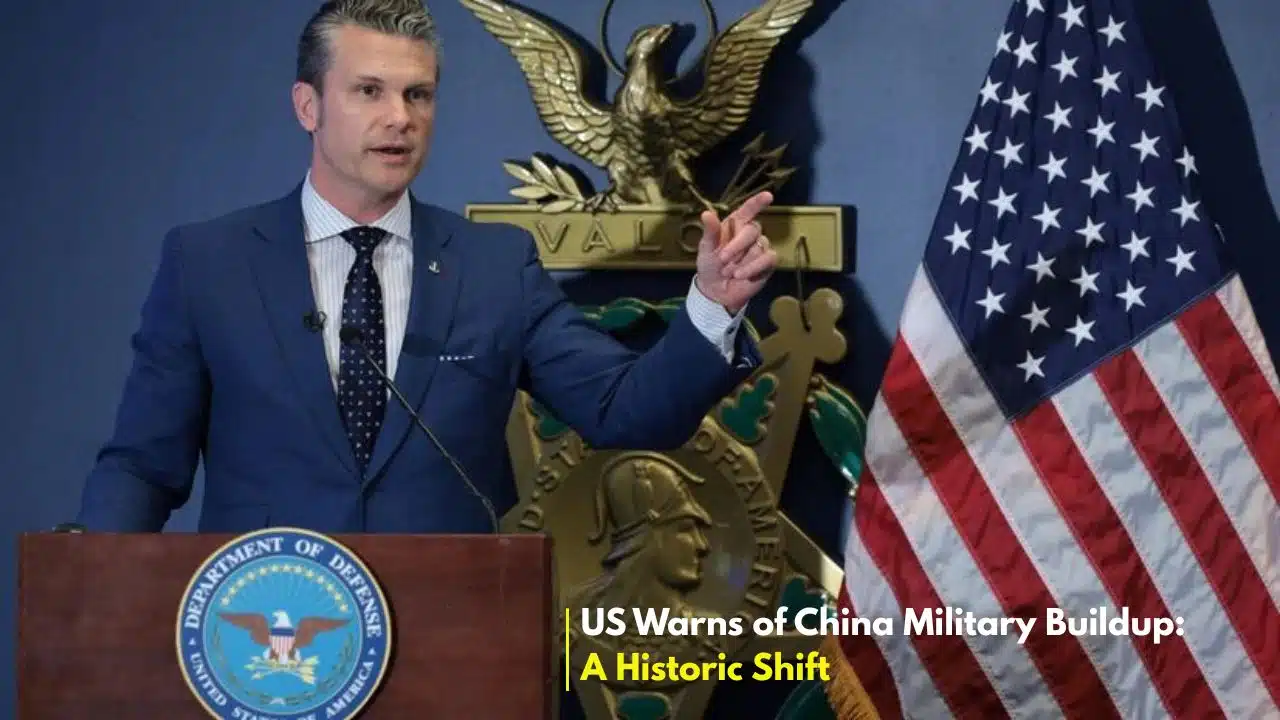
The United States has sounded the alarm on China’s unprecedented military expansion, labeling it a “historic” buildup that demands urgent action from Washington and its allies. Speaking at the Reagan National Defense Forum, US Secretary of War Pete Hegseth highlighted Beijing’s rapid naval growth, nuclear advancements, and industrial edge, warning that “it’s right in front of us.” This stark assessment comes amid escalating tensions in the Indo-Pacific, where China’s People’s Liberation Army (PLA) is reshaping the balance of power.
Hegseth’s remarks underscore a pivotal shift under President Donald Trump’s administration, prioritizing homeland defense, deterrence through strength, and revitalizing America’s defense industrial base. China’s navy now stands as the world’s largest by ship count, outpacing US production and fueling concerns over regional dominance. As the PLA modernizes at breakneck speed, nations like India watch closely, given Beijing’s assertiveness in the Indian Ocean and South China Sea.
This buildup is no secret. Pentagon reports detail China’s nuclear arsenal surpassing 600 warheads, with projections hitting 1,000 by 2030. Shipyards churn out warships at a rate 230% higher than the US, signaling a strategic race with profound implications. The world stands at a crossroads, where deterrence hinges on matching Beijing’s pace.
Hegseth’s Dire Warning at Reagan Forum
US Secretary of War Pete Hegseth delivered a blunt message at the Reagan National Defense Forum in Simi Valley, California, on December 6, 2025. He described China’s military expansion as “historic,” pointing to its world’s largest navy and nuclear modernization outstripping US capabilities. “For every eight warships Beijing builds, the United States produces fewer than two,” Hegseth stated, emphasizing China’s shipbuilding capacity at 230% of America’s.
The forum, a key platform for US security policy, drew top officials and analysts. Hegseth outlined four priorities: defending the homeland, deterring China through strength rather than confrontation, burden-sharing with allies, and supercharging the defense industrial base. He stressed internal reforms, including a complete overhaul of acquisitions and foreign military sales, calling it a “game change” to deliver systems faster.
This speech marks a departure from past strategies. Hegseth criticized post-Cold War “utopian idealism,” pivoting to a hard-edged posture focused on the Western Hemisphere and China. His words resonated amid ongoing PLA drills near Taiwan and heightened South China Sea activities. For allies, the message is clear: America rebuilds to lead.
China’s Navy: World’s Largest Fleet by Numbers
China’s People’s Liberation Army Navy (PLAN) has eclipsed all others in hull count, boasting around 754 vessels as of 2025. This includes two aircraft carriers, 20-22 Aegis-like destroyers, and a growing submarine force poised to surpass the US. Pentagon projections see the fleet expanding to 395 ships by 2025 and 435 by 2030, compared to the US Navy’s 296 ships stabilizing at 294.
Shipbuilding prowess drives this surge. Beijing’s yards produce at 200 times the US rate, per experts, enabling rapid replacement and expansion. While US ships boast superior tonnage—over 4.5 million tons versus China’s 2 million—quantity enables regional control. The PLAN dominates East Asian waters, projecting power into the Indian Ocean.
Modernization accelerates this edge. New Type 055 destroyers, advanced frigates, and nuclear submarines enhance blue-water capabilities. Joint exercises with Russia bolster interoperability. For India, this means heightened vigilance, as Chinese vessels probe the Indian Ocean amid Pakistan ties.
| Navy Comparison (2025) | China (PLAN) | United States (USN) |
|---|---|---|
| Total Ships | 754 | 440 |
| Aircraft Carriers | 3 (operational/planned) | 11 |
| Destroyers | 50+ | 70+ |
| Submarines | 60+ | 70 |
This table highlights China’s numerical lead against US qualitative advantages.
Nuclear Arsenal: Rapid Expansion Alarms Pentagon
China’s nuclear forces are modernizing at a pace unseen since the Cold War. The Pentagon reports over 600 operational warheads as of mid-2024, exceeding prior estimates, with 1,000 by 2030 and growth beyond. This includes silo-based intercontinental ballistic missiles (ICBMs), submarine-launched options, and bombers.
Key developments include a launch-on-warning posture this decade and lower-yield weapons for battlefield use. Beijing develops conventional ICBMs targeting Hawaii and the US mainland. The Defense Intelligence Agency notes 500 warheads already, doubling 2020 figures.
Military-Civil Fusion (MCF) fuels this. Civilian tech in AI, quantum, and hypersonics integrates into PLA systems. Xi Jinping aims for a “world-class” force by 2049, accelerated to basic modernization by 2035.
| Nuclear Projections | 2024 | 2030 | 2035 |
|---|---|---|---|
| Warheads | 600+ | 1,000+ | 1,200+ |
These figures shift from retaliatory to overwhelming damage capabilities.
PLA Modernization: Xi’s Ambitious Timeline
Under Xi Jinping, the PLA pursues a “world-class” military by 2049, with mechanization by 2020, full modernization by 2035, and peak readiness thereafter. Reforms emphasize jointness, merging services for integrated operations.
Ground forces mechanize with advanced armor; air and missile forces gain stealth fighters like J-20. Cyber, space, and AI domains expand via MCF. Defense budget hits 1.78 trillion yuan ($249 billion) in 2025, up 7.2%—second globally.
Xi’s control tightens through purges and restructuring. Corruption scandals hit the Rocket Force, but expansion persists. Manpower exceeds 2 million, dwarfing US active forces.
-
Joint command structures streamline operations.
-
AI/autonomous systems draw Ukraine lessons.
-
30,000 civilian hires yearly boost expertise.
Budget and Industrial Might: Fueling the Surge
China’s 2025 defense spending of 1.78 trillion yuan supports new domains like reconnaissance and joint strikes. Single-digit growth for a decade masks off-books R&D. This funds munitions, logistics, and training.
Industrial capacity shines. Shipyards outbuild rivals; missile production scales massively. Hegseth calls for US urgency to match.
Implications loom large. Taiwan invasion readiness may take 10-15 years, per analysts.
Implications for India and Indo-Pacific
India faces direct threats from China’s Indian Ocean forays, South China Sea militarization, and Pakistan alliances. Quad cooperation with the US, Japan, Australia counters this. iCET advances jet engines, munitions.
New Delhi bolsters carriers, submarines, surveillance. US industrial revival aids stability.
Beijing’s global ambitions test alliances.
US Response: Strength Over Confrontation
Trump’s team prioritizes deterrence. Hegseth vows production surges, ally burden-sharing. Reforms overhaul procurement.
Pentagon reports guide strategy. AI, autonomy shape future battlefields Allies must step up.
Global Repercussions: A New Arms Race?
- China’s buildup risks escalation. Russia ties deepen. Europe views US shifts warily.
- Taiwan, Philippines brace. Arms control stalls.
- Economies strain; stability frays.
Expert Views and Future Outlook
Analysts across think tanks and government circles see no signs of slowdown in China’s military expansion, with projections indicating sustained investment through the decade. Buck Sexton, a former national security analyst and radio host, has warned of the PLA’s aggressive integration of artificial intelligence, predicting AI-enhanced autonomous systems could dominate future battlefields by enabling real-time decision-making and swarm tactics. Patricia Kim, a China expert testifying before Congress, urges the US to bolster alliances, accelerate tech exports to partners like India, and invest in asymmetric capabilities to counter Beijing’s numerical advantages.





















