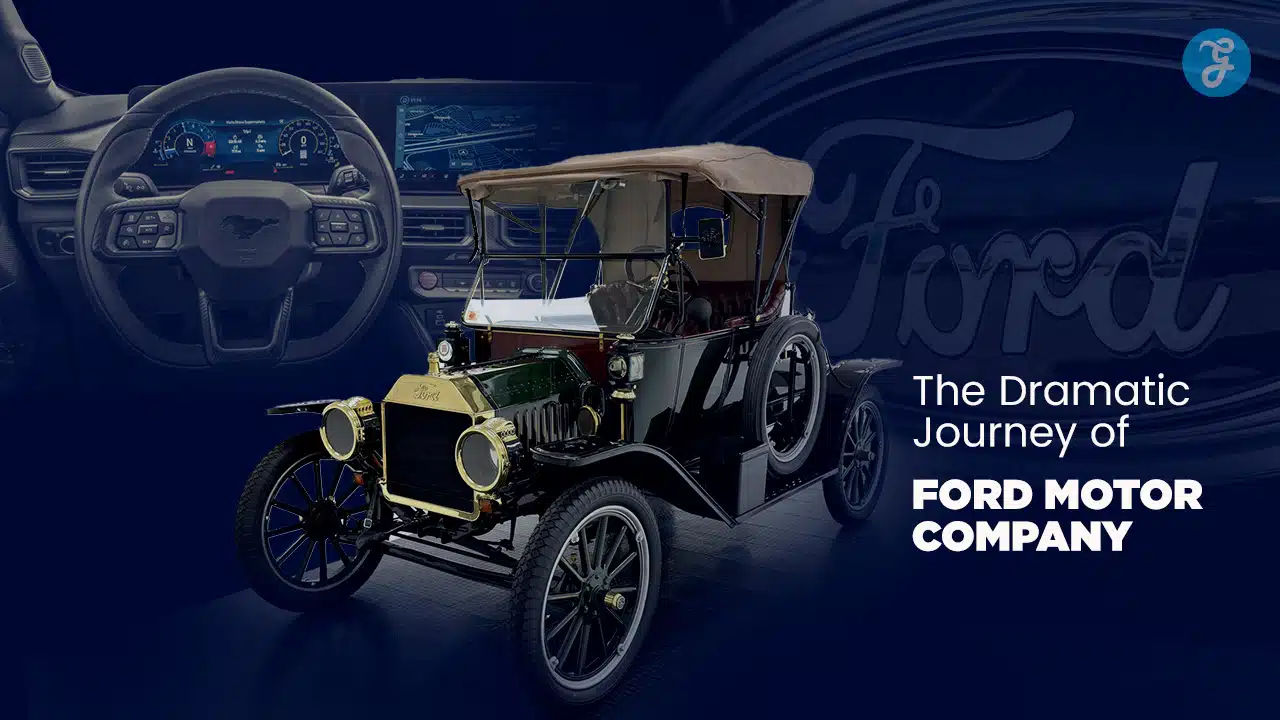
In the summer of 1903, inside a small brick factory in Detroit, a man with piercing blue eyes and a stubborn dream began a revolution. A son of a farmer, wanted to build cars not for the wealthy elite but for every working man and woman. Few believed him.
Yet, what followed was one of the most dramatic corporate journeys in history—a tale of triumphs, scandals, near-death crises, and rebirths that continue to shape the way we move today.
And the result? More than a century later, as I write these words, that once-ridiculed dream still endures. The company Henry Ford built remains a pillar of American industry, and its F-Series trucks continue their reign as the best-selling trucks in the United States for over four decades running.
But Ford’s journey was never a straight road. Along the journey of ford motor company came bitter labor battles, family feuds, product triumphs, and stinging scandals. It fought through the Great Depression, witnessed a World War, even collapsed in a financial crisis—but why do legends fall? only to rise again.
The Dreamer’s Vision: Out of Failures, a Revolution Rolled
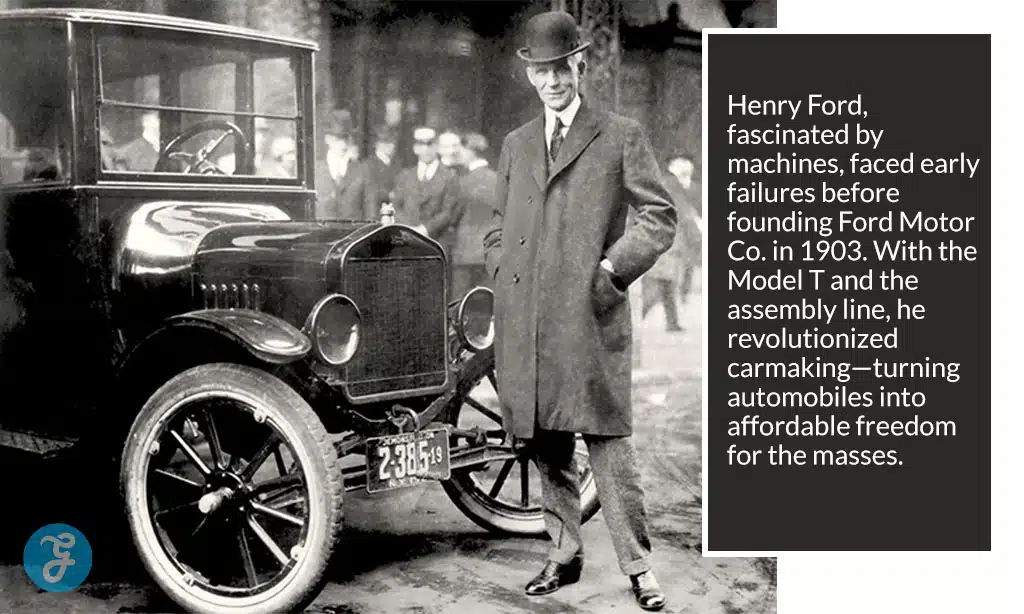
Henry Ford grew up on a farm in Greenfield Township, Michigan but he was fascinated by machines from an early age. From the watch gifted by his father to the steam rail engine he saw first at school tour attracts him much more than the plow. Ford left the farm as a teenager to work in Detroit’s machine shops. The clanging of iron and the hiss of steam engines fueled his curiosity and ambition. By the 1890s, while the automobile was still a sign of novelty for the wealthy, Ford had already set his vision: building a car that ordinary people could afford.
In 1899 Ford started his first venture, the Detroit Automobile Company, collapsed within two years – its cars were too heavy, too costly, and too slow. Investors lost faith, and Ford was left humiliated.
He tried again with the Henry Ford Company in 1901. But soon, clashes erupted with his investors, who demanded high-end luxury vehicles while Ford still dreamed of affordable cars for the masses. As a result Ford quit his own company in early 1902. The investors kept the factory and reorganized the venture under a new name – Cadillac.
Yes, the very company that would one day stand as Ford’s competitor in the luxury market was born from the ashes of his failure.
In 1902, he formed a third effort with a small group of partners and built a racing car named “999”, a roaring machine that stunned the public with its speed. Ford wasn’t a racer at heart, but he understood the power of presentation. Ford played almost a blind card: if he could prove his engineering skill on the racetrack, investors might believe in him. The gamble worked. 999’s speed and raw power won races and headlines.
In 1903, with $28,000 in capital, Henry Ford finally launched the Ford Motor Company—the venture that would change automobile history.
The mission of the Ford Motor Company was very simple: build an affordable, reliable car for the masses. In 1908, the Model T rolled onto America’s roads. Strong, dependable, and priced at just $825. It became an instant hit. Painted in the now-famous promise of “any color, so long as it’s black,” the Model T was more than a car; it was mobility made universal.
But Henry Ford’s true innovation wasn’t just the product—it was the process. In 1913, at his Highland Park plant, he introduced the moving assembly line, a revolutionary system that cut production time from over 12 hours to just 93 minutes. Cars could now be churned out faster and cheaper than ever before. Ford didn’t just build cars—he built freedom.
Empire and Shadows: When Giants Cast Long Shadows
By the 1920s the Model T had conquered the roads and reshaped the American’s daily life with more than 15 million units sold. Henry Ford, once a farmer’s son, was now hailed as an industrial king.
In 1914, Ford announced the $5 workday, which was double the average wage. Workers cheered, critics scoffed, and newspapers exploded with headlines. The business world was stunned; many called it madness! Yet it was also hailed as brilliance—part philanthropy, part business strategy. By paying his workers enough to afford the very cars they built, Ford was not just rewarding labor; he was creating a new class of consumers.
Problems arise with Ford’s famously rigid policies demanding intense discipline on the factory floor. The company’s “Sociological Department” monitored employees’ private lives, visiting homes to check on their spending habits, and even how they raised their children. What looked like generosity also felt like surveillance.
By the 1930s, tensions boiled over as unions gained strength. The most infamous clash came in 1937 at the “Battle of the Overpass,” when Ford’s security men savagely beat union organizers at the River Rouge plant. Photographers captured the scene. The images shocked the nation, painting Ford as both a titan and an industrial tyrant.
Henry Ford himself became a controversial figure. Fiercely independent, he resisted advice from his own executives and stick stubbornly to the Model T long after the public wanted something new. His newspaper, The Dearborn Independent, published anti-Semitic editorials that damaged his reputation and forced public apologies. The man who once put the world on wheels was now dividing opinion as much as he inspired it.
Then came World War II. Ford initially resisted involvement, clashing with Washington and holding onto his isolationist views. But when America entered the war, Ford shifted gears with astonishing force. The Willow Run plant in Michigan became known as the “Arsenal of Democracy,” producing a B-24 bomber every 63 minutes!! – an achievement no other company could match. Ford had proven it could build not just cars, but empires of machinery, feeding both America’s highways and its battlefronts.
By 1945, as the world emerged from war, the Ford Motor Company stood as both a symbol of progress and a monument to controversy: innovation and rigidity, generosity and control, triumph and turmoil.
The Crisis Years: Icons, Scandals, and A Faded Titan
The war ended, but Ford’s glory began to fade. The postwar era brought fierce competition, and the once-unquestioned giant now faced challengers on every front. General Motors and Chrysler surged ahead with sleek new designs, aggressive marketing, and modern management strategies. By the 1970s, Japanese automakers—Toyota, Honda, and Datsun—were winning over American drivers with reliable, fuel-efficient cars. After decades of dominance, Detroit’s iron grip on the nation’s roads was finally shaken, and Ford, once untouchable, had to fight to reclaim its place in a rapidly changing automotive world.
Then Ford Motor Company entered a new chapter of drama. Henry Ford II, grandson of the legendary founder, inherited a sprawling empire weighed down by inefficiency, outdated management, and lingering family rivalries. Determined to modernize, he recruited a team of brilliant young executives—famously called the “Whiz Kids”—veterans of World War II planning units. Their mission was ambitious: streamline operations, cut waste, and restore Ford’s competitive edge. They revolutionized accounting, production, and management systems, injecting fresh energy into the company—but the road ahead remained long, and the challenges far from over.
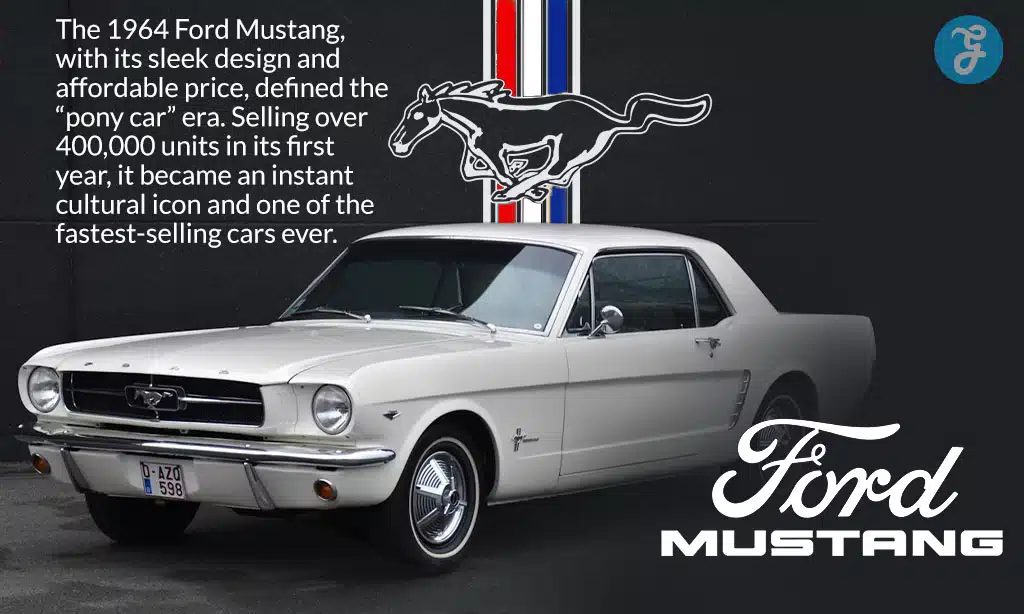
In 1964, the Ford Mustang roared onto the scene—a spark of brilliance that instantly captured the imagination of a generation. With Sleek, sporty design and affordable price, it defined the “pony car” category and became a cultural icon. Over 400,000 Mustangs were sold in its first year, making it one of the fastest-selling cars of its time.
But Ford’s brilliance was shadowed by controversy once again. The Ford Pinto, launched in the early 1970s, became infamous for safety flaws. Reports alleged that the gas tank could explode in rear-end collisions, and company memos revealed internal debates over cost versus safety. The resulting public outrage sparked lawsuits and a long-lasting black mark on Ford’s reputation.
Then came the oil crises of 1973 and 1979, which caused an unusual hike in fuel prices. Gas-guzzling American cars – including many of Ford’s sedans and trucks – fell out of favor. The company struggled to adapt quickly, losing market share to more fuel-efficient Japanese imported vehicles.
By the late 1970s and early 1980s, Ford was still a titan – but a faded one. Once the invincible Ford Motor Company, now faced a world of relentless competition, fast shifting consumer tastes, and a reputation that balanced innovation with scandal. The empire that Henry Ford had built seemed formidable, yet fragile – a reminder that even legends must evolve or risk being left behind in the race.
On the Brink: A Legend at the Edge of Collapse
The late 20th century was a time of SUV booms, record profits, and global expansion for Ford. The company reveled in the success of models like the Explorer and the F-Series, and it extended its reach into Europe, Asia, and South America. Yet deep inside Ford was bloated, unfocused, and plagued by inefficiencies.
By the early 2000s, cracks were becoming brighter. While rivals like GM and Chrysler struggled, Ford’s financial health was deteriorating. Between 2001 and 2006, the company lost $12.7 billion , red lights flashing across Wall Street. A large red question mark hung over the industry: could the once-invincible giant survive the storm, or was its fall inevitable?
Then came 2008, a year that shook the American auto industry. GM and Chrysler fell into bankruptcy. Ford faced a similar threat, but thanks to outsider CEO Alan Mulally, the company charted a different course. Mulally, recruited from Boeing, was a bold, disciplined leader who demanded accountability at every level.
He introduced the “One Ford” plan, a sweeping strategy to unify Ford’s global operations, streamline production, focus on core brands, and cut unprofitable models.
Mulally mortgaged all of Ford’s assets in 2006, raising $23.5 billion in cash before the crisis hit—a move widely criticized at the time but later hailed as genius. When the financial storm arrived, Ford had liquidity while its rivals scrambled.
Mulally’s leadership wasn’t just about numbers—it was about culture. He centralized decision-making, cut bureaucracy, and forced managers to collaborate globally, reminding the company of its former agility and audacity. By the end of the crisis, Ford had survived without a government bailout. This was Ford’s near-death moment, a crucible that tested every ounce of its resilience. Its hard fought survival added a new chapter to its legacy, proving that even after decades of triumphs, scandals, and near-collapse, the company could rise again—ready to face the challenges of a new century.
Electric Dreams: Wheels of the Past, Currents of the Future
Today, Ford stands at another crossroads. The rise of Tesla and the EV revolution has forced the century-old automaker to reinvent itself once again.
Ford leaned on its legacy while embracing innovation. The F-Series trucks, already an American icon, continued to dominate sales, maintaining their reign as the best-selling trucks in the United States for over four decades. At the same time, the Ford Mustang evolved, blending heritage with modern performance, including electric and hybrid variants—proof that nostalgia and innovation could coexist.
Ford took a bold leap into electric vehicles, launching the Mustang Mach-E on November 17, 2019. A proof that the company was serious about sustainability and future mobility. Factories were retrofitted, batteries developed, and software-driven vehicles became central to Ford’s vision. The momentum continued with the fully electric F-150 Lightning, launched on April 26, 2022, merging America’s most iconic truck with cutting-edge EV technology.
From Henry Ford’s small Detroit workshop to the high-tech EV plants of today, the company has survived failures, scandals, near-bankruptcy, and global upheavals. But the lessons of the past—resilience, audacity, and reinvention—remain ingrained in the company’s DNA.