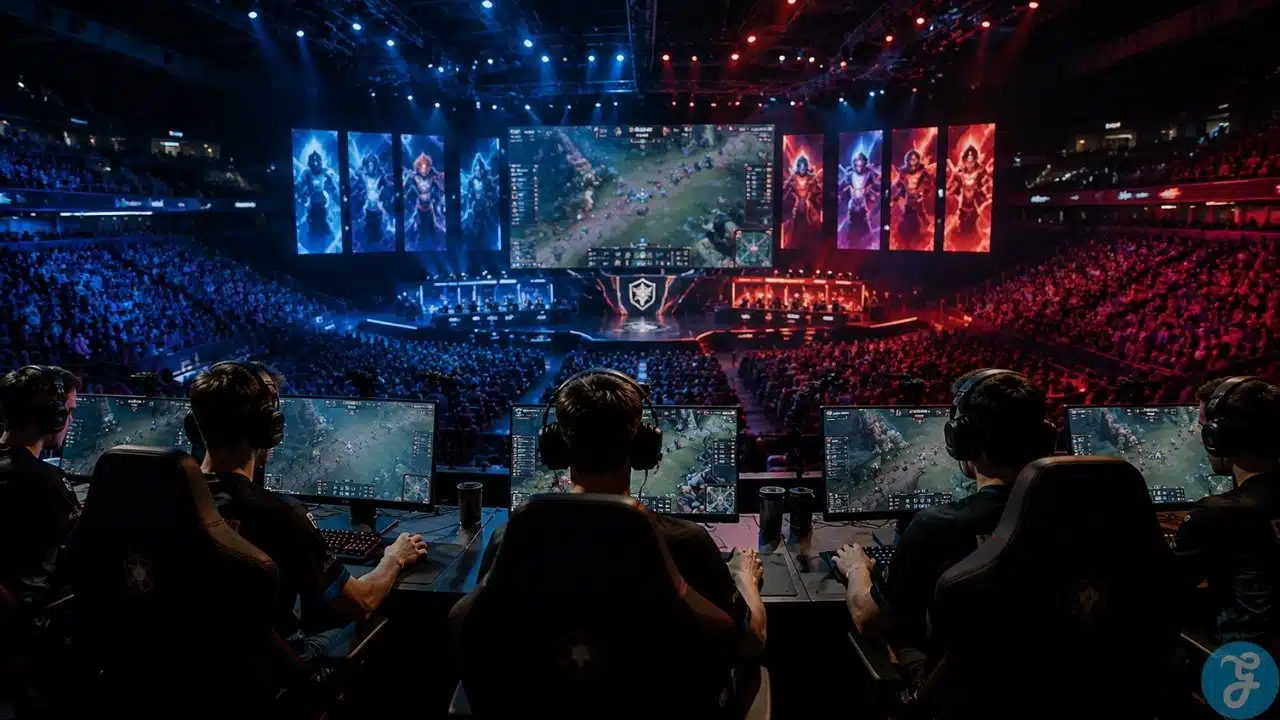
Esports games are not defined just by popularity. A game becomes a major esports title when it can consistently support competitive play, spectator viewing, and long-term skill development. That combination is harder to achieve than it looks.
At a glance, esports games seem like just competitive versions of regular multiplayer titles. But the structure underneath is more specific. Balance, map design, mechanical depth, and clarity for viewers all matter. Without those, a game might be fun to play casually but never work as a competitive ecosystem.
I’ve spent a lot of time in games like League of Legends, Counter-Strike, and Valorant, and what stands out is not just how different they feel, but how deliberately they are designed around competition. Small changes in timing, positioning, or economy management can completely shift outcomes.
What Makes a Game a Major Esports Title
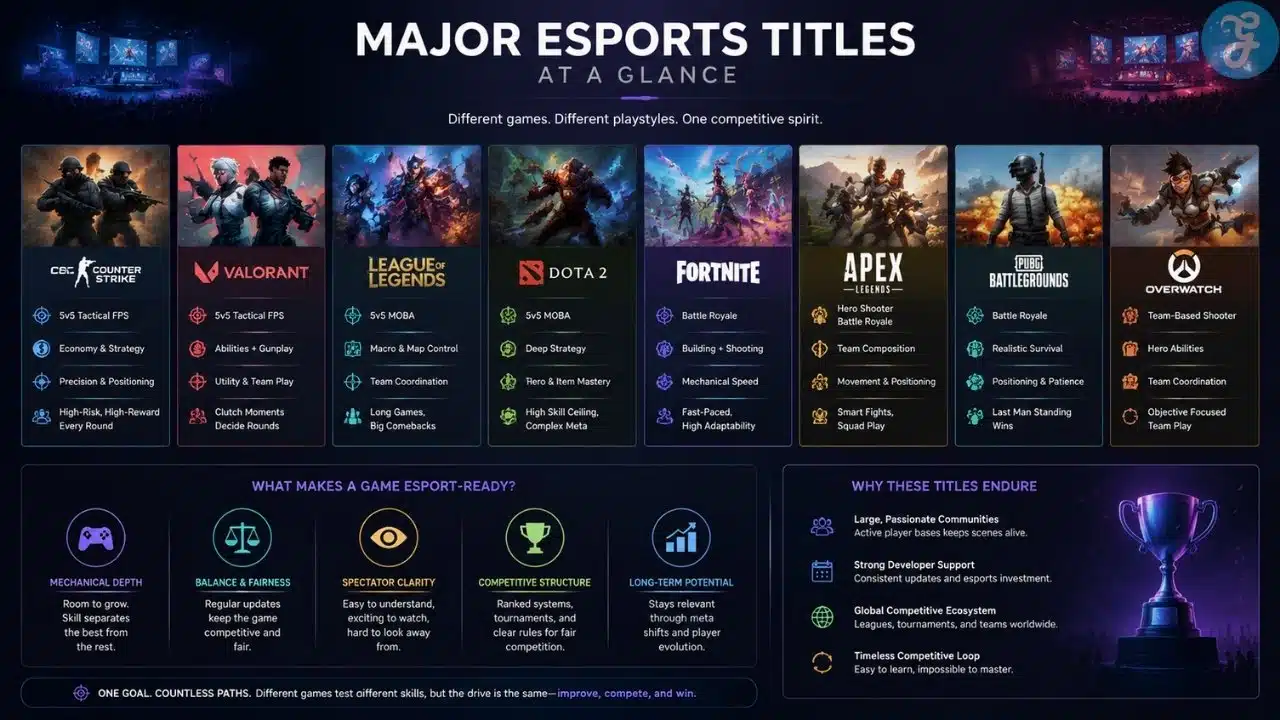
Not every multiplayer game becomes an esports. There are specific design traits that tend to repeat across successful competitive titles.
The first is mechanical depth. A game needs enough systems for players to improve over time without reaching a ceiling too quickly. This is what allows professional players to separate themselves from casual ones.
The second is balance stability. If one strategy dominates for too long, competitive integrity breaks. Esports games usually require continuous updates to keep systems fair across different playstyles.
The third is clarity. Viewers need to understand what is happening, even if they do not play the game. This is one of the most underrated factors in esports success. A match that is confusing to watch struggles to grow as a competitive product.
Finally, there is structure. Esports titles need ranked systems, matchmaking, tournament formats, and consistent rulesets that allow fair competition across regions.
Core Esports Games and Why They Dominate
A small group of games consistently appear in esports discussions because they each represent a different competitive structure.
League of Legends is built around team coordination, map control, and long-form strategy execution. Matches are not decided by one moment but by a series of small advantages built over time. It rewards teamwork and macro-level decision-making.
Counter-Strike focuses on precision, positioning, and economy management. Every round matters. One mistake can shift the entire match. Unlike many shooters, there is no room for chaos without consequence.
Valorant blends tactical shooting with ability-based utility. It adds layers of strategy without removing the core aim-based skill ceiling. This balance is what keeps it competitive across different skill levels.
Dota 2 is one of the most complex esports titles in existence. It has deep hero interactions, item systems, and long match durations that reward patience and strategic planning.
Fortnite introduced a different angle, combining shooting mechanics with fast building systems. Its competitive scene relies heavily on mechanical speed and adaptability under pressure.
Apex Legends and PUBG represent the battle royale side of esports. These games are less about fixed lanes or rounds and more about survival, positioning, and decision-making under uncertainty.
Overwatch focuses on team composition and ability synergy. Its competitive identity depends heavily on coordination and timing between multiple roles.
Each of these games succeeds for different reasons, but they all share one thing. They create space for long-term skill growth.
My Personal Experience with Competitive Games
Playing League of Legends, CS, and Valorant over time makes one pattern very clear. The learning curve never really flattens. You just start noticing different layers.
In League of Legends, early improvement feels like learning champions and mechanics. Later, it becomes about map awareness, objective timing, and team coordination.
In Counter-Strike, beginners focus on aiming. After that, it becomes about movement control, utility usage, economy planning, and predicting opponent behavior.
Valorant sits somewhere in between. Mechanical aim matters, but utility timing and team coordination often decide rounds more than raw shooting skill.
What changes over time is not just skill, but awareness. You begin to see why decisions are made, not just what happens in the match.
Why do These Games Become Esports Staples
Not every popular multiplayer game becomes an esports. Many fail because they are not built for long-term competitive balance.
Successful esports games usually support three things over time.
They allow skill expression without relying on randomness. They stay readable for viewers. And they can survive balance changes without breaking core gameplay identity.
Games that fail in esports often struggle with one of these. Either they are too chaotic to balance, too confusing to watch, or too shallow for long-term competition.
Esports titles also tend to have strong developer support. Regular updates, competitive seasons, and structured tournament ecosystems help maintain relevance over years, not months.
Casual Play vs Competitive Mindset
Most esports games are played by casual players far more than competitive ones. But the mindset shift between the two groups is significant.
Casual players focus on enjoyment, experimentation, and short-term outcomes. Competitive players focus on consistency, optimization, and long-term improvement.
Neither approach is wrong, but they lead to very different experiences in the same game.
A casual League of Legends match can feel chaotic and reactive. A competitive match feels structured, even when it looks chaotic from the outside.
Common Misunderstandings about Esports Games
A common misunderstanding is that esports games are only for professionals. In reality, most players never enter competitive scenes. They simply enjoy ranked or casual competitive play.
Another misconception is that esports success is only about mechanical skill. In most games, decision-making and teamwork matter just as much, sometimes more.
There is also a tendency to assume all esports games are similar. In reality, each one has a completely different internal logic. CS rewards precision. Dota rewards planning. League rewards coordination. Valorant mixes structure with adaptability.
Final perspective
Esports games exist because they combine fairness, depth, and long-term mastery potential. They are not just competitive games. They are systems designed to be learned over time.
Whether it is CS, League of Legends, Valorant, or Dota 2, the core experience is the same at a structural level. You start with basic understanding, then slowly uncover deeper layers of strategy, timing, and coordination.
That depth is what keeps esports alive. Not just competition, but continuous improvement over time.