You finished the ride or the delivery, but your pay will take days to reach your bank. Instant payouts for gig workers fix that: the app sends pay you already earned over a fast payment network, and it lands in seconds or within about 30 minutes, usually for a small fee. A regular bank transfer takes 1 to 3 business days.
The fast networks are push-to-card (Visa Direct and Mastercard Send), real-time bank transfers (RTP and FedNow), and app wallets like PayPal, Venmo, and Cash App. The fee is typically $0.50 to $1.99 per cash-out, though some platforms pay it for you. Same-day ACH is a middle option: it beats the usual wait, but it runs only on business days and isn’t instant.
Below, you’ll follow one cash-out from tap to deposit and compare each option side by side. You’ll also see who should pay the fee and when it’s worth paying.
What Are Instant Payouts for Gig Workers?
An instant payout moves money from the platform to your account in near real time, usually within 30 minutes. That could be a driver on Uber or Lyft, a DoorDash courier, or a seller on Poshmark or Mercari.
Gig work doesn’t follow a two-week paycheck. Trolley puts it this way: “Each completed job or project is income already earned, yet many still wait days (or even weeks) to access it.”
The slow default is the Automated Clearing House, or ACH. It’s the network banks use for direct deposit, and a standard ACH transfer takes 1 to 3 business days. ACH runs only on business days, so a payout sent on Friday can sit through the weekend.
On-demand pay vs. instant pay
People mix these two terms up, but they mean different things. On-demand pay is about when you can get your earnings. Instant pay is about how fast the money arrives.
So an app might let you cash out any time (on-demand) but still send the money by ACH (slow). Or it might pay you once a week but send the money in seconds (instant). The best setup gives you both.
How Instant Payouts Work: The Payment Rails Behind Them
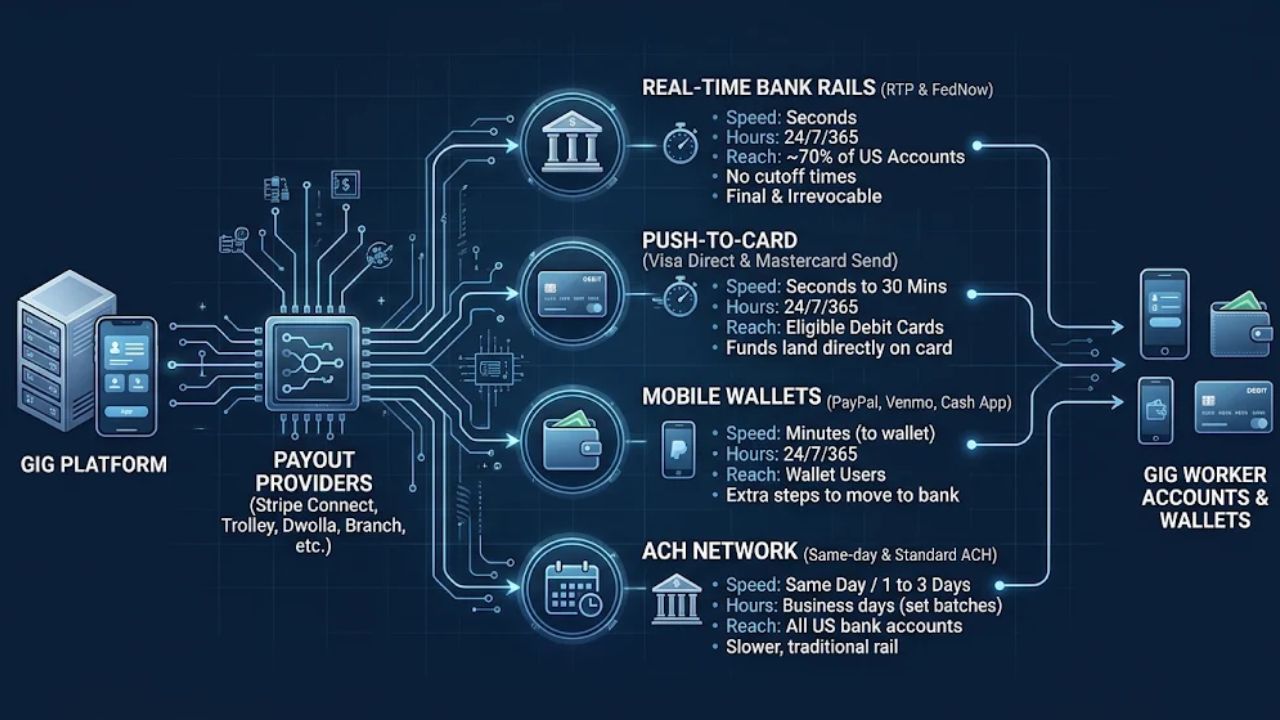
A “payment rail” is just the road money travels on between the platform and you. Instant payouts use three main kinds of rails: real-time bank rails (RTP and FedNow), push-to-card rails (Visa Direct and Mastercard Send), and mobile wallets (PayPal, Venmo, and Cash App).
Same-day ACH is a fourth, slower choice that still beats the regular wait.
Most platforms don’t connect to these rails themselves. They use a payout provider such as Stripe Connect, Trolley, Dwolla, Branch, Hyperwallet, or Routable. The provider sends each payout down the right rail.
Push-to-card: Visa Direct and Mastercard Send
Push-to-card sends money straight to your debit card. Visa Direct and Mastercard Send run all day, every day, and the funds land in seconds to 30 minutes.
It works with eligible debit cards, so you don’t need a bank that has joined the newer bank rails. Not every debit card is eligible, though, and instant pay usually costs more than a bank transfer.
Real-time bank rails: RTP and FedNow
RTP is run by The Clearing House. FedNow is run by the Federal Reserve, which launched it in July 2023.
Both run 24 hours a day, 365 days a year, with no cutoff times. Both networks allow up to $10 million in one payment. Routable calls them the only true real-time options because they settle final, irrevocable funds in seconds, even on weekends and holidays.
Both are “credit-push only.” That means only the sender can start a payment, and the receiver can’t pull money out. “Final” means the network itself won’t undo a payment once it settles. If money goes to the wrong place, getting it back takes steps outside the network.
Same-day ACH and standard ACH
Same-day ACH works if the platform sends the payout before the bank’s cutoff. Then the money arrives that same business day. Banks may set their own cutoff earlier than the network’s final deadline.
It still runs only on business days and in set batches. Miss the cutoff, and the money waits for the next business day. Standard ACH takes 1 to 3 business days.
Mobile wallets: PayPal, Venmo, and Cash App
Wallets can show the money in minutes. Moving it from the wallet to your bank can take longer, and that step may have its own fee.
Outside the US, other countries have their own rails. Mexico uses SPEI, Brazil uses Pix, the UK uses Faster Payments, and many workers in Sub-Saharan Africa get paid through mobile money like MTN MoMo. Platforms with workers abroad must pick rails that work where those workers live.
The rails side by side
| Rail | Speed | Hours | Reach | Cost | Network cap per payment | Final in seconds? |
| RTP | Seconds | 24/7/365 | Accounts at banks on the RTP network (see note) | Worker fee set by the app. Platform cost varies by provider | $10 million | Yes. Final and irrevocable. Credit-push only |
| FedNow | Seconds | 24/7/365 | 1,725 banks and credit unions taking part (Q1 2026) | Worker fee set by the app. Platform cost varies by provider | $10 million | Yes. Final and irrevocable. Credit-push only |
| Push-to-card (Visa Direct, Mastercard Send) | Seconds to 30 minutes | 24/7 | Eligible debit cards | Worker fee set by the app. Platform cost varies by provider | Set by the provider and card | No. Only RTP and FedNow settle final in seconds |
| Same-day ACH | Same business day, if sent before the bank’s cutoff | Business days, set batch times | US bank accounts | Varies by provider | Set by the bank and provider | No |
| Standard ACH | 1 to 3 business days | Business days only | US bank accounts | Often free to the worker on scheduled weekly payouts | Set by the bank and provider | No |
| Wallets (PayPal, Venmo, Cash App) | Minutes to the wallet. Moving it on to a bank can take longer | Varies by wallet | Workers with a wallet account | Moving money to a bank may carry its own fee | Set by the wallet | No. Only RTP and FedNow settle final in seconds |
Note on reach: About 70% of US deposit accounts can be reached on RTP and FedNow together. That is a count of accounts, while the 1,725 figure for FedNow is a count of banks and credit unions.
Note on cost and limits: The worker’s instant fee is set by the app, not the rail, and it’s typically $0.50 to $1.99. The $10 million cap is the network limit, so check your bank or provider for the limit that applies to you.
How few US payments use RTP and FedNow so far
It helps to keep three ideas apart. Availability is how many banks have joined. Reach is how many accounts can be paid. Use is how many payments really go through.
Use is still low. In the second quarter of 2026, RTP handled 142 million payments, and FedNow handled nearly 5 million.
Compare that with other countries. In the first quarter of 2026, the US had only 0.12 fast payments per person each month on RTP and FedNow together. Brazil had 27, Thailand had 35, Sweden had 13, and India had 11.
FedNow’s average payment was $99,414, compared with $3,750 on RTP. An average can be pulled up by a few huge payments, so it doesn’t tell you what a typical payment looks like.
FedNow also arrived in a crowded field of tools that already feel instant, like Zelle, Visa Direct, same-day ACH, and digital wallets.
So what does this mean for you? About 70% of US deposit accounts can be reached on these rails. Roughly 3 in 10 can’t, so a platform that offers more than one rail can reach more of its workers.
What Happens When a Gig Worker Taps “Cash Out”: Step by Step
Here’s one example cash-out from start to finish. Say you have $40 in earnings; you pick instant pay to your debit card, and the app charges a $1.99 fee.
- You sign up and pass checks. You enter your name, ID details, and tax info in the app. The platform runs Know Your Customer (KYC) checks to confirm who you are and collects your W-9, or a W-8 for workers outside the US. Collecting these forms before the first payment is what makes automatic 1099-NEC or 1042-S forms possible at year-end.
- You link a card or bank account. You add a debit card, a bank account, or both. A bank account can get instant pay too, if both the platform and your bank support RTP or FedNow. The payout provider checks which rails can reach what you added.
- You finish jobs and $40 posts. You see your balance go up in the app. The platform records what it owes you. That money is already earned, even though it hasn’t moved yet.
- You tap “Cash Out” and pick instant. The app shows the $1.99 fee and the $38.01 you’ll get. The platform confirms you have a balance and that nothing is on hold.
- The platform checks its funding. You don’t see this part. The platform makes sure it has money set aside with its payout provider, which is called “prefunding.” Without it, an ACH transfer to fund the payout adds about one business day.
- The provider checks your card and picks the rail. You just see “processing.” The provider chooses between real-time bank rails, push-to-card or a wallet, based on what your card or bank can take.
- If your card can’t take it, the payout falls back. Some cards can’t receive push payments. If you also linked a bank account and the platform supports it, a well-built system sends the money by standard ACH instead. The app should tell you it will now take 1 to 3 business days and whether the fee still applies.
- The money arrives. If your card is eligible, you get a notice and $38.01 lands, usually within 30 minutes. The platform records the payout for your tax forms.
Every step has to stay fast without skipping the rules. As Trolley says, “Speed can’t come at the expense of regulatory integrity.”
How Instant Payouts Help Gig Workers
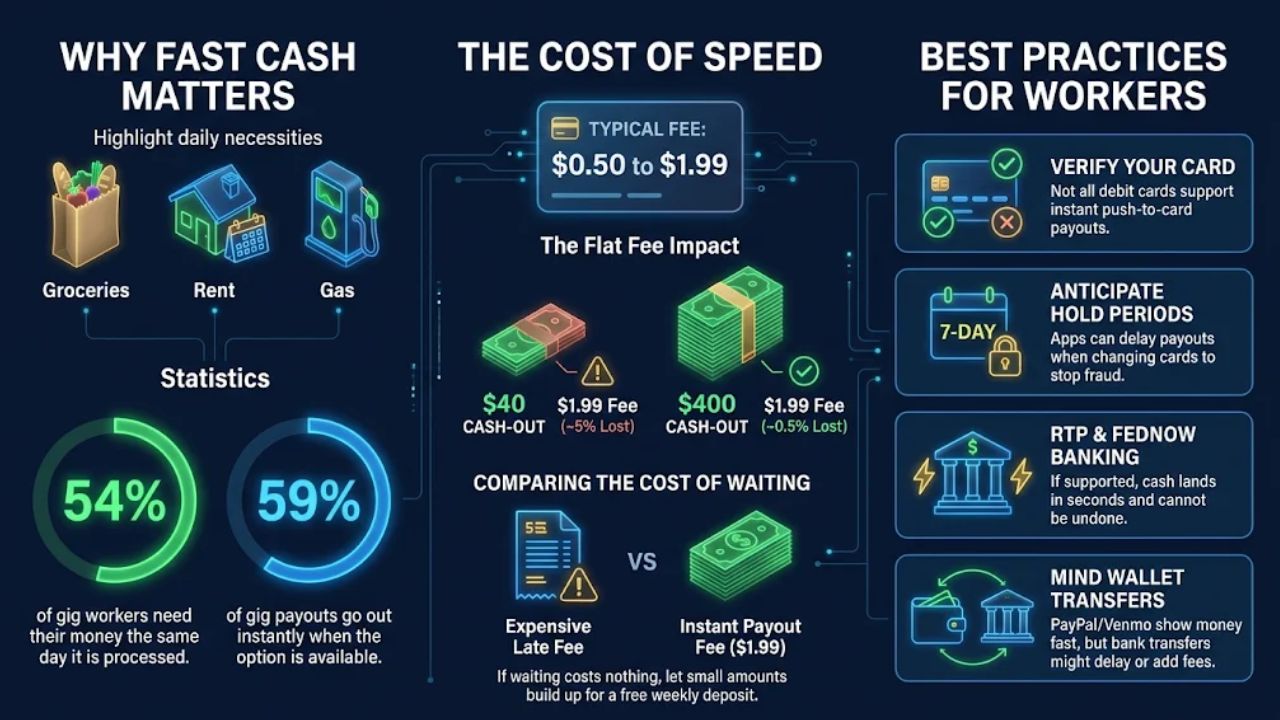
For workers, instant pay is less about convenience and more about paying for gas, rent, and groceries on time. Two numbers show how much it matters:
- Many need cash the same day. 54% of gig workers say they need their money the same day it’s processed.
- Workers pick fast when they can. When the option exists, 59% of gig payouts go out instantly.
When the fee is worth it, and when to wait
Instant pay typically costs $0.50 to $1.99 per cash-out on consumer-facing platforms. DoorDash Fast Pay, for example, charges $1.99 per cash-out.
A flat fee hurts most on small payouts. Say you cash out $40 and pay $1.99, so you lose about 5%. Cash out $400 with the same fee, and you lose only about 0.5%.
First, check if your app has a free instant option. Some platforms pay the fee for you.
If not, compare the fee with what waiting would cost you. Say a bill is due today and a late fee would cost more than $1.99. Then paying for instant pay makes sense.
If waiting costs you nothing, let small amounts build up and take the free weekly deposit.
Tips for picking a payout method
- Check that your debit card is eligible. Not every debit card can take instant pay. The app will tell you when you add the card, and if yours isn’t eligible, try a debit card from a different bank.
- Expect a short hold after you change cards. Platforms add holds to stop fraud. DoorDash, for example, uses a seven-day wait after a debit card change, so add your card early, before you need the cash.
- Check if your bank takes RTP or FedNow. If it does and your app supports it, you can get bank-to-bank money that is final in seconds.
- Watch wallet transfers. PayPal or Venmo may show the money fast, but moving it to your bank can take longer.
How Instant Payouts Help Gig Platforms Keep Workers
Here’s the gap most guides miss. In a PYMNTS Intelligence survey of 4,170 US consumers across 11 business types, only 36% said gig platforms offer instant pay always or most of the time.
The other 64% said gig platforms offer it only sometimes, rarely or never. So only 36% of gig platforms offer instant payouts consistently.
The same research found nearly 9 in 10 businesses offer instant payouts for at least one purpose. That figure covers all kinds of businesses and payouts, so it isn’t a direct match for the gig number. Still, it shows instant pay is common in general but not yet routine for gig workers.
Why speed keeps workers
PYMNTS found that same-day access to income “has quickly moved from a convenience to a prerequisite” for gig workers. Being able to get money instantly shapes where workers choose to work and how long they stay.
Trolley says it plainly: “talent is naturally migrating to the companies that pay them the fastest.” The platforms workers pick today aren’t just offering more jobs. They’re offering faster access to pay.
Roughly 85% of gig workers say they would take on more work if they were paid faster. For a platform, that means fast pay can help keep shifts covered.
Providers like Everee and Checkbook, along with Stripe Connect, Trolley, Dwolla, Branch, and Routable, sell this as a service. The hard part is the choices around it: which rails, who pays, and how you stay compliant.
What Platforms Must Plan For: Fees, Compliance and Security
Instant pay costs more than standard ACH. Before you turn it on, make two separate choices: who pays the fee, and how the fee is priced. Then plan how you’ll fund payouts and keep money and data safe.
Who pays the fee
There are three common models. Each one changes what workers feel and what you spend.
| Model | Who pays | How it works | Best for | Watch out for |
| Platform absorbs the fee | Platform | Every instant payout is free to the worker. The platform pays its provider. Stripe Instant Payouts, for example, charges 1% of the payout, with a $0.50 minimum. | Platforms in tight races for workers | Costs rise with every cash-out and with volume |
| Worker pays per cash-out | Worker | A fee per instant cash-out, typically $0.50 to $1.99. DoorDash Fast Pay, for example, charges $1.99. | Platforms watching margins | Flat fees hit small payouts hardest |
| Free scheduled ACH plus paid instant | Worker chooses | Weekly ACH is free. Instant is an opt-in with a fee. | Most gig platforms | Show the fee clearly before the worker taps |
We’d suggest the mixed model for most platforms. Keep a free weekly ACH so no worker is forced to pay, and offer instant pay for a clear, small fee.
Flat fee or percentage?
Whoever pays, the fee can be a flat amount or a percentage. Run the math on both small and large payouts.
Say a worker cashes out $40. A $1.99 flat fee takes about 5%. Stripe’s 1% rate hits its $0.50 minimum, or about 1.25%.
On a $400 payout, the $1.99 fee is about 0.5%, while 1% is $4. So flat fees favor big payouts, and percentage fees favor small ones.
Pick the pricing that fits the size of a typical cash-out on your platform.
Funding and timing
To pay out instantly, you need money ready with your provider. If you fund payouts by ACH each time, that adds about one business day.
Prefunding a balance removes that delay. The catch is that the cash sits there waiting, and tied-up cash has its own cost.
Compliance and tax forms
Compliance starts at onboarding. Collect W-9s and W-8s before the first payment so you can create 1099-NEC and 1042-S forms automatically at year-end. The 1099-NEC is needed for any US worker paid $2,000 or more starting in 2026.
Run KYC checks on workers and Know Your Business (KYB) checks on business accounts. These checks take a little time, but they protect both the platform and the worker.
Payout providers can carry much of this load. Providers like Stripe, Dwolla, Branch, and Hyperwallet handle these steps, so platforms don’t need multiple money transmitter licenses.
Security and fraud
Fast money is hard to get back. RTP and FedNow are credit-push only, so receivers can’t pull funds, and payments settle as final and irrevocable. If a payout goes to the wrong account, the network won’t reverse it.
That’s why checks come first. Confirm identity, verify the card or account, and add holds when a worker changes payout details. DoorDash’s seven-day wait after a debit card change is one example.
Encrypt payment data and pick a provider that balances speed with security. Workers should get their pay fast without risking their personal or financial information.
The Bottom Line on Instant Payouts
Instant payouts for gig workers send money they’ve already earned over a fast rail, usually within 30 minutes. Push-to-card reaches eligible debit cards. RTP and FedNow are final and run 24/7, but they reach only about 70% of US deposit accounts so far.
For workers, check for a free instant option first. Pay the fee when waiting would cost you more, and take the free deposit when you can wait.
For platforms, only 36% of gig platforms offer instant pay consistently. That makes it a real edge, not a standard feature.
Companies that treat fast money movement as core infrastructure may gain advantages slower rivals find hard to match. Pick your rails, decide who pays, and set up compliance from day one.
Frequently Asked Questions About Instant Payouts for Gig Workers
1. What is an instant payout, and how does it work for gig workers?
An instant payout sends your earnings to a debit card or bank account within 30 minutes instead of waiting the standard 3 to 5 business days. The gig app uses a payment partner like Astra to move money over fast card networks. Most apps charge a small fee for this speed, typically 1% to 2% per transfer.
2. How do I start getting instant payouts from my gig app?
First, log in to your app, or create a new account if you are new, then add a U.S.-issued Visa or Mastercard debit card. If you forgot your password, tap “Forgot Password” to reset it and turn on instant payouts in your settings.
3. Do sites like eBay and Facebook offer instant payouts too?
Yes, eBay offers on-demand payouts that arrive within 30 minutes for a fee, and Facebook Marketplace processes payments through its own system. Check each site’s payout page for current fees and card requirements.
4. Where can gig platforms compare instant payout providers?
Sites like FintechSpecs let platforms compare instant payout providers by settlement speed, transaction fees, and geographic reach.