

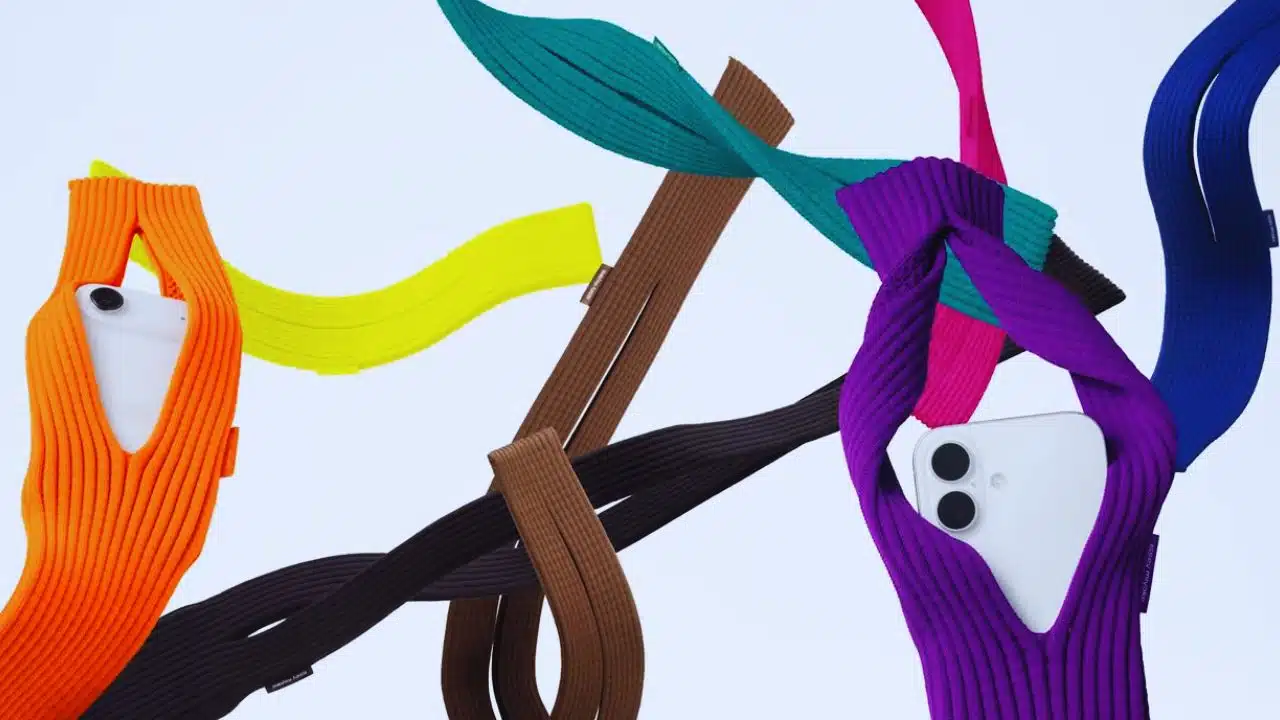
In an unexpected yet inspired collaboration, ISSEY MIYAKE and Apple have joined creative forces to launch an accessory that reimagines the relationship between humans and their everyday technology. Called the iPhone Pocket, this limited-edition piece is neither a conventional phone case nor a typical bag—it is a 3D-knitted wearable sculpture designed to let users “wear” their iPhone rather than simply carry it.
Debuting worldwide on November 14, 2025, the collaboration merges the minimalist precision of Apple’s industrial design with the textile innovation of ISSEY MIYAKE’s legendary design philosophy. The iPhone Pocket represents the latest intersection of technology and craftsmanship—two worlds that have often admired each other from afar but rarely intertwined so seamlessly. Crafted entirely in Japan, this sculptural accessory reflects ISSEY MIYAKE’s founding principle: the transformation of a single piece of fabric into form.
The idea was born from the concept of “a piece of cloth,” the cornerstone of Miyake’s decades-long exploration into how fabric moves, folds, and interacts with the human body. Here, that philosophy is applied to technology itself. The iPhone, one of the most recognizable objects in modern culture, is given a softer, more human dimension through textile design. The 3D-knitted structure forms a continuous ribbed shell that naturally expands to fit any iPhone model—an elegant solution that eliminates the need for multiple sizes or rigid casings.
Visually, the iPhone Pocket evokes ISSEY MIYAKE’s iconic pleats—subtle yet dynamic folds that respond to motion and touch. The ribbed texture not only references this design legacy but also adds a tactile pleasure to daily interaction. As the user slides the phone inside, the knit stretches gently, adapting to its shape while allowing glimpses of what’s within. It creates a unique sensory connection between the device, the user, and the material—an interplay between technology and textile that feels both futuristic and familiar.
According to Yoshiyuki Miyamae, design director at Miyake Design Studio, the collaboration explores “the joy of wearing iPhone in your own way.” The idea is to make technology part of the body’s natural movement rather than an external object to hold or hide. Apple’s industrial design team, led by Molly Anderson, shares this philosophy—seeking beauty in utility and elegance in simplicity. Together, the two design houses have produced an accessory that challenges the traditional boundaries between fashion, design, and functionality.
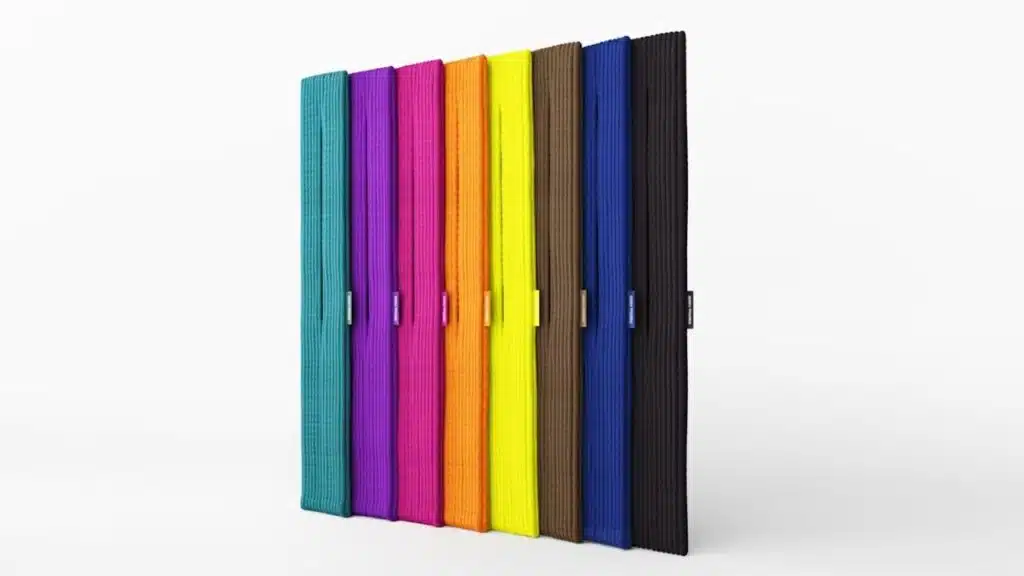
The iPhone Pocket will be available in two lengths—short and long—to accommodate different wearing styles. The short version is playful and compact, ideal for being held, tied to a tote, or used as a statement accessory. It comes in eight colors: lemon, mandarin, purple, pink, peacock, sapphire, cinnamon, and black—a palette inspired by Miyake’s vibrant textiles and Apple’s modern finish spectrum. The long version, intended for crossbody or draped wear, is available in sapphire, cinnamon, and black, offering a sleeker, more minimalistic tone.
Every version is knitted in Japan with meticulous craftsmanship, using advanced 3D-knitting technology to ensure seamlessness and structural precision. The absence of stitching or additional material results in a form that is lightweight, stretchable, and durable, embodying both engineering efficiency and artisanal care. The fabric’s open rib design not only breathes visually but also gives a sculptural dimension to the surface—transforming a simple pocket into a wearable piece of art.
Apple describes the iPhone Pocket as “a fluid approach to how personal technology integrates with the body.” Unlike cases or pouches that merely protect or store, this design seeks to harmonize the object with the wearer. It can be worn in various ways—around the neck, across the chest, or attached to a bag—reflecting each user’s individuality. The accessory doesn’t hide the device; it celebrates it, allowing for visibility, accessibility, and creative styling.
This collaboration is as much about philosophy as it is about design. For Apple, it continues the brand’s subtle move into fashion-driven product ecosystems, where technology merges with lifestyle. For ISSEY MIYAKE, it reinforces its mission to explore the potential of textiles beyond garments—into objects, environments, and now, digital companions. Both brands share a respect for minimalism, human-centered design, and the beauty of materials, making this partnership a natural evolution rather than a commercial stunt.
Beyond aesthetics, the iPhone Pocket also embodies a sustainability ethos. By creating a single 3D-knitted structure from one continuous thread, material waste is minimized, and production efficiency is maximized. Each piece demonstrates how digital fabrication can coexist with artisanal sensibility—a reflection of how modern design can respect both technology and tradition.
The accessory will launch through select Apple Stores worldwide, including Tokyo Ginza, New York SoHo, London Regent Street, Milan Piazza Liberty, and other flagship locations. It will also be available online in limited quantities. The short version is priced at $149.95, while the long crossbody version will retail for $229.95.
The iPhone Pocket isn’t just an accessory—it’s a statement. It turns the everyday act of carrying a phone into a design ritual. It bridges two creative disciplines—Apple’s world of precision engineering and ISSEY MIYAKE’s universe of fluid textile expression—in a way that feels both functional and poetic.
Ultimately, the iPhone Pocket celebrates the convergence of art, design, and daily life. It invites people to think differently about how they interact with their devices and how design can transform routine behavior into aesthetic experience. The collaboration stands as a quiet manifesto: that technology, when approached with imagination and respect for craft, can become not just useful—but beautiful, wearable, and deeply human.
The Information is Collected from Design Boom and Apple.






















