

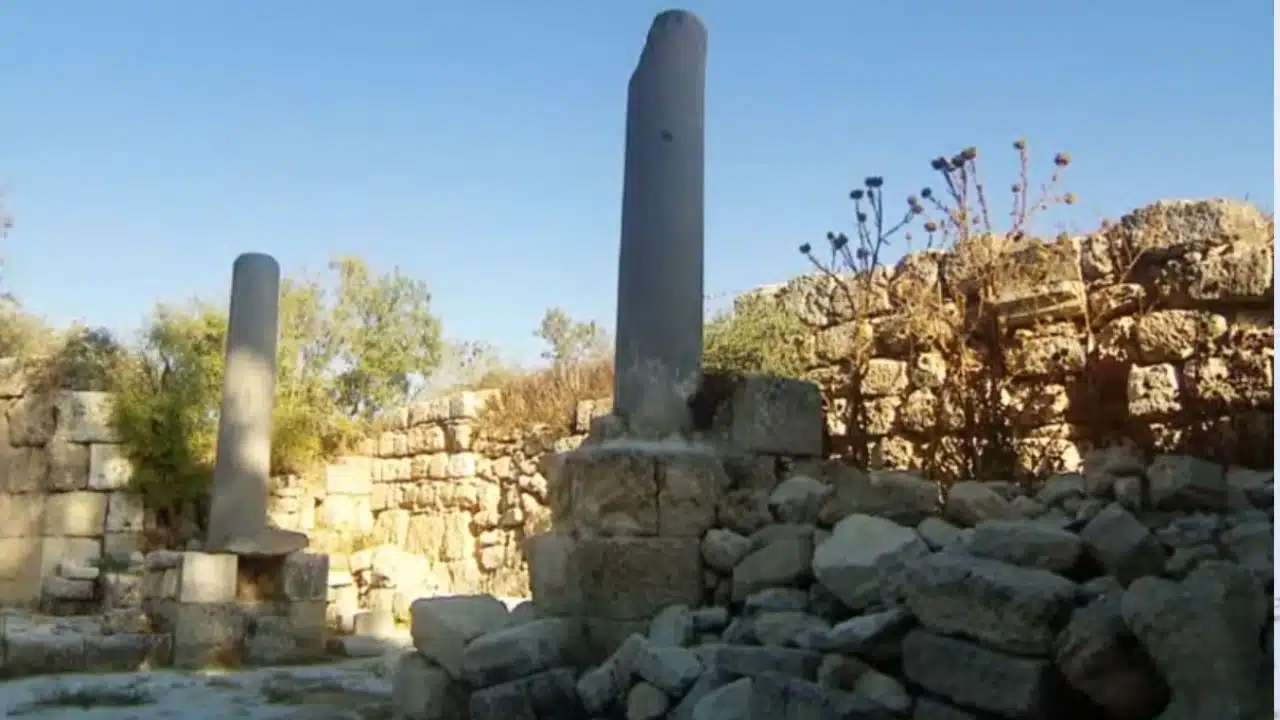
Israel has announced plans to seize a large portion of one of the West Bank’s most significant archaeological and cultural sites, Sebastia, while settlers have simultaneously established a new unauthorized outpost near Bethlehem. The developments come at a moment of growing international pressure on Israel to rein in settler violence and address rising instability across the occupied territory. Rights groups say these moves represent an escalation in land appropriation, forced displacement, and structural control over Palestinian areas, raising questions about legality, heritage preservation, and the future of Palestinian statehood.
Israel’s Civil Administration issued a formal notice declaring its intent to expropriate roughly 450 acres of land surrounding Sebastia — a sweeping claim that activists describe as the largest Israeli seizure of archaeologically important land in the West Bank to date. The announcement was included in a government document dated November 12, which outlines the specific parcels Israel intends to take. Palestinians who own or cultivate the land have been given 14 days to submit objections, though such appeals rarely overturn Israeli expropriation decisions.
Sebastia — known for its layered Jewish, Christian, Roman, and Islamic history — is considered the capital of the ancient Kingdom of Samaria, with archaeological ruins that tie into biblical narratives and regional cultural memory. The site is also held sacred by Christians and Muslims who believe it contains the burial place of John the Baptist. Much of its land is home to thousands of olive trees tended by Palestinian families whose livelihoods depend on seasonal harvests. For years, Sebastia has been a symbol of the complex intersection between archaeology, religion, heritage tourism, and territorial control in the occupied West Bank.
Israel announced in 2023 that it intended to transform Sebastia into a major tourist destination and subsequently allocated more than $9 million to develop the site. Excavations have already begun, with Israeli crews working in archaeological zones that local Palestinian experts say historically fall under their stewardship. Palestinian villagers argue that Israel’s development plans are a pretext for deeper control over the area, limiting their freedom of movement, undermining their heritage claims, and preventing them from accessing land they have used for generations.
The scale of this latest expropriation is unprecedented. Peace Now, an Israeli watchdog group that monitors settlement activity, noted that before this move, the largest historical land seizure in the West Bank was a 70-acre takeover in the village of Susya — a fraction of what is now being claimed in Sebastia. Critics warn that this act further blurs the line between heritage preservation and political expansion, pointing out that Israeli settlers often use archaeological sites as footholds for territorial claims.
The announcement also comes at a time when settlers are expanding their presence across the West Bank, including through unauthorized outposts. Shortly after the Sebastia order was made public, Israeli settlers established a new outpost near Bethlehem overnight. The settlement consists of temporary structures and newly bulldozed land, erected near a busy junction where a Palestinian stabbing attack earlier in the week killed one Israeli and wounded three others. Settler leaders described the creation of the outpost as both a symbolic and strategic act — a “return” to land they claim has ancestral and biblical significance.
Yaron Rosenthal, head of the Etzion regional settler council, praised the outpost as a reaffirmation of Jewish historical connection to the land. He framed it as strengthening ties between the Etzion settlement bloc and Jerusalem, calling for stronger state support and demanding a harsh response against Palestinian violence. He also argued that “terrorism is fueled by the hope of a state,” asserting that Palestinian aspirations for sovereignty should be confronted through firm action and continued settlement presence.
Rights groups, however, warn that these outposts — illegal even under Israeli law until they are retroactively approved — deepen tensions and contribute to violence, displacement, and the fragmentation of Palestinian land. They point out that many such outposts sit on privately owned Palestinian land and often restrict access to farmland, water sources, and main roads. Photos shared by settlers on social media show mobile homes being installed and heavy equipment preparing the terrain, underscoring the speed at which such outposts can materialize and alter the landscape.
As settlement expansion accelerates, concerns about human rights violations across the West Bank are also intensifying. A Palestinian activist known for documenting settler violence, Ayman Ghrayeb Odeh, was recently detained and hospitalized under circumstances that remain unclear. His lawyer said Israeli authorities have refused to disclose his condition or the nature of his detention. His brother, who briefly spoke with him after the arrest, said the military confiscated Odeh’s phone and that the family has not heard from him since. Israeli intelligence officials confirmed the detention but said Odeh is suspected of incitement — a charge that could lead to administrative detention without formal trial.
Meanwhile, Human Rights Watch released a report stating that Israel forcibly expelled an estimated 32,000 Palestinians from three refugee camps — Tulkarem, Nur Shams, and Jenin — during large-scale raids earlier this year. According to the organization, satellite analysis shows that more than 850 homes and buildings within the camps were severely damaged or destroyed. The displacements, the largest since Israel captured the West Bank in 1967, have left thousands homeless, many of them sheltering with relatives or in crowded public buildings. HRW argues that the operations may constitute war crimes, given that forced displacement without military necessity violates international law.
Israel’s military maintains that the raids were part of “Operation Iron Wall,” aimed at dismantling militant networks in the camps following the Hamas attack on October 7, 2023. Officials say troops uncovered weapons factories, explosives labs, and militant tunnels, asserting that attacks on Israelis in the West Bank have dropped by 70 percent since the operations — though they provided no evidence for this figure. The military also claims that some of the structural damage within the camps was necessary to allow vehicle movement and ensure the safety of troops navigating densely populated streets and alleyways.
Rights organizations argue that the Israeli government has not justified why entire civilian populations had to be evacuated nor why displaced Palestinians still cannot return to their homes months later. They contend that prohibiting returns and failing to provide shelter, aid, or rebuilding plans deepens humanitarian suffering and signals a wider policy of territorial re-engineering — one that affects demographics, access to land, and Palestinian prospects for sovereignty.
All of this unfolds against a political backdrop shaped by Israel’s most right-wing government in history. Key ministers — including Finance Minister Bezalel Smotrich, who oversees settlement policy, and National Security Minister Itamar Ben-Gvir, who controls the police — are staunch supporters of settlement expansion and have long sought to solidify Israeli control over the West Bank. Their influence has led to a surge in settlement approvals, outpost expansion, and policies that critics say entrench permanent occupation and undermine any path toward a negotiated two-state solution.
Military leaders and President Isaac Herzog have publicly condemned a recent spike in settler violence, acknowledging that extremist attacks on Palestinians are damaging Israel’s global image and destabilizing security. However, rights groups argue that condemnation without enforcement changes little, as violence and intimidation continue across rural Palestinian communities, often accompanied by property damage, the uprooting of olive trees, and the forced displacement of families from pastoral areas.
As the Sebastia expropriation moves forward, Palestinians face another narrowing of space — geographically, economically, and culturally. The fate of Sebastia will likely be a major flashpoint in the months ahead. Its blend of heritage, agriculture, religious symbolism, and geopolitical weight represents the complex reality of the West Bank: every parcel of land carries history, identity, and contested narratives. With settlement growth continuing at a rapid rate and displacement concerns rising, the struggle over sites like Sebastia is emblematic of broader dynamics shaping the future of the Israeli-Palestinian conflict.






















