

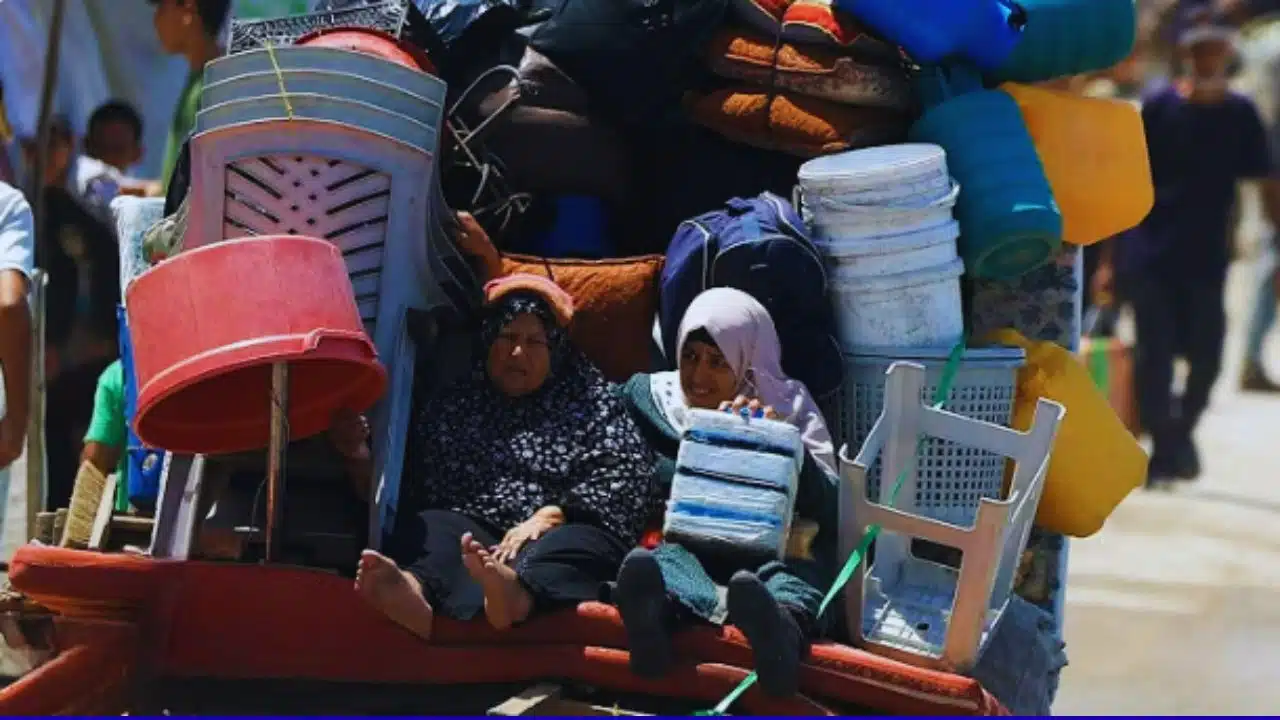
The Israeli military has intensified its offensive in Gaza City, pressing deeper into the urban center and unleashing heavy bombardments that have left neighborhoods in ruins.
What was once Gaza’s largest and most densely populated area is now a landscape of collapsed buildings, burning rubble, and mass displacement. Humanitarian agencies warn of a catastrophe unfolding in real time, with families forced to make impossible choices between staying in their homes under fire or fleeing into uncertainty.
Entire Neighborhoods Flattened in Gaza City
The Palestinian Civil Defence reported that more than 1,000 buildings in Zeitoun and Sabra alone have been reduced to rubble since the offensive began on August 6. The assault is not limited to targeted strikes but involves sustained air raids, artillery shelling, and tank incursions, all converging on Gaza City from multiple directions.
Footage verified by international outlets, including Al Jazeera, shows long columns of residents evacuating under smoke-filled skies. Men push carts piled with salvaged belongings; women carry children while holding plastic bags of food and blankets; and elderly people, many unwell, struggle to keep up. The scenes echo earlier displacement crises, yet residents emphasize that this time there may be no safe refuge left in the Strip.
A local resident, writer Sara Awad, described the agony of choosing between the dangers of bombardment at home and the misery of tent life. “Every day, I watch families leave with nowhere to go,” she said. “It doesn’t make sense to abandon our homes while we are treated as if we are not human.”
View this post on Instagram
Mass Exodus and Concentration Zones
Israel’s military strategy has included issuing warnings for civilians to move southward. Nearly one million Palestinians are now believed to have been displaced, directed into what humanitarian observers describe as overcrowded “concentration zones.” These areas lack basic infrastructure, clean water, and medical facilities, creating breeding grounds for disease and hunger.
Satellite images reveal entire residential blocks hollowed out, with streets lined with makeshift shelters. The United Nations warns that this level of forced displacement constitutes a severe violation of international humanitarian law, as civilians are not provided with safe passage or adequate living conditions once evacuated.
Rising Civilian Deaths and Humanitarian Collapse
The Palestinian Ministry of Health reported that 64 people were killed in Israeli attacks since dawn on Tuesday alone, among them 13 civilians trying to collect food aid. In total, more than 2,100 people have died while seeking aid since May, when U.S.- and Israeli-backed entities took over humanitarian distribution.
The U.N. Office for the Coordination of Humanitarian Affairs (OCHA) has confirmed worsening famine conditions. Gaza’s Health Ministry documented 303 starvation-related deaths since October 2023, including 117 children, marking one of the starkest humanitarian failures of modern conflict.
International relief groups say famine in northern Gaza is now officially recognized. The U.N. Secretary-General described the crisis as a “failure of humanity,” underscoring the inability of global powers to protect civilians in one of the most densely populated regions on earth.
Market Strike Adds to Casualties
On Tuesday, an airstrike targeted a busy market in eastern Gaza City, killing at least five Palestinians, including two women, and injuring many more. Witnesses said the strike occurred during peak activity when families were trying to purchase dwindling supplies of food. Al-Ahli Arab Hospital confirmed the casualties, treating dozens of wounded civilians, many with life-threatening injuries.
The Nasser Hospital Attack and Outcry
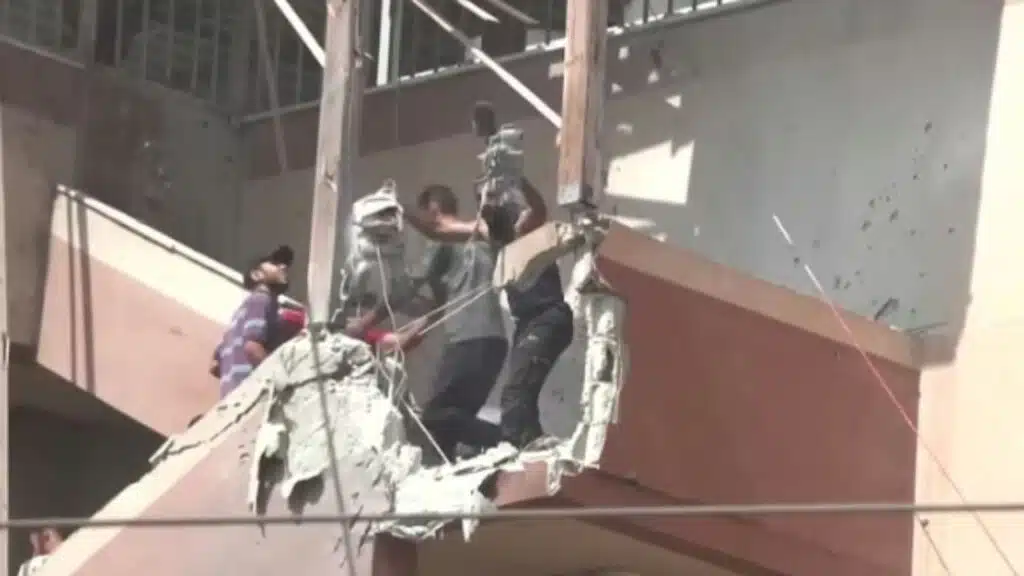
One of the most shocking incidents in recent days has been the “double-tap” strike on Nasser Hospital in Khan Younis. At least 21 people were killed, including five journalists and multiple emergency responders.
“Double-tap” attacks—hitting a site once, waiting for rescuers and reporters to arrive, and then striking again—are widely considered a war crime under international law.
Israel admitted to striking the hospital but called it a “tragic mishap.” Prime Minister Benjamin Netanyahu, in a statement released only in English, suggested the strike was accidental, while the Israeli military later claimed it was aimed at destroying a Hamas surveillance camera in the area.
Hamas rejected this account as “baseless,” calling it an attempt to cover up a “full-fledged massacre.” Human rights experts and legal scholars insist that Israel’s own admission should trigger independent international investigations.
Journalists Targeted in Record Numbers
The Nasser Hospital attack also added to the toll of journalists killed in Gaza. According to media tallies, more than 270 journalists and media workers have died since October 2023. This marks the deadliest conflict for journalists in modern history, surpassing casualty figures from wars in Iraq, Syria, and Afghanistan combined.
Several of those killed worked for major international agencies including Reuters, Associated Press, and Al Jazeera. Gaza-based journalist Abd Raouf Shaat said, “Every day, we bury another colleague, but we will continue their work.”
The targeting of media workers has sparked outrage from international press freedom organizations, which accuse Israel of systematically silencing witnesses to the war.
Legal and Political Repercussions
Human rights groups including Amnesty International and Human Rights Watch have accused Israel of committing war crimes through indiscriminate bombardment and forced displacement. Former U.N. prosecutor Geoffrey Nice said that Israel’s admission of error in the hospital strike means “an investigation with absolute ferocity” is now required.
Meanwhile, Palestinian political leader Mustafa Barghouti argued that Israel’s campaign amounts not only to genocide but to ethnic cleansing, designed to permanently displace Gaza’s population and reshape the Middle East to Israel’s advantage.
At the same time, international pressure is mounting. Protests within Israel demand a ceasefire and the return of hostages, while the European Union, United Nations, and several humanitarian organizations call for accountability. Yet military operations continue, and ceasefire talks remain fragile.
Israel’s push into Gaza City marks one of the most destructive phases of the war yet. Entire neighborhoods have been erased, famine has taken hold, and hospitals and journalists remain under fire. Humanitarian agencies warn of a complete collapse of civilian life, while legal experts insist that alleged war crimes must be investigated internationally. As the death toll rises, Palestinians face what many describe as their “final days” in Gaza City, caught between bombardment and displacement, with little hope of safety anywhere in the Strip.
The Information is collected from BBC and Yahoo.





















