

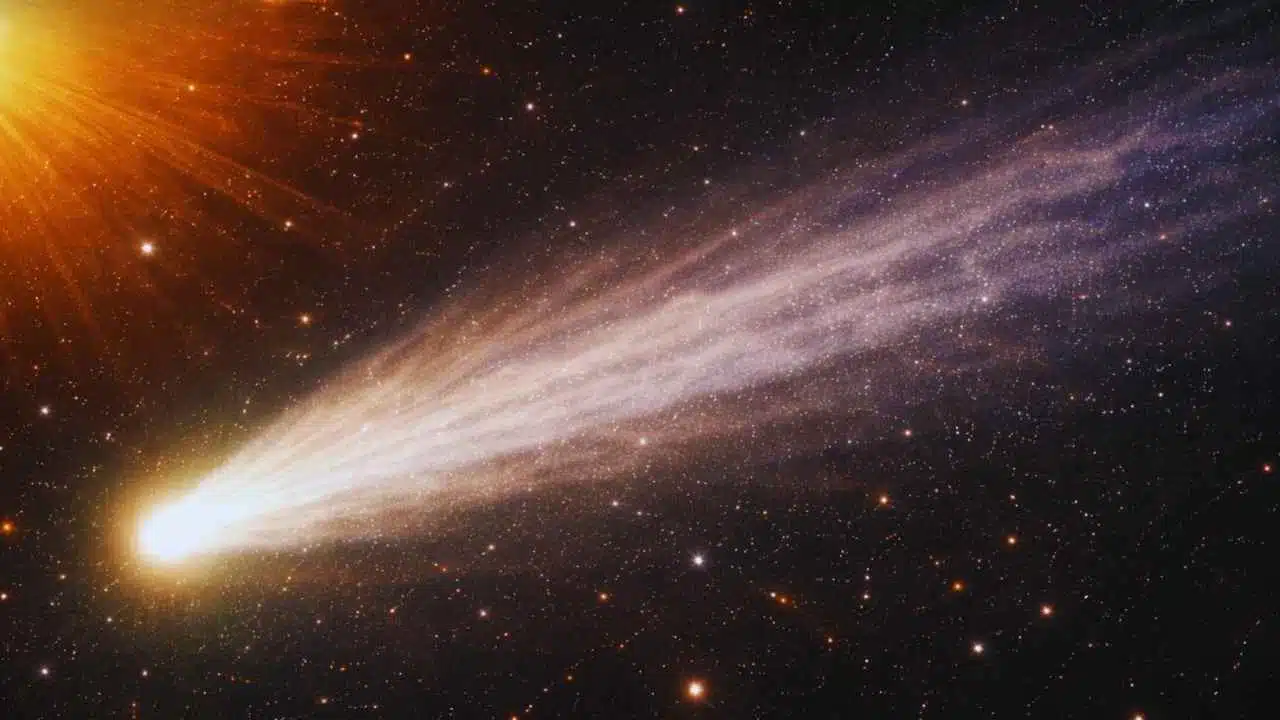
Interstellar comet 3I/ATLAS—only the third confirmed object from another star system—revealed a rare Sun-facing “anti-tail” and wobbling jets in 2025, giving astronomers fresh clues about its spin, dust, and icy grains as it crossed the inner solar system.
3I/ATLAS at a glance: who discovered it, what it is, and where it went?
3I/ATLAS is an interstellar comet, meaning its orbit shows it did not originate in our solar system. Instead, it arrived from deep space on a path that carries it back out again, making it a temporary visitor rather than a bound comet that returns every few years or centuries.
The discovery was announced in early July 2025, after survey telescopes flagged a fast-moving object with a trajectory consistent with an interstellar origin. Follow-up observations quickly confirmed comet-like activity, including a coma and tail structures. Later, astronomers found earlier “pre-discovery” images that extended the observation timeline back into mid-June 2025. Extending that timeline matters because a longer record improves orbit calculations and helps separate true physical changes from viewing-geometry effects.
From a public-interest standpoint, the key point was reassurance: the comet’s path kept it far away, with its closest pass to Earth still at a large astronomical distance. It also reached perihelion (closest point to the Sun) at a distance that is relatively “moderate” by comet standards—close enough to heat the surface and drive visible activity, but not so close that it would be a naked-eye spectacle for most observers.
Key facts table
| Item | What it means | Reported value (2025) |
| Classification | Confirmed interstellar object | Third confirmed (after 1I/‘Oumuamua and 2I/Borisov) |
| Discovery window | First reports and rapid follow-up | Early July 2025 |
| Pre-discovery images | Earlier images found after discovery | Mid-June 2025 |
| Closest approach to Earth | Safety and viewing context | About 1.8 AU |
| Perihelion distance | Heating level that drives activity | About 1.4 AU |
| Perihelion timing | Peak solar heating period | Around Oct. 30, 2025 |
Note: AU (astronomical unit) is the average Earth–Sun distance, about 150 million km.
The unusual feature that grabbed attention: a Sun-facing “anti-tail”
Comet tails usually point away from the Sun. That’s because sunlight and the solar wind push dust and gas outward, forming a familiar trailing plume.
But in 2025, images of 3I/ATLAS showed something that looked backwards: a Sun-facing extension often described as an “anti-tail.” This term can be confusing, because an anti-tail is not a magical force pulling material toward the Sun. It’s a visual and physical outcome of how dust and icy grains behave, combined with how we view the comet from Earth.
There are two major reasons a Sun-facing feature can appear:
- Viewing geometry: In some cases, Earth crosses or nearly aligns with a comet’s orbital plane. Dust concentrated along that plane can look like a thin spike pointing sunward even though the particles are not traveling toward the Sun.
- Grain physics and survival: Different particle sizes and compositions react differently to sunlight. Some grains can persist longer (or appear brighter) in directions that don’t match the classic “tail away from the Sun” pattern, especially if sunlight heats and destroys grains at different rates depending on where they are in the coma.
For 3I/ATLAS, scientists emphasized that the anti-tail behavior was a useful diagnostic because it can reflect particle size distribution and sublimation (the process where ice turns directly into vapor). If the comet releases icy grains mixed with dust, those grains can create a sunward brightness structure under certain conditions, especially when their lifetimes and scattering properties favor visibility in that direction.
Anti-tail vs normal tail: quick comparison
| Feature | Typical direction | Main driver | What it can tell scientists |
| Dust tail | Away from Sun | Sunlight pressure on dust | Dust sizes, activity level, timing of dust release |
| Ion tail (gas) | Away from Sun, often straighter | Solar wind acting on ions | Gas composition and interaction with solar wind |
| “Anti-tail” | Appears Sun-facing | Geometry and/or grain survival effects | Dust sheet structure, grain lifetimes, possible icy grain behavior |
The anti-tail became one of the most discussed aspects of 3I/ATLAS because it stood out visually and because it offered a way to test models of how interstellar comets shed and process material under solar heating.
The wobbling jets: what astronomers measured and how it points to spin?
Beyond the overall tail shapes, astronomers also tracked jet-like structures—narrower features that can emerge when localized regions on a rotating nucleus become active and vent gas and dust.
Jets matter because they can behave like a rotating lighthouse beam: as the nucleus spins, an active patch may point in different directions, creating a measurable pattern across nights of imaging. That pattern can reveal the rotation period, the orientation of the spin axis, and whether activity comes from one dominant source region or multiple.
For 3I/ATLAS, observers conducting multi-night monitoring reported a repeating “wobble” in a detected jet feature. The jet’s measured direction shifted with a consistent rhythm. This kind of periodic change is difficult to explain by chance alone if it persists across separate observing sessions and instruments, and it often signals rotation-driven geometry.
One reported outcome from the jet tracking was a modulation period of roughly 7.74 hours, interpreted as a signature of the nucleus’ rotational behavior. Under a common jet-geometry interpretation—where the visible jet pattern repeats twice per full spin because of the jet’s placement relative to the rotation axis—the implied rotation period is about 15.5 hours.
That estimate is not just a trivia detail. Spin rate influences:
- How evenly the surface heats up.
- Whether activity is steady or bursts in cycles.
- How jets can torque the nucleus over time, potentially changing its rotation.
Jet-derived rotation estimate (reported from monitoring)
| Measurement | Value | Why it matters |
| Jet modulation period | ~7.74 hours | Indicates repeating rotational geometry in the coma |
| Implied rotation period | ~15.5 hours | Suggests how fast the nucleus spins |
| Practical implication | Moderate spin | Can support persistent jet sources without extreme centrifugal disruption |
Because 3I/ATLAS is interstellar, these measurements carry extra weight. We don’t get many chances to clock the spin of an object formed around another star, especially while it is actively venting material that can be tracked.
What 2025 observations revealed about dust, ice, and interstellar origins?
The most important scientific value in 3I/ATLAS is not that it looked strange—it’s that it gave researchers multiple lines of evidence about composition and behavior.
1) Activity driven by solar heating
As 3I/ATLAS moved closer to the Sun, its surface warmed. That heating can trigger:
- Release of gas (from sublimating ices).
- Dragging of dust particles off the surface.
- Formation of a coma and structured tails.
Even without overcomplicating the physics, one point is clear: the comet’s visible evolution during 2025 reflected an object responding to a new environment—our Sun—after spending most of its lifetime in the cold of interstellar space.
2) Dust grains and “icy grain” hypotheses
A key idea discussed around 3I/ATLAS is that icy grains—small particles containing volatile ices—may play a role in shaping the anti-tail and inner coma brightness. If those grains sublimate, they can change both the dust distribution and the appearance of sunward features.
This matters because interstellar comets are potential messengers of how solids formed in other systems. Grain behavior can hint at:
- How dusty or ice-rich the material is.
- Whether grains are porous or compact.
- How easily they fragment or sublimate under sunlight.
3) Why interstellar comets don’t all look alike?
The first two confirmed interstellar visitors looked very different: one was famously “comet-like or not?” depending on the dataset, while the other behaved like a more classic active comet. 3I/ATLAS adds a third data point that again looks distinct.
That diversity is a message by itself. It suggests interstellar objects arriving here could come from:
- Different formation zones around their parent stars.
- Different histories of heating, collisions, or radiation exposure.
- Different sizes, structures, and volatile inventories.
Interstellar trio comparison table
| Object | Year confirmed | Basic appearance | Big takeaway |
| 1I/‘Oumuamua | 2017 | Lacked a clear, long-lived coma in many views | Interstellar objects can be difficult to classify visually |
| 2I/Borisov | 2019 | Clearly cometary, active | Interstellar comets can look “classic” with coma and tail |
| 3I/ATLAS | 2025 | Active comet with anti-tail and jet patterns | Offers jet-based spin constraints and rare tail geometry clues |
This comparison doesn’t mean one is “more normal.” It means the sample is tiny and varied—exactly why each well-observed visitor is valuable.
What comes next after perihelion?
3I/ATLAS’ most intense activity likely clustered around its closest approach to the Sun in late October 2025, when heating peaked. After perihelion, comets often change: jets can strengthen, fade, or shift; dust production can rise or drop; and tail geometry can evolve as the comet’s position relative to Earth changes.
For researchers, the next steps are straightforward in concept, even if technically demanding:
- Compare pre- and post-perihelion images to see whether the anti-tail persists or disappears.
- Test whether the jet periodicity remains stable or shifts as activity changes.
- Combine ground-based tracking with space-based observations to better constrain dust properties and the nucleus’ behavior.
For the public, the main significance is that this was a rare chance to watch a visitor from another star system behave like an active comet—then use those changes to infer physical properties such as spin and dust-grain dynamics. Each interstellar object is a short-lived opportunity, and 3I/ATLAS delivered a set of features that astronomers can mine for years.
























